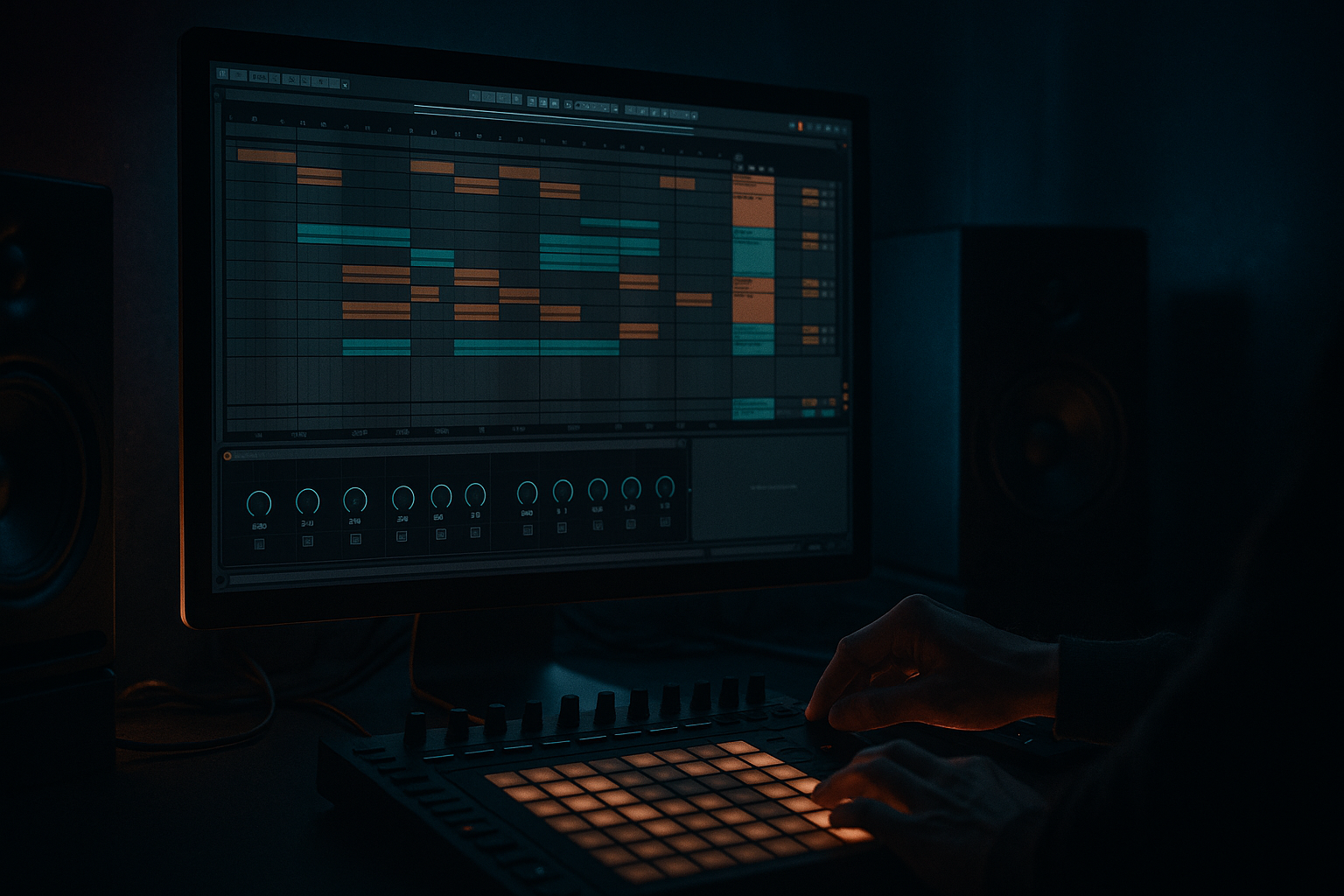
Main tutorial
Subsine in Ableton Live 12: Shape It for 90s-Inspired Darkness (Jungle / Oldskool DnB) 🕳️🔊
1. Lesson overview
In 90s jungle and early DnB, the sub isn’t “pretty”—it’s authoritative, slightly unstable, and glued to the drums. This lesson is about building a subsine in Ableton Live 12 that feels dark, rolling, and menacing, while still translating on modern systems.
We’ll focus on groove: how your sub moves with the break, how it breathes with the kick, and how tiny pitch/amp behaviors create that oldskool “weight” without muddying the mix.
---
2. What you will build
You’ll create a 90s-inspired subsine rack using stock devices:
- Operator (pure sine + controlled harmonics)
- Saturator / Overdrive (dark grit + speaker translation)
- Auto Filter (sub cleanup + “murky” tone shaping)
- Glue Compressor (optional: controlled density)
- Utility (mono management + gain staging)
- Shaper / LFO (Live 12 modulation) for subtle movement
- Sidechain ducking keyed from your kick
- 165–172 BPM
- Break-driven drums (Amen / Think / Hot Pants style chops)
- Sub that hits long notes, short stabs, and pitch dips (classic jungle language)
- Attack: 0.0–2.0 ms
- Decay: 200–500 ms (if you want a slightly “plucky” sub)
- Sustain: -inf to -6 dB (depends on your note lengths)
- Release: 80–160 ms (enough to feel round, not flabby)
- Ratio: 4:1
- Attack: 3–10 ms (let a tiny bit of sub transient through)
- Release: 80–150 ms (timed to tempo; adjust by feel)
- Threshold: lower until you get 2–5 dB gain reduction per kick
- F minor
- G minor
- E minor
- F# minor (very weighty on systems)
- Bar 1: long root note (roll)
- Bar 2: shorter stabs + a slide into root
- Use Legato notes to create slides (Operator glide will connect them)
- Keep most notes between F1–A1 (sub region), but don’t fear dips to D#1/E1 for menace
- Mix long held notes with 1/8 stabs to mirror the break accents
- Intro (0:00–0:32): atmos + filtered break, no sub
- Drop 1 (0:32): full sub enters, simple pattern
- Mid (1:04): remove sub for 2–4 bars, let break ride (classic tease)
- Drop 2: reintroduce sub with a variation (extra slide, octave dip, or stabs)
- Saturator Drive: +1–2 dB on drop sections
- Auto Filter LPF: open from 140 → 180 Hz for perceived lift
- Glide time: slightly longer on fill bars for that “falling into the note” feel
- Parallel “audibility” layer (optional):
- Short “pre-drop sub stab”
- Pitch envelope dip for menace (Operator Pitch Env)
- Use a ghost kick pattern that matches the break accents
- Check with a Spectrum + reference
- A 90s-inspired subsine is simple source, complex behavior: glide, tiny drift, controlled harmonics.
- Saturator + lowpass gives dark translation without turning into mid-bass.
- Mono + sidechain is non-negotiable for rolling jungle weight.
- The real magic is groove inheritance: extract groove from the break and let the sub lean the same way.
And you’ll place it in a typical jungle context:
---
3. Step-by-step walkthrough
Step 0 — Session setup (groove first)
1. Set tempo to 170 BPM.
2. Drop in a breakbeat loop or your chopped break pattern.
3. Put a simple kick layered under the break (even if temporary).
Jungle subs are often shaped by the kick relationship, not just the bass patch.
Tip: If you’re using a break-only groove, still create a “ghost kick” (silent trigger) for consistent sidechain timing.
---
Step 1 — Create the subsine source (Operator)
1. Create a MIDI Track → load Operator.
2. In Operator:
- Oscillator A: Sine
- Oscillator B/C/D: Off
- Voices: 1 (Mono) and enable Legato (important for slides)
- Glide/Portamento: start around 60–120 ms (we’ll tune it per pattern)
Amp Envelope (Operator → Global/AMP):
For darker oldskool vibes, you typically want a controlled tail—long enough to roll, short enough not to smear.
---
Step 2 — Add intentional 90s instability (micro pitch + amp movement)
Old jungle subs often feel “alive” because of tiny pitch drift and amplitude inconsistency (tape, samplers, power amps, etc.). We recreate that tastefully.
#### 2A) Subtle pitch drift (Operator LFO)
1. In Operator, enable the LFO.
2. Set:
- Destination: Pitch (A)
- Amount: 0.03–0.10 (keep it tiny)
- Rate: 0.10–0.35 Hz (slow drift)
- Wave: Sine or random-ish (triangle can work too)
You’re not making wobble—you’re making unease.
#### 2B) Sub “breath” (Auto Pan as tremolo)
1. Add Auto Pan after Operator.
2. Turn Phase to 0° (so it becomes volume modulation, not stereo).
3. Set:
- Rate: 1/8 or 1/16 (sync)
- Amount: 5–12%
- Shape: closer to sine for smoothness
This can create that subtle push-pull with the break without audible pumping.
---
Step 3 — Harmonics that translate (Saturator / Overdrive)
Pure sine disappears on small speakers. 90s darkness comes from low harmonics and grit, not bright fuzz.
#### Option A: Saturator (recommended start)
1. Add Saturator.
2. Settings:
- Drive: 2–6 dB
- Soft Clip: ON
- Curve Type: try Analog Clip or Soft Sine
3. Click Color ON (if available) and keep it subtle.
Goal: add 2nd/3rd harmonics so the sub reads in the mix without sounding like a reese.
#### Option B: Overdrive (darker mid growl)
1. Add Overdrive instead of / after Saturator.
2. Settings:
- Drive: 10–25%
- Tone: 2.0–4.0 kHz (keep tone lower/darker)
- Dynamics: 20–40%
Keep it understated—too much and your sub becomes a mid-bass.
---
Step 4 — Control the mud (Auto Filter + Utility)
#### 4A) Auto Filter cleanup
1. Add Auto Filter after distortion.
2. Set it to Lowpass.
3. Frequency: 120–200 Hz (depends on how much harmonic content you added)
4. Resonance: 0.2–0.7 (small bump can add weight)
This prevents the distortion harmonics from climbing into “break conflict” territory.
#### 4B) Utility for mono + gain
1. Add Utility at the end.
2. Set:
- Bass Mono: ON (set around 120 Hz)
- Width: 0% (true mono sub)
- Gain: adjust so you’re not slamming your master
Jungle subs are usually dead center. Let the breaks and atmos do the width.
---
Step 5 — Sidechain it like classic rolling DnB (clean + controlled) 🎯
You want the sub to “get out of the way” of the kick while still sounding continuous.
1. Add Compressor (or Glue Compressor) after Utility (or before Utility—either works, but keep Utility last if you’re doing mono management there).
2. Enable Sidechain, select Kick track (or your ghost kick).
Starting settings (Compressor):
DnB groove tip:
If the sub feels like it “vanishes,” lengthen release. If it feels like it “blooms late,” shorten release or lower ratio.
---
Step 6 — Write a proper oldskool subline (MIDI + groove logic)
90s jungle subs tend to be simple but dangerous: lots of root + fifth, short drops, and portamento slides.
#### 6A) Scale and key choices
Dark jungle-friendly keys:
#### 6B) Pattern approach (rolling + call/response)
At 170 BPM, think in 1-bar or 2-bar loops.
Bar concept (example):
Practical MIDI tips:
#### 6C) Lock it to the break groove
1. In the break track, use Groove Pool (e.g., MPC-ish swing or extracted groove).
2. Extract Groove from your break.
3. Apply that groove (lightly) to your sub MIDI clip:
- Timing: 10–25
- Velocity: 0 (sub doesn’t need velocity randomness usually)
- Random: 0–5
This is huge: the sub inherits the break’s lean.
---
Step 7 — Arrangement moves for 90s darkness (simple, effective) 🌫️
Oldskool arrangement is about tension and restraint, not constant bass flex.
Try these:
Automation ideas (subtle):
---
4. Common mistakes
1. Too much distortion = not a sub anymore
If it sounds like a bass synth, you’ve moved out of subsine territory. Keep harmonics low and dark.
2. Stereo sub
Wide subs destroy translation and punch. Mono it.
3. No sidechain / poor sidechain timing
Jungle kick + sub must interlock. If your low-end feels blurry, fix ducking before EQ.
4. Notes too low for your system / key
Going crazy low (below ~35–40 Hz fundamental) can vanish on many rigs. Use harmonics, not just lower notes.
5. Break and sub not sharing groove
If your sub is perfectly quantized but your break swings, it’ll feel detached.
---
5. Pro tips for darker/heavier DnB 🧠
Duplicate the sub track, high-pass it at 120–180 Hz, saturate more aggressively, then blend very low. This keeps the main sub clean but readable.
Before the drop, add a 1/4 or 1/2 note sub hit with a quick pitch fall (see next tip). Classic tension builder.
Use a tiny pitch envelope: start slightly above pitch and fall fast.
- Pitch Env Amount: small (tastefully)
- Decay: 50–120 ms
This creates that thoom without needing a separate bass hit.
Sidechain off a kick pattern that reflects where the break “feels” like it hits, not necessarily a 4-on-the-floor.
Put Spectrum on the sub bus. Compare low-end curve to a jungle reference. You’re aiming for a strong fundamental plus controlled low harmonics—not a mountain of 200–400 Hz.
---
6. Mini practice exercise (15–20 minutes) 🎛️
1. Build the subsine chain:
Operator → Saturator → Auto Filter → Utility → Compressor (SC)
2. Write a 2-bar sub pattern:
- Bar 1: one long root note
- Bar 2: three stabs + one slide into root (legato)
3. Extract groove from your break and apply Timing 15–20 to the sub clip.
4. Adjust sidechain release until the low-end feels like it “breathes” with the kick.
5. Bounce 8 bars and A/B:
- With drift + tremolo OFF
- With drift + tremolo ON (subtle settings)
You’re listening for vibe: the second should feel darker and more human, not wobbly.
---
7. Recap
If you want, tell me your target tempo + a reference tune vibe (e.g., “Metalheadz early,” “RAM ‘95,” “Moving Shadow jungle”), and I’ll suggest a specific 2-bar MIDI pattern and exact sidechain timings for that feel.

