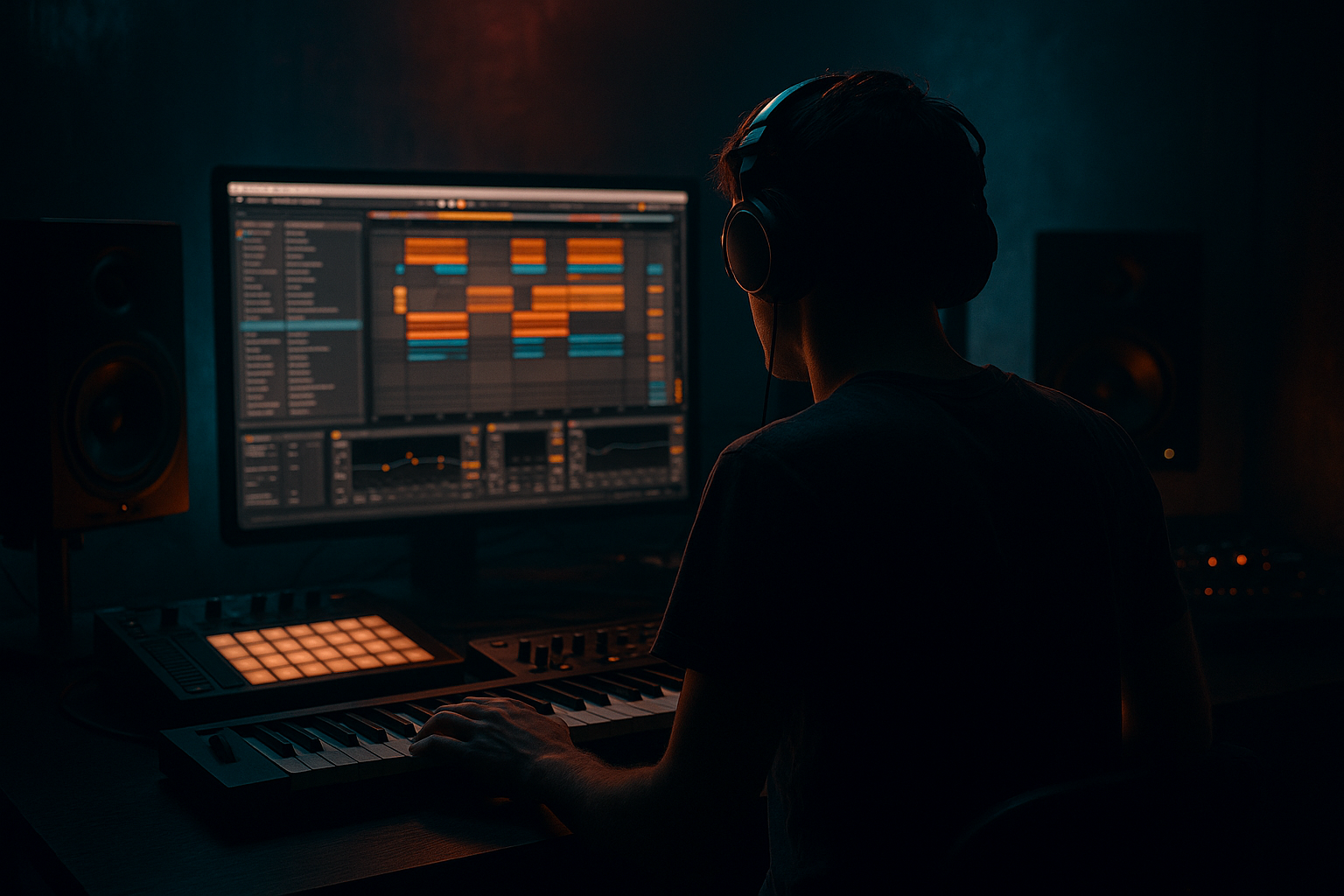
Main tutorial
Subtle Arcade-Style Textures in DnB (Ableton Stock Only) 🎮⚡
Advanced FX lesson — built for rolling drum & bass / jungle atmospheres.
---
1. Lesson overview
Arcade textures in DnB aren’t about obvious “chiptune leads” — the magic is in micro-details: tiny bleeps, noisy UI ticks, short “coin” blips, CRT-ish air, and bit-reduced tails that sit behind your drums and bass.
In this lesson you’ll build a modular, stock-only arcade texture rack in Ableton Live that you can:
- sprinkle between drum hits
- sidechain under a rolling bass
- automate into transitions (fills, drops, breakdowns)
- resample into one-shots and loops for fast arrangement
- Algorithm: `A -> Output` (simple)
- Osc A: `Square` (or Pulse if available)
- Coarse: `2.00` (one octave up)
- Fine: `+5 to +15` (tiny detune for “cheap digital” vibe)
- Attack: `0.00 ms`
- Decay: `80–140 ms`
- Sustain: `-inf` (off)
- Release: `30–80 ms`
- Turn on Pitch Env:
- Place notes on offbeats (e.g., 1.2.3, 1.3.2, 1.4.4)
- Use velocity variation (35–90)
- Use note length very short (even if envelope is doing most of it)
- Make a 2–4 bar sustained note (one long MIDI note)
- Automate filter frequency subtly over time (±10–20%)
- Keep the track quiet: -18 to -30 dB is normal.
- Create a new audio track: “Arcade Resample”
- Set Audio From: `Arcade Textures (Group)`
- Arm and record 8–16 bars while your drums/bass loop plays.
- Find tiny “happy accidents”: little stutters, tails, shifts.
- Consolidate to 1-bar or 2-bar loops.
- Warp mode: Complex Pro (safe) or Beats if you want more grain.
- Between-snare fills: automate Bleep layer up for the last 2 beats of every 16 bars.
- Drop enhancement: bring in Noise/CRT layer only after drop to subtly widen the space.
- Breakdown nostalgia: automate Redux bits down (more lo-fi) in breakdown → clean up slightly at drop for contrast.
- Call-and-response with bass: place bleeps on gaps where the bass sustains (classic techy roller spacing).
- Jungle nod: chop resample into 1/16 stutters in fills, but low in level so it reads as “old sampler artifacts”.
- Too loud: Arcade textures should live below the drums/bass. If you notice them constantly, they’re probably 3–6 dB too high.
- Too wide in the highs: Over-wide fizz can smear hats and kill mono compatibility. Keep Width reasonable and check mono.
- No filtering: Raw bleeps often fight snare presence (2–6 kHz). Filter and EQ intentionally.
- Over-bitcrushing: Redux is addictive—go easy. One tasteful stage beats three brutal ones.
- Ignoring groove: If bleeps aren’t swung/placed like percussion, they’ll feel pasted on.
- Shift textures down in pitch (but keep them filtered): darker rollers love “low-mid UI” ticks around 400–1.5k rather than bright bleeps.
- Corpus for sinister resonance:
- Gated reverb vibe (without third-party):
- Bass-safe rule: keep almost everything above 200 Hz. Let sub and reese own the low end.
- Make it gritty, not bright: tilt with EQ Eight—a small high shelf down can instantly turn “cute arcade” into “industrial hardware.”
- You made arcade-style textures that work in DnB by thinking like a sound designer and a mixer: small, rhythmic, filtered, and ducked.
- Key tools: Operator (bleeps), Frequency Shifter (drift/grit), Redux (lo-fi), Echo/Hybrid Reverb (space), sidechain compression (discipline), resampling (character).
- The winning workflow is: design → bus process → resample → chop → arrange.
No third-party plugins. Just Operator / Wavetable / Drum Rack / Redux / Saturator / Corpus / Echo / Auto Filter / Hybrid Reverb / Frequency Shifter / Utility and good resampling discipline.
---
2. What you will build
You’ll end up with three texture layers (all subtle by default) that you can blend:
1. Bleep Layer (Operator)
Short 8-bit style bleeps that trigger rhythmically like percussion ghost notes.
2. Noise/CRT Layer (Wavetable or Operator noise + filtering)
Controlled, filtered noise that adds “screen air” and movement.
3. FX Tail Layer (Resampled + Redux/Echo/Hybrid Reverb)
A re-sampled, bit-reduced, stereo-widened tail that glues into DnB space.
All routed to a Texture Bus with sidechain + ducking so your drums stay dominant.
---
3. Step-by-step walkthrough
Session setup (DnB context) 🥁
1. Set tempo to 172–176 BPM.
2. Have at least:
- a drum bus (kick/snare/break)
- a bass group
- a spare “Arcade Textures” group
> Goal: keep textures felt, not heard until you solo them.
---
A) Build the Bleep Layer (Operator “coin blips”)
Create a MIDI track → load Operator.
Operator settings (fast, percussive, “arcade”)
#### Amp Envelope (A Env)
#### Add pitch “pip” (classic arcade click)
- Amount: `+12 to +24 st`
- Decay: `30–60 ms`
This gives that instant “blip-down” that reads as arcade UI.
Post-FX chain (stock)
Place these after Operator:
1. Redux
- Downsample: `2.0–4.0` (start at `2.5`)
- Bit Reduction: `10–12 bits`
Keep it subtle: you’re not making a chip lead, you’re adding texture grain.
2. Auto Filter (to keep it out of the way)
- Mode: HP 12 dB
- Freq: `600–1.2 kHz`
- Res: `0.70–1.10`
- Optional: tiny movement
- LFO Amount: `5–10%`
- Rate: `1/8` or `1/16` (sync)
3. Utility
- Gain: pull down so it sits: `-12 to -24 dB` (yes, really)
MIDI programming (DnB-friendly)
Create a 1-bar clip and program bleeps like ghost percussion:
Swing tip: Use Groove Pool with an MPC-ish swing at 10–20% so it breathes like a shuffled break.
---
B) Build the Noise/CRT Layer (moving “screen air”)
Create another MIDI track. Use Wavetable (or Operator with noise).
Option 1: Wavetable noise bed (controlled)
1. Load Wavetable
2. Set Osc 1 to a noisy waveform (any noise-ish wavetable works; if unsure, use a bright wave and heavily filter)
3. Turn Unison off (keep it clean)
4. Use Filter inside Wavetable:
- Type: BP (band-pass)
- Freq: `2.5–6 kHz`
- Res: `0.80–1.20`
- Drive: `1–3 dB` (tiny)
Add “CRT drift” movement
After Wavetable:
1. Frequency Shifter (this is the secret sauce) 🔥
- Mode: Ring Mod (for more metallic UI grit) or Frequency Shift (for subtle drift)
- Frequency: `10–60 Hz` (start ~`23 Hz`)
- Fine: tiny adjustments to find sweet spots
- Dry/Wet: `5–15%`
2. Auto Pan (micro stereo movement)
- Rate: `0.10–0.30 Hz` (slow) or `1/2` synced for rhythmic
- Amount: `20–40%`
- Phase: `120–180°` (wide but not crazy)
3. Auto Filter (final cleanup)
- HP at `200–400 Hz`
- Optional LP at `10–12 kHz` if it’s too fizzy
Clip creation
---
C) Make an “Arcade Tail” Layer via Resampling (glue + realism) 🎛️
This is how you get that authentic “sampled from a machine” feel without overprocessing in real time.
1) Create a Texture Bus
Group your Bleep + Noise tracks into Arcade Textures (Group).
On the Group add:
1. Glue Compressor (for cohesion)
- Attack: `3 ms`
- Release: `Auto`
- Ratio: `2:1`
- Aim for 1–2 dB of GR when bleeps hit
2. Saturator
- Mode: Soft Clip ON
- Drive: `1–3 dB`
- Keep it subtle; we’re thickening, not distorting.
3. Echo (micro reflections = “arcade room”)
- Time: `1/8` or `1/16`
- Feedback: `10–25%`
- Filter: HP ~`600 Hz`, LP ~`6–8 kHz`
- Dry/Wet: `5–12%`
4. Hybrid Reverb (short, dark)
- Algorithm: Room or Plate
- Decay: `0.4–1.2 s`
- Pre-delay: `10–25 ms`
- Color: darker tilt
- Dry/Wet: `4–10%`
2) Resample to audio
3) Chop the best moments
4) Post-process the resample (the “captured hardware” feel)
On the resampled audio track:
1. Redux
- Downsample `1.5–3.0`
- Bits `11–14`
Keep it lighter than the bleeps—this is glue.
2. EQ Eight
- HP at `200–500 Hz`
- Small dip at `3–5 kHz` if it fights snare crack
- Gentle shelf down above `10–12 kHz` if harsh
3. Utility
- Width: `80–120%` (be careful—DnB mono compatibility matters)
- Gain: aim for barely there under the mix
---
D) Make it DnB-proof: sidechain/ducking so it never fights drums 🔧
On Arcade Textures Group (or the resample track):
Quick ducking with Compressor
1. Add Compressor
2. Enable Sidechain
3. Audio From: your Kick+Snare bus (or just snare for “snare breath”)
4. Settings:
- Ratio: `4:1`
- Attack: `1–5 ms`
- Release: `60–140 ms`
- Set threshold for 2–6 dB duck on hits
This makes textures pump musically with the groove.
---
E) Arrangement ideas (rolling DnB use-cases) 🎚️
---
4. Common mistakes
---
5. Pro tips for darker/heavier DnB 🖤
- Put Corpus after Operator (very low Dry/Wet like `3–8%`)
- Try Tube or Beam, tune around `200–600 Hz` for ominous “metal chassis” tone.
- Put Hybrid Reverb on the bus (short plate)
- Follow with Gate
- Sidechain Gate from snare so the reverb “pops” only on hits.
---
6. Mini practice exercise (15–25 minutes) 🧪
1. Build the Bleep Layer and program a 2-bar pattern that complements a rolling break (leave space for snare).
2. Add Noise/CRT Layer as a sustained note and modulate Frequency Shifter slowly.
3. Route both to Arcade Textures Group with Glue + Echo + short Hybrid Reverb.
4. Sidechain duck to kick+snare for 3–5 dB on hits.
5. Resample 8 bars, chop your favorite 1 bar, and use it as:
- a quiet bed under the drop, and
- a slightly louder version only in the last bar before a 16-bar phrase change.
Deliverable: a 32-bar loop where textures are obvious in solo but subtle in the full mix.
---
7. Recap ✅
If you tell me your subgenre (liquid / jump-up / neuro / jungle) and what your drums are doing (2-step vs break-heavy), I can suggest a couple of tight bleep rhythms + exact ducking timings for that groove.

