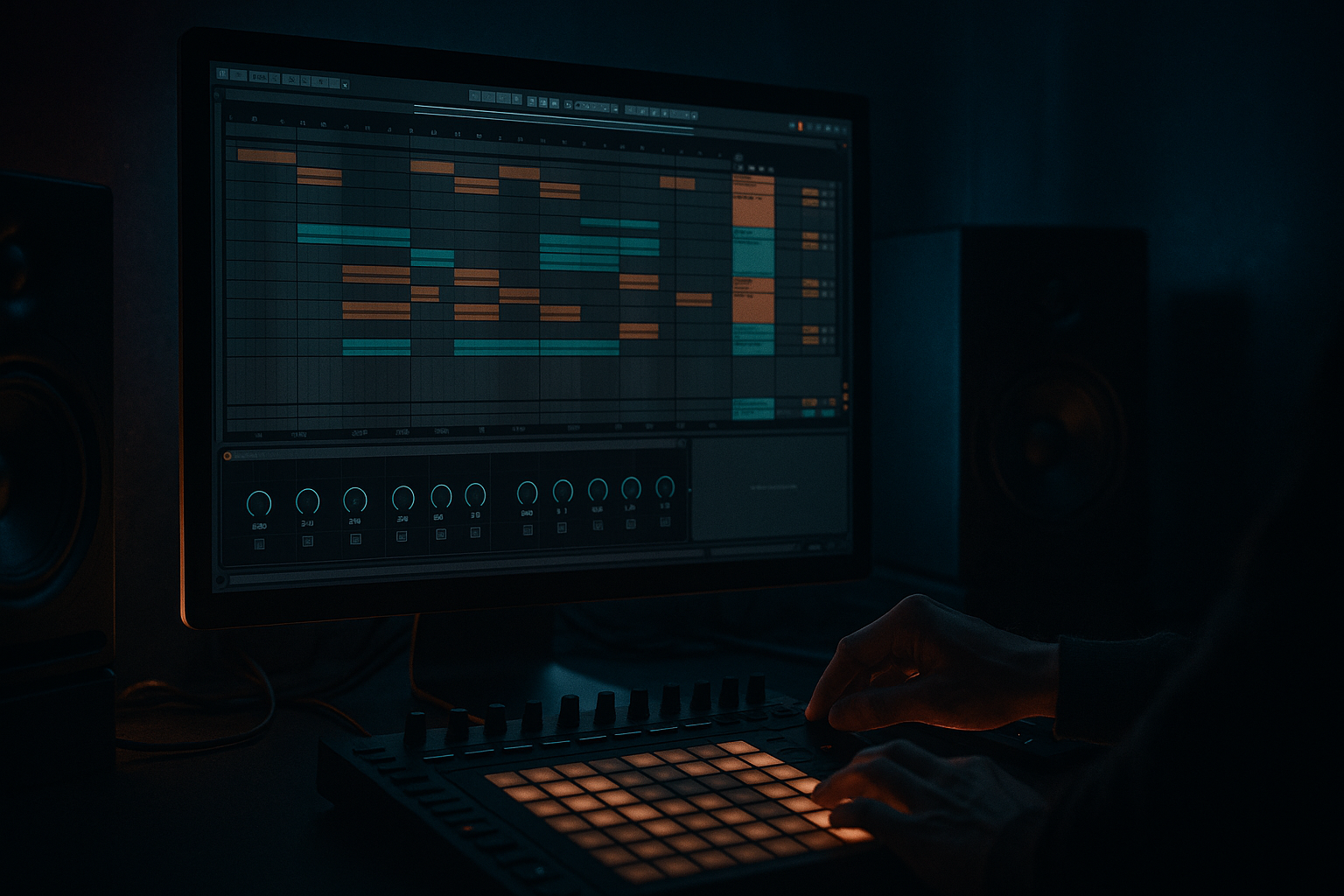
Main tutorial
Subtle Arcade-Style Textures Masterclass (Oldskool DnB Vibes) 🎮🔥
Ableton Live | Intermediate | FX
---
1. Lesson overview
Arcade textures in oldskool jungle/DnB aren’t about big chiptune melodies dominating the mix—they’re micro-details that add nostalgia, movement, and “air” around drums and bass. In this lesson you’ll create subtle 8‑bit/arcade-style textures that sit behind your break, Reese, and pads—without turning the tune into a game soundtrack.
We’ll focus on:
- Building layered arcade noise beds + tiny tonal “bleeps”
- Making them rhythmic, ducked, and filtered so they groove with breaks
- Using Ableton stock devices for fast, repeatable workflows
- Arranging them like real jungle/DnB: intros, drops, fills, and transitions
- Tempo: 170–175 BPM
- Have at least:
- `Arcade Bed`
- `Bleep Sprite`
- `Arcade FX`
- Mode: Band-Pass
- Freq: 1.2–2.5 kHz (start ~1.8 kHz)
- Resonance: 0.70–1.10 (a bit peaky = arcade)
- Drive: 2–5 dB (subtle grit)
- Envelope: Off (for now)
- Downsample: 2.0–6.0 (start 3.5)
- Bit Reduction: 6–10 bits (start 8)
- Dry/Wet: 10–25% (key: subtle!)
- Chorus: Classic mode
- Amount: 15–30%
- Rate: 0.15–0.35 Hz
- Width: 80–120%
- High-pass: 250–500 Hz (12 dB/oct)
- Gentle dip: 2–4 kHz if it fights snares
- Low-pass: 7–10 kHz (24 dB/oct) to remove modern “hi-fi”
- Mono: ON below 200 Hz (or just keep the whole thing fairly mono)
- Gain: set so you barely notice it when drums are full
- Add Compressor
- Enable Sidechain
- Input: your Drum Bus (or Kick+Snare bus)
- Settings (starting point):
- Amount: 10–25%
- Rate: 1/8 or 1/16 (sync)
- Phase: 0–90° (avoid super-wide if your mix is dense)
- Osc A: Square
- Osc B: Sine (very low level, just to round it)
- Amp Envelope (A):
- In Operator, enable Pitch Env
- Amount: +12 to +36 semitones (start +24)
- Decay: 40–120 ms
- Downsample: 4–10
- Bits: 6–9
- Dry/Wet: 20–40% (more obvious than the bed, but still controlled)
- Mode: Soft Sine or Analog Clip
- Drive: 2–6 dB
- Output: trim to match level
- High-pass: 300–800 Hz
- Notch any harshness around 3–5 kHz if needed
- Low-pass: 8–12 kHz (depends how “bright” you want)
- Size: 15–25%
- Decay: 0.6–1.4 s
- Pre-delay: 10–25 ms
- Hi Cut: 5–8 kHz
- Dry/Wet: 8–18%
- Work in 2-bar loops.
- Place bleeps on:
- Randomize MIDI velocities (or draw) between 40–90
- You want variety like sampled arcade crumbs.
- Add Compressor sidechain from snare/kick or whole drums
- Aim for 3–6 dB GR (bleeps should duck out of the way)
- Put your `Arcade Bed` or `Bleep Sprite` audio into Simpler (Slice mode optional)
- Or resample a bar of textures and use:
- Interval: 1 Bar (or 2 Bars)
- Grid: 1/8 or 1/16
- Chance: 10–25% (subtle!)
- Variation: 0–20%
- Pitch: 0 or +12 for a cheeky arcade jump
- Intro (0–32 bars):
- Pre-drop (last 8 bars before drop):
- Drop (first 16 bars):
- Mid-section / second drop:
- Keep arcade textures “mid-band”: band-pass around 1–4 kHz so they feel like nostalgia noise rather than shiny top-end.
- Distort them like they were sampled: try Saturator (Analog Clip) before EQ, then low-pass.
- Resample + flatten: bounce 8 bars of textures to audio, then chop/warp like a jungle sample. Imperfections = vibe.
- Use “ghost modulation”: automate filter cutoff or Redux Dry/Wet with very small ranges (like 5–10%) so it moves without being obvious.
- Call-and-response with Reese: put bleeps mainly when the bass sustains; leave space when the bass does movement fills.
- Arcade textures in oldskool DnB work best as subtle, band-limited, ducked layers.
- Build three tools: Bed (atmosphere), Bleeps (gaps + responses), Transitions (phrase markers).
- Stock Ableton devices that do the heavy lifting: Operator, Auto Filter, Redux, Saturator, EQ Eight, Compressor (Sidechain), Beat Repeat, Reverb/Delay.
- Arrangement matters: deploy textures around 8/16-bar phrasing, not constantly.
---
2. What you will build
By the end you’ll have three reusable elements you can drop into any rolling tune:
1) Arcade Bed (Noise/Texture Layer)
A constant but evolving layer that feels like CRT hiss + 8-bit ambiance.
2) Bleep Sprite (Micro One-Shots)
Tiny pitchy “UI” sounds that answer the drums in the gaps.
3) Transition FX (Coin-Up / Power-Up Sweeps)
Short ear-candy risers and downlifters that mark 8/16-bar sections.
All three will be subtle, sidechained, band-limited, and glued into the mix—classic oldskool vibe.
---
3. Step-by-step walkthrough
Step 0 — Set the DnB context (session prep)
- A break loop (Amen-style or chopped)
- A bass (Reese/sub)
- Basic drum bus routing (Drums group, Bass group)
Create a new Group called: `ARCADE TEXTURES`
Inside it, make 3 MIDI tracks:
Route the group to your master like normal, but we’ll treat it like a “background FX bus.”
---
Step 1 — Build the Arcade Bed (subtle, constant texture) 🎛️
#### 1A) Source sound (Operator or Wavetable)
Option A: Operator (quick + oldschool)
1. On `Arcade Bed`, load Operator
2. Set Algorithm: all oscillators to output (no FM)
3. Use Osc A:
- Wave: Square
- Octave: -2 (keep it low-mid, not fizzy yet)
4. Add Noise (Operator has a Noise oscillator):
- Turn Noise on
- Keep it quiet (you want “air,” not white noise)
MIDI: Draw a long note (e.g., C2) for 8–16 bars.
#### 1B) Make it “arcade/CRT” with filtering + degradation
Add devices after Operator in this order:
1) Auto Filter
2) Redux (this is the “8-bit” stamp)
3) Chorus-Ensemble (or Phaser-Flanger if you want more swirl)
This gives gentle motion so the bed doesn’t feel static.
4) EQ Eight (band-limit like it’s sampled from an old source)
5) Utility
#### 1C) Make it groove: sidechain + rhythmic movement
Sidechain (must-have for DnB):
- Ratio: 3:1
- Attack: 2–10 ms
- Release: 80–160 ms (time it to the groove)
- Threshold: adjust for 2–5 dB gain reduction on hits
Extra movement (optional but nice):
Add Auto Pan after the compressor:
Result: A background arcade haze that “breathes” with the breaks.
---
Step 2 — Create the Bleep Sprite (tiny one-shots that fill gaps) 🕹️
#### 2A) Sound design: quick bleep patch
On `Bleep Sprite`, load Operator (again, fast and era-correct):
- Attack: 0 ms
- Decay: 80–160 ms
- Sustain: -inf (or 0 with very short decay)
- Release: 30–80 ms
Add Pitch Envelope (classic arcade zap):
Now add FX chain:
1) Redux
2) Saturator
3) EQ Eight
4) Reverb (small + gated vibe)
#### 2B) MIDI placement (DnB/jungle arrangement logic)
Don’t spam bleeps. Place them like percussion “responses.”
Try this workflow:
- The “and” after snare (e.g., 2.3 / 2.4-ish)
- The last 1/16 before a snare (tension into hit)
- Bar-end (last 1/8) leading into a new phrase
Velocity trick:
Timing trick (swing):
Use Groove Pool: try MPC 16 Swing 55–58 lightly.
Commit at 20–40% to keep it rolling, not sloppy.
#### 2C) Make it sit behind drums
---
Step 3 — Build Arcade Transition FX (power-up sweeps + stutters) ⚡
On `Arcade FX`, create 2 clips: a riser and a downlifter.
#### 3A) Riser: “coin-up” noise sweep
Use Wavetable or Operator + noise. Here’s a stock-only classic:
1. Load Operator
2. Turn on Noise as main source (or keep a quiet square under it)
3. Add Auto Filter (Low-pass)
- Freq automation: 500 Hz → 8 kHz over 1–2 bars
- Resonance: 0.8–1.2
4. Add Redux
- Downsample: 4–8
- Bits: 6–8
- Dry/Wet: 15–30%
5. Add Delay (or Echo if you want more character)
- Time: 1/8 or 3/16
- Feedback: 15–30%
- Dry/Wet: 10–20%
6. Add Reverb
- Decay: 1.2–2.5s
- Hi Cut: 6–8 kHz
- Dry/Wet: 10–18%
Keep it quiet. It’s a transition marker, not a lead.
#### 3B) Stutter fills (oldskool edit energy)
To get that jungle “edited FX” feel:
Beat Repeat (stock, perfect for this)
Automate Beat Repeat ON only at phrase ends (every 8/16 bars).
---
Step 4 — Arrangement ideas (how to use textures like a real DnB tune) 🧠
Here’s a practical map:
- Arcade Bed filtered low (Auto Filter LP at ~2 kHz)
- Occasional Bleep Sprite every 2–4 bars
- Add vinyl/crackle-like vibe if desired (but keep it subtle)
- Increase band-pass resonance slightly
- Add a short coin-up riser on bar 7–8
- Add a stutter fill on the last half-bar
- Reduce arcade content by ~30–50% (DnB priority: drums + bass)
- Bring in bleeps only in gaps—especially after snare hits
- Sidechain stronger here
- Swap bleep pattern or transpose up +7 semitones
- Automate Redux Dry/Wet slightly higher for 4 bars, then back down (ear candy)
---
4. Common mistakes
1) Too loud / too bright
If your textures live above 8–10 kHz, they’ll fight hats and make the mix feel brittle. Low-pass and keep level conservative.
2) No sidechain
Arcade layers without ducking will smear your snare and blur break transients—instant “flat” drop.
3) Over-Redux everywhere
Heavy bitcrush is cool for a hook, but constant heavy reduction reads as gimmicky and tiring. Use Dry/Wet and automation.
4) Too wide
Wide chorus + wide reverb on constant textures can wreck mono compatibility and blur the center where drums/bass need to hit.
5) Random bleeps with no phrasing
Oldskool feels edited and intentional. Put bleeps at phrase boundaries and drum-response gaps, not everywhere.
---
5. Pro tips for darker/heavier DnB 🖤
---
6. Mini practice exercise (15–25 minutes) 🧪
1) Make a 16-bar loop with: break + bass.
2) Build an `Arcade Bed` using the chain:
- Operator → Auto Filter (BP) → Redux → Chorus-Ensemble → EQ Eight → Compressor (SC)
3) Create 6 bleep hits in bar 1–2, then copy and change 2 notes every 4 bars.
4) Add one riser in bars 15–16 and a Beat Repeat stutter on the last 1/2 bar before bar 17.
5) Final check: Mute/unmute textures. When unmuted, the track should feel more alive—but not “different genre.”
Deliverable: export a 32-bar sketch and label the three texture tracks clearly.
---
7. Recap ✅
If you tell me what subgenre you’re aiming for (’94 jungle, techstep, early Pendulum-era dancefloor, modern rollers), I can suggest a tighter set of cutoff ranges, sidechain timing, and a couple of bleep “motifs” that fit the vibe.

