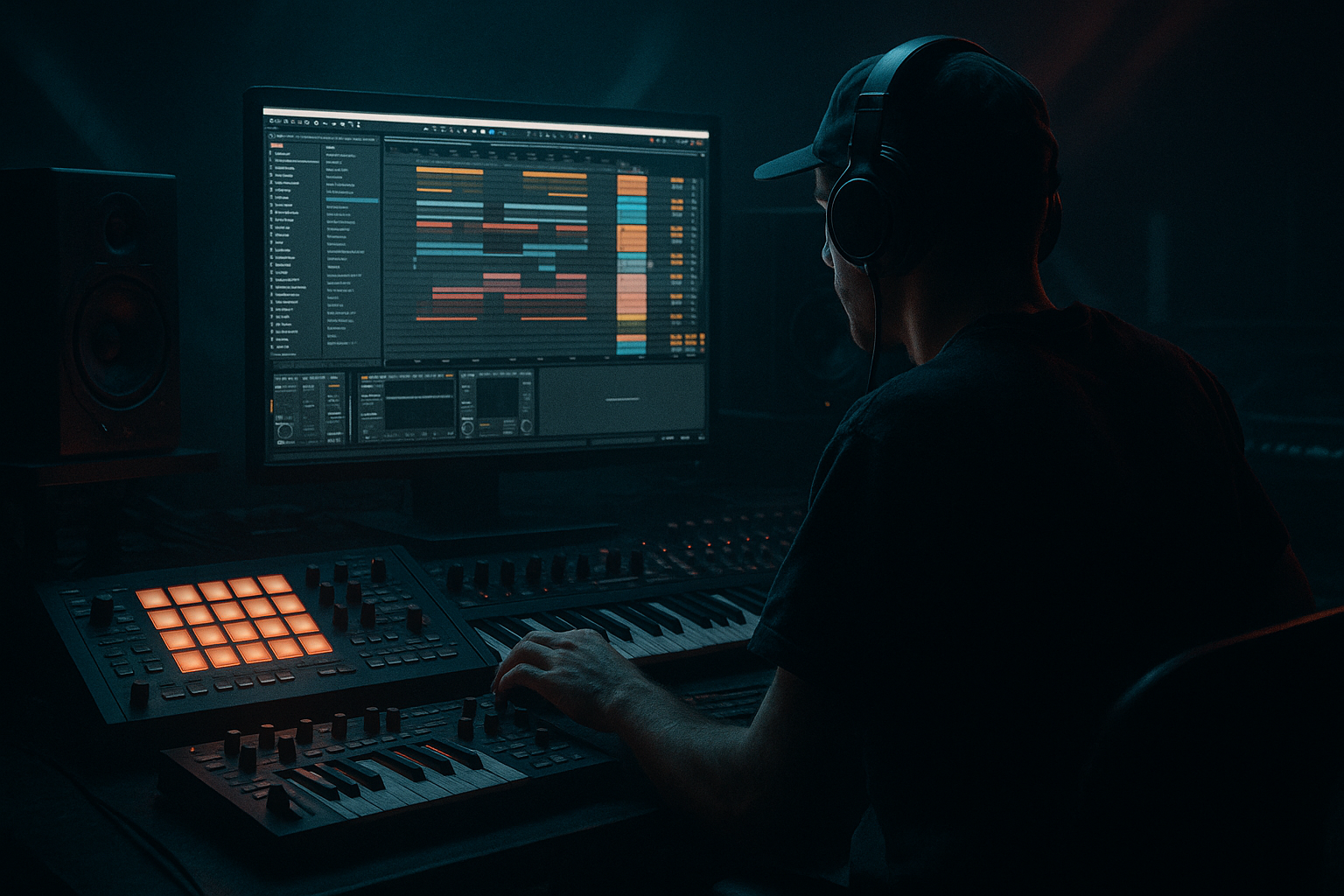
Main tutorial
```markdown
Subtle Detune on Chords (Session View) — Drum & Bass Sound Design in Ableton Live 🎛️
1. Lesson overview
Subtle detune is one of the fastest ways to make chords feel alive—wider, thicker, slightly unstable—without turning into cheesy trance supersaws. In drum & bass (especially liquid, jungle-tinged rollers, and deep minimal) detune gives pads, stabs, and reeses a “moving air” quality that sits beautifully above a rolling break and under a heavy sub.
In this lesson you’ll build a Session View chord rig designed for fast auditioning: different detune “flavours,” macro control, and performance-ready clips you can record straight into Arrangement.
---
2. What you will build
A Session View setup with:
- A chord track that can switch between:
- A Macro-controlled Instrument Rack so you can perform detune amounts live 🎚️
- A few DnB-ready chord clips (stabs + pads) that work with 170–175 BPM grooves
- A clean workflow to resample detuned chords into audio for tighter mixes
- Use 2 oscillators (saw + pulse), a LP24 filter, and keep resonance low for a classic dark “hardware-ish” bed.
- Bar 1: Dm7 (D–F–A–C)
- Bar 2: Bbmaj7 (Bb–D–F–A)
- Bar 1: Fm (F–Ab–C)
- Bar 2: Fmsus2 (F–G–C)
- Nudge the chord start -5 to -15 ms early (groove pocket).
- Or use Groove Pool: try an MPC-ish swing at 10–20%.
- Keep it as your reference. This matters—your ears need a “zero point”.
- Scene `B: Micro Detune`: switch Macro 1 to Micro + slightly open filter
- Scene `C: Drift`: switch to Drift for breakdown/atmosphere
- Scene `D: Wide Unison`: wide for intros/outros, but tighten for drops
- Intro (16 bars): Drift pad (low-passed)
- Build (16 bars): Micro Detune stabs start appearing (rhythmic)
- Drop (32 bars): Tight or Micro (keep mix focused)
- Break (16 bars): Drift returns + reverb tail moments
- Second drop: Add Wide only for call-and-response fills, not constant
- Detuning the entire chord including sub range: detune below ~150 Hz = phase wobble and weak mono. Use Utility Bass Mono and high-pass chords.
- Too much unison voices + wide width: sounds big solo, but destroys clarity with rides and breaks.
- LFO drift too fast: if it moves like vibrato, it’ll scream “effect.” Keep it slow (0.05–0.15 Hz).
- Not gain-matching chains: louder always sounds “better.” Match levels per chain before deciding.
- Using wide chords constantly in the drop: you lose contrast. Use Wide as a moment, not a default.
- Keep the center aggressive, the sides smooth:
- Mid/Side EQ for control:
- Make detune react to energy:
- Reese-friendly chord layers:
- Jungle texture hack:
- Session View is perfect for detune because you can audition variations instantly and perform them into Arrangement.
- Use an Instrument Rack with chains as detune “modes” (Tight/Micro/Drift/Wide).
- Keep detune subtle, especially in the low mids; mono the bass and high-pass chord layers.
- For DnB, detune is most powerful as contrast: drift in breaks, tighter in drops.
- Resampling turns “nice motion” into mixable, sliceable audio—classic rolling DnB workflow.
- Micro detune (barely-there width)
- Tape-ish drift (slow random pitch motion)
- Unison-style spread (controlled thickness)
---
3. Step-by-step walkthrough
Step 0 — Session View prep (DnB context)
1. Set tempo to 174 BPM.
2. Create MIDI Track: `CHORDS`.
3. In Session View, create 4 clips (one per scene), labelled:
- `A: Tight`
- `B: Micro Detune`
- `C: Drift`
- `D: Wide Unison`
Workflow tip: Keep your drums looping on another track while you audition chord detune. Detune that feels lush solo can clash with hats and ride textures.
---
Step 1 — Build the core chord sound (Wavetable or Analog)
Option A (recommended): Wavetable
1. Drop Wavetable onto `CHORDS`.
2. Basic setup:
- Osc 1: Basic Shapes → Sine/Triangle-ish (or a mellow wave)
- Osc 2: Basic Shapes → Square-ish (low level for harmonics)
- Unison: OFF (for now)
3. Filter:
- Filter Type: LP24
- Freq: ~ 1.2–3 kHz (depends on brightness)
- Drive: 2–5
4. Amp Envelope:
- Attack: 5–20 ms (prevents click)
- Decay: 600 ms (stabs) / 2–5 s (pads)
- Sustain: -6 to -12 dB (stabs) / 0 to -6 dB (pads)
- Release: 200–600 ms
Option B: Analog
---
Step 2 — Write DnB-friendly chord clips (Session View)
Create a 2-bar MIDI clip in `A: Tight`.
Try one of these chord approaches (root notes depend on your tune):
A) Liquid/roller minor 7 movement
B) Dark minimal: minor chord + sus tension
Performance note: In DnB, chords often feel best off the grid:
---
Step 3 — Put the synth into an Instrument Rack for detune “modes”
1. Select Wavetable (or Analog) → press Cmd/Ctrl+G to Group into an Instrument Rack.
2. In the Rack, click Chain List → create 4 chains:
- `Tight`
- `Micro`
- `Drift`
- `Wide`
Now duplicate the instrument into each chain (so they start identical).
---
Step 4 — Add subtle detune per chain (clean + controllable)
#### Chain 1: Tight (no detune)
#### Chain 2: Micro Detune (static, subtle width) 🎯
Goal: slight chorusing without obvious wobble.
1. In Wavetable:
- Turn Unison ON
- Voices: 2
- Amount: 10–20%
- Detune: 3–8
- Width: 80–120% (keep it tasteful)
2. Optional (stock device): add Chorus-Ensemble
- Mode: Chorus
- Rate: 0.20–0.40 Hz
- Amount: 10–20%
- Mix: 10–25%
- Keep it quiet—this is “feel”, not “effect”.
#### Chain 3: Drift (random pitch movement like tape) 🌀
Goal: slow instability that feels organic in sustained chords.
1. Add LFO (MIDI Modulation device) after the instrument.
2. Map LFO to Wavetable → Osc 1 Pitch (or Global Tune if you prefer).
- LFO Shape: Random (S&H) or Smooth Random
- Rate: 0.05–0.15 Hz (slow!)
- Amount: tiny: aim for ±2 to ±6 cents max
(If your mapping is in semitones, keep it extremely small.)
3. Add Utility after it:
- Bass Mono: ON
- Width: 80–110%
(Keeps low-end solid while the top drifts.)
#### Chain 4: Wide Unison (controlled thickening) 🌫️
Goal: wide, lush chords without eating the mix.
1. In Wavetable:
- Unison: ON
- Voices: 4–6
- Detune: 8–18 (avoid “supersaw” territory)
- Width: 120–160%
2. Add EQ Eight after:
- High-pass at 150–250 Hz (24 dB slope if needed)
- Small dip around 300–500 Hz if it gets boxy
3. Add Saturator (subtle):
- Drive: 1–3 dB
- Soft Clip: ON
- Keep output matched (A/B level is critical).
---
Step 5 — Make it performable in Session View (Macros + Chain Selector)
1. In the Rack, map Chain Selector to Macro 1.
- Macro 1 name: `Detune Mode`
- Set ranges so each chain occupies a zone:
- Tight: 0–31
- Micro: 32–63
- Drift: 64–95
- Wide: 96–127
2. Map key parameters to Macros (per chain if needed):
- `Detune Amount` → Unison Detune / Chorus Amount
- `Drift Amount` → LFO Amount
- `Tone` → Filter Frequency
- `Width` → Utility Width
- `Air` → EQ Eight high shelf (subtle +1 to +3 dB above 6–10 kHz)
Session View trick: Record Macro moves into Arrangement by arming automation and jamming scenes. You’ll get “human” detune changes without overthinking.
---
Step 6 — Clip-level variations: detune as an arrangement tool
Duplicate your `A: Tight` clip into the other scenes and tweak only what’s needed:
DnB arrangement idea (simple but effective):
---
Step 7 — Glue it into the mix (DnB-friendly chain)
On the `CHORDS` track (after the Rack), add:
1. EQ Eight
- HPF 120–250 Hz (depends on bass/sub)
- Cut mud at 250–450 Hz if needed (-2 to -5 dB)
2. Compressor (gentle control)
- Ratio 2:1
- Attack 10–30 ms
- Release 80–200 ms
- Gain reduction 1–3 dB
3. Sidechain Compressor (to kick or kick+snare bus)
- Attack 0.5–2 ms
- Release 80–140 ms (tune to groove)
- Aim 2–6 dB of ducking for a rolling feel
4. Optional: Hybrid Reverb (send is usually better than insert)
- Short plate or dark room
- Pre-delay 15–30 ms
- Low cut 250–400 Hz in the reverb
---
Step 8 — Resample for tightness (classic DnB move) 🎚️
Once you’ve got detune motion you like:
1. Create a new audio track: `CHORD RESAMPLE`.
2. Set its input to Resampling (or from `CHORDS`).
3. Record 8–16 bars while you launch scenes and tweak macros.
4. Now you can:
- Warp and tighten timing
- Slice to New MIDI Track (for jungle-style chord chops)
- Add Redux or Saturator for grit without unstable pitch in the low end
---
4. Common mistakes
---
5. Pro tips for darker/heavier DnB 🖤
Put Saturator before widening, then use Utility or subtle chorus after.
With EQ Eight in M/S mode:
- Cut low end on Sides (HPF 200–400 Hz on Sides)
- Slight presence boost on Mid around 1–3 kHz if chords need bite
Automate `Detune Mode` so it gets tighter at the drop, driftier in breaks.
Layer a quiet, filtered Operator sine or triangle an octave below but keep it mono—don’t detune that layer.
Resample wide chords → Redux (bit reduction subtle) → Auto Filter with envelope → instant dusty rave undertone.
---
6. Mini practice exercise (15 minutes) ⏱️
1. Build the 4-chain rack as above.
2. Create a 2-bar chord stab clip and a 4-bar pad clip.
3. Jam these scene changes:
- 8 bars Tight
- 8 bars Micro
- 8 bars Drift (filter closes)
- 8 bars Wide (only on bar 7–8 as a “lift”)
4. Resample the jam to audio and do one edit:
- Slice one chord hit, reverse it, and use it as a pre-drop sweep.
Deliverable: a 32-bar loop that feels like it could sit under a rolling break at 174 BPM.
---
7. Recap ✅
If you tell me what sub style you’re aiming for (liquid, jump-up, minimal, jungle/140-cross, techy roller), I can suggest exact chord voicings + detune ranges that match that aesthetic.
```

