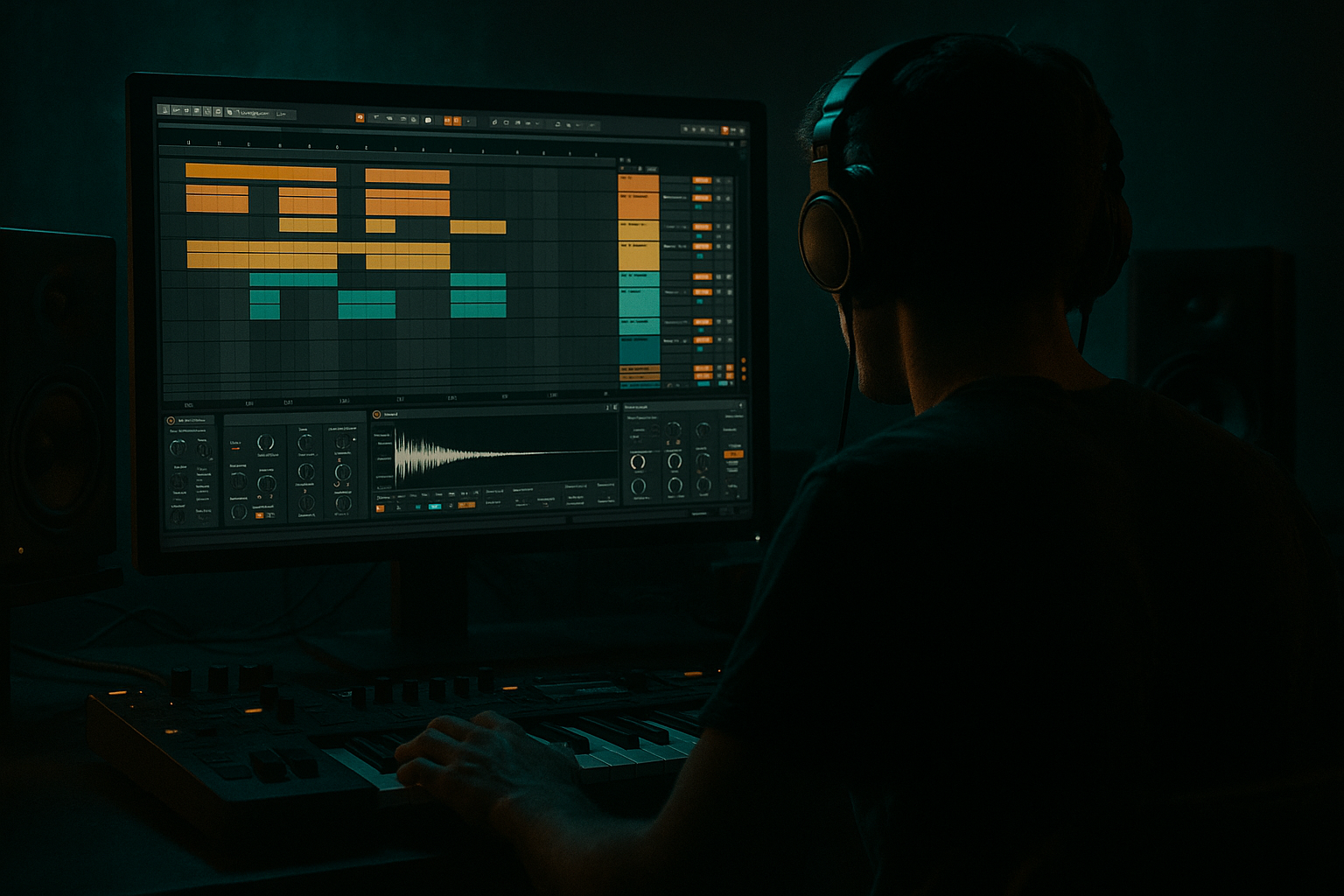
Main tutorial
Subtle Pan Automation on Atmospheres (DnB in Ableton Live) 🎛️🌫️
1. Lesson overview
Subtle pan automation is one of those “you don’t notice it until it’s gone” techniques that makes drum & bass atmospheres feel alive, wide, and cinematic without messing up mono compatibility or stealing focus from your drums/bass.
In this lesson, you’ll learn how to add controlled, minimal left-right motion to pads, noise beds, jungle ambiences, and FX layers using Ableton Live stock tools—in a way that supports a rolling groove and keeps the center clean for kick, snare, and sub. ✅
---
2. What you will build
You’ll create a DnB atmosphere track (pad/noise/field recording) with:
- Micro pan movement (slow, subtle) for width
- Phrase-based pan automation (changes every 8/16 bars for arrangement energy)
- Optional “call and response” pan moments tied to fills/transitions
- A safe device chain that stays stable in mono 🎧➡️📱
- A pad (Wavetable / Analog)
- A noise bed (Operator noise oscillator, or a vinyl/room texture sample)
- A field recording (train station, rain, crowd—classic jungle vibe)
- High-pass: 24 dB/oct @ 120–200 Hz (adjust to taste)
- Optional dip: -2 to -4 dB around 250–500 Hz if it’s muddy
- Optional tame harshness: -2 to -3 dB around 3–6 kHz if needed
- Mode: Low-pass
- Frequency: 8–14 kHz
- Resonance: 0.70–1.20
- Envelope: Off (for now)
- Width: 110–140% (be careful above this)
- Bass Mono: On, set around 120 Hz (super useful for safety)
- This is where we’ll automate Pan subtly.
- Size: 20–35%
- Decay: 1.2–2.5s
- Low Cut: 200–400 Hz
- High Cut: 7–10 kHz
- Dry/Wet: 10–25%
- Saturator (very light): Drive 1–3 dB, Soft Clip on (adds density)
- Great for liquid, rollers, deep jungle atmos.
- Great for arrangement: intro → drop → breakdown.
- Great for impact without constant motion.
- For wide/noisy atmos: ±5 to ±12 (Ableton pan units)
- For tonal pads: ±3 to ±8 (less is more)
- Over 8 bars, curve from 0 → +8
- Over next 8 bars, curve from +8 → -6
- Next 8 bars, return toward 0
- Bar 17 (start of drop)
- Bar 49 (2nd phrase / variation)
- Breakdown start
- Final drop
- Right before the drop (last bar of build): pull pan back toward center (0)
- At the drop: set pan to 0 or slight offset (+2/-2) for stability
- After 4–8 bars: allow drift again
- Keep overall range small (±4 to ±7)
- Add a few gentle points:
- Amount: 10–20%
- Rate: 0.03–0.08 Hz (very slow drift)
- Shape: Sine
- Phase: 120°–180° (wide feel)
- Offset: adjust to taste
- On your Master, add Utility
- Map a key to Mono toggle (or click it periodically)
- If the atmosphere disappears or gets phasey:
- Intro (16 bars): pan drift slowly increasing (0 → +8)
- Pre-drop (8 bars): pan returns toward center (reduce motion)
- Drop (32 bars): subtle drift stays small (±3 to ±6)
- Mid-section variation (16 bars): drift slightly wider (±6 to ±10)
- Breakdown (16 bars): wider + slower (±8 to ±12) + extra filter movement
- Final drop: lock closer to center for punch, then reopen last 8 bars
- Make motion feel “ominous,” not playful
- Pair pan drift with subtle filtering
- Use reverb width instead of source width
- Add slight distortion before movement
- Sidechain the atmosphere to the drums
- On bar 16 (pre-drop), snap pan to 0 for 1 beat, then resume drift after the drop hits.
- Use Utility Pan automation for controlled, mix-safe stereo motion.
- Keep ranges small: usually ±3 to ±12 depending on the material.
- Make automation phrase-aware (8/16 bar arcs), and “reset” near drops.
- Protect the center: mono low end, check mono, and avoid over-widening.
- In darker DnB, slower + smaller movement often feels heavier and more serious. 🖤
---
3. Step-by-step walkthrough
Step 1 — Choose (or make) the right atmosphere source 🌌
Pick one:
DnB tip: Atmospheres work best when they have mid/high content and not too much sub. Keep your sub lane sacred.
Quick setup (Audio track):
1. Drag in an ambience sample (8–32 bars works great).
2. Warp mode: Complex (or Complex Pro if it’s tonal).
3. Set it to loop cleanly.
---
Step 2 — Build a clean “Atmos” device chain (stock devices) 🧱
On your Atmos track, use this chain:
1) EQ Eight
2) Auto Filter (for movement without volume changes)
3) Utility (your main pan tool)
4) Reverb (light, controlled)
Optional:
---
Step 3 — Decide the “style” of pan automation (3 DnB-friendly options) 🎚️
You’ll generally use one of these:
A) Slow drift (continuous, subtle)
B) Phrase-based offsets (every 8/16 bars)
C) Accent pans (short moments on fills/transitions)
We’ll do A + B together (most useful combo).
---
Step 4 — Set up subtle pan automation (the safe way) ✅
1. Open Arrangement View.
2. Press A to show automation lanes.
3. On your Atmos track, choose Utility → Pan.
Recommended subtle ranges (start here):
Draw a slow drift:
Why this works in DnB: Your drums/bass are repetitive; tiny evolving motion keeps the loop from feeling static without distracting the groove.
---
Step 5 — Add phrase-based “reset points” for arrangement energy 📐
This is the trick that makes it feel intentional rather than random.
At key points (common DnB structure):
Do this:
Result: The drop hits harder because the stereo image “locks” briefly, then reopens. 🎯
---
Step 6 — Add “micro-movement” without sounding like autopan 🌀
If your automation feels too obvious, reduce the movement but increase the detail.
Method: subtle nodes
- tiny nudge left on bar 3
- tiny nudge right on bar 6
- back toward center on bar 8
DnB grounding: Do this in 8-bar chunks so it matches the drum phrasing (like hat variations or ghost note patterns).
---
Step 7 — Optional: Use Auto Pan… but tame it 🎛️
Auto Pan can be great if you keep it barely moving.
Add Auto Pan after EQ/Filter and before Reverb:
Settings (subtle DnB safe starting point):
Important: Auto Pan can feel “plugin-y” if rate is rhythmic (like 1/4, 1/8). For rolling DnB, keep it slow and atmospheric unless you’re doing a deliberate effect.
---
Step 8 — Keep mono compatibility tight (don’t destroy the center) 📱
Atmospheres are often wide. That’s fine—but check the mix survives mono.
Quick mono check workflow:
- Reduce Width on the Atmos Utility (try 100–120%)
- Reduce extreme panning ranges
- Consider making the dry signal more centered and letting reverb carry width
Pro move: Put reverb on a Return track and keep the source more mono-ish.
---
Step 9 — Arrangement ideas rooted in DnB/jungle structure 🧩
Try this template:
This gives your roller that “breathing” sense without needing constant new sounds.
---
4. Common mistakes 🚫
1. Too much pan range
- If it’s swinging like a trance autopan, it’s not subtle. Keep it tight.
2. Panning the sub layer
- Don’t. If your atmosphere has low end, high-pass it or mono it.
3. Constant motion during the drop
- DnB drops like stability. Use motion, but reduce intensity at the most rhythmically dense moments.
4. Ignoring mono
- Wide atmospheres that vanish in mono make the mix feel weaker on phones/clubs.
5. Automating Track Pan instead of Utility (sometimes)
- Track pan is fine, but Utility gives you width + bass mono control in one place.
---
5. Pro tips for darker/heavier DnB 🖤🔊
- Use slower changes, smaller range: ±3 to ±7, longer curves (16 bars).
- Automate Auto Filter cutoff slightly downward in the drop (e.g., 12 kHz → 9 kHz) while pan drifts—creates tension.
- Keep source near center; send to a wide reverb return (Reverb or Hybrid Reverb).
- This keeps the punchy mid-center intact for snarish basses and snare crack.
- A touch of Saturator before pan automation makes the texture “grab” the stereo field better.
- Use Compressor with sidechain from your kick/snare group:
- Ratio: 2:1
- Attack: 10–30 ms
- Release: 80–200 ms
- Gain reduction: 1–3 dB
- Keeps the groove clean while the pan movement still reads.
---
6. Mini practice exercise 🧪
Goal: Make a 32-bar rolling DnB loop feel wider and more expensive using only subtle pan automation.
1. Choose an atmosphere sample or pad.
2. Add chain: EQ Eight → Utility → Reverb
3. High-pass at 150 Hz.
4. Automate Utility Pan:
- Bars 1–8: 0 → +6
- Bars 9–16: +6 → -5
- Bars 17–24 (drop): keep within ±3
- Bars 25–32: widen slightly to ±7
5. Mono check on the master:
- If it collapses too much, reduce Width or pan range.
Bonus: Add one intentional moment:
---
7. Recap ✅
If you want, tell me your tempo and sub genre (liquid/roller/jump-up/neuro/jungle) and I’ll suggest an exact 64-bar automation map that fits that arrangement.

