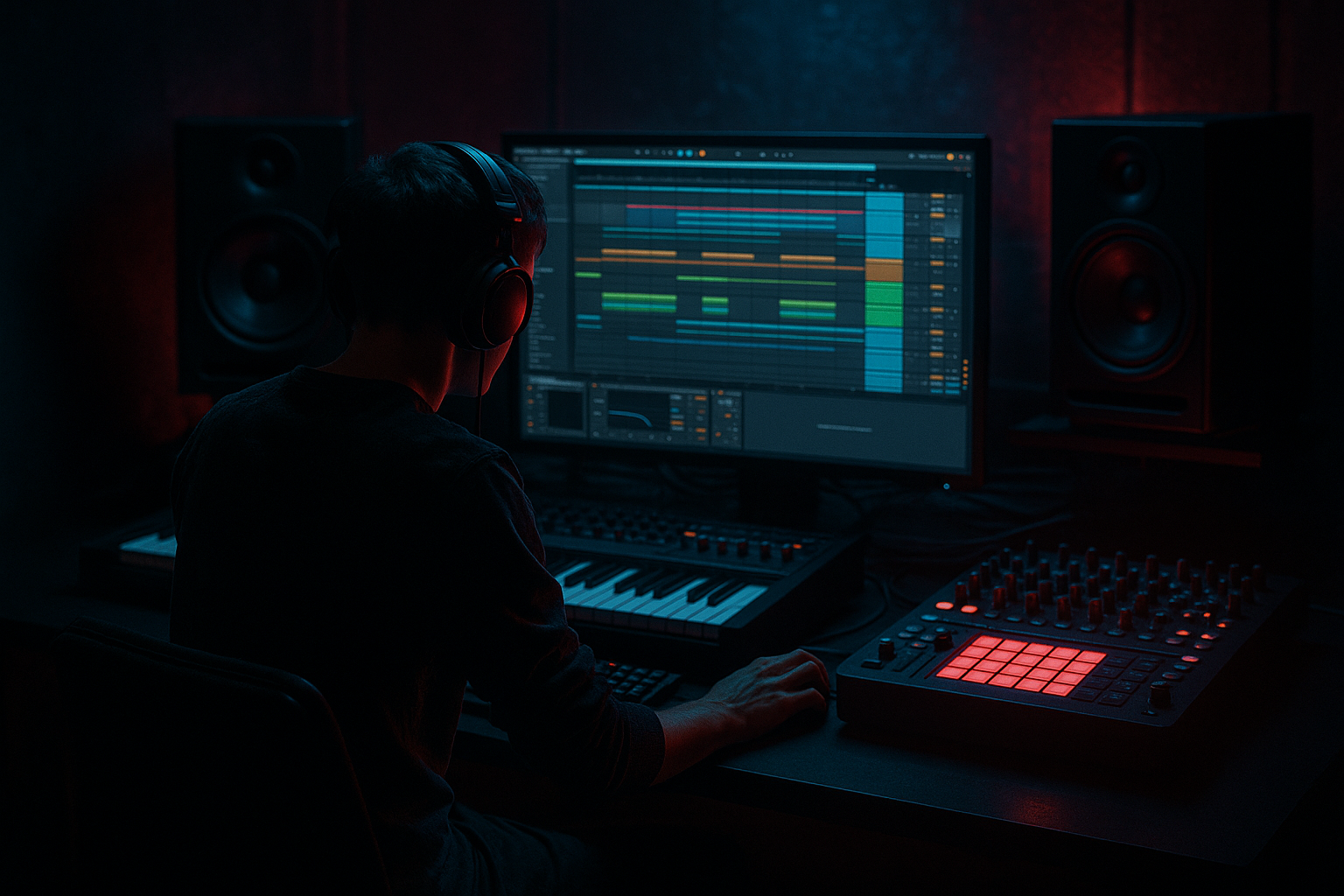
Main tutorial
Lesson Overview
This lesson is about building a sub-heavy breakbeat DnB loop in Ableton Live 12 that still leaves clean headroom for the drop. The goal is not just to make the drums hit hard, but to make them hit hard without the low end turning into mud or the master getting pinned too early.
This technique sits right in the heart of modern Drum & Bass composition: think rollers, dark jungle edits, neuro-adjacent pressure, and stripped-back dancefloor arrangements where the break carries movement and the sub supplies the physical weight. In a real track, this is the kind of loop you’d use for:
- a first drop foundation
- a 16-bar roller section
- a breakdown-to-drop reset
- an intro groove that quietly establishes the vibe before the full bassline arrives
- a chopped drum break layered with a controlled kick and snare
- a tight mono sub line that follows the groove without eating the kick
- a subweight bass presence created through saturation and envelope shaping, not brute-force volume
- small ghost notes, fills, and automation so the loop feels alive
- enough headroom to keep the master comfortably below clipping while still sounding loud and weighty
- Making the sub too loud too early
- Letting the break and sub fight in the same register
- Over-processing the break until it loses swing
- Using wide stereo effects on the low end
- Writing a bassline that plays every gap
- Ignoring arrangement while sound designing
- Pushing the master too hard while composing
- Layer sub with harmonics, not more sub
- Automate a low-pass filter on the bass texture
- Use short gaps before the snare hit
- Resample your break once it feels good
- Keep one “dirty” layer and one “clean” layer
- Use contrast in the arrangement
- Add low-level atmospheric noise under the intro
- Clip gain and clip automation before reaching for heavy limiting
- Build the loop around drum/bass separation, not raw loudness.
- Keep the sub mono, controlled, and rhythmically intentional.
- Use light saturation, careful EQ, and subtle sidechain to create weight without killing headroom.
- Let the break carry groove and the bassline answer it.
- Arrange with contrast: remove elements, then bring them back stronger.
- Always finish with a headroom check before moving on.
Why it matters: in DnB, the kick, break, and sub often compete in the same low-frequency space. If you build the loop badly, the track feels big for five seconds and then collapses once you add the bassline, FX, and arrangement energy. If you build it well, you get punch, depth, and headroom—which means your track can keep growing without falling apart. 🔥
---
What You Will Build
You will create a 4- to 8-bar breakbeat foundation in Ableton Live 12 with:
Musically, the result should feel like a dark DnB roller with jungle DNA: the break supplies swing and urgency, the sub locks the floor, and the arrangement hints at a drop without fully revealing it. The loop should sound strong at a moderate level, not only when pushed loud.
---
Step-by-Step Walkthrough
1. Set up a clean DnB session template first
Start with a fresh Ableton set and organize it before writing anything:
- Tempo: 172–174 BPM for modern DnB / rollers
- Create separate tracks for:
- Breaks
- Kick layer
- Snare layer
- Sub
- Bass texture / reese layer
- FX / atmos
- Put all drums into a Drum Bus group and all bass elements into a Bass Bus group
On your master, avoid any heavy limiting while composing. Leave headroom so you can judge balance honestly. A good target is to keep the master peaking around -6 dB to -8 dB during writing.
Add Utility on the Bass Bus early and set Bass Mono behavior by keeping the bass chain centered. For a composition template, this prevents you from accidentally writing wide low-end material that later collapses in the mix.
Why this works in DnB: the genre depends on low-end authority. If your template is already disciplined, every new layer you add will sit more predictably.
2. Choose a break with movement, not just impact
Pick a break that already has a natural shuffle or character—classic amen-style phrasing, a dusty jungle break, or a tight modern chopped loop. You want something with:
- a clear snare transient
- smaller ghost hits or hat bleed
- enough midrange texture to stay audible after processing
Drag it into Simpler or directly into a track and work at the clip level first. Use Ableton’s Warp carefully:
- For breaks with natural feel, try Complex Pro only if needed
- For punchier chopped drums, Beats mode can preserve transients better
- Keep warp markers minimal; don’t over-quantize the life out of the break
Now slice the break into sections and re-order it into a simple 2-bar phrase. Your first goal is not complexity—it’s making a loop that grooves while leaving room for the sub. Start with a pattern like:
- bar 1: main break statement
- bar 2: variation with a cut or fill
Keep kick-heavy sections sparse. In DnB, the break often works best when it is given space to breathe rather than constantly hammered.
3. Shape the break for punch and headroom
Add Drum Buss or Saturator to the break track, but use restraint.
A solid starting point:
- Drum Buss
- Drive: 5–15%
- Boom: usually off or very subtle if the break already has low end
- Transients: +5 to +20
- Or Saturator
- Drive: 1–4 dB
- Soft Clip: on
Follow with EQ Eight:
- high-pass the break around 28–40 Hz if there is useless sub rumble
- gently cut any boxy buildup around 200–400 Hz
- if the snare feels papery, a small boost around 2–5 kHz can help, but keep it subtle
If the break is too wild dynamically, use Glue Compressor lightly:
- Ratio: 2:1
- Attack: 10–30 ms
- Release: Auto or around 0.3 s
- Aim for only 1–2 dB of gain reduction
The point is to preserve impact while making the break sit in the pocket. You want room in the mix for the sub to speak clearly.
4. Build the sub line as part of the rhythm, not a separate afterthought
Create a dedicated Sub track using Operator or Wavetable with a pure sine or near-sine tone. Keep it simple and mono.
Suggested starting setup:
- Oscillator: sine
- Voices: monophonic
- Glide/Portamento: subtle, if you want slides between notes
- Filter: mostly open, unless you want a little shape
- Amp envelope:
- Attack: 0–5 ms
- Decay: moderate
- Sustain: high for sustained notes
- Release: short to medium
Now write a bassline that follows the drum phrase instead of constantly filling every gap. In DnB, that rhythm choice is everything. Try:
- long root notes under the snare space
- offbeat pushes before fills
- short pickup notes leading into bar 2 or bar 4
- occasional call-and-response with the break
Example musical context:
- In a 4-bar roller, let the sub hold the root under bars 1 and 3, then answer with a short rising note or slide into bars 2 and 4. That gives the loop a subtle “question and answer” shape without overcrowding the groove.
Keep the sub almost entirely mono. Use Utility on the Sub track and ensure width is collapsed. The sub should feel physical, not spacious.
5. Separate kick energy from sub energy with arrangement choices
If your break already includes a kick, be careful not to stack a second kick on top of every hit. In DnB, the loudest low-end often comes from clarity, not quantity.
Add a kick layer only where the break needs reinforcement:
- use a clean, short kick sample
- trim the tail so it doesn’t clash with the sub
- high-pass any unnecessary low-end from the kick layer only if the main break already provides weight
If you do use a layered kick, try this:
- keep the layer in the 60–90 Hz area
- let the sub own the very deep end below that
- use EQ Eight to carve out a small notch in the kick around the sub’s strongest note if needed
A practical workflow move: place the kick layer on the “ands” or only on selected accents in the bar, rather than on every downbeat. That creates pressure without flattening the groove.
Why this works in DnB: the genre often sounds heavy because the low frequencies are distributed intelligently. If everything hits at once, the mix feels smaller.
6. Add movement with a reese or mid-bass texture above the sub
To make the loop feel more expensive and more modern, add a separate mid-bass layer above the sub. This can be a restrained reese made from Wavetable, Analog, or a resampled bass texture.
A practical DnB chain:
- Wavetable or Analog with two detuned saws or a harmonic-rich waveform
- Low-pass filter to keep it from fighting the snare brightness
- Auto Filter automation for movement
- Saturator or Overdrive for edge
- Utility to keep the low end managed
Suggested settings:
- Filter cutoff: start around 150–500 Hz depending on the patch
- Resonance: low to moderate
- Saturator drive: 2–6 dB
- Width: wide in the mids, but not in the sub region
Use this layer to answer the break, not to drown it. For example, let the reese open slightly on the last half of bar 2 or bar 4. That creates tension before the next drum phrase.
If it starts stepping on the sub, high-pass the reese more aggressively. This is composition first, mix second: the arrangement should already prevent the layers from fighting.
7. Use ghost notes, micro-edits, and fills to make the loop feel alive
This is where the loop stops sounding like a loop. In the MIDI editor or clip view, add tiny details:
- ghost snare taps before the main snare
- very low-velocity ghost kicks in the break
- chopped hi-hat stutters at the end of bar 4
- reversed drum tails into a fill
- a one-beat sub pickup before the drop resets
Keep these details subtle. A good range for ghost hits is often 10–45 velocity, depending on sample response. They should be felt more than heard.
For variation, use:
- Clip Envelopes for filter or volume automation
- Note chance on occasional percussion hits if you’re working in MIDI
- small timing nudges to preserve human feel
In darker DnB, micro-edits matter because the arrangement often repeats a motif for 16 bars. These tiny changes keep energy moving without adding clutter.
8. Control the low end with sidechain, but don’t overdo it
Use Compressor on the Bass Bus or Sub track with sidechain from the kick or main drum trigger.
Good starting range:
- Attack: 1–5 ms
- Release: 50–120 ms, adjusted to groove
- Ratio: 2:1 to 4:1
- Aim for modest gain reduction, not a pump effect unless stylistically desired
If your kick is short and your sub is sustained, this helps the kick poke through while the sub returns quickly enough to keep the floor moving.
In Ableton Live, you can also use Utility automation or Volume Shaper-style thinking with clip envelopes, but keep it simple. The best sidechain in DnB is often the one you barely notice.
Check the mix in mono. If the bass loses power, it probably means too much of the “weight” was coming from width or stereo effects rather than true low-end balance.
9. Arrange the loop like a real DnB section
Don’t just build a 2-bar loop and stop. Turn it into a musical section.
Try this arrangement shape:
- Bars 1–4: main groove introduction
- Bars 5–8: add extra hat or reese movement
- Bars 9–12: strip back for tension, maybe remove the kick layer
- Bars 13–16: bring back full weight with a fill into the next section
For a DJ-friendly intro or outro, keep the first 8 bars sparse:
- drums first
- then sub hint
- then a fuller bass reveal
- maybe one atmospheric stab or vinyl-like texture if it suits the tune
A strong composition trick in DnB is subtractive arrangement. Pull elements out before the drop or before a switch-up so the re-entry feels heavier. The listener hears contrast as impact.
Keep one bar reserved for a transition fill. Even a tiny snare pickup, reverse cymbal, or delayed bass hit can signal a new phrase without needing a big cinematic moment.
10. Do a headroom check before calling the loop finished
This is the final discipline pass. Lower the whole session if needed so the loop feels powerful at sane levels.
Check:
- master peak around -6 dB to -8 dB
- bass bus not masking the kick
- sub audible in mono
- break still clear when the bass is present
- no harsh buildup around 2–5 kHz from hats, snare, or distorted bass texture
Use Spectrum on the master or bass bus if you need a visual sanity check, but trust your ears first. If the loop feels exciting without needing extra gain, you’ve won.
Save the set as a reusable template or extract the drum rack, bass chain, and automation moves for future rollers. This kind of disciplined loop-building is what makes a DnB project finishable later.
---
Common Mistakes
Fix: lower the sub and build weight with saturation, note length, and arrangement contrast instead of pure volume.
Fix: high-pass unnecessary rumble from the break, keep the sub mono, and leave space around the kick transient.
Fix: use lighter compression and saturation. Preserve the groove and transient shape.
Fix: keep width above the bass region, not inside it. Check the track in mono regularly.
Fix: leave breathing room. In DnB, silence and space are part of the rhythm.
Fix: decide where the bass answers the break, where the fill lands, and what gets removed before the next phrase.
Fix: preserve headroom. A mix that sounds huge at -6 dB usually finishes better than one that is already crushed.
---
Pro Tips for Darker / Heavier DnB
Add a faint mid layer with Saturator or Overdrive so the bass reads on smaller systems, while the true low end stays controlled.
A slow opening filter over 4 or 8 bars creates tension without adding more notes.
Pull bass or drum elements back just before the snare to make the impact feel larger.
Flatten it to audio, then re-chop for more control. This often gives a more aggressive, cohesive DnB feel.
Clean sub for weight, dirty mid-bass for attitude. Separating roles keeps the mix readable.
Dense bar into sparse bar, then full re-entry. Dark DnB thrives on tension/release rather than constant density.
Very subtle vinyl, room tone, or dark ambience can make the break feel deeper without stealing headroom.
Shape sections manually. In DnB, arrangement decisions often outperform fix-it processing.
---
Mini Practice Exercise
Set a timer for 15 minutes and build one 4-bar loop.
1. Choose one break and chop it into a 2-bar phrase.
2. Add a mono sine sub in Operator or Wavetable.
3. Write a simple bass rhythm with at least one bar of space.
4. Add one ghost note or micro-fill in bar 4.
5. Process the break lightly with Drum Buss or Saturator.
6. Sidechain the sub gently to the kick or drum trigger.
7. Make one arrangement change: remove the kick layer in bar 3 or add a fill in bar 4.
8. Check mono and lower the master until the loop still feels strong.
Goal: by the end, your loop should feel like a real DnB section, not just a drum pattern with a sub underneath.
---
Recap
If your breakbeat lab sounds powerful at moderate level and still has space for more layers, you’ve built it the DnB way.

