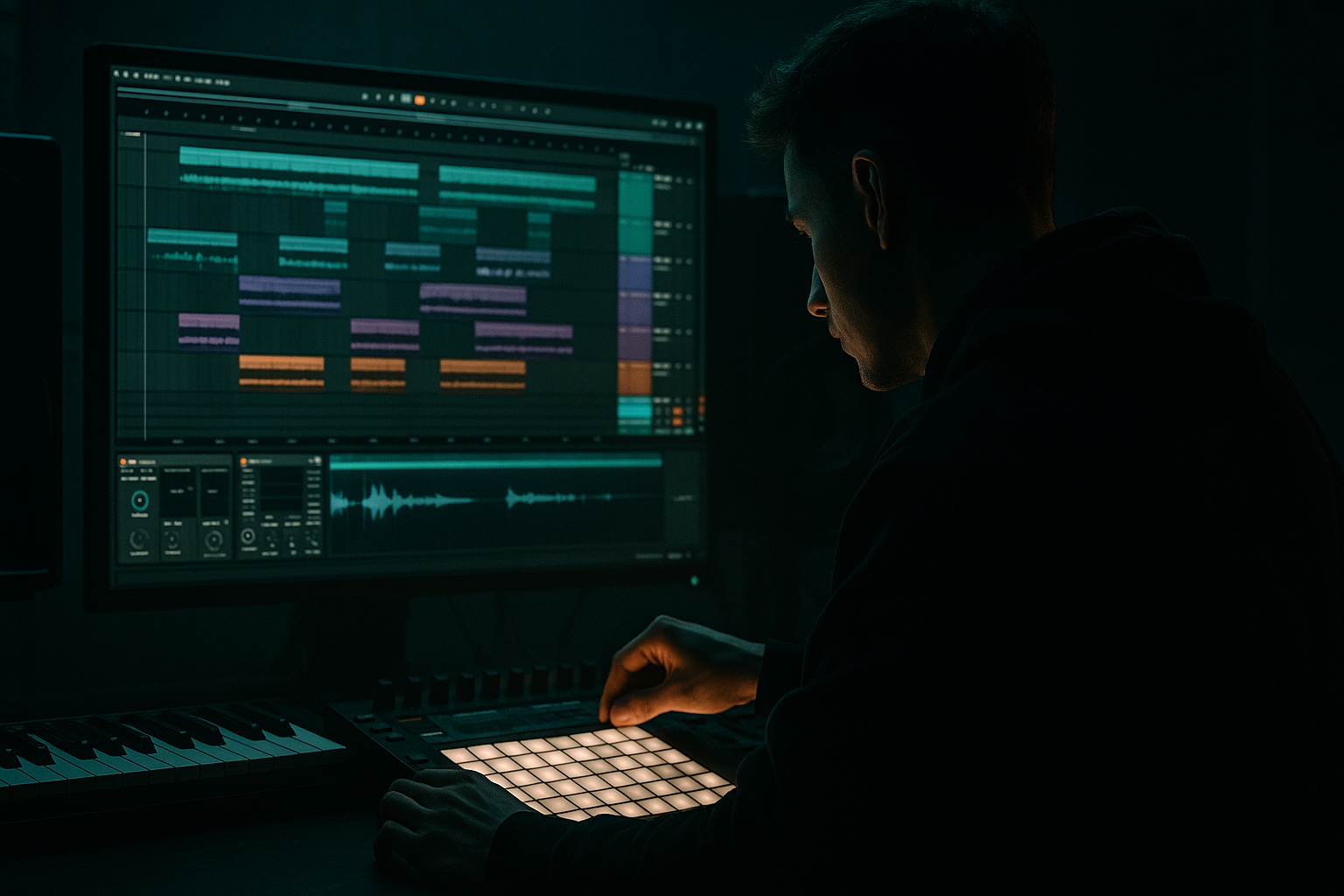
Main tutorial
```markdown
Subweight Ableton Live 12 Impact Breakdown for VHS-Rave Color in Jungle / Oldskool DnB
Groove-focused lesson for intermediate producers 🔊📼
---
1. Lesson overview
In this lesson, you’ll build a subweight impact breakdown in Ableton Live 12 that feels like it came from a faded VHS rave tape: dusty, slightly unstable, dark, and full of jungle-era attitude.
We’re focusing on a classic DnB technique:
- Drop the drums
- Let the sub and impact elements breathe
- Use space, tape-style degradation, and rhythmic tension
- Then bring the full roller back in with weight
- A sub-led breakdown
- A VHS-rave texture layer
- A drumless tension section
- An impact return that slams back into the drop
- A sub drone or sub riff holding the center
- A chopped atmospheric texture with VHS color
- A filtered break ghost for motion
- A simple impact hit that introduces the next section
- A transition return into the full drum groove
- dusty warehouse tape rip
- dark rave memory
- skeletal amen ghosting in the background
- sub pressure without full drum density
- Operator or Wavetable for sub
- Sampler or Simpler for break fragments
- Auto Filter
- Saturator
- Redux
- Echo
- Reverb
- Drum Buss
- Utility
- Compressor
- EQ Eight
- Glue Compressor if needed
- sub rhythm
- delayed textures
- chopped atmospheres
- filtered break fragments
- Root note
- Fifth or octave response
- Small passing note into the next bar
- `D1 - D1 - A0 - C1`
- then a short pickup like `D1 -> E1 -> F1`
- a washed pad
- a field recording
- a chopped sample from an amen break
- a detuned synth stab
- a recorded vinyl texture
- automate Redux downsample slightly over time
- automate Auto Filter cutoff slowly
- use LFO-like modulation via Auto Pan with phase at `0°` for tremolo-style movement
- In Live, use Groove Pool
- Try a light MPC 16 Swing or MPC 8 Swing
- Apply around `10–25%` to the break fragments
- a sub drop
- a noise hit
- a reversed cymbal
- a short dub chord stab
- Start on `A1`
- Glide down to `D1`
- Very short note, about `1/4` or `1/2` bar depending on arrangement
- Oscillator set to noise if available in your setup
- High-pass it
- Short envelope
- Saturate lightly
- Fade it in
- Add Reverb before the reverse if you want a swell
- filter it heavily
- add Echo
- keep it short
- EQ Eight: clean low mud
- Compressor: 1–2 dB gain reduction max
- Saturator: subtle body
- Utility: narrow or widen as needed
- at the end of bar 8 or bar 16
- usually on the “and” of 4 leading into the drop
- or on the first beat of the return if you want a hard reset
- Sub enters alone or with minimal texture
- VHS FX slowly fades in
- Break ghost absent or very faint
- Break ghost begins
- Add filter movement
- Slightly increase echo feedback
- Bring in a small chord stab or atmospheric cue
- Sub rhythm becomes more active
- VHS FX gets more unstable
- Reduce low-end density from the break ghost
- Build tension with automation
- Impact elements rise
- Reverse cymbal or noise swell increases
- Final sub note holds or drops away
- Cut to silence or full drum return
- a one-bar pre-drop silence
- a filtered amen fill
- a sub pickup note
- a short impact hit right before the full drums slam in
- Redux Downsample
- Auto Filter Cutoff
- Reverb Dry/Wet
- Echo Feedback
- Saturator Drive
- Utility Gain
- ±5 to 15 cents
- very subtle movement
- use clip envelopes or simpler sample transpose automation
- Keep the sub mono
- Don’t let the VHS FX layer carry low frequencies
- Avoid too much overlapping kick/sub information in the breakdown
- Use sidechain compression gently if you have ghost percussion that clashes
- high-pass on the ghost kick if needed
- transient shaping via Drum Buss
- brief gaps in the sub around the impact
- root note
- octave drop
- semitone tension note
- resolution back to root
- Echo with feedback automation
- short dub chord stabs
- filtered delays
- abrupt mute moments
- slight negative/positive track delay
- groove pool
- micro-edits on slice timing
- Cut everything for a fraction of a beat
- Then bring the drop back hard
- carve some upper-mid harshness
- keep the bass clear
- let the texture occupy the smoky midrange
- high-pass it
- reduce volume heavily
- automate it in and out
- 1 sub track
- 1 texture track
- 1 break ghost track
- 1 impact element
- Sub must stay mono
- Texture must be high-passed above 200 Hz
- Break ghost may only use 3 slices
- Impact must occur in bar 8
- Does it still feel like DnB even without full drums?
- Is the sub doing emotional work?
- Does the breakdown create anticipation?
- Does the return feel like a payoff?
- Start with a solid mono sub
- Add a high-passed degraded texture
- Use a ghosted break to preserve jungle identity
- Shape an impact moment with sub drops, noise, reverses, and stabs
- Arrange the breakdown for tension, space, and return power
- Use automation to make everything feel alive and unstable
- a bar-by-bar MIDI arrangement template
- an Ableton device chain preset guide
- or a matching drop section tutorial for the same track style 🎛️
This is not about flashy sound design for its own sake. It’s about groove architecture: how to make a breakdown feel heavy, emotional, and urgent without losing the low-end identity of drum and bass.
By the end, you’ll know how to create:
---
2. What you will build
You’ll create a 16-bar breakdown for a jungle / oldskool DnB track at around 170–174 BPM with:
Target vibe
Think:
Core Ableton stock devices you’ll use
---
3. Step-by-step walkthrough
Step 1: Set the project up for oldskool DnB movement
1. Open Ableton Live 12.
2. Set tempo to 172 BPM.
3. Create a new MIDI track named SUB.
4. Create an audio track named VHS FX.
5. Create another audio track named BREAK GHOST.
6. Create a return track for large dubby reverb if you want extra space.
Groove mindset
Oldskool/jungle breakdowns work best when they feel like they’re still moving, even when the drums are stripped out. Keep some rhythmic pulse through:
---
Step 2: Build the subweight center
You want a sub that feels like the emotional anchor of the breakdown.
#### Option A: Simple Operator sub
1. Load Operator on the SUB track.
2. Initialize the patch.
3. Set Oscillator A to Sine.
4. Turn off the other oscillators.
5. Set Amp Envelope:
- Attack: `0–5 ms`
- Decay: `200–400 ms` if you want note movement
- Sustain: `0 to -6 dB` range depending on MIDI pattern
- Release: `80–160 ms`
6. Add a small amount of Glide/Portamento if using sliding notes.
#### MIDI pattern idea
Use a simple 2-bar phrase:
Example in D minor:
Keep it sparse. The space between notes is part of the groove.
#### Processing chain for the sub
Order:
1. Utility
- Bass mono: ON
- Width: `0%` for the sub
2. EQ Eight
- Low cut below `20–25 Hz`
- Tiny dip if anything muddy lives around `80–120 Hz`
3. Saturator
- Drive: `1–3 dB`
- Soft Clip: ON
4. Optional Compressor
- Sidechain from ghost kick if the sub needs subtle movement
📌 Goal: Make the sub audible on smaller systems without turning it into a midrange bass.
---
Step 3: Create the VHS-rave atmosphere
This is where the “color” comes in. We’re not just making a breakdown — we’re making it feel like a memory of the rave.
#### Source choice
Use one of these:
Load your source into Simpler or use an audio clip directly.
#### Process it with a stock Ableton chain
On the VHS FX track, try:
1. EQ Eight
- High-pass around `150–300 Hz`
- Remove low mud
2. Redux
- Bit Depth: `8–12 bits`
- Downsample lightly until it gets grainy
3. Saturator
- Drive: `2–5 dB`
4. Auto Filter
- Use a low-pass or band-pass
- Add a little envelope movement if the texture needs life
5. Echo
- Time: synced dotted 1/8 or 1/4
- Feedback: `20–40%`
- Filter the repeats darker
6. Reverb
- Decay: `3–8 s`
- Pre-delay: `10–25 ms`
- Dry/Wet: keep modest unless it’s purely ambient
#### VHS character trick
For a more authentic degraded feel:
This creates that unstable tape-warp sensation 📼
---
Step 4: Add a break ghost for jungle identity
Now we want a hint of classic jungle energy, but not full drums.
#### Option A: Chopped amen ghost
1. Drop an amen break into Simpler.
2. Set mode to Slice if using a longer loop.
3. Mute most slices.
4. Keep only:
- one ghost snare
- one light kick
- one shuffled hat fragment
- maybe a reversed tail
#### Processing chain
1. EQ Eight
- High-pass up to `180–250 Hz`
- This keeps it ghostly
2. Drum Buss
- Drive lightly: `5–10%`
- Boom low or off depending on content
- Crunch very lightly if needed
3. Auto Filter
- Band-pass for telephone-rave texture
4. Reverb
- Small to medium room, not giant unless desired
5. Compressor
- Gentle glue if the chopped hits are uneven
#### Groove tip
Keep the break ghost slightly late or humanized.
This gives the breakdown oldskool shuffle without sounding mechanical.
---
Step 5: Design the impact moment
The “impact breakdown” needs a clear emotional point: a hit, rise, or pressure event before the return.
#### Build the impact from stock tools
On an audio track or MIDI track, layer:
##### Layer 1: Sub drop
Create a MIDI note that slides down:
Use Operator or a sampled sine.
##### Layer 2: Noise hit
Use a noise sample or create one in Operator:
##### Layer 3: Reversed cymbal
Reverse a cymbal sample in arrangement view.
##### Layer 4: Dub chord stab
Use a minor 7 or suspended chord stab:
#### Group and process the impact
Route the layers to a group called IMPACT BUS:
#### Impact timing
Place the impact:
---
Step 6: Arrange the breakdown like a proper DnB transition
A good DnB breakdown is about contrast and return energy.
#### Example 16-bar structure
Bars 1–4
Bars 5–8
Bars 9–12
Bars 13–16
#### Transition back into the drop
For the return, use:
This is classic jungle psychology: absence makes the drop feel huge.
---
Step 7: Use automation to sell the VHS-rave illusion
Automation is everything here.
#### Automate these parameters:
- gradually increase during tension
- open slowly toward the return
- more washed in the middle, drier near impact
- rise then cut suddenly
- push slightly in the final bars
- tiny volume dips for fake tape instability
#### A great trick
Automate a very small pitch drift on a sampled texture or break ghost:
This gives the breakdown that wobbling analog tape feel without ruining tuning.
---
Step 8: Control the low end like a DnB engineer
Subweight only works if the low end is disciplined.
#### Rules
#### Practical low-end chain
On the sub or low bus:
1. EQ Eight
2. Utility
3. Saturator
4. Compressor or Glue Compressor
If the breakdown includes a kick ghost, make sure it doesn’t smear the sub. Use:
---
4. Common mistakes
1. Making the breakdown too full
If every layer is active, the breakdown loses tension.
Fix: Strip it back. Let the sub and one or two textural elements do the work.
2. Overprocessing the sub
Too much distortion, widening, or reverb on the sub will kill the low end.
Fix: Keep sub mono, clean, and mostly dry.
3. Using too much reverb on the whole mix
A giant wash can blur the groove.
Fix: Put reverb on selected elements only, and automate it.
4. No rhythmic movement
A static breakdown feels empty instead of powerful.
Fix: Use ghost break slices, echo, or subtle filter motion.
5. Weak transition into the drop
If the return is too smooth, the drop won’t hit.
Fix: Use a clear pre-drop cut, impact hit, or reverse swell.
6. VHS texture masking the core idea
The “color” should enhance the groove, not bury it.
Fix: High-pass the texture and keep the sub central.
---
5. Pro tips for darker/heavier DnB
Tip 1: Make the sub narrative-based
Instead of a boring held note, let the sub answer itself:
This is especially effective in dark jungle and rollers.
Tip 2: Use dub techniques on the breakdown
Try:
That creates a classic sound system feel.
Tip 3: Humanize the break ghost
Even in a tight digital setup, a little swing and timing looseness gives life.
Tip 4: Layer impact with silence
A huge impact often sounds bigger when followed by a tiny gap.
Tip 5: Darken the mids, not the bass
If you want heaviness, don’t just boost low end.
Tip 6: Use a “memory” layer
Put a very low-level cassette/tape noise or field recording under the breakdown.
This is a subtle way to give the section an authentic VHS-rave atmosphere 📼🔥
---
6. Mini practice exercise
Exercise: Build a 8-bar VHS jungle breakdown
#### Task
Create an 8-bar breakdown at 172 BPM using only:
#### Constraints
#### Suggested workflow
1. Write a simple sub phrase in D minor.
2. Create a filtered, degraded atmosphere with Redux + Echo + Reverb.
3. Chop one amen fragment into three ghost hits.
4. Automate filter movement over 8 bars.
5. Add a reverse cymbal into the final bar.
6. Mute everything for a tiny gap before the drop.
#### Goal
When you play it back, ask:
If yes, you’re on the right track.
---
7. Recap
You’ve now got a practical method for building a subweight breakdown with VHS-rave color in Ableton Live 12:
The big idea is simple:
> In DnB, the breakdown shouldn’t stop the groove — it should transform it.
If you want, I can also turn this into:
```

