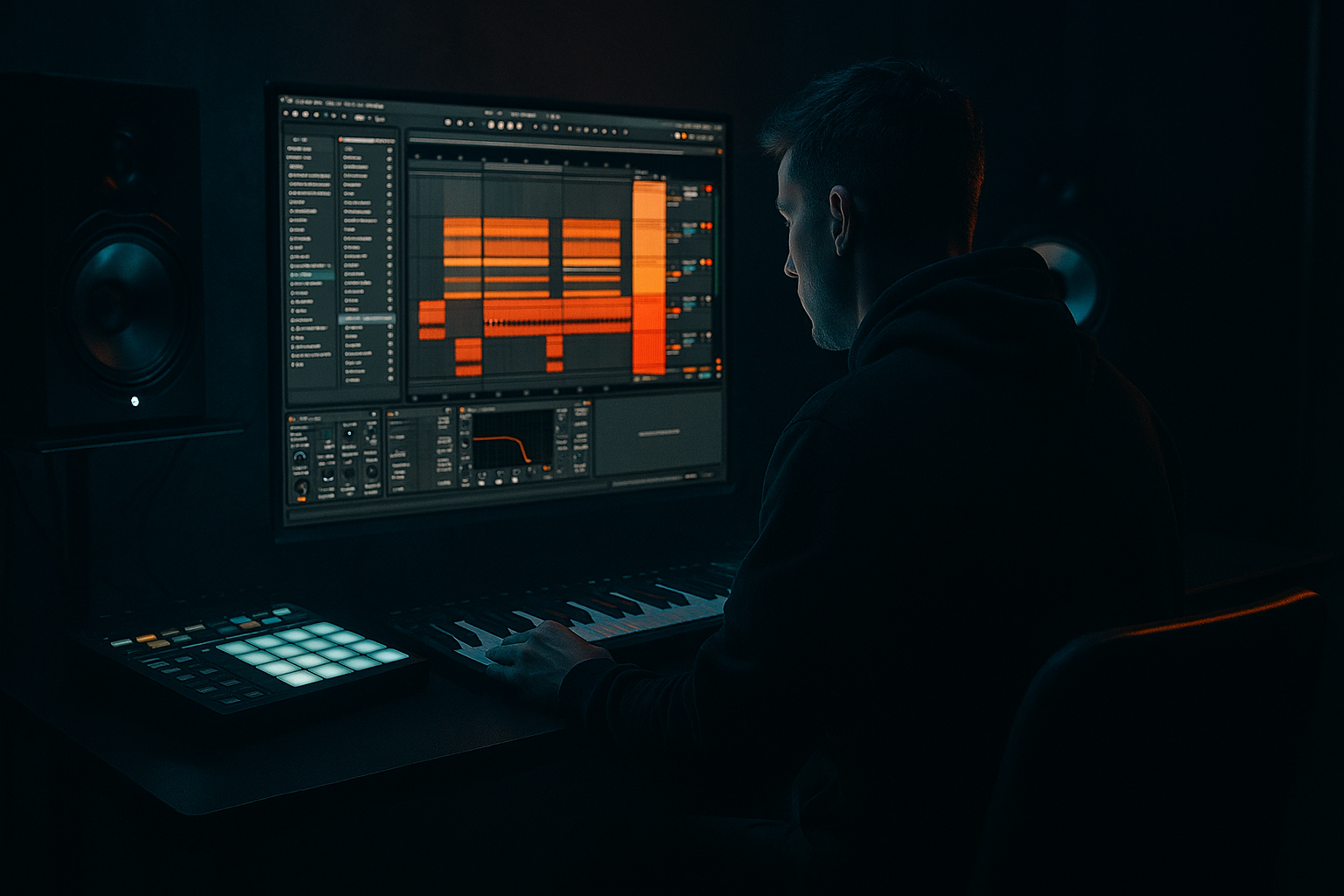
Main tutorial
```markdown
Subweight Bass Wobble Arrange Masterclass (Stock Devices Only)
Ableton Live 12 • Jungle / Oldskool DnB vibes • Intermediate • Composition Focus 🎛️🔊
---
1. Lesson overview
In this lesson you’ll build an oldskool jungle / early DnB-style subweight wobble bass and—more importantly—learn how to arrange it like a tune, not just a loop. We’ll use only stock Ableton Live 12 devices, focusing on:
- A clean, deep sub foundation
- A wobble/mid layer with movement + character
- Arrangement techniques (switch-ups, fills, call/response, energy ramps)
- Mix-ready routing (grouping, EQ, sidechain, mono control)
- A Bass Group with two layers:
- A practical arrangement:
- Stock-device chain examples using:
- Keep notes simple and long-ish (1/2 bar to 1 bar) for weight.
- Jungle flavor often uses minor keys and a root + b7 + b6 kind of movement. Example in F minor:
- Start with 1/2-bar notes, then add occasional 1/4 “push” notes before snare hits.
- SUB is constant weight. MID is where you do the dancing.
- Don’t let the MID carry the sub—split the roles.
- Bar 1: stable root note with wobble movement (LFO at 1/8)
- Bar 2: variation: shorter notes + faster wobble (LFO 1/16 on the last half)
- Keep the SUB MIDI clip simple and consistent across 8–16 bars.
- Duplicate that clip.
- On MID WOBBLE, create variations using:
- LFO Rate:
- Drums: filtered break / light tops
- Bass: SUB very low or muted for first 8 bars, then tease
- MID WOBBLE: HP filtered (Auto Filter freq higher, less LFO amount)
- Add atmosphere via Return effects (dark verb + dub echo)
- Automate Bass Group Utility Gain: fade in slightly
- Automate Auto Filter cutoff rising slowly
- Full breaks + bass
- Keep SUB consistent
- MID WOBBLE does the evolving:
- On bar 32 and 48, do a 1-beat bass mute (silence hits hard).
- Increase Saturator drive slightly (e.g., +1–2 dB)
- Change Auto Filter:
- Optional: add Portamento/Glide in Wavetable for more slur
- Last 2 bars: automate back to LP24 + your original cutoff range
- Drop drums down
- Keep a hint of sub for 8 bars (DJ mix feel)
- Filter the MID up and out
- Clip → Envelopes → choose Auto Filter → Frequency
- Clip → Envelopes → LFO Amount
- Parallel dirt on MID only:
- Pitch drops for impact:
- Sub control with gentle limiting (optional):
- Oldskool weight trick:
- Make it feel “taped”:
- Is the sub steady on a spectrum (low end doesn’t disappear)?
- Do you get a noticeable “section change” at bar 25 without changing the whole bassline?
- Build bass like a pro: SUB = clean mono weight, MID = character + movement.
- Use Auto Filter LFO as your wobble core, then arrange via rate flips, mutes, and cutoff automation.
- Think in 4/8/16-bar phrases like classic jungle: call/response and controlled edits.
- Keep it mix-ready: HP the MID, sidechain the Bass Group, keep lows mono.
The goal: that rolling, weighty bass that locks with breaks and evolves across 32–64 bars. 🥁🖤
---
2. What you will build
By the end, you’ll have:
- SUB: pure sine/triangle weight (mono, consistent)
- WOBBLE/MID: filtered, modulated movement (oldskool wobble vibe)
- 16-bar intro
- 32-bar drop (A section)
- 16-bar switch (B section)
- Outro
- Wavetable (or Operator)
- Auto Filter
- Saturator
- EQ Eight
- Compressor (sidechain)
- Utility
- Glue Compressor (optional)
- Echo / Reverb for atmosphere (send-based)
---
3. Step-by-step walkthrough
Step 0 — Project setup (so it feels like jungle) 🧭
1. Tempo: set to 165–170 BPM (try 168 BPM).
2. Create these tracks:
- Drum Group (your breaks / drums)
- Bass Group (will contain SUB + MID)
- Optional: Atmos / FX / Pads
3. Make two return tracks:
- Return A: Short Verb (Reverb: short, dark)
- Return B: Dub Echo (Echo: dotted 1/8, filtered)
> Arrangement tip: oldskool DnB relies on space + contrast. Your bass should breathe around the drums.
---
Step 1 — Build the SUB layer (the “don’t mess this up” channel) 🧱
Create MIDI Track → rename `SUB` → put inside `Bass Group`.
Device chain (SUB):
1. Operator (simple + stable)
- Algorithm: A only
- Osc A: Sine
- Level: leave headroom (don’t max it)
- Voices: 1 (mono by design)
- Glide: Off for now (we’ll add later if desired)
2. EQ Eight
- HP filter at 20–25 Hz (24 dB/oct) to remove rumble
- Optional tiny dip around 200–300 Hz if it gets boxy
3. Utility
- Bass Mono: 120 Hz (or just enable Mono)
- Gain: adjust so sub is strong but not clipping
MIDI writing (SUB):
- F → Eb → Db → F (with rhythmic variation)
Rhythm guideline:
---
Step 2 — Build the WOBBLE/MID layer (movement + character) 🐍
Create MIDI Track → rename `MID WOBBLE` → put inside `Bass Group`.
Device chain (MID WOBBLE):
1. Wavetable
- Osc 1: Basic Shapes
- Position: toward saw/triangle blend (not full saw yet)
- Osc 2: OFF (for clarity) or add very quietly if needed
- Unison: 2 (keep it subtle; too wide = messy)
- Voices: 1 (mono line)
2. Auto Filter (the wobble engine)
- Filter type: LP24
- Frequency: start around 200–500 Hz
- Resonance: 15–25% (enough to speak, not whistle)
- Drive: 2–6 dB (adds bite)
- LFO ON
- Wave: Sine (classic wobble), try Triangle for steadier motion
- Rate: start at 1/8, then automate to 1/4 and 1/16
- Amount: adjust so it “talks” but doesn’t vanish
3. Saturator
- Mode: Analog Clip
- Drive: 2–6 dB
- Soft Clip: ON
- This helps the mid translate on smaller speakers
4. EQ Eight
- HP at 90–120 Hz (make room for SUB)
- Gentle boost around 700 Hz–1.5 kHz if you want more “wah”
- Optional notch if resonance gets harsh
5. Utility
- Mono: usually ON (oldskool wobble is often centered)
- If you want width, do it above ~200 Hz only (keep lows mono)
Key concept:
---
Step 3 — Glue the bass together (group processing + sidechain) 🔗
On the Bass Group, add:
1. EQ Eight (cleanup)
- Tiny dip around 250–400 Hz if muddy
- Optional gentle shelf down above 8–10 kHz (keep it dark/oldskool)
2. Compressor (sidechain from kick/snare or kick)
- Enable Sidechain
- Audio From: your Kick (or full Drum Group)
- Ratio: 3:1
- Attack: 5–15 ms (lets initial bass transient through a bit)
- Release: 80–140 ms (sync to groove)
- Aim for 2–5 dB of gain reduction on heavy hits
> Jungle movement often comes from that kick + bass conversation. Sidechain helps the bass “bounce” without losing weight.
---
Step 4 — Write the bass phrase like jungle (call/response + edits) ✍️
Here’s a practical 2-bar phrase concept:
How to do it cleanly in Ableton:
- Note length changes (staccato on fills)
- Octave jumps (sparingly: +12 for a quick bite)
- Filter LFO Rate automation for switch-ups
Automate this (MID WOBBLE Auto Filter):
- Bars 1–8: 1/8
- Bars 9–16: occasional hits of 1/16
- Before drop: ramp to 1/4 briefly, then snap back (nice tease)
---
Step 5 — Arrange it into a proper oldskool DnB structure 🧱🥁
Let’s build a 64-bar core arrangement. Use Locator markers in Arrangement View.
#### Bars 1–16: Intro (DJ-friendly)
Practical moves:
#### Bars 17–48: Drop A (32 bars)
- 17–32: steady wobble (1/8)
- 33–48: introduce switch-ups every 4 bars:
- One-bar stutter (short notes)
- LFO rate flip to 1/16 at phrase ends
- Quick cutoff dips for “suck” effect
Classic jungle trick:
#### Bars 49–64: Switch / B section (16 bars)
Keep the same SUB notes, but change the MID identity:
- LP24 → BP12 (band-pass for a “telephone wah”)
- Reduce low end even more (HP ~150 Hz)
Then set up a clean route back:
#### Outro
---
Step 6 — Add “movement without chaos” using Clip Envelopes 🎚️
Instead of automating everything on the timeline, use Clip Envelopes inside the MID WOBBLE MIDI clip:
- Draw small dips on snare gaps (creates pump without compressor)
- More wobble at phrase ends, less during busy drum moments
This keeps edits repeatable and makes arranging fast.
---
4. Common mistakes 🚫
1. MID layer has too much sub
- Fix: HP the MID at 90–120 Hz, keep SUB responsible for low end.
2. Wobble is cool but arrangement is static
- Fix: plan 4-bar and 8-bar change points (mutes, rate flips, fills).
3. Too much resonance = whistling
- Fix: lower Auto Filter resonance; notch harsh peaks with EQ Eight.
4. Bass fights the kick
- Fix: sidechain on Bass Group; also shorten some SUB notes slightly.
5. Over-widening bass
- Fix: keep bass mostly mono; widen only higher textures if needed.
---
5. Pro tips for darker/heavier DnB (still oldskool-rooted) 🖤
Duplicate MID WOBBLE → call it `MID DIRTY`
Add Saturator (Drive 8–12 dB) + Auto Filter (BP) + EQ Eight HP @ 200 Hz
Blend quietly under the clean MID for menace.
On the last beat before a drop, automate Transpose -2 to -5 semitones (short moment).
Put Limiter on SUB only, set Ceiling to -1 dB, just kissing peaks (don’t squash).
Keep the SUB notes longer than you think, but add tiny gaps (10–40 ms) before big kick hits so drums smack through.
Use Saturator lightly on Bass Group (1–2 dB Drive) + soft clip.
---
6. Mini practice exercise (20–30 minutes) 🧪
1. Create the SUB + MID WOBBLE layers exactly as above.
2. Write an 8-bar bassline in F minor:
- Bars 1–4: simple root movement
- Bars 5–8: add 2 staccato notes and 1 octave jump
3. Arrange 32 bars:
- 1–8: intro tease (filter high, low LFO amount)
- 9–24: drop (steady wobble)
- 25–32: switch (BP filter for 4 bars + one-bar mute)
Deliverable: export a quick bounce and check:
---
7. Recap ✅
If you want, tell me your key + tempo + break style (Amen-heavy, tight 2-step, ragga chops), and I’ll suggest a specific 8-bar bass MIDI pattern and automation map that fits it. 🎚️🥁
```

