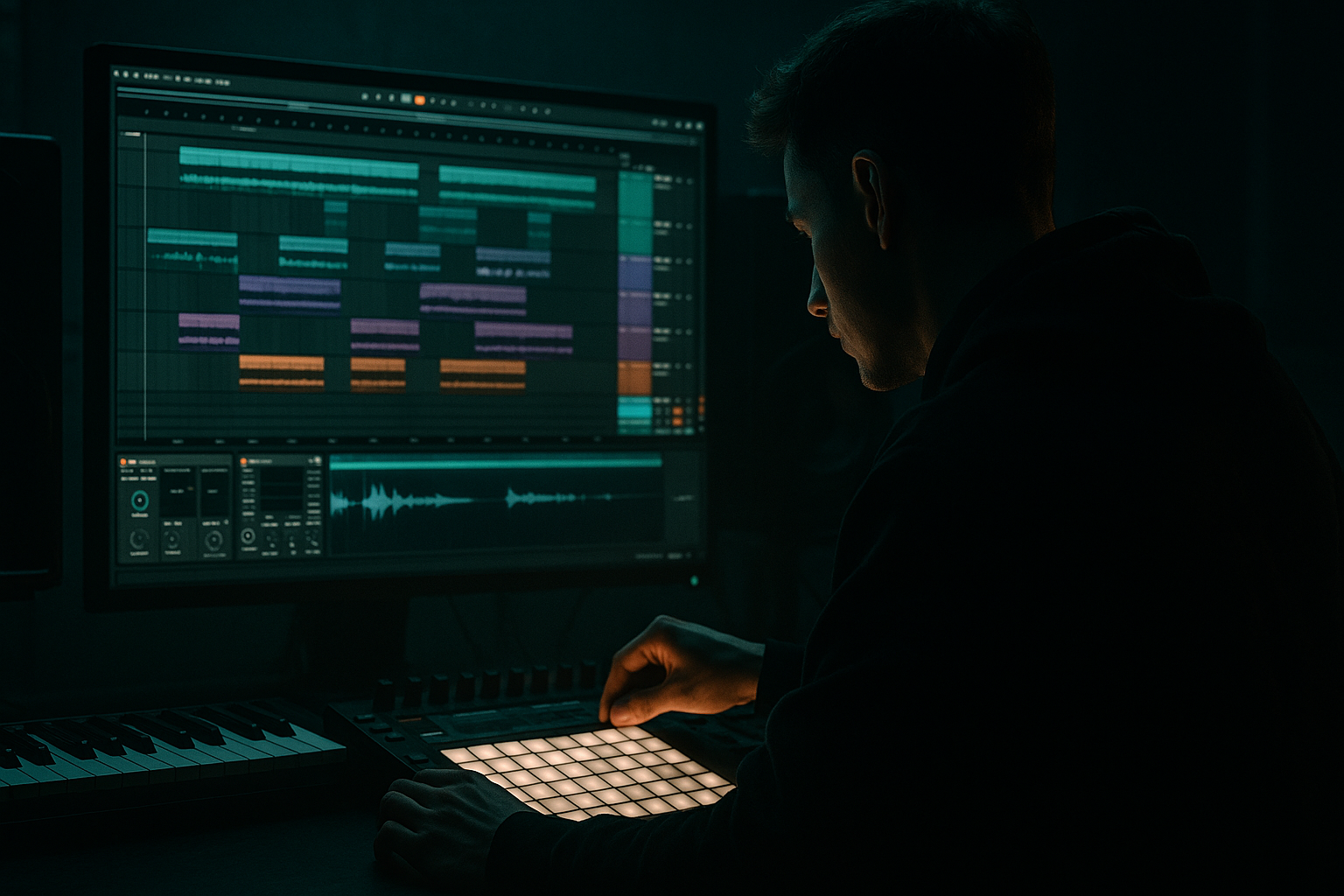
Main tutorial
Lesson Overview
This lesson is about turning a clean bassline into a subweight distortion edit that feels controlled, dangerous, and very DnB. In practice, that means taking a bass phrase that already carries low-end authority, then using automation, resampling, saturation, filtering, and arrangement-focused edits to make the turn or transition into a distorted section hit like a proper drop switch.
In Drum & Bass, this kind of edit usually lives at a phrase boundary: the end of an 8-bar or 16-bar section, the last 1–2 bars before a drop, or a mid-drop switch-up where the bassline “turns” into something rougher, wider, and more aggressive. You’re not just adding distortion for color — you’re designing a moment of impact. That matters because DnB arrangement is often built on tension, release, and contrast. A subweight edit gives you that contrast while keeping the low-end narrative intact.
This technique is especially useful in:
- rollers, where you want the bassline to mutate without losing groove
- dark halftime or neuro-leaning sections, where the bass needs to feel more mechanical and hostile
- jungle-inspired edits, where a bass turn can answer the break or fill
- DJ-friendly arrangements, where you want the drop to evolve in a way that translates on a club system
- a tight, weighty bass phrase with clear fundamental note movement
- a filtered build into a distorted turn
- a moment where the bass becomes more unstable, gritty, and wide
- a drop-ready or switch-up-ready edit that still preserves kick and snare impact
- the last two bars before a second drop
- a response phrase after a vocal or atmos transition
- a bass “answer” after an 8-bar drum break
- a transition from clean roller bass into a nastier neuro-style section
- clean sub weight
- to controlled saturation
- to harder distortion
- to a final turn or stuttered edit
- Distorting the sub directly
- Over-automating every parameter at once
- Making the turn too wide too early
- Using harsh distortion without EQ cleanup
- No rhythmic reason for the turn
- Letting the bass fight the kick
- Relying on one static bass sound for the whole section
- Use short filter automation ramps in the final beat before the drop. A fast rise into a hard cutoff or snap-back feels brutal in dark DnB.
- Layer a very quiet noise or reese harmonic bed behind the distorted turn to make it feel larger without adding too much low end.
- If the bass sounds too polite, try Roar or Saturator in parallel with a high-pass around 100 Hz so the aggression lives above the sub.
- Put a Utility after the distortion chain and automate Width from 0% to 50–80% only on the upper layer for a controlled opening effect.
- For neuro-leaning movement, automate wavetable position, filter frequency, and drive together in a coordinated phrase.
- Use ghost notes in the drums or a tiny break fill right before the bass turn so the edit feels locked to the rhythm.
- Try a bar-7 pre-drop false resolve: keep the bass restrained, then let the final bar of the phrase collapse into distortion. That contrast hits hard.
- If the bass gets muddy, carve a small pocket around 200–350 Hz on the bass bus rather than over-thinning the sound.
- For a more underground roller vibe, keep the distortion subtle and let movement + sub pressure do the heavy lifting.
- For a meaner edge, print two versions: one clean and one aggressive, then alternate them across 8-bar phrases for call-and-response energy.
- Build the bass in layers: clean mono sub + separate mid/distortion path.
- Use automation to turn the bass from controlled weight into gritty movement.
- Resample the best transition so you can edit the moment precisely.
- Keep the sub stable while the upper harmonics do the heavy lifting.
- Make the edit serve the arrangement, drums, and phrase energy.
- In DnB, the best bass turns are not just loud — they’re rhythmic, intentional, and mix-aware.
We’ll build the edit in Ableton Live 12 using stock devices only, with a workflow that keeps the sub stable, the distortion deliberate, and the automation musical. The goal is not “more distortion.” The goal is controlled low-end transformation 🔥
What You Will Build
By the end, you’ll have a bassline section that starts with a solid mono sub and a clean reese or midbass layer, then progressively turns into a heavier distorted variation using automation and resampling.
The result will sound like:
Musically, this can work as:
You’ll end up with a clip that can move from:
without losing the groove.
Step-by-Step Walkthrough
1. Set up a bass architecture that can survive distortion
Start with a dedicated bass group:
- Track 1: Sub
- Track 2: Mid bass / reese
- Track 3: Distortion return or parallel processor if you want it
Keep the sub as a separate mono layer. A simple way in Ableton Live:
- Use Operator or Wavetable for the sub.
- Set oscillator to a sine or near-sine shape.
- Keep it mono with a Utility on the track set to Width = 0%.
- High-pass nothing on the sub unless absolutely necessary; instead, clean up with note choice and envelope control.
For the mid layer, choose:
- a detuned saw-based reese in Wavetable
- or a harmonically rich source from Operator with multiple oscillators slightly detuned
Starting settings:
- Mid-bass low-pass around 180–350 Hz depending on tone
- Resonance moderate, not exaggerated
- Attack short, decay controlled, sustain stable enough for rollers
The reason for this separation is simple: once distortion enters the picture, the sub can smear fast. Keeping a dedicated clean sub lets you distort the upper bass without losing the floor.
2. Program a bassline with phrasing that invites a turn
Build an 8-bar MIDI phrase with strong rhythmic identity. For advanced DnB, this should not just be root notes on the grid. Add:
- syncopated note lengths
- small rests
- call-and-response between low and mid registers
- a note or two that leads into a turnaround
Good DnB examples:
- Bar 1–2: repeated root note groove
- Bar 3–4: answer phrase with a small pitch drop
- Bar 5–6: variation with one held note
- Bar 7–8: tension note that sets up the distorted turn
Use velocity automation or varied note lengths to create movement. If your bass source responds well to velocity, map it to filter or wavetable position inside the instrument. In Ableton, you can also use MIDI CC or envelope modulation in Wavetable to make a phrase breathe.
Why this works in DnB: the bassline needs to feel like part of the drum conversation. A turn distort edit lands harder when the phrase already has rhythmic logic and space around the snare.
3. Build the initial clean-to-grit transition with automation lanes
On the mid-bass track, add a chain of stock devices:
- Auto Filter
- Saturator
- Drum Buss or Roar if you want a heavier tonal turn
- Utility
Start with gentle settings:
- Auto Filter low-pass cutoff around 250–800 Hz depending on your source
- Saturator Drive around 2–5 dB
- Soft Clip on in Saturator if the tone benefits
- Drum Buss Drive at 5–15% for density, not destruction
Now automate the turn:
- Over 1 or 2 bars, slowly open the filter or shift from low-pass to a more aggressive band-pass feel
- Increase Saturator Drive over the same span
- If using Drum Buss, automate Drive and possibly Boom very carefully
- Use Utility to narrow the stereo image before the turn, then widen only the distorted upper layer after the turn
Suggested automation shape:
- Bar 1 of transition: clean, stable, slightly filtered
- Bar 2: cutoff rises, drive increases, tone becomes harmonically richer
- Final half-bar: rapid movement, maybe a quick mute or filter snap to sell the edit
Keep the automation curves musical, not linear if possible. A slow start and steeper end often feels more natural in DnB.
4. Resample the bass turn into a new audio clip
This is where the edit becomes real. Set up resampling or create an audio track with input from the bass group, then print the transition.
In Ableton Live:
- Create an audio track
- Set input to Resampling or route from the bass bus
- Record the transition section
Print at least:
- a clean pass
- a saturated pass
- a more aggressive pass with the automation pushed slightly further
Once recorded, slice the best take into a new audio clip and keep the strongest moment around the turn. This is classic DnB workflow: commit to audio, then shape the result.
After resampling, use:
- Warp only if needed; keep transients natural
- Simple Delay for micro width if the source can take it
- EQ Eight to clean sub-rumble or harsh spikes
- Auto Filter for a final motion pass
Advanced tip: if the resampled turn contains a great transient or growl, duplicate the clip and process the duplicate differently for call-and-response layering.
5. Shape the distorted version with parallel processing
The “turn distort” should sound like the bass evolved, not like it simply got clipped. A parallel chain helps preserve weight.
Create a return track or Audio Effect Rack with:
- Saturator
- Overdrive
- Roar if you want a modern aggressive edge
- EQ Eight
- Utility
Parallel settings to try:
- Saturator Drive: 6–10 dB
- Overdrive Frequency: focus around 200–600 Hz for growl emphasis
- EQ Eight high-pass the parallel distortion around 80–120 Hz so the sub remains clean
- Utility Width: keep the parallel distorted layer moderately wide or mono depending on the arrangement
Blend this under the main bass until the phrase gains body and menace without losing fundamental clarity.
Then automate the send or dry/wet:
- low send in the clean section
- heavier send as the turn arrives
- drop it slightly after the impact so the bass doesn’t stay overcooked
This is the core of the technique: the listener hears the bass becoming more dangerous while the low end still feels anchored.
6. Add a turn effect that connects to the drums
DnB bass edits hit harder when they interact with the drum pattern. Add a short turn effect in the last bar or half-bar before the switch.
Good stock options:
- Beat Repeat for a stuttered bass burst
- Gate for rhythmic chokes
- Echo for a short feedback smear
- Redux for digital roughness, used sparingly
Practical ideas:
- Use Beat Repeat with Interval set to 1 Bar or 1/2 Bar, Chance low, Grid around 1/16 or 1/32
- Use Gate keyed or driven by the bass clip to create a sharp cut before the drop
- Use Echo with short Delay Time and low feedback to create a brief tail on the last note
- Use Redux at low bit reduction values only if you want a sharper, more broken texture
Pair this with a snare fill, break chop, or ghost-note flourish. A strong arrangement move is:
- last 2 beats: bass filter opens
- last 1 beat: stutter or gate cut
- downbeat: distorted bass returns with full drums
That combo feels huge in a club because the ear registers both the bass mutation and the drum punctuation.
7. Refine the sub weight so the distortion doesn’t steal the floor
Now check the low end in detail. This is where advanced control matters.
On the sub track:
- keep it mono with Utility
- avoid distortion unless extremely subtle
- use EQ Eight to cut unnecessary low-mid buildup only if required
On the mid/distorted layer:
- use EQ Eight to reduce clashing frequencies around 150–300 Hz if the bass gets boxy
- tame harshness in the 2–5 kHz zone if the distortion becomes tiring
- keep the distorted layer from fighting the kick
If needed, use Compressor or Glue Compressor on the bass bus with gentle settings:
- slow-ish attack
- medium release
- only a few dB of gain reduction
For DnB, the bass should feel huge but not swallow the kick/snare. The best turn edits leave the sub anchored while the upper harmonics do the talking.
8. Automate arrangement movement, not just tone
The difference between a sound design trick and a proper DnB edit is arrangement intent. Place the turn in a section where it changes the emotional energy.
Common uses:
- end of the first 16 bars before the full drop
- bar 8 or bar 16 of the drop for a switch-up
- after a breakdown with break edits and atmospheres
Try this arrangement shape:
- 8 bars: relatively clean bassline and drums
- 2 bars: increasing filter and drive
- 1 bar: break chop or snare fill, bass stutter, impact
- next 8 bars: distorted bass turn continues with a new variation
Add automation to other elements too:
- slightly widen noise or ambience before the turn
- automate reverb send on a snare fill, then cut it hard on the drop
- filter out hats or tops briefly to let the bass turn dominate
This makes the edit feel like part of the record, not just a sound effect.
9. Finalize with auditioning, gain staging, and bounce-friendly cleanup
Before calling it done, audition the bass turn in the full drop with drums, break layers, and any atmospheres.
Check:
- kick and sub are not masking each other
- snare still hits with authority
- distortion is exciting but not fizzy all the time
- the phrase still grooves when looped
Use a reference section at the same loudness if possible. Lower your monitoring a bit and check if the bass turn still reads. If the effect only works loud, it’s probably overdone.
Export or freeze/flatten the best version so you can continue arranging quickly. Advanced workflow is about decision speed: once the turn is working, commit and move on.
Common Mistakes
Fix: keep the sub clean and mono; distort the mids separately.
Fix: choose 2–3 meaningful moves, like filter cutoff, drive, and stereo width.
Fix: keep the pre-turn narrow and let width open only when the distortion lands.
Fix: place EQ Eight after distortion and remove ugly top-end or low-mid bloom.
Fix: align the edit with the snare fill, break chop, or phrase boundary.
Fix: check low-end separation, shorten bass notes if needed, and keep the sub consistent.
Fix: resample the best moments and create a turn variation with different energy.
Pro Tips for Darker / Heavier DnB
Mini Practice Exercise
Set a 15-minute timer and build a two-bar subweight turn edit.
1. Create a clean sub in Operator and a mid-bass layer in Wavetable.
2. Program a simple 2-bar DnB phrase with one repeated root note and one turnaround note.
3. Add Auto Filter, Saturator, and Utility on the mid-bass.
4. Automate the filter cutoff and drive so the bass becomes rougher in bar 2.
5. Resample the result into audio.
6. Slice the best 1-bar or half-bar moment and add one of these:
- Beat Repeat stutter
- Gate choke
- short Echo tail
7. Place it against kick, snare, and hats and listen for groove.
8. Make one mix fix only: either tighten the low end or tame harshness.
Goal: make the turn feel like it belongs in a real drop, not like a random effect. Keep it loopable and DJ-friendly.

