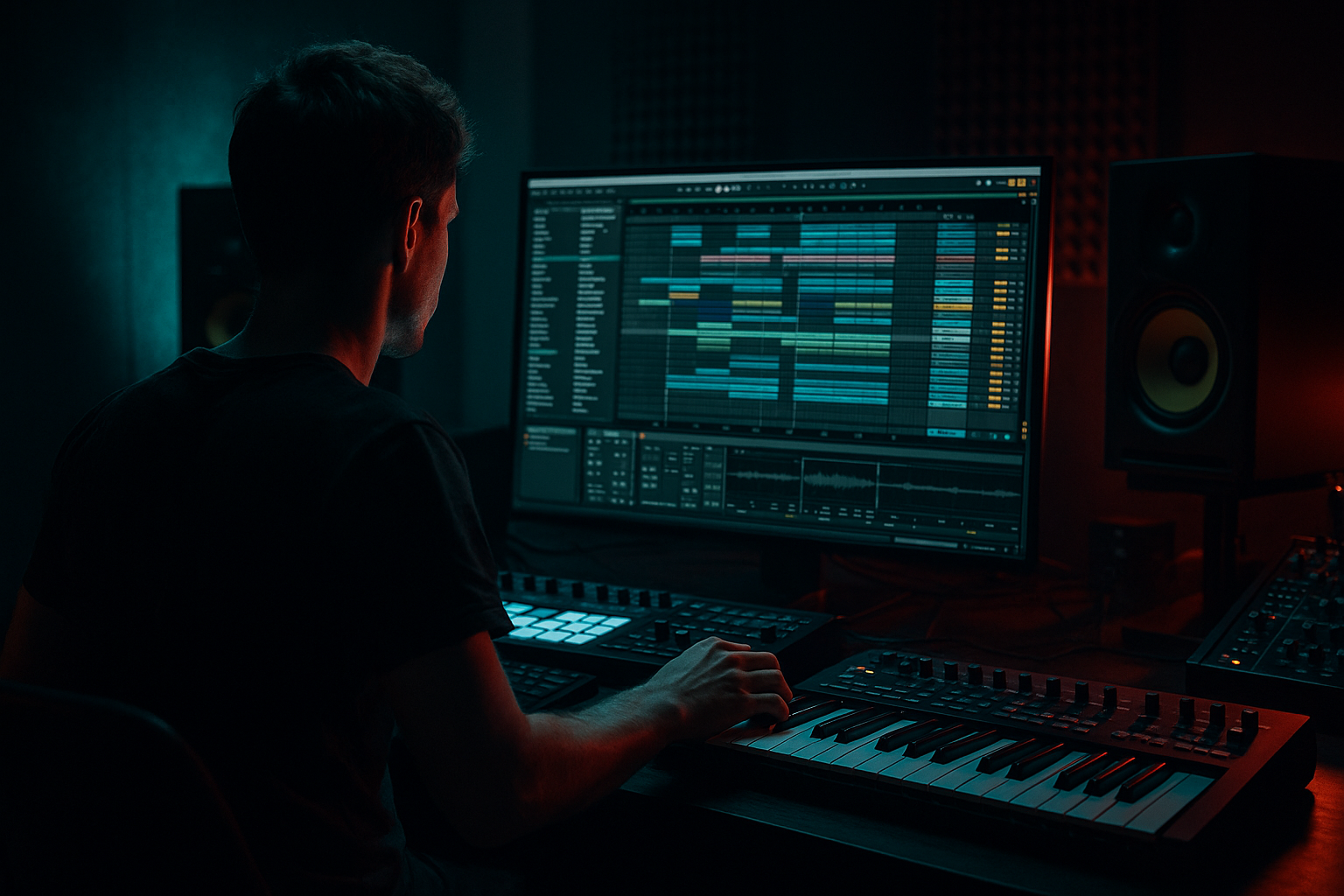
Main tutorial
Subweight Edit Blend Approach Using Resampling in Ableton Live 12
For jungle / oldskool DnB atmospheres and heavyweight bass motion 🎛️🧨
---
1. Lesson overview
In this lesson, you’ll build a subweight edit blend: a layered atmospheric-bass technique where a clean, controlled sub foundation is blended with a resampled edit layer that adds movement, grit, and character. This is especially effective for jungle, oldskool DnB, and rolling bass music, where the low end needs to feel deep but alive.
The key idea is:
- keep the sub stable and mono
- create a mid/upper-bass edit layer from resampling
- process the edit so it has texture, pitch motion, and rhythmic identity
- blend the layers so the result feels heavy without losing clarity
- resample internally
- slice and re-edit audio quickly
- use stock devices like Simpler, Drift, EQ Eight, Saturator, Auto Filter, Compressor, Roar, Echo, Utility, and Corpus to shape the sound
- a sub bass lane with a clean sine/triangle foundation
- a resampled bass edit lane with texture and movement
- an atmospheric layer that helps the bass feel wider and moodier
- a simple 8-bar arrangement that cycles through bass states for variation
- a reusable device rack / workflow for future DnB ideas
- deep sub holding the floor
- a slightly crunchy, filtered, chopped upper-bass phrase
- space around the sound so the drums can hit hard
- a vibe that feels at home under amen breaks, padded atmospheres, and ghostly samples
- Keep the sub mono
- Avoid heavy stereo widening
- Don’t over-compress it
- Don’t let the sub fight the kick drum
- Oscillator wave: saw or square mix
- Filter: low-pass around 150–500 Hz
- Add a touch of drive
- Short amp envelope for a stabby feel
- Load a short vintage bass stab, reese fragment, or even a filtered break hit
- Set to Classic or One-Shot
- Adjust filter and glide
- Add subtle pitch movement
- create a dark mid-bass with harmonics
- keep it rhythmic and not too wide
- offbeat hits
- call-and-response phrases
- note repeats
- one or two pitch changes for tension
- note transitions
- filter sweeps
- brief distortion moments
- rhythmic gaps
- chop it
- reverse parts
- pitch it
- warp it
- filter it
- re-edit it into phrases that feel more organic than MIDI
- reverse them
- nudge them earlier/later for swing
- shorten them into stabs
- layer with silence between hits
- create a little “answer” phrase after the main bass hit
- Warp markers for timing control
- Fade handles to avoid clicks
- Clip Gain to manage dynamics before processing
- Echo: short, filtered feedback for dubby jungle tails
- Corpus: useful for adding resonance or physical “body”
- Redux: very light bit reduction for grit
- Delay with very short times for movement
- a stable sub
- a chopped/resampled edit layer above it
- Sub track = fundamental energy
- Edit layer = texture and bass identity
- Sub: roughly 30–90 Hz
- Edit layer: roughly 90 Hz and above, depending on the sound
- Use Wavetable, Drift, or a sampled ambience in Simpler
- Long attack, long release
- Low-pass heavily
- Add Reverb and Auto Filter
- Use a dusty sample of room tone, rain, tape hiss, or crushed ambience
- Filter out the lows
- Keep it very low in the mix
- Chop a tiny break fragment and process it into a haze
- Put it through Reverb, Echo, and a low-pass filter
- makes it feel darker
- adds depth behind the edit
- helps the track feel like a jungle tune rather than a dry bass exercise
- Sub only or very minimal edit layer
- Atmosphere enters softly
- Drum break starts
- Bring in the resampled edit layer
- Open filter slightly
- Add a small echo tail on the last note
- Drop out one hit from the edit layer
- Add a reverse slice or pitch-shifted variation
- Increase atmosphere intensity slightly
- Add a more aggressive version of the edit
- Automate filter open
- End with a transition hit or a muted pickup into the next loop
- filter cutoff
- drive amount
- reverb send
- clip gain on edits
- pitch for selected slices
- repeat one slice twice before moving on
- reverse the last chop of a phrase
- stretch one tail for tension
- mute the first beat of the phrase to create drag
- insert a tiny pickup note before the downbeat
- Try pitching a slice down 1–3 semitones
- Use brief pitch dips on transition notes
- Keep it subtle for oldskool flavor
- high-pass more aggressively
- saturate it harder
- keep it quieter
- decay: short
- pre-delay: small
- filter the reverb heavily
- close the filter for weight
- open it for release
- add a quick resonance bump before a drop
- amen-style breaks
- chopped percussion
- vinyl crackle
- ghost snare layers
- it has deep sub pressure
- it has character in the mids
- it sits inside a moody jungle space
- a clean, stable sub
- a resampled, chopped edit layer
- a dark atmospheric bed
- careful frequency separation and arrangement movement
- Use resampling to turn MIDI ideas into editable audio phrases
- Keep the sub mono and clean
- Let the edit layer provide texture, motion, and attitude
- Use Ableton stock devices to shape, filter, saturate, and automate
- Build the bass around the break and atmosphere, not in isolation
In Ableton Live 12, this workflow is fast because you can:
This is not about making a huge modern neuro bass. This is about getting that dusty, weighty, slightly broken jungle bass energy that sits under breaks and atmospheres beautifully.
---
2. What you will build
By the end, you’ll have:
Sound goal
Think:
---
3. Step-by-step walkthrough
Step 1: Set up the project for DnB timing
1. Open Ableton Live 12.
2. Set tempo to 165–174 BPM.
- For oldskool jungle vibes, 168–172 BPM is a great sweet spot.
3. Create three tracks:
- MIDI track 1: Sub
- Audio track 2: Resample Edit
- Audio track 3: Atmosphere / texture
4. Load a simple break or drum loop on a separate track if you want immediate context.
Step 2: Create the sub foundation
On the Sub MIDI track:
1. Load Drift or Operator.
- Operator is excellent for a pure sine sub.
- Drift is great if you want a slightly softer analog feel.
2. Set oscillator to sine if possible.
- In Operator:
- Oscillator A: sine
- Volume only on A
- Turn off other oscillators
3. Write a simple bassline in 1-bar or 2-bar phrases.
- Keep notes mostly in the root and fifth movement
- Use short note lengths for groove
- Leave gaps for drums
4. Add Utility after the synth:
- Turn Bass Mono on if needed
- Width: 0%
- Gain: adjust to taste
5. Add EQ Eight:
- low cut nothing drastic
- if necessary, remove a little mud around 120–250 Hz
- avoid boosting the sub too much; let it breathe
6. Add a very light Saturator:
- Drive: 1–3 dB
- Soft Clip: On
- This helps the sub translate on smaller systems without sounding distorted
#### Good sub habits
---
Step 3: Design the bass edit source
Now create the sound that will be resampled and edited.
On a new MIDI track, make a source bass using one of these approaches:
#### Option A: Simple analog-ish bass
Use Drift:
#### Option B: Sample-based bass
Use Simpler:
#### Option C: Harmonic bass synth
Use Wavetable or Operator:
What to play
Make a 1- or 2-bar riff with:
Oldskool DnB often works better when the bass line feels musical but restrained.
---
Step 4: Resample the bass source
This is the core of the lesson 🔥
1. Create an Audio track called Resample Edit.
2. Set its input to Resampling or route from your bass source track.
3. Arm the track.
4. Record 4–8 bars of the bass source while the drums and atmospheres play.
You want enough material to choose interesting moments:
Why resample?
Because once audio is recorded, you can:
This is especially useful for jungle-style atmospheres where the bass should feel like it’s evolving in the mix.
---
Step 5: Slice the resampled audio into useful edits
Once recorded:
1. Duplicate the audio clip or consolidate it if useful.
2. Right-click the clip and choose:
- Slice to New MIDI Track
or
- manually cut the clip with the Split tool
If you want more control, manual slicing is often better for this style.
Useful edit ideas
Take small sections and:
In Ableton Live 12
You can use:
A good jungle edit often sounds like it was assembled from fragments, not performed perfectly. That’s part of the charm.
---
Step 6: Process the resampled edit layer
Now make the edit layer more interesting than the original source.
Insert this basic chain on the Resample Edit audio track:
1. EQ Eight
- High-pass around 80–150 Hz
- Remove unnecessary sub so it doesn’t clash with the main sub
- If needed, notch harshness around 2–5 kHz
2. Auto Filter
- Use low-pass or band-pass
- Add a little resonance
- Automate cutoff for movement
3. Saturator or Roar
- Add harmonic weight
- Keep it controlled; aim for texture, not mush
- Try subtle drive first
4. Compressor or Glue Compressor
- Light compression to glue the chopped material
- Don’t flatten the rhythm completely
5. Utility
- Narrow width if the low-mid gets too wide
- Keep the bass energy focused
Optional creative additions
---
Step 7: Blend the sub and edit layers properly
This is where the “subweight” idea really comes alive.
You should now have:
Blend strategy
Balance tips
1. Start with the sub alone.
2. Bring up the edit layer slowly until it adds weight without masking the sub.
3. Compare in mono often.
4. Use Utility on the edit layer to keep the low end focused.
5. Let the edit layer occupy mostly 80 Hz and above, while the sub handles the deepest part.
Good frequency split
Use EQ Eight to carve this separation intentionally.
---
Step 8: Add atmospheric glue
Because this lesson is in the Atmospheres category, we need to make the bass sit inside a space, not just exist in isolation.
Create an Atmosphere audio or MIDI track and add:
#### Option A: Pad or drone
#### Option B: Vinyl / field texture
#### Option C: Break atmosphere
Purpose
The atmosphere gives the bass context:
---
Step 9: Build an 8-bar arrangement
A strong DnB bass idea needs arrangement movement, even if the main loop is simple.
Example 8-bar structure
Bars 1–2
Bars 3–4
Bars 5–6
Bars 7–8
Arrangement trick
Use automation clips on:
This keeps the bass evolving without needing a new sound every bar.
---
Step 10: Make the edit feel “edited,” not random
This style works when the resampled layer sounds intentional.
Try these edit moves:
A great jungle bass edit often feels like it is answering the drums.
---
4. Common mistakes
1. Too much low end in the edit layer
If the resampled layer has too much sub, it will fight the actual sub bass.
Fix: high-pass the edit layer and use Utility / EQ Eight to keep it out of the way.
2. Over-processing before the blend
Too much distortion, compression, and widening can turn the bass to mud.
Fix: build from clean to dirty gradually. Blend first, then enhance.
3. No mono check
Oldskool DnB and jungle need a strong center image.
Fix: check the project in mono regularly with Utility or by reducing width.
4. Flat editing
If every chop is the same length and volume, the bass feels mechanical.
Fix: vary slice lengths, note velocities, and gap placement.
5. Bad kick/sub relationship
A strong DnB bassline still needs space for the kick.
Fix: carve the kick and sub so they don’t hit at the same exact moment every time.
6. Forgetting atmospheres
A bassline alone may sound heavy, but it won’t sound like a full jungle record.
Fix: add dark room tones, filtered breaks, or pad drones.
---
5. Pro tips for darker/heavier DnB
Use subtle pitch movement
A tiny pitch envelope or manual slice pitch changes can make the edit feel alive.
Layer with a ghost harmonic
Duplicate the edit layer and process it differently:
This creates “presence” without crowding the sub.
Try resampling after effects
Once you like the processed edit, resample it again.
This can create a more cohesive, “finished” sound.
Use short reverb on only the upper layer
Send just the edit layer to a tiny room or dark plate:
This gives depth without washing out the low end.
Automate filtering in phrases
For jungle tension, automate the bass edit like it’s breathing:
Use break context
This bass style sounds much better against:
The bass should feel like it belongs to the break, not separate from it.
---
6. Mini practice exercise
Exercise: Build a 4-bar subweight edit loop
Do this in Ableton Live 12:
1. Set project tempo to 170 BPM.
2. Create a sub bass using Operator with a sine wave.
3. Write a 2-bar bassline with 4–6 notes.
4. Create a second bass sound with Drift or Simpler.
5. Record that sound to audio for 4 bars.
6. Chop the audio into at least 6 slices.
7. Process the slices with:
- EQ Eight
- Auto Filter
- Saturator
8. Blend the edit layer under the sub.
9. Add a dark atmosphere pad or vinyl texture.
10. Loop it and make three variations:
- one with more filter open
- one with a reverse chop
- one with a muted gap before the downbeat
Goal
By the end, you should have a loop that feels like:
---
7. Recap
The subweight edit blend approach is about combining:
Core takeaways
If you approach it this way, you’ll get bass that feels properly rooted in jungle / oldskool DnB culture: deep, dusty, and alive 🥁🌑
If you want, I can also turn this into:
1. a device-by-device Ableton rack recipe, or
2. a specific 8-bar MIDI + resampling example for a jungle bassline.

