Main tutorial
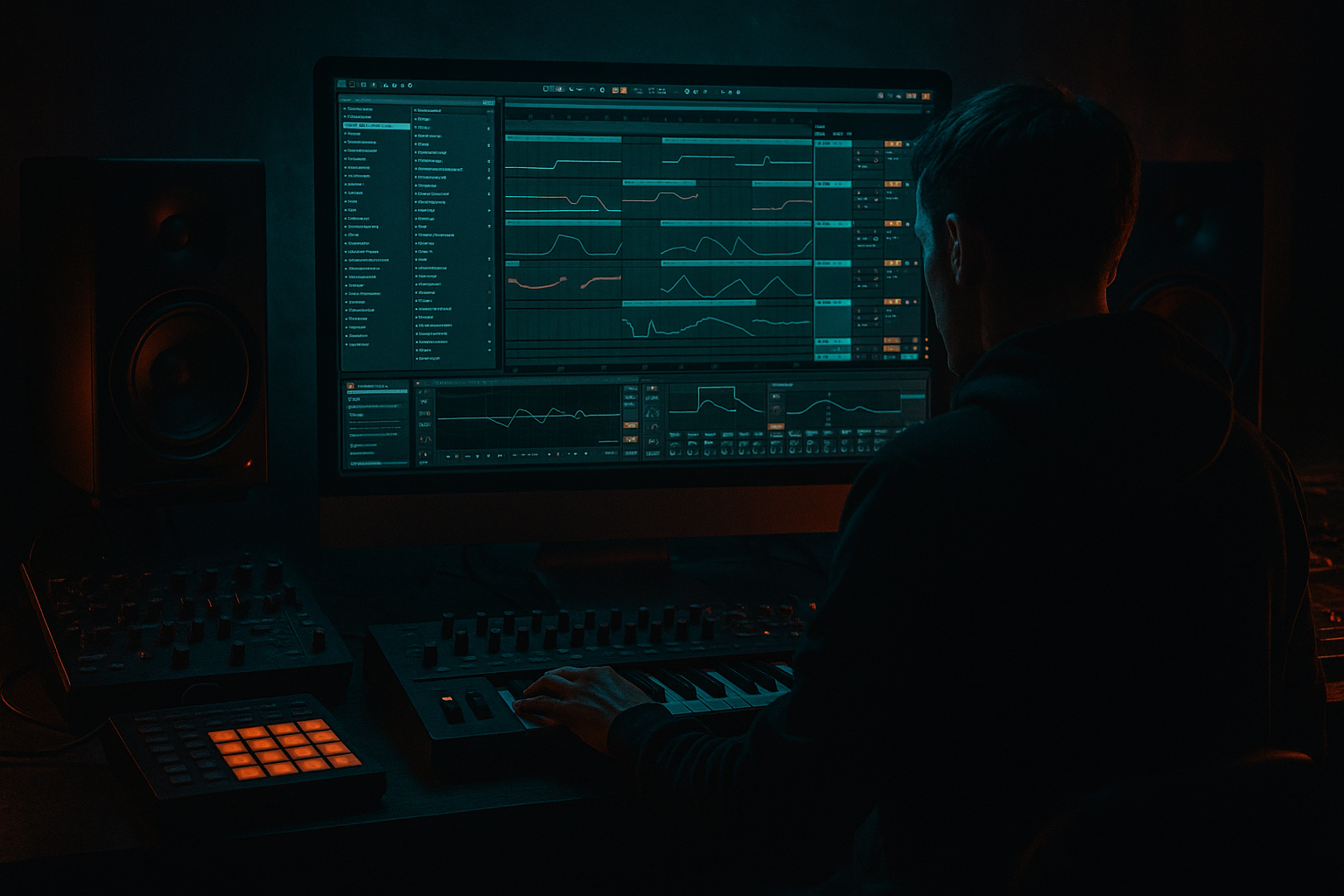
Subweight Edit + Modulate Tutorial for Pirate-Radio Energy in Ableton Live 12
Jungle / Oldskool DnB / Ragga Elements — Advanced
If you want that late-night pirate radio pressure—the kind of sub that makes a room feel like it’s leaning forward—this lesson is about building a subweight edit that moves, breathes, and modulates without losing low-end authority. We’re aiming for that oldskool jungle / ragga DnB vibe: raw, punchy, a little unstable, and very intentional. 🔊
---
1. Lesson overview
A subweight edit is a bass edit that puts extra emphasis on the weight and movement of the sub layer, usually by combining:
- clean mono sub
- tuned pitch movement
- filter / amp modulation
- call-and-response phrasing
- automation-driven energy shifts
- ragga-style chopped vocal or stab accents
- Dark, forward sub movement
- Midrange grit from saturation or resampling
- Short edits that answer the drums
- Tape-like instability and slight modulation
- Unexpected drops in energy before impact
- Ragga vocal chops, horn stabs, or dub-style echoes
- intro tension
- breakdown pressure
- drop variation
- 8-bar and 16-bar arrangement loops
- a modulation rack
- an automation strategy
- a subweight edit pattern that works against a jungle drum loop
- a mix-safe low end that doesn’t collapse in the drop
- kick on the downbeat or as a supporting punch
- snare on 2 and 4
- chopped break layer with swing
- ghost hits and fills
- optional rim or percussion off-beats
- Drum Rack for individual break chops
- Simpler in Slice mode for break manipulation
- Groove Pool to apply swing from classic break feel
- Keep the break fairly busy, but leave space for the sub.
- Let the snare and kick define the “spine” of the bar.
- Leave intentional gaps where the sub can punch through.
- Operator is ideal for a pure sine sub
- Wavetable can work if you want more movement, but keep it simple
- Oscillator A: Sine
- Turn off extra oscillators
- Filter off or fully open
- Amp envelope:
- supports the kick/snare phrasing
- uses short notes for punch
- includes occasional held notes for tension
- stays in a comfortable low register
- root note movement around F, G, A, C or similar dark DnB keys
- avoid too much melodic wandering early on
- think weight first, melody second
- Mono: yes
- Legato: on if you want slide-like continuity
- Glide/portamento: subtle, around `20–60 ms` if using Wavetable or a glide-capable synth
- Keep velocity consistent unless you want expression tied to volume or filter modulation
- Choose a simple waveform with harmonic content:
- Keep oscillators low and focused
- Use unison sparingly; too wide will hurt the low-end
- Detune lightly if needed, but preserve mono compatibility
- Use low-pass or band-pass
- Cutoff automation is key
- Drive can add subtle edge
- Add an LFO in Live 12’s modulation workflow if you want rhythmic movement
- Drive: `2–8 dB` depending on tone
- Soft Clip: on if you need containment
- This helps the bass translate on smaller speakers
- High-pass only if needed on this layer
- Remove mud around `200–400 Hz` if the note gets boxy
- Avoid adding sub here; let the SUB track own the true low end
- Bar 1: short root note hits
- Bar 2: longer held note or descending response
- Add a small pitch or filter movement on the last note
- Let a vocal chop or delay tail answer the phrase
- Bars 1–2: simple root hits
- Bars 3–4: add one passing note
- Bars 5–6: introduce a glide or pitch drop
- Bars 7–8: strip back, then reintroduce full pressure
- filter cutoff
- wavetable position
- saturation drive
- utility gain
- reverb send on a separate FX track
- Rate: `1/8`, `1/4`, or dotted values
- Amount: just enough to move the note, not wobble it into EDM territory
- Shape: sine or triangle for smooth motion
- Phase: reset on note start if needed
- draw automation for Auto Filter cutoff
- automate Saturator drive
- automate Transpose in MIDI clips for classic sub movement
- put Envelope Follower on a track
- map it to filter or volume
- use it so hits push the bass subtly
- a chopped vocal phrase
- a horn stab
- a dub siren
- a one-shot crew chant
- a spoken line treated like a broadcast fragment
- load vocal one-shots or phrase snippets
- set to One-Shot or Classic
- slice words to rhythmically answer the bass
- High-pass the vocal above `120–200 Hz`
- Saturator drive moderate
- Delay synced to `1/4` or `1/8 dotted`
- Reverb short to medium; don’t drown the groove
- Utility width can be increased on the FX layer, but keep bass layers mono
- bass phrase
- vocal answer
- bass phrase
- siren or stab answer
- tighter control over transients
- a more “finished” feel
- natural instability from printed audio
- cut muddy low mids if needed
- keep the sub untouched unless there’s a real problem
- use gentle corrective cuts, not huge boosts
- Attack: `10–30 ms`
- Release: `Auto` or `0.1–0.3 s`
- Ratio: `2:1` or `4:1`
- Aim for light glue, not pumping unless it’s intentional
- very mild drive to unify layers
- if it starts sounding fuzzy, reduce before it gets ugly
- keep the bus mono below around `120 Hz` if necessary
- use width control carefully on higher layers only
- kick and sub are not fighting for the same transient space
- the bass is slightly ducked or carved around the kick if needed
- the snare stays dominant in the midrange
- Compressor sidechained to the kick
- Glue Compressor with sidechain
- EQ Eight to clear overlapping frequencies
- fast attack
- medium release
- enough reduction to make room, but not so much that the bass disappears
- Intro: drums, FX, vocal fragments, hint of bass
- Build: add movement layer and filtered sub
- Drop 1: full subweight edit, minimal ragga answers
- Mid-break: strip to break, siren, or vocal echo
- Drop 2: heavier variation with added modulation
- Outro: remove sub, leave drums and broadcast FX
- filter it down in the intro
- open it gradually into the drop
- briefly mute or thin it before a heavy return
- light on the sub
- moderate on the movement layer
- a little more on resampled audio if needed
- chop transients
- reverse tails
- layer ghost hits
- create “worn tape” character
- 1 clean sub track
- 1 movement layer
- 1 ragga FX track
- 1 bass bus
- 1 drum loop
- lowering the filter cutoff
- reducing FX brightness
- adding a pitch drop on the final bar
- removing one bass note to create space
- Keep the true sub clean, mono, and disciplined
- Use a movement layer for motion and grit
- Add ragga call-and-response to give the track character
- Use modulation and automation sparingly but purposefully
- Resample to create authentic roughness and control
- Arrange for contrast, because contrast is what makes the drop feel massive
In Ableton Live 12, you can build this effect using stock devices only. The goal is not just “more bass,” but controlled instability—the sound of a bassline that feels like it’s being pulled through a pirate-radio transmission chain.
What makes it feel like pirate radio?
We’ll build a playable bass/edit chain that works in:
---
2. What you will build
By the end of this tutorial, you’ll have a 4-part bass system:
1. Clean sub layer
- sine-based, mono, tightly controlled
2. Movement layer
- modulated bass tone with filter, warp, or pitch edits
3. Grit layer
- saturation and resampled harmonics for translation on smaller speakers
4. Ragga/pirate edit layer
- vocal chops, stabs, or FX hits that interact rhythmically with the bass
You’ll also create:
---
3. Step-by-step walkthrough
---
Step 1: Start with the drum foundation
Before you write the bass, get the drums talking.
Build a basic jungle drum loop:
In Ableton Live 12, use:
#### Suggested rhythm approach
If your drums are too dense, the subweight edit will feel smeared instead of dangerous.
---
Step 2: Build the clean sub layer
Create a new MIDI track called `SUB`.
Use Operator or Wavetable:
#### Operator setup
- Attack: `0–5 ms`
- Decay: `0–200 ms` depending on note length
- Sustain: `0 dB`
- Release: `30–80 ms`
#### MIDI notes
Write a bassline that:
A good start:
#### Important settings
---
Step 3: Add the movement layer
Duplicate the sub MIDI track to a new track called `MOVE`.
This layer should be audible in the low-mid range but not overpower the sub. Its job is to create motion, especially on small systems and headphones.
#### Device chain for movement
Try this:
1. Wavetable
2. Auto Filter
3. Saturator
4. EQ Eight
#### Wavetable settings
- saw, square, or a hybrid wave
#### Auto Filter
#### Saturator
#### EQ Eight
---
Step 4: Create the subweight edit movement
Now we make the actual subweight edit. This is where the bassline starts behaving like pirate radio.
The trick is to create structured variation without losing the core pulse.
#### Edit idea: 2-bar phrase with internal motion
Use MIDI notes and automation together:
#### Practical note strategy
For an 8-bar drop, try this pattern:
This gives you the feeling of a sub edit, not just a looped bassline.
---
Step 5: Add modulation with stock Ableton devices
This is where Live 12 shines.
#### Option A: Use Max for Live LFO if available
If you have Max for Live, map an LFO to:
Keep the LFO subtle and tempo-synced.
Good starting points:
#### Option B: Use clip automation
If you want more control and less randomness:
#### Option C: Use Envelope Follower
If your bass is interacting with drums or vocal chops:
This is great for a ragga arrangement where the groove should feel reactive.
---
Step 6: Make it pirate-radio with ragga elements
Now add the emotional identity: ragga energy.
This could be:
#### Practical setup
Create a track called `RAGGA FX`.
Use Simpler:
#### Process the ragga layer
Suggested chain:
1. EQ Eight
2. Saturator
3. Delay
4. Reverb
5. Utility
Settings:
#### Arrangement trick
Use ragga elements as responses:
That call-and-response structure is classic jungle language.
---
Step 7: Resample for grit and control
To get that authentic aged-rave pressure, resample the movement layer.
#### How to do it
1. Route your bass + FX bus to a new audio track.
2. Record 4–8 bars.
3. Chop the rendered audio into edits.
4. Re-trigger selected hits or tails in Simpler.
This gives you:
#### Why resample?
Because pirate-radio energy often feels like a chain of captures and replays. The sound becomes a little rougher, a little more human, and more dangerous.
---
Step 8: Build a bus chain for the bass group
Group your bass layers into a BASS BUS.
Try this chain:
1. EQ Eight
2. Glue Compressor
3. Saturator
4. Utility
#### EQ Eight
#### Glue Compressor
#### Saturator
#### Utility
---
Step 9: Mix the subweight edit against the drums
This is crucial.
#### Kick vs sub
Make sure:
Use one of these:
#### Sidechain settings
For jungle/DnB:
Aim for a sidechain that feels like pressure release, not a dancefloor “bounce” effect.
---
Step 10: Arrange for energy and narrative
Oldskool DnB and jungle thrive on contrast.
#### Suggested arrangement structure
#### Energy trick
Don’t keep the sub fully open the whole time.
Instead:
That contrast is what makes the drop hit harder.
---
4. Common mistakes
1. Making the sub too busy
If the subline is constantly changing, it loses weight.
Fix:
Keep the sub line rhythmically simple and move complexity into the movement layer or FX layer.
---
2. Stereo widening the low end
A wide sub sounds impressive in solo but falls apart in clubs.
Fix:
Keep true sub mono. Use width only above the low end.
---
3. Over-saturating everything
Too much distortion kills the punch and turns the bass into mush.
Fix:
Use saturation in layers:
---
4. Ignoring the drums
If the bass doesn’t lock to the break, it won’t feel like jungle.
Fix:
Write bass notes around the drum accents and test the groove with the break alone first.
---
5. Overusing LFO movement
If everything is wobbling, nothing feels intentional.
Fix:
Modulate one or two parameters per section, not the entire chain.
---
6. Poor gain staging
If the bass is too hot going into the bus chain, your compression and saturation will distort unintentionally.
Fix:
Leave headroom. Build the sound progressively.
---
5. Pro tips for darker/heavier DnB
Use note length as a weapon
Short notes feel more percussive and aggressive. Longer notes create menace. Alternate them.
Pitch movement on the last hit of a phrase
A quick downward pitch bend on the final note of a 2-bar or 4-bar phrase creates classic tension.
Resample your own bass
Printing your bass lets you:
Add subtle noise or texture
A quiet vinyl crackle, radio static, or room noise can help sell the pirate-radio aesthetic. Keep it very low.
Use reverb as a contrast tool
Try sending just the ragga FX or upper-mid bass layer into a short dubby reverb. Keep sub dry.
Automate silence
Drop the bass out for a beat or half-beat before a new phrase. That emptiness makes the return feel huge. 😈
Use filter movement to mimic hardware instability
A slow, slightly imperfect filter sweep can make a clean bassline feel more analog and alive.
---
6. Mini practice exercise
Build a 16-bar pirate-radio subweight edit in Ableton Live 12.
Requirements
Use:
Exercise steps
1. Create an 8-bar jungle drum loop.
2. Write a simple 2-note subline in `Operator`.
3. Duplicate it to a movement layer with `Wavetable`.
4. Automate the movement layer’s filter cutoff over 8 bars.
5. Add a chopped vocal phrase on bar 4 and bar 12.
6. Resample 4 bars of the bass bus.
7. Chop the resample and re-trigger one fill before the drop.
8. Sidechain the bass bus lightly to the kick.
9. Arrange the full 16 bars with:
- intro tension
- drop
- mini break
- heavier return
Challenge mode
Try making the second 8 bars darker by:
---
7. Recap
You’ve built a subweight edit modulate workflow for pirate-radio energy in Ableton Live 12 that fits jungle and oldskool DnB.
Key takeaways:
If you want, I can turn this into a bar-by-bar Ableton project template with exact MIDI patterns, device chains, and automation lanes for a 174 BPM jungle/DnB drop.

