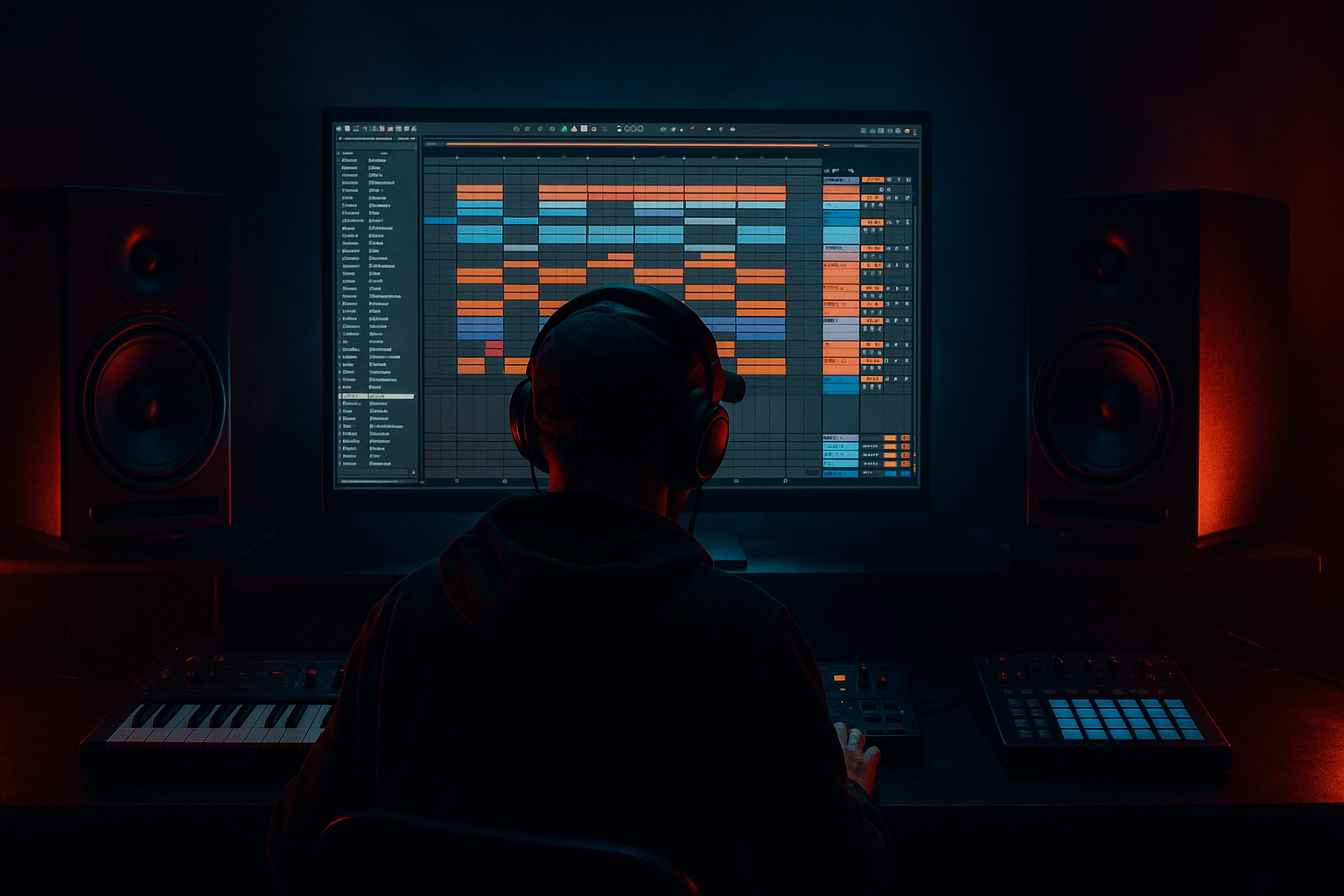
Main tutorial
Subweight Jungle Amen Variation: Offset & Arrange in Ableton Live 12 (Intermediate)
Category: Vocals 🎙️ (we’ll treat vocal chops like rhythmic “ghosts” + call/response with the Amen)
---
1) Lesson overview
In jungle and rolling DnB, the Amen break isn’t just a loop—it’s a modular kit. The classic heavy, forward “subweight” feel comes from:
- Micro-timing offsets (push/pull the break so it breathes)
- Rearrangement + variation (keep the listener hooked every 8/16 bars)
- Sub control (kick + sub relationship stays consistent)
- Vocal chops used as rhythmic fills, not full vocal leads 🎙️
- A core Amen groove that hits hard and stays consistent
- Offset layers (slightly shifted duplicates for movement + aggression)
- Subweight control: clean low-end, punchy transient, no flab
- A vocal chop track (call/response + hype stabs) that follows the drums
- A simple arrangement roadmap: A/B variation, fills, drop phrasing
- Drums – Amen Main → duplicate → Drums – Amen Offset
- HPF 120–180 Hz (steep)
- This ensures the offset layer adds texture and thickness without messing kick/sub.
- Keep the snare (Amen 2 & 4 feel) consistent
- Use ghost kicks + hat slices to create motion
- Add one fill per 2 bars, but alternate intensity
- Bars 1–4: “Statement” (clean, recognisable Amen)
- Bars 5–8: add offset layer + extra ghost notes
- Bars 9–12: introduce a bigger fill (1/8 or 1/16 stutter)
- Bars 13–16: “pre-drop tease” (pull elements, then slam back)
- Use a simple punchy kick sample (short) or build one:
- Add Compressor to the Sub track:
- End of every 2 bars (classic phrasing)
- Just before a snare (energises it)
- Bar 8 / 16 transitions (bigger shout, longer tail)
- Bars 1–2: 1–2 short chops (tease)
- Bars 3–4: add a repeat on the “and” (syncopation)
- Bars 5–8: introduce one “signature” phrase every 4 bars
- Bars 9–16: pull vocals out briefly → bring back for impact
- Amen Offset track volume: bring in/out every 4 bars
- Drum Buss Drive: +2–3% in fills
- EQ Eight high shelf: brighten last 2 bars before a drop
- Echo Dry/Wet on vocals: push to 25–35% on transitions
- Bar 15: remove offset layer + pull hats/vocals
- Bar 16: big vocal + fill
- Drop: slam offset layer back in
- Offset too loud → you get flamming and phasey snares. Keep it tucked and high-passed.
- No low-end plan → Amen low frequencies are inconsistent; reinforce sub intentionally.
- Over-warping the break → heavy warp artifacts can kill snap. Use Beats warp and preserve transients.
- Too many vocal chops 🎙️ → ends up sounding busy and distracts from groove. Use them as punctuation.
- Random fills → fills should mark structure (every 2/4/8 bars), not happen constantly.
- Parallel distortion for menace:
- Snare weight without mud:
- Make the offset “grit-only”:
- Darker vocal vibe:
- Tighter subs:
- Slice the Amen and treat it like a kit, not a loop. 🥁
- Create weight and movement using an offset layer (micro-timing + high-pass).
- Reinforce sub with a controlled kick/sub layer and sidechain discipline.
- Use vocal chops 🎙️ as rhythmic punctuation—call/response with the break.
- Arrange with intention: every 2/4/8 bars, something changes (often by subtraction).
In this lesson you’ll build an Amen variation workflow in Ableton Live 12 using stock tools, with a tight sub foundation and vocal accents that glue the groove together.
---
2) What you will build
You’ll end up with a 16-bar jungle/DnB drum arrangement at 170–174 BPM featuring:
---
3) Step-by-step walkthrough
Step 0 — Session setup (fast + correct)
1. Set tempo: 172 BPM (good jungle/DnB middle ground).
2. Create tracks:
- Drums – Amen Main (Audio)
- Drums – Amen Offset (Audio)
- Drums – Kick/Sub Reinforce (MIDI or Audio)
- Vocals – Chops (Audio)
- (Optional) Room/Verb Return and Delay Return
3. Set your global swing plan:
- Keep it mostly straight (jungle relies on break syncopation), but you can add a touch later.
---
Step 1 — Prep the Amen so it behaves
1. Drop an Amen break sample into Drums – Amen Main.
2. In Clip View:
- Warp: ON
- Warp mode: Beats
- Preserve: Transient
- Transient Loop Mode: Forward
- Set Seg. BPM so it locks tightly (use “Warp From Here (Straight)” if needed).
3. Right-click the clip → Slice to New MIDI Track
- Slicing preset: Transient
- This creates a Drum Rack with individual slices.
✅ Why slice? You’ll rearrange cleanly and create controlled variation without fighting the loop.
---
Step 2 — Build a “subweight-ready” Amen chain (stock devices)
On the Drum Rack (Amen Main), group these on the chain (or on the track if you’re staying audio):
Recommended track chain (simple + effective):
1. EQ Eight
- HPF at 25–30 Hz (24 dB/oct) to remove rumble
- Small dip 200–350 Hz if it’s boxy
- Gentle shelf +1–2 dB around 6–10 kHz if it needs air
2. Drum Buss 🥁
- Drive: 5–15% (don’t overcook)
- Boom: 0–10% (often OFF for jungle breaks—use kick/sub instead)
- Transients: +10 to +30 for snap
- Damp: adjust to control harshness
3. Saturator
- Mode: Soft Sine or Analog Clip
- Drive: 1–4 dB
- Turn on Soft Clip (great for jungle density)
4. Glue Compressor
- Attack: 3 ms
- Release: Auto
- Ratio: 2:1
- Aim for 1–3 dB gain reduction on peaks
This chain keeps the Amen aggressive while leaving space for sub.
---
Step 3 — Create the OFFSET Amen layer (movement + weight)
Duplicate the Amen track:
Now we’re going to misalign it on purpose (but tastefully).
#### Option A: Clip start offset (easy + musical)
1. On Amen Offset clip: nudge the Start Marker forward by:
- 1/16 for obvious jump
- 1/32 for subtle shuffle
- Or even a few milliseconds using the Sample Editor zoom
2. Lower its fader -8 to -14 dB under the main.
#### Option B: Track Delay (micro-timing precision)
1. In the mixer, show Track Delays (Live’s mixer section).
2. Set Amen Offset delay to:
- +8 to +20 ms (late = heavier, behind-the-beat)
- Or -5 to -12 ms (early = urgent, forward)
✅ Jungle trick: Main track = on-grid, Offset = slightly late. It feels bigger without flam chaos.
#### Make it “subweight safe”
On Amen Offset add EQ Eight:
---
Step 4 — Rearrange the Amen into rolling variation (8/16 bar logic)
You’ve got a Drum Rack of slices (from Step 1). Now program a 2-bar loop that feels classic:
#### Core 2-bar skeleton (starting point)
Workflow:
1. Create a MIDI clip in the sliced Drum Rack track.
2. Start with a straight foundation:
- Place main snare hits on beat 2 and 4 (or where the Amen snare lands).
3. Add kick slices around them (not too many—let the break breathe).
4. Every 2 bars, do one of:
- A snare drag (quick repeated slice before the snare)
- A reverse cymbal slice (or just reverse an audio slice)
- A stutter at end of bar 2 (1/16 repeats)
#### Turn it into 16 bars (arrangement plan)
---
Step 5 — Lock the SUBWEIGHT: Kick/Sub Reinforce layer
A lot of jungle breaks don’t carry consistent sub. You’ll reinforce it.
#### Create a Kick/Sub Reinforce track
- Drum Rack with a kick + sub tone
Option: Sub tone with Operator (stock)
1. Add Operator on a MIDI track.
2. Oscillator A: Sine
3. Pitch: -12 to -24 semitones depending on key
4. Amp Envelope:
- Attack: 0
- Decay: 120–250 ms
- Sustain: -inf (or very low)
- Release: 50–120 ms
5. Add Saturator (soft clip) lightly for audibility.
#### Sidechain the sub to the Amen/Kick transient
- Sidechain input: Amen Main (or your kick track)
- Attack: 1–3 ms
- Release: 60–120 ms
- Ratio: 4:1
- Reduce 2–6 dB as needed
✅ Result: break stays crunchy, sub stays consistent, low-end doesn’t blur.
---
Step 6 — Vocals (Category focus): rhythmic chops that enhance Amen variation 🎙️
We’ll add jungle-style vocal chops that act like percussion—think “ragga bits,” hype shouts, or single syllables.
#### A) Prep the vocal for chopping
1. Drop your vocal sample into Vocals – Chops (Audio).
2. Warp: ON, mode: Complex Pro (best for vocals).
3. Right-click → Slice to New MIDI Track
- Use Transient or 1/8 depending on material.
4. Now you’ve got a vocal Drum Rack.
#### B) Make it sit in the mix (stock chain)
On the Vocal Chop track:
1. EQ Eight
- HPF 150–250 Hz (keep low end clear)
- Dip 2–4 kHz if harsh (depends on sample)
2. Saturator (small)
- Drive: 1–3 dB
3. Delay (Echo) 🌫️
- Echo device:
- Time: 1/8 or 1/4
- Feedback: 15–30%
- Filter: HPF ~ 300 Hz, LPF ~ 6–8 kHz
- Dry/Wet: 8–18%
4. Reverb
- Decay: 0.8–1.6s
- Pre-delay: 10–25 ms
- Dry/Wet: 6–12%
- HP filter in reverb: 300 Hz+
#### C) Arrange vocals like a junglist (call/response)
Place vocal hits in these zones:
Go-to pattern idea:
✅ Keep vocals supportive. In DnB, too many chops can fight the break.
---
Step 7 — Make variation with offsets + automation (Live 12 workflow)
Now that your core is working, create movement without rewriting everything.
#### Automation targets that work great:
Arrangement trick: “Subtract to add impact”
---
4) Common mistakes
---
5) Pro tips for darker/heavier DnB
Send Amen to a Return with Saturator + EQ Eight (band-pass 300 Hz–6 kHz) + Compressor. Blend subtly.
Layer a tight snare one-shot under the Amen snare (high-pass the layer around 150 Hz, then add a small 200 Hz bump if needed).
HPF even higher (250–350 Hz) and add Redux lightly (Downsample 2–4) for texture.
Pitch vocal rack down -3 to -7 semitones, then filter with Auto Filter (LP around 6–9 kHz) and add a touch of Echo.
Use Utility on the sub track: Bass Mono ON, width 0% below ~120 Hz (use EQ M/S if needed).
---
6) Mini practice exercise (15–25 minutes)
1. Build a 2-bar Amen loop from slices (no vocals yet).
2. Duplicate it to create Amen Offset and set:
- Track delay: +12 ms
- EQ Eight HPF: 160 Hz
3. Arrange 16 bars:
- Bars 1–4: Main only
- Bars 5–8: Main + Offset
- Bars 9–12: Add one fill every 2 bars
- Bars 13–16: Pull offset out in bar 15, big fill in bar 16
4. Add 3 vocal chops total:
- One at bar 4 end
- One at bar 8 end (with more echo)
- One at bar 16 end (biggest)
Export a quick bounce and listen on low volume—if it still feels heavy, your subweight is working.
---
7) Recap
If you want, tell me your tempo, the type of vocal (ragga, spoken, sung), and whether you’re aiming for ’94 jungle, modern rollers, or techstep darkness, and I’ll suggest a specific 16–32 bar arrangement template.

