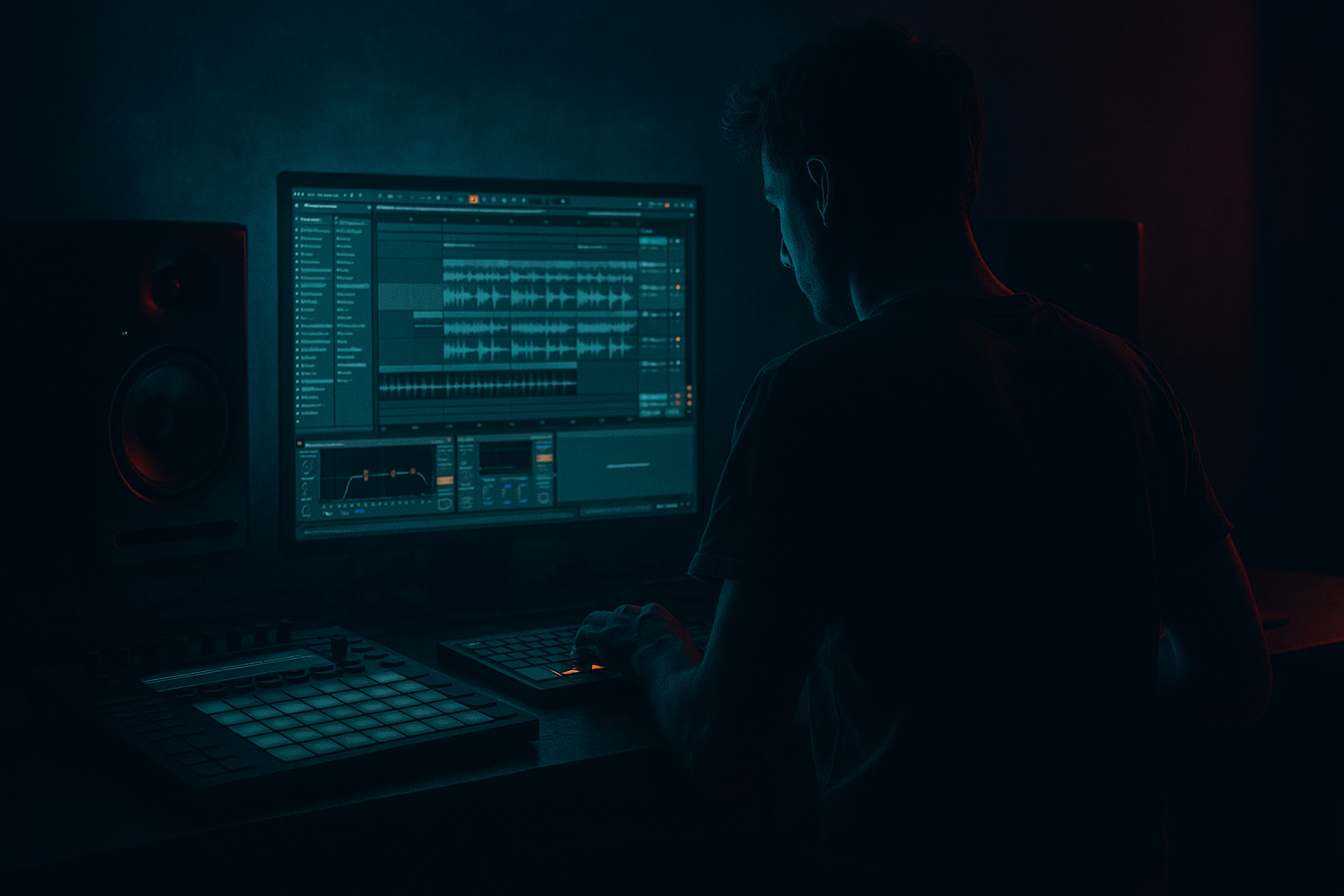
Main tutorial
Subweight: Top Loop Swing with Chopped‑Vinyl Character (Ableton Live 12)
Advanced composition workflow for jungle / oldskool DnB vibes 🥁💿
---
1) Lesson overview
You’re going to build that classic jungle “top loop” feel: swung, slightly late hats, ghosty percussion, and chopped‑vinyl character sitting on top of a solid break/drum backbone—while keeping the sub weight clean and unmoving.
Key goals:
- Swing without flamming your kick/snare
- Vinyl‑ish chopped texture that feels sampled, not programmed
- Arrangement-ready top loop that evolves across 16–64 bars
- All inside Ableton Live 12, mostly stock devices ✅
- Tempo: 165–172 BPM (start at 170 BPM)
- Create groups:
- Limiter (Ceiling: -0.8 dB, just as protection)
- Drop a classic break (Amen/Think-style) into a track.
- Warp: Complex Pro (or Beats if you prefer bite)
- Consolidate to 4 or 8 bars once aligned.
- Kick on 1 and 3, snare on 2 and 4 (classic 2-step base)
- Add a low-level break for glue.
- Drum Buss on the break/drum bus:
- EQ Eight:
- Closed hat (tight)
- Open hat (short)
- Shaker
- Ride/noise hat
- A couple of tiny percs (rim, click, wood, etc.)
- Closed hat: 8ths (every 1/8)
- Shaker: 16ths but remove some hits (make it breathe)
- Perc ghosts: sprinkle very low velocity offbeats
- Drag a groove like Swing 16-65 (or similar) to the clip.
- Set:
- Important: Commit only when you’re happy (right click → Commit) so you can micro-edit.
- Push some hats slightly late: +5 to +15 ms
- Push some ghost percs slightly early: -5 to -10 ms
- Keep any “backbeat reinforcement” (snare-ish tops) closer to grid.
- Track Delay on TOPS Core: try +7 ms as a starting point
- Strong-ish hits: 85–110
- Ghosts: 15–45
- Make every second 8th hat slightly quieter (classic bounce).
- Mode: Analog Clip
- Drive: 2–6 dB
- Soft Clip: On
- Output: trim down to match
- Downsample: 1.2–2.5
- Bit Reduction: 0 (often keep bits intact)
- HP 12 dB: 250–450 Hz (depending on density)
- Add a tiny resonance (0.8–1.2) for “recordy” edge
- Create a new audio track: TOPS Vinyl Chop
- Set input: Resampling
- Solo TOPS Core (and optionally a tiny amount of break ambience)
- Record 4–8 bars of tops.
- HP: 300–600 Hz
- Gentle dip at 6–9 kHz if harsh (old records often roll off)
- Mode: OD or Fuzz (very gentle)
- Drive: 5–15%
- Tone: roll off a bit (keep it dark-ish)
- Time: 1/16 or 1/8
- Feedback: 0–10%
- Filter: HP 500 Hz, LP 6–9 kHz
- Mix: 3–10%
- LP 12 dB
- Cutoff: 7–12 kHz
- Envelope: tiny amount, or slow LFO at 0.05–0.12 Hz
- Keep it subtle: it should breathe, not wobble.
- Width: 70–110% (careful: too wide = phasey hats)
- Bass Mono: On, set around 200–300 Hz
- Right-click the resampled audio clip → Slice to New MIDI Track
- Slicing preset:
- In the new MIDI clip:
- Duplicate the audio clip
- In Clip View, enable Warp
- Use Beats mode:
- Then:
- EQ Eight HP: typically 250–500 Hz
- Add Compressor on the TOPS group
- Sidechain input: Kick (and/or Snare bus)
- Settings:
- Use Drum Buss on Tops Group:
- Bars 1–9 (Intro): TOPS Vinyl Chop only (filtered darker), no open hats
- Bars 9–17 (Groove locks): add TOPS Core quietly, increase HP cutoff brightness
- Bars 17–33 (Drop): full tops, add occasional 1/8 open hat
- Bars 33–41 (Variation): mute TOPS Core for 2 bars, let chop carry it
- Bars 41–49 (Fill section): stutter 1 bar of chopped loop (repeat a slice)
- Bars 49–65 (Second drop): swap to alternate chop pattern + slightly more distortion
- Auto Filter cutoff on Vinyl Chop: open slightly every 8 bars
- Utility gain dips before fills (creates “pull”)
- Redux downsample small increases in fills for grit
- Swinging the whole drum bus: your kick/snare will flam and lose punch. Swing the tops, not the core.
- Too much groove amount: 16-65 at 70% timing often turns to drunken shuffle. Keep it controlled.
- Not resampling: MIDI-only tops can sound too “clean and perfect.” Resample to audio for realism.
- Over-widening hats: wide noisy tops + breaks = phase smear. Use Utility width with restraint.
- Leaving low-mid in tops: 200–600 Hz buildup kills sub clarity fast. High-pass aggressively.
- Darkness comes from less 10–14 kHz, not more 200 Hz. Roll a bit of top, keep low clean.
- Add a tiny roar layer behind tops:
- Gate the Vinyl Chop for “cut-up” feel:
- Parallel grit bus (for tops only):
- A/B against classic jungle: Your tops should feel like they’re “printed” into the break, not floating above it.
- Build tops swing with a hybrid approach: Groove Pool + microtiming + velocity dynamics.
- Resample and slice to create authentic chopped-vinyl movement. 💿
- Keep it subweight-safe: high-pass tops, control transients, gentle sidechain.
- Arrange tops like jungle: evolve, drop out, re-enter, and automate tone over time.
---
2) What you will build
A two-layer tops system:
1. Tops Core (Programmed): hats/shakers/percs with deliberate swing and microtiming
2. Vinyl Chop Layer (Resampled): a “recorded loop” you’ll resample, slice, pitch, and degrade to feel like a chopped break record
Both layers will be high-passed and mono-managed so your sub + kick remain solid.
---
3) Step-by-step walkthrough
Step 0 — Session setup (fast but important)
- DRUMS (Group)
- Break / Main drums
- TOPS Core
- TOPS Vinyl Chop
- BASS
- MUSIC/FX
On your Master, keep it simple for now:
---
Step 1 — Build a stable drum backbone (so swing sits right)
Even if this lesson is “tops,” the tops need an anchor.
Option A: Break + reinforcement
Option B: Program kick/snare and add break quietly
Backbone processing idea (stock):
- Drive: 5–15
- Crunch: 0–10 (taste)
- Boom: 0–20 (only if it doesn’t mess with sub)
- HP around 25–35 Hz
- Small dip around 200–350 Hz if boxy
✅ Rule: Keep kick + snare timing straight. All “wobble” happens in tops.
---
Step 2 — TOPS Core: Program swing that feels sampled, not “MIDI swing”
Create a Drum Rack on TOPS Core and load:
#### 2.1 Create a 1–2 bar tops pattern
In MIDI (1 bar to start):
#### 2.2 Add swing the “jungle way”
Instead of only using Groove Pool, combine three swing layers:
A) Groove Pool (global feel)
- Timing: 20–40%
- Velocity: 5–20%
- Random: 5–15%
B) Microtiming nudges (the secret sauce)
Go into the MIDI notes and do:
In Live, use the Delay section per track too:
This makes tops “sit behind” the break, instantly more oldskool.
C) Velocity shape (break-like dynamics)
In the MIDI velocity lane:
#### 2.3 Make it sound like audio, not clean samples
On the TOPS Core track, add:
1) Saturator
2) Redux (subtle!)
This gives “air fuzz” without turning it into chiptune.
3) Auto Filter
---
Step 3 — TOPS Vinyl Chop Layer: Resample → slice → re-groove 💿
This is where the chopped-vinyl character comes from.
#### 3.1 Resample your tops into audio
Now you have a continuous audio performance with natural timing.
#### 3.2 Add “vinyl-ish” degradation (stock chain)
On TOPS Vinyl Chop, try this chain:
1) EQ Eight (pre)
2) Pedal (subtle dirt)
3) Echo (as a space/texture tool, not audible delay)
This mimics room/print-through vibe.
4) Auto Filter (movement)
5) Utility
(Yes, even on tops—keeps the low-mid stable.)
#### 3.3 Slice it like you stole it from wax
Now for the chops:
Method A (fast): Slice to New MIDI Track
- Slice by: 1/16 or Transient (try both)
- Built-in: Simpler
- Re-order a few slices
- Repeat a slice for stutters
- Leave gaps for head-nod swing
Method B (more “DJ edit”): Clip chopping
- Preserve: 1/16
- Transients: 100
- Envelope: ~40–70
- Split (Cmd/Ctrl+E) on interesting hits
- Nudge slices slightly late/early (few ms)
- Reverse a tiny slice occasionally (classic jungle flourish)
✅ Keep it musical: chops should reinforce groove, not randomize it.
---
Step 4 — Make it “subweight-safe” (tops that don’t steal low end)
This is where many people ruin the heaviness.
On TOPS Core and TOPS Vinyl Chop (and/or their group), do:
A) High-pass properly
If your breaks carry body, you can go higher (even 700 Hz) for pure air.
B) Sidechain duck from kick/snare (tiny)
- Ratio: 2:1
- Attack: 3–10 ms
- Release: 60–140 ms
- Gain reduction: just 1–3 dB
This keeps impact clean while preserving groove.
C) Keep tops transient-controlled
- Transients: -5 to -15 (soften spiky hats)
- Drive: 0–8 (taste)
---
Step 5 — Arrangement: evolving tops across 32–64 bars (jungle logic)
A classic oldskool trick is tops evolution while kick/snare stays dependable.
Try a 64-bar plan:
Automation targets (easy wins):
---
4) Common mistakes
---
5) Pro tips for darker/heavier DnB 🕳️⚙️
- Create a noise hat/room layer, low-passed around 6–8 kHz, saturated, very quiet.
- Use Gate with short release so tails don’t wash over the snare.
- Return track: A – TOPS GRIT
- Add Saturator (Drive 8–12) + EQ Eight HP 1k
- Send small amounts from tops for aggressive bite without harshness.
---
6) Mini practice exercise (20 minutes)
1. Program a 1-bar TOPS Core groove with hats + shaker + 2 ghost percs.
2. Apply Groove Pool swing:
- Timing 30%, Random 10%, Velocity 10%
3. Set Track Delay on TOPS Core: +8 ms
4. Resample 8 bars to TOPS Vinyl Chop.
5. Slice to new MIDI track by 1/16 and create a 2-bar chop pattern:
- Bar 2: repeat a slice 3 times for a stutter
6. High-pass both tops at ~400 Hz, then sidechain duck 2 dB from kick.
7. Arrange a 16-bar loop:
- First 8 bars: darker filter
- Second 8 bars: open filter + add one open hat every 2 bars
Deliverable: a 16-bar groove that feels like a chopped break record sitting on a modern sub-safe foundation.
---
7) Recap
If you want, paste a screenshot of your Groove Pool settings + tops device chain, and I’ll suggest exact tweaks to push it more “’94 roller” vs “techstep dark.”

