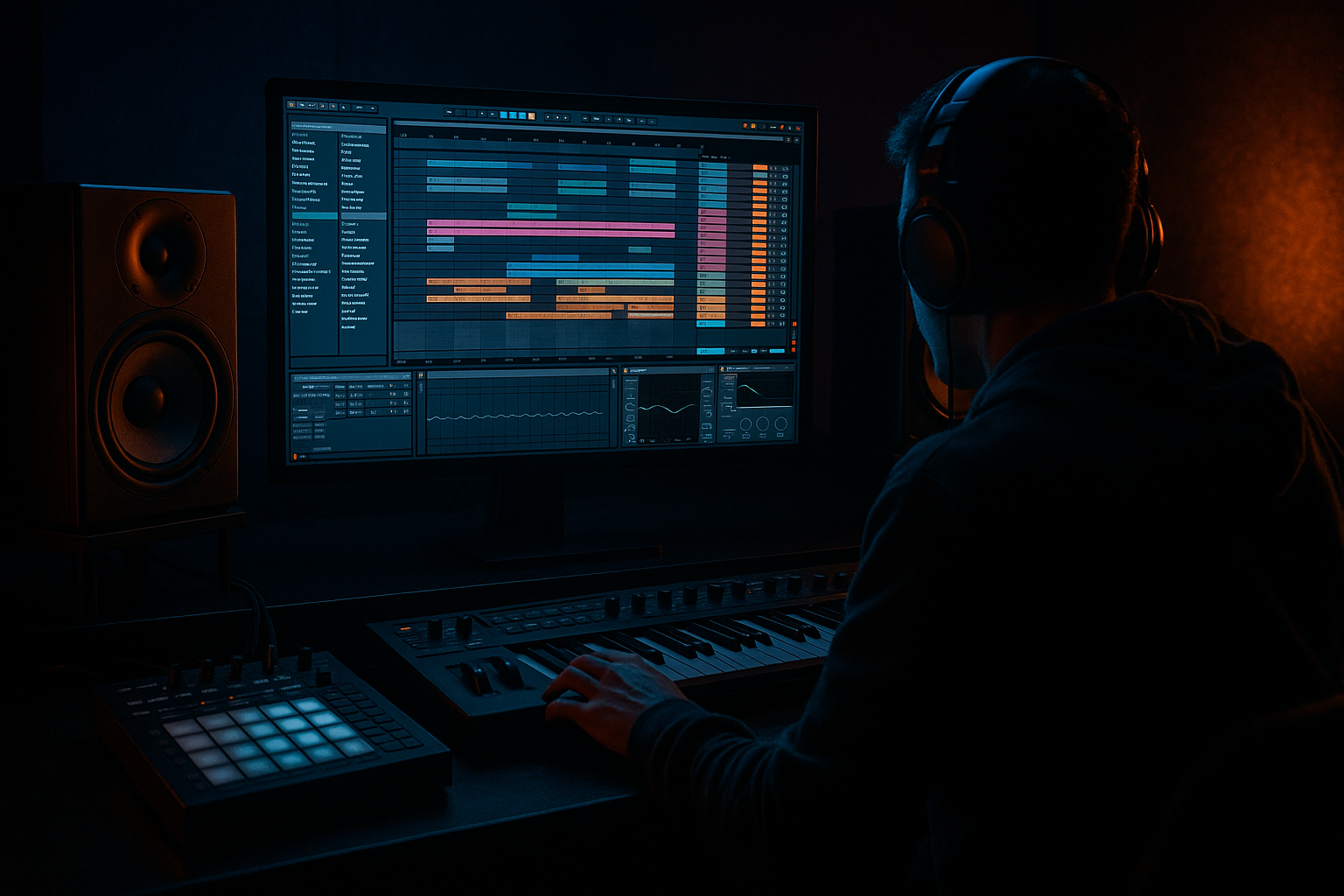
Main tutorial
```markdown
Swing a Kick Weight for Smoky Warehouse Vibes (Ableton Live 12)
Intermediate • Groove • Jungle / Oldskool DnB 🏭🖤
---
1. Lesson overview
In jungle and oldskool DnB, the kick isn’t just “on 1 and 3.” The feel comes from micro-timing, accent patterns, and weight management (sub vs knock vs air) so the groove rolls like a smoky warehouse system.
In this lesson you’ll learn how to:
- Add swing that actually feels DnB, not generic house shuffle
- Push/pull kick timing without losing impact
- Use Ableton Live 12 tools: Groove Pool, MIDI clip offsets, Track Delay, Drum Rack, Saturator, EQ Eight, Glue Compressor
- Make the kick “lean” into the break so the whole loop breathes 🔥
- The kick has weighted swing (sub stays solid, mid-knock swings slightly)
- The break drives the roll (classic Amen-style or similar)
- The groove has that dusty, late-night warehouse push/pull
- A kick layered in Drum Rack
- A break with groove extracted + applied
- A controlled timing workflow so your mix still hits hard
- Put Kick Sub on pad C1:
- Put Kick Knock on pad C#1:
- Place kicks on: 1.1.1 and 1.3.1 (the classic skeleton)
- Add a ghost/lead-in kick occasionally:
- Main kicks: 100–127
- Ghost kicks: 35–70
- Use Track Delay (bottom right in mixer section)
- Late knock = smoky and heavy
- Early knock = edgy and forward
- Drum Buss device
- Bars 1–2: Groove Timing on Knock 15%
- Bars 3–4: 22%
- Bars 5–6: 28%
- Bars 7–8: drop back to 18% (reset tension)
- Verse/rolling section: +8 ms
- Pre-drop tease: +12 ms
- Drop: back to +6 ms (tighter punch)
- Parallel dirt on the knock only:
- Roll the room with short ambience:
- Use transient shaping carefully:
- Sidechain the bass to the kick sub layer only:
- Ghost kick accents to steer the swing:
- Use the break as the groove reference (Extract Groove → Groove Pool) 🥁
- Keep sub timing stable and swing the knock/transient for warehouse weight 🏭
- Start subtle: 10–35% timing, low Random, then fine-tune with Track Delay
- Glue it with Glue Compressor and tasteful saturation for smoky density 🔥
- Add arrangement interest by automating groove intensity over 8 bars
---
2. What you will build
A 4–8 bar jungle/DnB drum loop at 165–172 BPM where:
You’ll end with:
---
3. Step-by-step walkthrough
Step 0 — Session setup (fast + intentional)
1. Set tempo to 170 BPM (classic jungle comfort zone).
2. Create three tracks:
- Kick Rack (MIDI)
- Break (Audio)
- Bass (MIDI or Audio; optional for checking pocket)
Why: If you only swing “everything,” you’ll lose punch. Separating kick + break lets you choose where swing lives.
---
Step 1 — Build a weighted kick inside Drum Rack 🎛️
1. On Kick Rack, load a Drum Rack.
2. Create two kick layers:
- Kick Sub (tight siney/low kick or filtered kick)
- Kick Knock (mid punch / beater / click)
Practical layering approach
- Add EQ Eight
- Low-pass around 120–180 Hz (steep-ish)
- Optional small dip around 50–70 Hz if it’s too boomy
- Add EQ Eight
- High-pass around 120–180 Hz
- Small boost around 2–4 kHz for bite (careful)
3. Group them:
- Select both chains in Drum Rack → Group (so you can process together)
4. Add Saturator on the group:
- Mode: Soft Clip
- Drive: 2–6 dB (start at 3 dB)
- Output: trim so you’re not louder, just denser
Goal: Your low end stays stable while your mid layer can swing and “talk.”
---
Step 2 — Program the kick pattern (oldskool-friendly)
In a 1-bar MIDI clip, start with a simple DnB-friendly anchor:
- Try a light hit around 1.2.4 or 1.4.4 (quiet + short)
Velocity suggestion
This gives you something to swing without losing the downbeat weight.
---
Step 3 — Choose a break and extract its groove 🥁
1. Drag an oldskool-style break (Amen, Think, Hot Pants-style—your choice) onto Break track.
2. Make sure Warp is on:
- Warp Mode: Complex or Complex Pro (safe for breaks)
3. Right-click the clip → Extract Groove
4. Open Groove Pool (left panel) and find the extracted groove.
Key: This groove is the DNA of the shuffle. Jungle feel usually comes more from the break than from a “Swing 16” preset.
---
Step 4 — Apply groove to the kick (but with control)
1. Select your kick MIDI clip
2. In Clip View → Groove dropdown: choose the extracted groove
3. Start with:
- Timing: 10–20%
- Random: 0–4% (tiny!)
- Velocity: 0% (for now)
- Base: usually 1/16 or 1/8 depending on extracted groove
4. Hit Commit only when you’re confident.
- For experimentation, don’t commit yet. Adjust and listen first.
Listening checkpoint:
Your kick should start to “nod” with the break, but the downbeats must still feel planted.
---
Step 5 — The secret sauce: swing the knock, not the sub 🧠
This is where warehouse weight happens.
Method A (cleanest): Split sub vs knock timing
1. Duplicate your kick MIDI track:
- Track 1: Kick Sub
- Track 2: Kick Knock
2. On Kick Sub, keep groove minimal:
- Groove Timing: 0–8% (almost straight)
3. On Kick Knock, increase groove:
- Groove Timing: 18–35%
- Optional Random: 2–6% (adds smoke)
Now the transient “leans” while the sub stays dependable. That’s the vibe.
Method B (quick): Track Delay
If you don’t want to duplicate tracks:
- Set Kick Knock track delay to +5 to +15 ms (late = laid back)
- Or -5 to -10 ms (early = urgent/aggressive)
Rule:
---
Step 6 — Glue the groove with subtle bus processing
Create a Drum Bus return/group:
1. Group Kick + Break into a Drums Group
2. On the group insert:
- Glue Compressor
- Attack: 3 ms
- Release: Auto
- Ratio: 2:1
- Aim for 1–3 dB gain reduction
- EQ Eight
- Gentle low shelf dip if too thick (around 120 Hz)
- Tiny presence lift if too dull (around 3–6 kHz)
Optional (for warehouse grit):
- Drive: 2–8
- Crunch: 0–10 (subtle)
- Boom: 0–10 (careful—DnB subs can explode fast)
---
Step 7 — Arrangement move: “swing the weight” across 8 bars
To make it feel like a DJ-friendly roller, automate groove intensity:
8-bar loop automation idea
Or automate Track Delay on the knock:
This creates movement without changing the pattern.
---
4. Common mistakes
1. Swinging the sub layer
Makes low end feel late/unstable. Keep sub timing straighter than the transient.
2. Too much groove amount
If Groove Timing is 50–100%, you’ll often get “drunk drums,” not jungle roll.
3. Random set too high
Random above ~10% can smear the pocket and ruin repeatability.
4. Over-quantizing the break
If you hard-quantize warp markers, you erase the human groove you wanted.
5. Ignoring velocity
Oldskool feel is timing and accents. A perfectly timed loop with flat velocity still sounds stiff.
---
5. Pro tips for darker/heavier DnB 🖤
Create a Return track with Saturator → Amp → EQ Eight, send only the knock layer. Keep sub clean.
Use Hybrid Reverb (very subtle) on the break only:
- Convolution: small room / warehouse-ish IR
- Decay: 0.3–0.8s
- High-pass reverb: 200–400 Hz
This adds “smoke” without washing low end.
Ableton doesn’t have a dedicated transient shaper stock, but you can fake it:
- Drum Buss: Transients knob (small moves)
- Glue Compressor with slower attack to let click through
Keeps low end clear without pumping the whole groove.
- Compressor on bass, sidechain from Kick Sub
- Attack: 1–5 ms, Release: 60–120 ms
- 2–5 dB reduction is usually enough
A quiet hit just before a snare can make the next downbeat feel heavier.
---
6. Mini practice exercise (15 minutes) ⏱️
1. Load a break, Extract Groove.
2. Make a two-layer kick (Sub + Knock).
3. Apply extracted groove:
- Sub: 0–8%
- Knock: 20–30%
4. Do three versions and A/B them:
- Version A: Knock Track Delay +10 ms
- Version B: Knock Track Delay 0 ms
- Version C: Knock Track Delay -7 ms
5. Pick the best pocket and commit it, then bounce a 8-bar drum loop.
Goal: Train your ear to identify “laid back heavy” vs “aggressive forward” groove.
---
7. Recap
If you want, tell me your BPM and which break you’re using, and I’ll suggest a specific groove amount + kick placement pattern that matches that break’s pocket.
```

