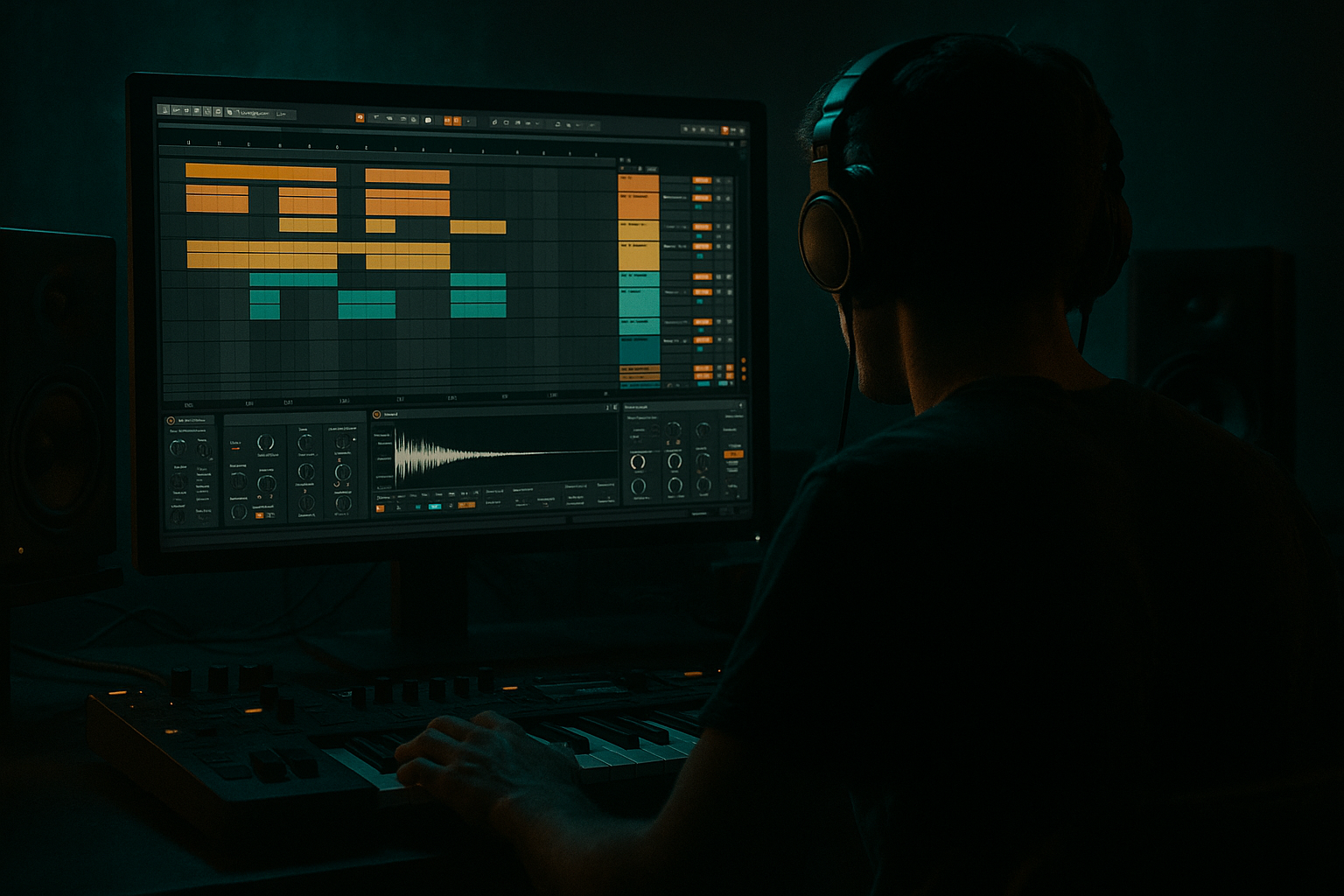
Main tutorial
Lesson Overview
Swing is one of the fastest ways to make a DnB loop feel alive, but in jungle and oldskool-inspired material it can go wrong fast if the groove gets too loose or the top end gets too sharp. In this lesson, you’ll learn how to take a clean Ableton Live 12 drum-and-bass pattern, apply swing with intention, then “clean” that swing into a warm tape-style grit that still hits like a proper system tune.
This sits right in the heart of Ragga Elements production: think chopped breaks, off-grid percussion, call-and-response bass, ragga vocal chops, and that slightly worn, machine-warm feel you hear in jungle, rollers, and darker oldskool DnB. The goal is not to make things sloppy. It’s to make them feel human, dusty, and pressure-heavy while preserving the drive that keeps a DnB track moving at 170–174 BPM.
Why this matters: in DnB, swing affects more than groove. It changes how your kick/snare pocket feels, how the break breathes, how the bass answers the drums, and how the listener perceives energy in the drop. If you overdo it, the track lurches. If you underdo it, the loop feels sterile. The sweet spot is where the drums still lock to the grid but the hats, ghosts, and percussion push and pull like a worn tape loop.
What You Will Build
You’ll build a 2-bar jungle/DnB drum-and-bass loop that combines:
- A tight kick/snare backbone with controlled swing
- Cleaned-up ghost notes and break fragments that give movement without clutter
- A sub and reese bass relationship that stays mono-solid but feels rhythmically elastic
- Warm tape-style grit from stock Ableton devices, not harsh distortion
- A ragga-flavoured vibe through chopped vocal hits or percussive call-and-response
- A loop that can become an 8- or 16-bar drop section with intro tension, small switch-ups, and DJ-friendly structure
- Over-swinging the whole groove
- Letting breaks fight the sub
- Adding too much saturation too early
- Making the bass too busy
- Using wide stereo effects on the low end
- Swinging ragga chops randomly
- Forgetting arrangement context
- Layer a clean kick with a slightly saturated low-end click, then keep the kick itself mostly straight while the break and hats carry the swing. That gives you pressure without wobble.
- Use Drum Buss on a break layer with Drive around 8–15% and keep Boom very conservative. This thickens the swing but doesn’t blow up the sub.
- Automate Auto Filter on the reese so the bass opens slightly on the offbeat or just after the snare. Tiny moves create a lot of perceived aggression.
- In darker rollers, reduce hat swing a little and increase ghost-note swing instead. That keeps the groove serious and less “funky.”
- For more tape-style grime, use Saturator before EQ Eight, then trim the low mids after saturation. This mimics the way old signal chains get thick before they get polished.
- Resample your drum bus once the groove feels right. Then chop the resampled audio and reintroduce one or two edited hits. This is a classic jungle move and often gives a better “worn” feel than endless MIDI editing.
- If your ragga vocal sounds too modern, band-limit it with Auto Filter or EQ Eight and add a short Echo tail. The degraded edge helps it sit in the oldskool world.
- In the drop, let the bass answer the snare every 2 bars, then break that pattern on bar 4. That kind of phrase disruption is huge in darker DnB.
- Keep the kick and snare relatively straight; swing the supporting details.
- Use Groove Pool lightly and selectively for hats, ghosts, breaks, and percussion.
- Clean breaks with high-pass filtering, transient control, and careful warping.
- Add warmth with subtle Saturator, Drum Buss, and light bus compression.
- Let bass phrase around the drums instead of fighting the swing.
- Use ragga vocal chops as rhythmic punctuation.
- Build the groove into a real arrangement with tension, switch-ups, and DJ-friendly structure.
By the end, you’ll have a loop that feels like it belongs in an oldskool jungle tune or a darker modern rollers track: punchy, swung, dusty, and mix-ready.
Step-by-Step Walkthrough
1. Set the tempo, grid, and reference the groove first
Start at 170–174 BPM. For oldskool jungle energy, 172 BPM is a very safe sweet spot. In Ableton Live 12, set the global grid to 1/16 while building the core loop, then switch to 1/32 only when you’re editing ghost notes or break cuts.
Load a reference track into an audio channel and warp it lightly if needed, but mainly use it to check the feel. You’re listening for:
- How hard the snare snaps against the grid
- Whether hats lean forward or sit behind the beat
- How much space the bass leaves after the kick
For this lesson, think “tight but unpolished.” That means clean timing on the main hits, but slightly offset swing on the supporting details.
Why this works in DnB: the main impact of a drop comes from consistency in the kick-snare spine. The swing lives in the layer around that spine, which gives motion without killing the mix.
2. Build a clean drum skeleton before adding swing
Create a Drum Rack with three lanes:
- Kick
- Snare
- Closed hat or rim/perc layer
Use stock devices:
- Drum Rack
- Simplers or Simpler-loaded one-shots
- EQ Eight on each lane if needed
Program a basic 2-bar pattern:
- Kick on 1 and a syncopated kick before 3 or after 3
- Snare on 2 and 4
- Closed hats on offbeats or 1/16s with a few gaps
Keep the snare strong and centered. If you’re using a break layer, place it on a separate audio track so you can shape it independently.
Parameter starting points:
- Kick: short decay, around 80–140 ms feel if using a sampled source
- Snare: add a little body around 180–220 Hz and crack around 2–5 kHz with EQ Eight if needed
- Hats: high-pass around 200–400 Hz to keep the low mids clean
Don’t swing anything yet. First, make sure the pattern works straight.
3. Apply groove with Groove Pool, then control how much actually lands
Drag a groove into the Groove Pool. For jungle and oldskool DnB, start with one of Ableton’s MPC-style or MPC-derived swing feels, or extract groove from a chopped break if you have a classic loop. Use it lightly at first.
Apply the groove to:
- Hats
- Ghost snares
- Percussion
- Break fragments
Leave the main kick/snare mostly straighter than the rest.
Useful starting points:
- Timing: 20–40%
- Random: 0–8%
- Velocity: 5–15%
- Base: keep near 100% unless the groove is too extreme
In Live 12, you can also use clip groove settings to fine-tune each element separately. That’s the key move: don’t swing the whole track equally. Swing the details more than the anchors.
If your drums feel too late, reduce the groove amount on hats first, not the kick/snare. If the groove feels too stiff, add a tiny bit more to ghost hits and offbeat percussion before touching the main groove.
4. Chop a break and clean the swing into a tighter pocket
Load a classic break into an audio track, then warp it carefully. For jungle-style movement, try Complex Pro only if needed; otherwise preserve the transients as much as possible. If the break is noisy or too unstable, switch to Beats warp mode and use transient preservation.
Slice the break to a Drum Rack if you want maximum control. In Live 12, this is perfect for editing:
- Separate snare ghost hits
- Move late kick fragments slightly forward
- Remove messy low-end from the break
- Rebuild the groove around your kick/snare
Clean-up workflow:
- High-pass the break at 120–180 Hz so it doesn’t fight the sub
- Use EQ Eight to dip harsh cymbal spikes around 7–10 kHz if needed
- Use Transient shaping via Drum Buss or clip gain to make ghost hits less pokey
- Nudge selected break slices 5–15 ms earlier if the swing starts feeling lazy
This is where “clean it” happens. You’re not removing the character. You’re trimming the loose ends so the swing feels intentional. A break with dirty tops and a controlled low-mid body is classic jungle gold.
5. Add warm tape-style grit with stock Ableton devices
To get that tape-style warmth, build a Drum Bus or group bus for your drums. On the drum group, insert:
- Saturator
- Drum Buss
- EQ Eight
- Glue Compressor if needed
Good starting points:
- Saturator: Soft Clip on, Drive 2–5 dB, Output trimmed to match level
- Drum Buss: Drive 5–15%, Crunch low or off to start, Boom carefully set or bypassed if your sub is already busy
- Glue Compressor: 1–2 dB gain reduction, Attack 10 ms, Release Auto or 0.3 s
If you want more tape-like feel, keep saturation subtle and layered rather than one huge distortion hit. The aim is warmth, density, and slight compression of transients, not fuzz overload.
For more control, split the drums into two buses:
- Clean punch bus: kick/snare
- Grit bus: breaks, hats, perc, ragga hits
Send the grit bus into Saturator and Drum Buss more aggressively than the clean punch bus. This lets the track stay tight while the swung layer gets dusty.
Suggested grit ranges:
- Saturator Drive: 1.5–4 dB on the clean bus, 4–8 dB on the grit bus
- EQ Eight after saturation: cut a little around 250–400 Hz if it clouds the mix
- Utility on the bus: keep bass-heavy sources mono
6. Shape the bass so it locks to the swung drums, not against them
Build a bassline with a sub and a mid reese layer. In jungle and rollers, the bass often answers the drums rather than playing nonstop. That call-and-response space is part of the vibe, especially when ragga vocal chops or break fills occupy the gaps.
Start with two tracks:
- Sub: Operator, Wavetable, or a sampled sine in Simpler
- Reese: Wavetable or Analog-style detuned saws, then filtered and widened carefully
Bass setup:
- Sub mono, centered, no unnecessary stereo
- Reese slightly wider, but high-pass it around 90–120 Hz
- Use Envelope shaping so notes are short enough to leave snare space
Rhythmically, place bass notes:
- After the snare for forward motion
- Before the snare for tension
- With small rests that let the swing breathe
Practical settings:
- Sub decay: 150–300 ms for short notes, longer if the tune is more rolling
- Reese filter cutoff: around 200–800 Hz depending on brightness
- Chorus-Ensemble or Phaser-Flanger very lightly if you want subtle movement, but keep it controlled
Why this works in DnB: swung drums create micro-delay in the groove, and the bass needs to either lean into that pocket or contrast it. If both drums and bass are crowded, the drop loses propulsion. If the bass phrases around the swing, the groove feels bigger without needing more notes.
7. Add ragga elements as rhythmic punctuation, not decoration
For Ragga Elements, place vocal chops, toasts, shouts, or skank-style stabs as punctuation points. These should interact with the swung drum pocket rather than sit on top of it.
Use one of these stock workflows:
- Simpler in Slice mode for chopped vocal phrases
- Auto Filter for bandpass-style movement
- Echo for quick dub-style tails
- Reverb for short, dark room space
Arrange your ragga layers like this:
- Short vocal hit on the upbeat after the snare
- Another chop before the drop or at the end of bar 4
- A delayed call-and-response phrase that trails into a break fill
Settings to try:
- Auto Filter: bandpass or lowpass, resonance moderate, automate cutoff between 400 Hz and 4 kHz
- Echo: very short delay times, low feedback, filtered repeats
- Reverb: small or medium room, decay under 2 s for tightness
Keep ragga elements slightly degraded with saturation or filtering so they sit in the same world as the drums. The oldskool feel comes from texture cohesion, not from every element being shiny and separate.
8. Automate swing-adjacent movement instead of over-editing every bar
You don’t have to change the Groove Pool constantly. A lot of the energy can come from automation that enhances the swung feel:
- Filter cutoff opening into fills
- Reverb sends increasing on vocal chops in the last half of a 4-bar phrase
- Drum Buss Drive increasing slightly in the build
- Utility gain automating the break layer down in the first 2 bars, then up in the drop
In a 16-bar arrangement, use this shape:
- Bars 1–4: stripped intro groove, hint of swing, less bass
- Bars 5–8: full drums and bass, ragga chops appear
- Bars 9–12: break fill and bass variation
- Bars 13–16: tension rise, then reset or drop switch
Small automation moves matter more than huge ones. Even 1–2 dB of bus drive or a 10–15% groove variation on percussion can make the loop feel more alive.
9. Control the low end and stereo image so the grit doesn’t destroy clarity
On the master or a mix bus, don’t over-compress too early. Keep headroom and listen in mono often.
Use:
- Utility on bass bus: Bass Mono or just manual mono via Utility
- EQ Eight to carve a little space where kick and sub collide
- Spectrum to watch low-end overlap
- Glue Compressor lightly on the drum bus, not the master, if possible
Useful checks:
- Sub should be strongest between roughly 40–70 Hz depending on key
- Reese should not dominate below 100 Hz
- Breaks should not mask the snare crack around 2–5 kHz
- Hats should stay lively but not brittle
If the swing feels good in stereo but weak in mono, your groove is relying too much on width. Rebalance the arrangement so the rhythmic feel comes from timing and phrasing, not just panning.
10. Finish the loop as a playable section, not just a loop
Turn the 2-bar idea into a proper DJ-friendly DnB section:
- Intro: filtered drums, hints of ragga chop, reduced sub
- Drop: full kick/snare, swung hats, bass answers the snare
- Switch-up: half-bar break fill, vocal cut, or reversed cymbal
- Outro: strip bass first, then drums
For an oldskool/jungle feel, use one bar of slightly different drum programming every 8 bars. That could be:
- A snare flam
- A break stop
- A ghost kick variation
- A vocal stab echoing into silence
This keeps the track from sounding looped while preserving the hypnotic roll. In DnB, repetition is fine if the details evolve.
Common Mistakes
Fix: Keep kick and main snare more rigid, swing hats and ghosts more heavily.
Fix: High-pass breaks around 120–180 Hz and use mono on the sub.
Fix: Use subtle Drive amounts, then level-match. Warmth is about density, not volume.
Fix: Leave empty space after snare hits. Let the rhythm breathe.
Fix: Keep sub mono and confine width to higher bass layers and tops.
Fix: Treat vocals like percussion. Place them in response to drums, not as continuous overlays.
Fix: A loop can feel great but still fail in a track. Build intro, drop, fill, and outro behavior early.
Pro Tips for Darker / Heavier DnB
Mini Practice Exercise
Spend 10–20 minutes building a single 4-bar jungle/DnB groove with this exact brief:
1. Set the project to 172 BPM.
2. Program a kick/snare skeleton with a clean backbeat.
3. Add a break layer and apply Groove Pool swing only to hats, ghost hits, and break chops.
4. Insert Saturator and Drum Buss on the drum group with subtle drive.
5. Create a sub note pattern that leaves space after each snare.
6. Add one ragga vocal chop that answers the snare on bars 2 and 4.
7. Automate the break layer volume down by 2–4 dB in bar 1, then back up by bar 3.
8. Bounce the drum group to audio and make one micro-edit: shift one ghost hit or chop slightly early/late and listen to the difference.
9. Check the loop in mono.
10. Compare your first and second pass: which version feels more alive, and which one feels tighter?
Goal: make one loop that feels groovy, dusty, and controlled without losing punch.

