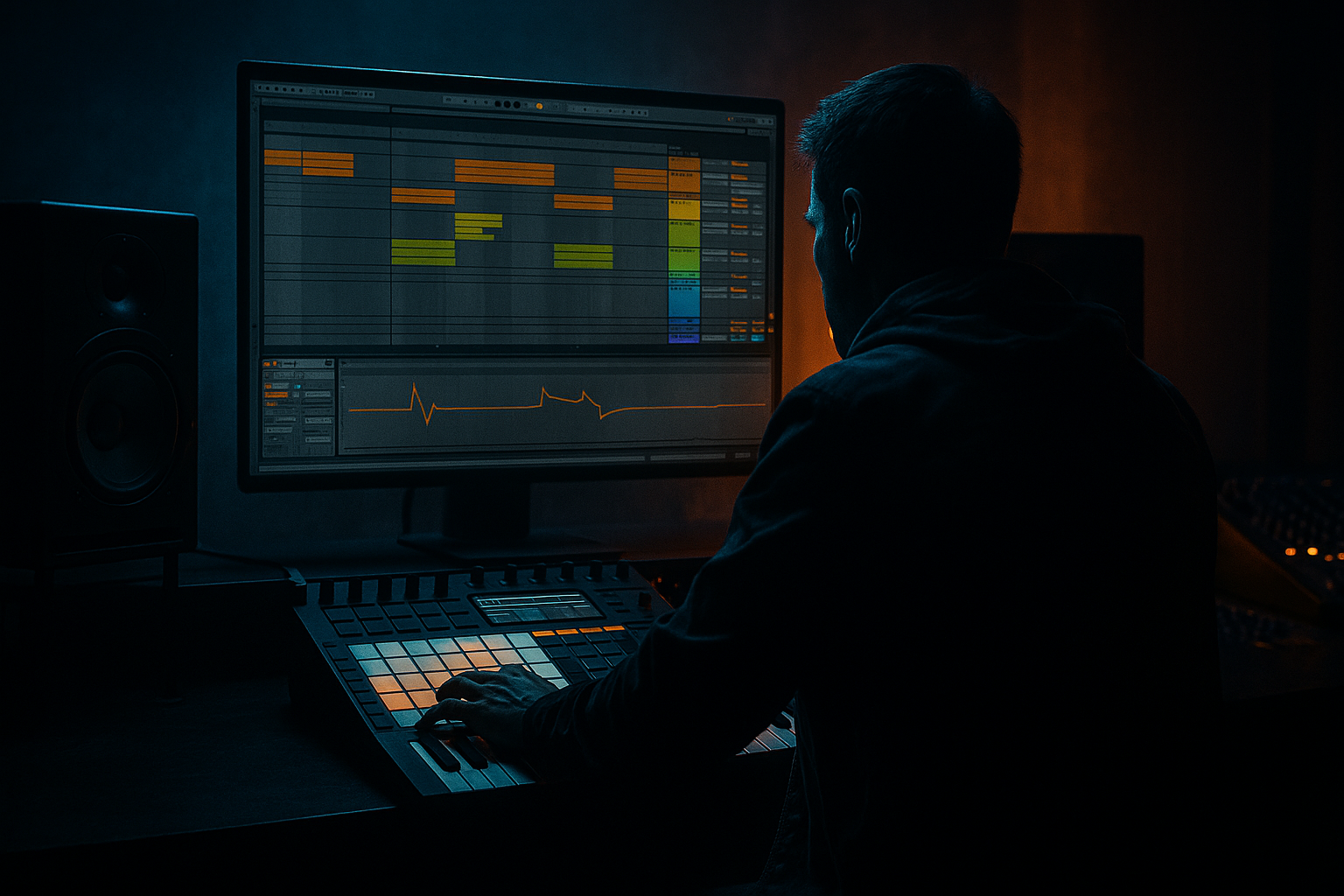
Main tutorial
Lesson Overview
Swing in Drum & Bass is not just about making drums feel “human.” In a ragga-infused DnB context, it’s a weapon for controlled chaos: it can make chopped breaks feel unruly, push snares behind the beat for swagger, and let bassline call-and-response breathe like a live MC performance over a sound system.
In Ableton Live 12, swing is especially powerful because you can shape it at multiple levels: clip groove, drum rack timing, MIDI note placement, launch quantization, and even resampled edit timing. That means you’re not just applying a generic shuffle — you’re designing a pocket that can sit inside jungle rollers, darker half-time switch-ups, or ragga-rubbed jump-up pressure without losing the drive that makes DnB hit.
This lesson focuses on edits: break rearrangement, micro-timing, bass stabs, fills, and transition design. The goal is to make your groove feel like it’s constantly skidding, dodging, and snapping back into place while still locking to a 174 BPM system-ready mix. If you want your tune to feel like a selector just dropped the perfect dubplate cut after a warning siren and a half-done amen chop, this is the pocket you’re after 🔥
What You Will Build
You’ll build a swing-driven DnB edit system in Ableton Live 12 that includes:
- A chopped break with asymmetric swing variations
- Ragga-style offbeat drum and bass stabs that answer the break
- Micro-shifted ghost notes and fill edits that keep the groove restless
- A sub-and-reese bass phrase that stays tight while the top-end “talks”
- A transition framework for 8-bar and 16-bar phrases with DJ-friendly energy
- A resampled edit lane for further slicing, warping, and bass movement
- A rolling 174 BPM break that leans late in the pocket
- Snare hits that land with authority but not rigidity
- Syncopated bass shots that stab around the kick/snare grid
- Ragga vocal or horn-style chops that answer the drums like a call-and-response MC
- Enough movement and tension to work in a darker mix, but with swagger and dancefloor heat
- Applying one global swing value to everything
- Over-swinging the kick and snare
- Making the break too busy after adding ragga chops
- Losing low-end focus when editing bass rhythm
- Using too much saturation on the drum bus
- Editing by eye instead of by feel
- Use swing to make the top feel unstable while the bottom stays armored. A solid mono sub under late ghost hats is a classic dark DnB contrast.
- Try a reese bass that stays rhythmically simple but changes tone with filter automation or wavetable position. The groove should move more in timing than in note density.
- For heavier edits, duplicate your drum rack and make one lane “tight” and one lane “dirty.” Blend the dirty lane quietly with high mids only.
- Use Saturator or Pedal on percussion returns for grit, but high-pass the return so it doesn’t smear your low end.
- On break fills, try tiny reverse slices before the snare. That little inhale makes the drop feel bigger.
- For more underground character, lower the velocity of some ghost notes rather than adding more notes. Negative space is part of the swing.
- Keep an ear on mono compatibility. Ragga-infused chaos should still hit hard from the center, even when the top layers get wide.
- If the track starts sounding too polished, reduce quantization on one percussion lane and resample the result. Slight imperfections often make the groove feel more “dubplate.”
Musically, the result should feel like:
Step-by-Step Walkthrough
1. Build a swing-focused drum foundation with a break and a dry anchor pattern
Start with two drum layers in separate tracks:
- Track 1: a chopped break loop
- Track 2: a dry kick/snare anchor or minimal “safety” kit
In Ableton, drag a classic break into Simplified Warp mode if needed, then slice it to a Drum Rack using Slice to New MIDI Track. Keep the slices tight and playable. You’re not trying to preserve a clean loop here — you’re creating edit material.
Set the project around 170–176 BPM. For ragga-infused chaos, 174 BPM is the sweet spot: fast enough to bounce, slow enough for pocket manipulation.
On the break track, place:
- kicks and snares aligned to the grid initially
- ghost hits and hats slightly late
- one or two edited “pickup” hits leading into the snare
On the anchor track, use a stripped pattern with a punchy snare on 2 and 4 plus a low kick to keep the floor stable. This gives you a timing reference while the break gets slippery.
Why this works in DnB: the anchor preserves genre identity. Even if the break gets heavily swung, the listener still hears the forward propulsion that makes the track hit like DnB instead of a loose shuffle beat.
2. Set groove intentionally instead of blindly applying swing
Open the Groove Pool and audition a few grooves from the library. In advanced DnB edits, the goal is not “more swing,” but the right asymmetry between hats, ghost notes, and strong transients.
Try these starting points:
- A subtle MPC-style 54–58% swing feel for hats and light percussion
- A stronger 60–62% feel for chopped break fills only
- Leave kick and main snare closer to straight time so the floor doesn’t collapse
Apply groove at the clip level rather than globally when possible. This lets you:
- keep the main break slightly loose
- keep bassline MIDI tighter
- swing only the edit layers or top loop
Use Commit Groove if the timing feels good and you want to start making surgical edits. Then manually refine with:
- nudging individual notes late by a few milliseconds
- leaving strong backbeats unshifted
- pushing ghost snare taps behind the beat for ragga swagger
A useful approach is to create three groove zones:
- Straight zone: kick/sub anchor
- Pocket zone: hats, ghost snares, shakers
- Chaos zone: fills, pickups, vocal chops, break slices
3. Shape the break edit with intentional asymmetry
In the MIDI editor, make your break phrasing slightly uneven. Advanced DnB edits sound more alive when they’re not symmetrical across every 2 or 4 beats.
Edit ideas:
- Remove one kick before a snare to create a suction effect
- Duplicate a snare ghost and place it just late of the grid
- Add a tiny roll on the last 1/8 or 1/16 before bar 2 or bar 4
- Shift one hat slice earlier while keeping the next one late
Use velocity as part of the swing design:
- Main snare: 115–127 velocity
- Ghost snare taps: 25–55 velocity
- Hat chatter: vary between 35–80 velocity
- Break accent hits: keep a few in the 90–110 range to prevent blur
Then process the break with stock Ableton devices:
- Drum Buss for transient drive and boom control
- Saturator for harmonic thickness
- Auto Filter if you want a subtle moving top-end on fills
Suggested settings:
- Drum Buss Drive: 5–15%
- Crunch: 10–25%
- Boom: use sparingly, or tune it low and keep the Amount around 10–20%
- Saturator Soft Clip on: yes, with Drive around 2–6 dB
This keeps the edit alive without turning it into brittle noodle drums.
4. Design ragga-style call-and-response with bass stabs and vocal-type chops
The ragga influence should live in the rhythm, not just the sample choice. Build a bassline or stab lane that answers the drum edits.
In a MIDI bass track, create short notes that avoid constant grid lock. Think of the bass like a deejay reacting to the drums:
- a short stab after the snare
- a delayed answer on the “and” of 2 or 4
- a clipped pickup before the drop back into the groove
Use Wavetable, Operator, or Analog for the bass source. A strong workflow is:
- Sub layer: simple sine or filtered triangle
- Mid layer: detuned saw or square for reese character
- Top texture: filtered noise, FM edge, or saturation-heavy upper harmonic layer
Keep the sub mono and clean. Let only the mid layer swing and wobble.
Useful Ableton devices:
- Auto Pan with Amount at 0% but Phase adjusted if you want rhythmic tremor on texture layers
- Chorus-Ensemble very lightly on the top layer only
- Echo for dub-style tail throws on select hits, not the whole bass
Automation ideas:
- open a low-pass filter only on the final hit of an 8-bar phrase
- automate Echo feedback briefly on a vocal chop or stab
- mute the sub for one beat before a drop-back to create a fake-out
Keep the bass phrasing short enough that the swing in the drums stays audible.
5. Use swing to create contrast between the main loop and the edits
The most effective DnB swing often happens in the contrast between “steady” and “fractured.” Make your main loop relatively stable, then push the edits harder.
In practice:
- Main 4-bar groove: mild swing, consistent pocket
- Bar 4 fill: heavier swing, more syncopation
- Bar 8 transition: exaggerated late ghost hits, bass stabs, reverse FX
- Drop 2 or switch-up: reduce swing briefly for impact, then reintroduce it
In Arrangement View, structure 8-bar blocks like this:
- Bars 1–2: establish groove
- Bars 3–4: add ghost snares and hat edits
- Bars 5–6: introduce bass call-and-response
- Bars 7–8: intensify with fills, vocal chops, and a filtered breakdown into the next section
This is especially strong for rollers and jungle-influenced arrangements because it makes the track feel like it’s constantly evolving, even when the core loop is simple.
6. Resample the groove and cut it back into edits
Once the pocket feels good, resample it. Route the drum group or the full edit bus to a new audio track and record a few bars of your best groove.
Then:
- warp the resampled audio if needed
- slice it into a new Drum Rack
- cut new fills from the tail ends of snares and ghost notes
- create one-shot “accident” edits from interesting transient overlaps
This is where advanced edits become special. Ableton’s resampling lets you turn timing decisions into audio detail. You can now:
- reverse a transient
- pitch down a fill hit for a dubby drop
- truncate a vocal chop so it lands in a tighter pocket
- layer a resampled snare ghost under the original for extra grit
Devices to add after resampling:
- EQ Eight to high-pass non-bass edits around 120–180 Hz
- Glue Compressor for light glue, 1–2 dB of gain reduction
- Saturator or Overdrive for controlled edge
If the edit starts feeling too tidy, resample again after changing only one or two timing values. Chaos improves when you preserve some imperfect timing artifacts.
7. Control transient balance so the swing reads on club systems
Swing in DnB has to survive loud playback. If your transients are too soft, the groove collapses. If they’re too sharp, the pocket feels stiff.
For drum groups:
- use Drum Buss to thicken the transient body
- use Glue Compressor on a parallel bus if needed, not across everything too hard
- use Transient shaping by clipping the source clip edges with care, or by tightening envelopes in Simpler/Drum Rack
Good starting points:
- Glue Compressor Ratio: 2:1 or 4:1
- Attack: 10–30 ms to preserve snap
- Release: Auto or around 100–300 ms, depending on groove speed
- Parallel wet bus blend: 10–30%
For bass:
- keep sub in mono
- sidechain lightly from kick or main drum bus
- avoid over-compressing the bass so the swing becomes smeared
A good test: mute the bass and see if the drum swing still feels compelling. Then mute the drums and see if the bass rhythm still communicates intent. You want both to be independently readable.
8. Automate the chaos, but only at the arrangement edges
The best ragga-infused edits usually reserve the biggest swing and movement for the ends of phrases. That keeps the drop clean while making transitions feel alive.
Automate:
- Auto Filter cutoff on a drum loop during 1-bar pickups
- Echo send throws on vocal snippets or percussion hits
- Reverb tail bursts on the last snare before a drop
- Bass filter opening or distortion amount increasing into a switch-up
Try this arrangement move:
- bars 1–7: stable groove with subtle swing
- bar 8: add a late snare ghost, a vocal chop, and a low-pass sweep
- last 1/2 bar: remove kick, leave a snapped rim or hat, then slam back into the drop
This is classic DnB tension/release design. The swing isn’t just rhythmic — it becomes part of the arrangement language.
Common Mistakes
Fix: swing hats, ghosts, fills, and bass differently. Keep the sub and main backbeat more stable.
Fix: let the main impact points stay solid. Put the looseness in the supporting percussion and edits.
Fix: if the vocal/stab lane is active, simplify the break for that bar. Call-and-response needs space.
Fix: keep sub notes short, mono, and rhythmically simple. Swing belongs more in the mid-bass layer.
Fix: saturate in stages. Use light drive on individual layers, then subtle glue on the group.
Fix: loop 2 bars, close your eyes, and listen to whether the groove pulls you forward. If it feels like it’s dragging, reduce the late timing on the backbeat-adjacent hits.
Pro Tips for Darker / Heavier DnB
Mini Practice Exercise
Spend 10–20 minutes building a swing edit loop at 174 BPM:
1. Create a 2-bar drum loop with one chopped break and one anchor snare pattern.
2. Add a Groove Pool groove and set the break clips to 54–60% swing feel.
3. Manually offset three ghost notes late by small amounts.
4. Add one bass stab that answers the snare on bar 2, beat 4.
5. Insert one vocal chop or stab with an Echo throw on the final 1/2 bar.
6. Resample the loop, then slice one interesting fill back into a Drum Rack.
7. Compare the original and the resampled version. Choose the one that feels more like a proper DnB edit pocket.
8. Repeat once, but this time make the kick and sub less swung and the top percussion more swung.
Goal: end with a loop that feels like it can survive into a drop and also work as a transition edit.
Recap
Swing in Ableton Live 12 becomes powerful in DnB when you treat it as an edit design tool, not a blanket shuffle setting. Keep the kick and sub stable, push ghost notes and top percussion later, and use resampling to turn good timing into new material. For ragga-infused chaos, let the drums and bass speak in call-and-response, and reserve your biggest timing moves for transitions and phrase endings. That balance of control and unruliness is what makes the groove feel alive.

