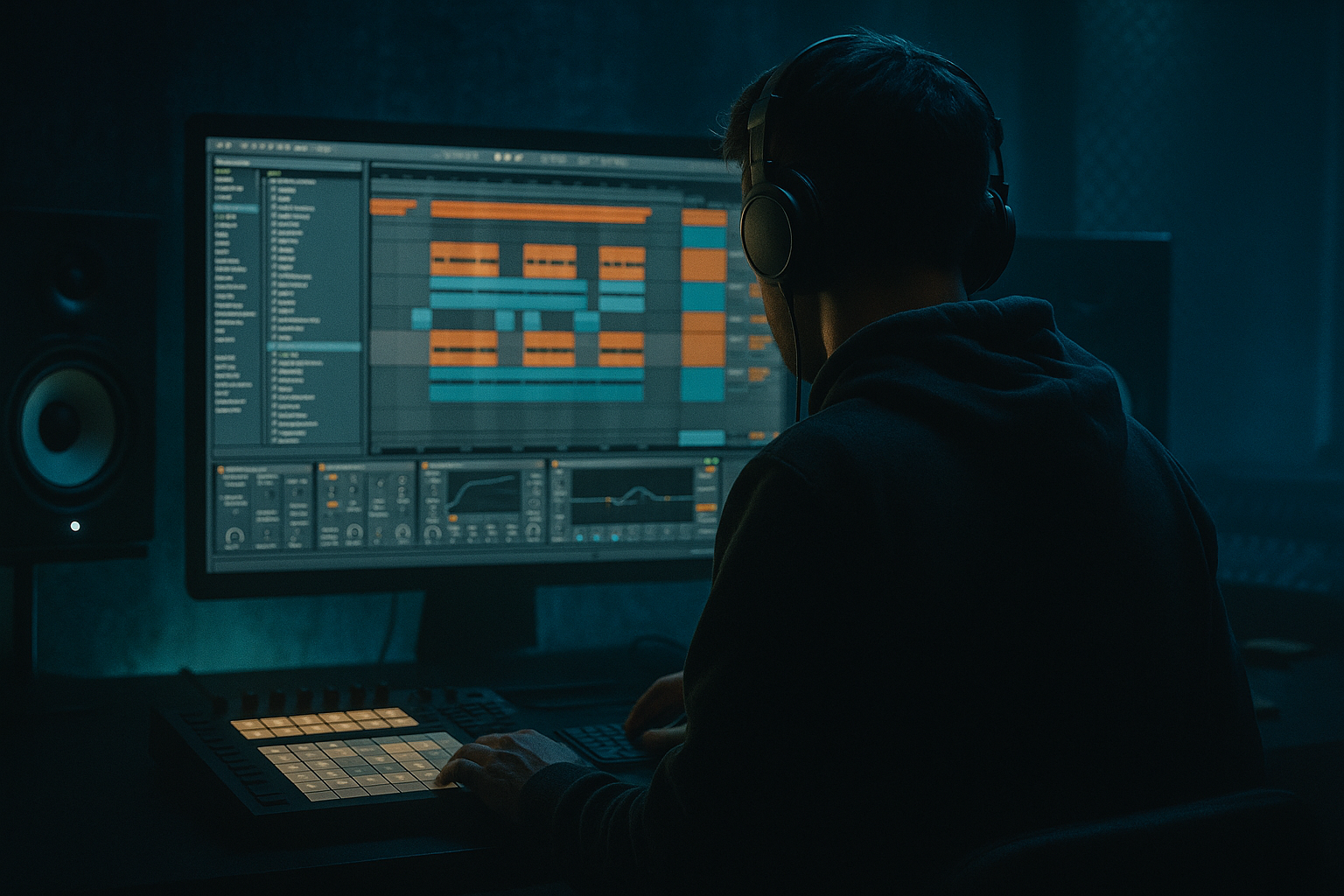
Main tutorial
```markdown
Tagging One‑Shots by Mood — Masterclass (Ableton Live 12) 🔖🥁
Skill level: Intermediate
Category: Workflow
Context: Drum & Bass / Jungle / Rolling bass music in Ableton Live 12
---
1) Lesson overview
In DnB, speed kills—in a good way. The faster you can find the right snare, hat, rim, stab, or vocal chop for the mood, the faster you can write 16–32 bar ideas that actually slap.
This lesson is about building a mood-based one‑shot tagging system inside Ableton Live 12 so you can:
- Audition one-shots quickly at 172–176 BPM
- Choose samples that match the vibe (dark, punchy, jazzy, airy, neuro, etc.)
- Stay consistent across a track (drum identity + palette cohesion)
- Move from “sample browsing” to “arrangement momentum” 💨
- Ableton Live 12 Browser + tags/collections
- Drum Rack + Simpler
- A few key stock devices for preview normalization and vibe shaping
- DARK / MENACE (industrial, cold, shadowy)
- ROLLING / GROOVE (shuffly, tight, forward motion)
- JUNGLE / RUFF (breaky, raw transients, grime)
- LIQUID / AIRY (soft top, wide, silky)
- NEURO / TECH (clinical, aggressive mids, synthetic)
- RETRO / 90s (Akai-ish, crunchy, sampled)
- CINEMATIC / IMPACT (big hits, booms, risers)
- WEIRD / EAR CANDY (odd perc, foley, glitch)
- `tight`, `snappy`, `ringy`, `papery`, `woody`, `metal`, `dusty`, `bright`, `soft`, `wide`
- Tempo: 174 BPM
- Groove Pool: load a classic shuffle (e.g., MPC-ish 16 swing), keep it ready
- Create these tracks:
- C1: Kick
- D1: Snare
- E1: Clap/Layer
- F#1: Rim/Click
- A#1: Closed hat
- C#2: Open hat
- D#2: Ride/shaker
- F2: Perc 1
- G2: Perc 2
- A2: FX hit
- Use Simpler (One-Shot mode)
- Kick: 1.1
- Snare: 1.2 and 1.4
- Closed hats: 1/8 or 1/16 with slight velocity variation
- Add one ghost note/snare drag (very low velocity) if you like
- Load a classic break (Amen-ish / Think-ish) at low volume
- HP at 150–250 Hz so it’s mainly top texture
- Does it cut through hats + break?
- Does it fight the break transient?
- Does it feel liquid vs tech vs jungle?
- If a one-shot is “pretty good,” don’t tag it.
- If it’s “I’d use this in a track today,” tag it.
- `SNARE_dark_metal_tight_01.wav`
- `HAT_liquid_air_16th_03.wav`
- `PERC_jungle_wood_ghost_02.wav`
- ROLLING KIT — tight kick, snappy snare, clean hats, minimal perc
- DARK KIT — heavy snare layer, metallic hats, industrial hits
- JUNGLE KIT — break-friendly snare, crunchy rides, foley perc
- “Top Brightness” = EQ Eight high shelf
- “Dirt” = Redux (tiny) or Saturator
- “Room” = Reverb (short)
- Tag by mood and role:
- Audition stabs with:
- Tag:
- Audition with Gate (tighten), then Saturator (presence)
- Tag by function:
- Bars 1–16: Rolling kit (clean hats, tight snare)
- Bars 17–32: Introduce DARK perc one-shots (metal hits every 4 bars)
- Bars 33–48 (Drop): Dark kit snare layer + industrial hat swap
- Bars 49–64: Return to Rolling hats but keep Dark snare tail for tension
- Make a dedicated “METAL TOPS” collection
- Transient control is everything
- Layer with intent (2 layers max most of the time)
- Use Redux lightly for “old rave / jungle grime”
- Mono your sub interactions while auditioning kicks
- Print a “dark room tail” as an FX one-shot
- Mood tagging works when you keep the mood list small, tag only winners, and audition in a real DnB loop.
- Use Collections for mood, file names for character/function.
- Build a Drum Rack audition rig with macros and a light drum bus chain (EQ Eight → Drum Buss → Glue → Limiter).
- Turn curated tags into mood kits (Drum Rack presets) so you can write faster and keep a coherent drum identity.
- For darker/heavier DnB, prioritize tops character, transient shaping, and functional layering.
We’ll do this using:
---
2) What you will build
A practical system that includes:
1. A mood taxonomy for DnB one‑shots (kicks, snares, hats, perc, stabs, vox, FX)
2. A “Tagging Session” project template
3. Mood-based Collections (e.g., DARK, ROLLING, JUNGLE, LIQUID, NEURO) + consistent naming rules
4. A Drum Rack audition rig that lets you test one-shots in context (with a beat + bus chain)
5. A quick method to commit: save curated mini-packs as Ableton presets (Drum Rack + macro mapping)
End result: when you want a “cold metal snare” for a halftime switch, you can pull it instantly without derailing your flow.
---
3) Step-by-step walkthrough
Step 0 — Decide your DnB mood map (keep it usable) 🧠
Don’t tag 40 moods. Tag 8–12 that actually reflect decisions you make while producing.
Here’s a solid DnB-focused set:
Core moods (Collections):
Optional “feel” tags in the file name:
> Rule: Collections = mood, file naming = character.
---
Step 1 — Create a dedicated “One‑Shot Tagging” Ableton project 📁
Make a project you open only to tag and curate.
Project setup (recommended):
1. DRUM AUDITION (Drum Rack)
2. REFERENCE LOOP (a 4–8 bar drum loop you trust)
3. BASS BED (simple reese/sub to test low-end interactions)
4. PREVIEW BUS (return track or group processing)
Why: You’re tagging based on how samples behave in DnB context, not in isolation.
---
Step 2 — Build the Drum Rack audition rig (fast + honest) 🥁⚡
Create a Drum Rack with these pads loaded (use any placeholders initially):
On each pad (inside the Rack):
- Snap: On
- Fade In/Out: tiny (1–5 ms) if clicks happen
- Voices: 1 (for most drums), hats can be 2–4 if needed
Macro controls (map these to Rack macros):
1. Pitch (Simpler Transpose)
2. Start (Sample Start)
3. Decay (Volume envelope Decay)
4. Drive (Saturator Drive)
5. Punch (Drum Buss Amount)
6. Tone (EQ Eight tilt: lows down/highs up or vice versa)
7. Width (Utility Width; for hats/perc mostly)
8. Room (Reverb send amount or small Reverb device)
On the Drum Rack (group/bus chain):
1. EQ Eight
- HP filter around 25–35 Hz (remove rumble)
- Gentle dip 200–350 Hz if boxy buildup happens
2. Drum Buss
- Drive: 2–10% (use taste)
- Crunch: 0–20
- Boom: Off for auditioning (turn on later if desired)
3. Glue Compressor
- Attack: 3 ms
- Release: Auto
- Ratio: 2:1
- Aim for 1–2 dB GR when the loop plays
4. Limiter (safety)
- Ceiling: -0.8 dB
> This chain helps you hear how one-shots will behave in a typical DnB drum bus—without over-processing.
---
Step 3 — Create a DnB context loop to audition against 🎛️
Make a simple clip that plays constantly while you swap samples:
Basic 2-step loop (1 bar):
Add a break layer track (optional but recommended):
Now when you audition a snare, you’ll immediately know:
---
Step 4 — Use Live 12’s Browser tagging + Collections properly 🏷️
Goal: Your browser becomes your mood library.
Practical workflow:
1. In the Browser, locate your one-shot folders (kicks, snares, hats, perc, stabs, vox, fx).
2. Start with one category, e.g., Snares.
3. Audition by dragging a snare onto the Snare pad (D1) in the Drum Rack while your loop is playing.
4. When it matches a mood, tag it immediately:
- Add to a Collection (e.g., DARK, JUNGLE, LIQUID)
- If it fits multiple moods, that’s fine—but cap it at 2–3 tags max to avoid chaos.
Tagging rule (very effective):
Naming rule (fast and consistent):
If you’re willing to rename files, use:
If you can’t rename (sample packs), create a “_Curated” folder and copy favorites in with your naming.
---
Step 5 — Build “Mood Kits” as Drum Rack presets 🎒
Once you have tagged enough, build mini kits that match a vibe.
Example kits:
How to build:
1. Load your Drum Rack.
2. Fill pads using tagged one-shots only.
3. Save the Drum Rack:
- Click the disk icon → save as:
- `DnB_Rolling_Kit_01.adg`
- `DnB_Dark_Kit_Metal_01.adg`
Pro move: map a few macros for quick vibe shifts:
Now you’re not just tagging samples—you’re tagging usable palettes.
---
Step 6 — Tag non-drum one-shots like a DnB producer (stabs/vox/fx) 🔊
DnB lives on quick ear-candy moments.
Stabs:
- `stab_dark_short`
- `stab_liquid_wide`
- `stab_90s_rave`
- Echo (1/8 or dotted 1/8)
- Auto Filter (for movement)
- Reverb (short plate for liquid, darker room for tech)
Vocal chops:
- `vox_command` (shouts, “rewind,” “listen”)
- `vox_atmo` (breathy textures)
- `vox_hooky` (melodic bits)
FX hits:
- `fx_impact_dark`
- `fx_riser_noise`
- `fx_downlifter`
- `fx_glitch`
This makes arrangement faster: you can build a 32-bar drop with intentional moments.
---
Step 7 — Arrangement idea: mood-based “drum identity” across 64 bars 🧱
Once tagged, use mood kits to keep identity consistent:
Example: Rolling-to-Dark switch (64 bars at 174):
This is where mood tagging pays off: you’re swapping vibes, not randomly browsing.
---
4) Common mistakes 🚫
1. Tagging everything
If your DARK collection has 400 snares, you’ve just rebuilt the problem.
2. Auditioning solo
A snare that sounds “huge” solo might vanish against breaks + hats at 174.
3. No consistent loudness
Some samples are way louder—your brain will pick them unfairly. Use a Limiter and keep your monitor level consistent.
4. Over-tagging with micro-moods
“Dark-industrial-metal-warehouse-icy” is not a system.
5. Ignoring function
Mood is great, but “ghost snare,” “main snare,” “layer click,” “ride loop” is what gets tracks finished.
---
5) Pro tips for darker/heavier DnB 🖤🔥
Dark DnB often wins with hats/perc character more than kick choice.
Use Drum Buss (Transient) subtly on snares/claps to sharpen without harsh EQ.
Example:
- Layer A: snappy transient (short)
- Layer B: body (200–600 Hz) or tail (reverb print)
Use EQ Eight to carve each layer’s job.
On hats or break toppings:
- Downsample a touch, keep it subtle, then lowpass a bit.
Put Utility on the Drum Rack bus and toggle:
- Width = 0% (briefly) to check mono punch/phase.
Take a snare hit → add Reverb (dark) → resample the tail → now you have signature atmosphere hits you can tag as `fx_tail_dark`.
---
6) Mini practice exercise (15–25 minutes) ⏱️
Goal: Tag 30 one-shots with confidence and build 1 mood kit.
1. Set project to 174 BPM and loop your 1-bar 2-step.
2. Choose one category: Snares.
3. Audition 50 snares quickly.
4. Tag only 10 as:
- 4 = DARK / MENACE
- 3 = ROLLING / GROOVE
- 3 = JUNGLE / RUFF
5. Repeat for hats: tag 10 hats (mostly ROLLING vs LIQUID vs DARK).
6. Build a DnB_Dark_Kit_01 Drum Rack using only tagged samples.
7. Save it as an .adg and write a quick 16-bar loop:
- Bar 1–8: tight groove
- Bar 9–16: add 2 ear-candy hits (stab/vox/fx), both tagged DARK
You’ve now converted browsing into a repeatable workflow.
---
7) Recap ✅
If you want, tell me your current mood categories and how your samples are organized (packs, Splice, custom folders), and I’ll propose a clean tag taxonomy + a Rack macro layout tailored to your sound.
```

