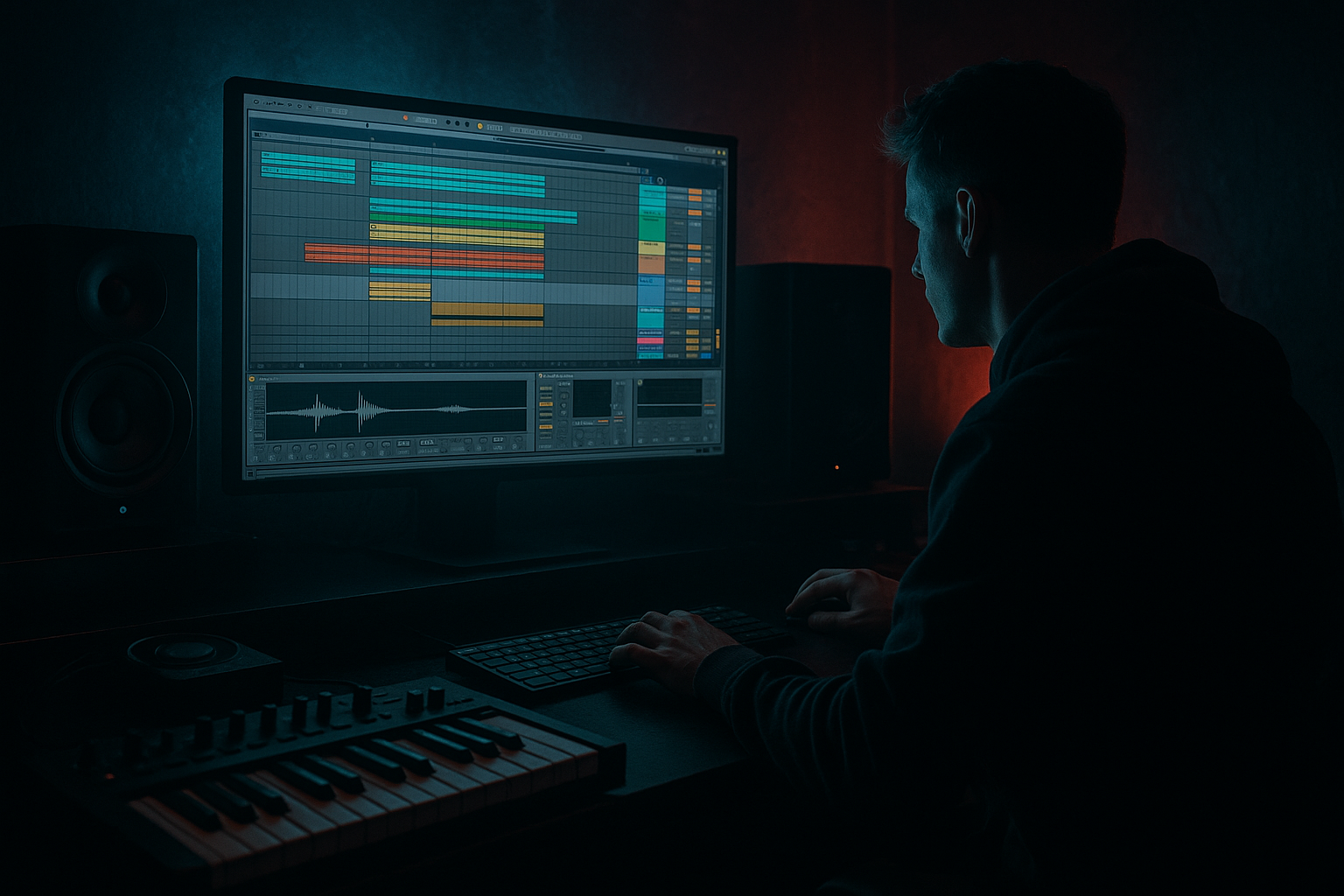
Main tutorial
```markdown
Tail Trimming for Cleaner Break Loops (DnB in Ableton Live) ✂️🥁
1) Lesson overview
In drum and bass, break loops live or die on tightness. Even a legendary Amen-style break can feel messy if the tails (ring-out, room noise, cymbal wash, bleed) overlap into the next hit. In this lesson, you’ll learn practical tail trimming workflows in Ableton Live to make breaks punchy, clean, and mix-ready—without killing the vibe. ⚡
You’ll cover:
- Manual trimming in Clip View (fast + precise)
- Fades to avoid clicks
- Gates/expanders for consistent control
- Transient shaping for snap
- Resampling for a clean, locked-in break loop
- Hits cut cleanly so kicks and snares don’t smear
- Cymbal/room tails controlled so your sub and reese have space
- A “clean version” and a “dirty version” for quick arrangement swaps
- Kick: tail tight but not choked → end right after body (often 40–120 ms depending on the break)
- Snare: allow a bit more ring → 80–180 ms
- Hats: keep short for roll clarity → 20–60 ms
- In Simpler: use Fade Out
- In Arrangement: if working with audio slices, select a clip edge and apply Fade handles (enable Create Fades on Clip Edges in Live’s preferences if needed)
- Drop into builds
- Chop further
- Reverse tail bits for transitions
- Layer with other breaks
- Clean break (tight tails, gated, punchy)
- Dirty break (more room/hat tail, less gating)
- Intro: dirty (more vibe, less aggressive)
- Drop: clean (space for sub + reese)
- Second 16 bars: alternate clean/dirty every 4 bars for movement
- Fills: bring back tails briefly before a snare fill (energy spike)
- Multiband tail control:
- “Sub-safe breaks” trick:
- Parallel dirt, clean transients:
- Short room reverb after trimming:
- Tail trimming is about space: tighter breaks = clearer bass + louder mixes.
- Warp first, then trim.
- Use Slice to New MIDI Track + Simpler for detailed control, and Gate for quick cleanup.
- Always apply micro fades to avoid clicks.
- Restore punch with Drum Buss / Saturator, and keep the low-end clean with EQ Eight.
- Resample your final loop to stay fast and creative in arrangements.
---
2) What you will build
A 16th-grid-tight, rolling DnB break loop (think classic jungle funk but modern clean):
---
3) Step-by-step walkthrough
Step 0 — Session setup (so trimming is easy)
1. Set tempo: 170–174 BPM (start at 174).
2. Drop a break sample onto an audio track (e.g., “Amen”, “Think”, “Funky Drummer”, or any DnB break).
3. In the clip:
- Turn Warp = ON
- Warp Mode: Beats
- Preserve: Transients
- Set Loop ON and loop length to 1 bar (or 2 bars if the break is longer)
Why Beats mode? It’s perfect for percussive audio and keeps transient timing solid while you edit tails.
---
Step 1 — Get the break properly aligned first (don’t trim a mis-warped loop)
1. In Clip View, click Warp markers only where needed:
- Put a marker at 1.1.1 (first kick)
- Ensure the main snare lands exactly on 1.2 and 1.4 (typical DnB backbeat)
2. Right-click the first transient → “Set 1.1.1 Here”
3. If the groove drifts, add a warp marker at the end of the bar and gently align.
✅ Goal: The loop plays in time before you start micro-editing tails.
---
Step 2 — Manual tail trimming with Clip envelopes + fades (quick + musical)
This is the most “producer” method: you keep the break as audio but sculpt it.
#### A) Split the break into hits (non-destructive and fast)
1. Right-click the clip in Arrangement View (or Session) → Slice to New MIDI Track
2. Settings:
- Slicing preset: Built-in > Slicing
- Slice by: Transient
3. Ableton creates a Drum Rack with slices (each slice = a hit/region).
Now you can trim tails per slice.
#### B) Trim tails inside each slice (critical!)
1. Click a pad in the Drum Rack.
2. Open Simpler (each pad uses Simpler by default).
3. In Simpler:
- Classic mode
- Enable Snap (if available) for easier editing
- Drag the End marker left to cut the tail
- Add small Fades:
- Fade Out: short (just enough to prevent clicks)
Suggested starting points (per slice):
🎯 You’re aiming for “punch then silence,” not “punch then wash into the next 16th note.”
---
Step 3 — Add consistent control with a Gate (classic DnB cleaning tool) 🚪
For breaks with messy room tone, a Gate can do the repetitive work.
1. On the break audio track (or on the Drum Rack chain output), add:
- Gate (Ableton stock)
2. Start with these settings:
- Threshold: start around -25 dB (adjust until hats/snare open, but noise closes)
- Return: -inf dB (hard gate) or -20 dB (gentler)
- Attack: 0.3–1 ms (fast, keeps transients)
- Hold: 10–25 ms (prevents chatter)
- Release: 40–120 ms (controls tail length)
- Turn on Sidechain Filter and set it to focus on the “hit” area:
- HP around 120 Hz (reduces low rumble opening the gate)
- LP around 10 kHz (optional—helps ignore hiss)
3. A/B test:
- Bypass the Gate → hear the wash
- Re-enable → hear space open up
✅ Goal: Cleaner gaps between hits so your bass and reverb don’t fight the break.
---
Step 4 — Prevent clicks (tiny fades are non-negotiable)
Clicks happen when you cut audio away from a zero crossing.
Options:
Rule of thumb:
Use 1–5 ms fade-ins/outs for drums. That’s enough to remove clicks without dulling transients.
---
Step 5 — Add punch back after trimming (transients can get softer)
If your trimming/gating made the break a little too polite:
1. Add Drum Buss after the Gate:
- Drive: 2–8
- Boom: OFF (or very low for breaks)
- Transient: +5 to +20 (use taste)
- Soft Clip: ON
2. Optionally add Saturator before Drum Buss:
- Mode: Analog Clip or Soft Sine
- Drive: 2–6 dB
- Turn on Soft Clip
This gives you that modern DnB snap while keeping the tails controlled.
---
Step 6 — Resample a clean “final break” for arrangement speed 🎛️
Once it sounds tight, print it so you’re not juggling 20 slices later.
1. Create a new audio track: “BREAK_RESAMPLE”
2. Set input to:
- Resampling (or route from your break group)
3. Arm the track and record 4–8 bars of the loop.
Now you have a clean loop you can:
---
Step 7 — Arrangement ideas (DnB-friendly)
Use two versions:
Try:
---
4) Common mistakes
1. Over-trimming snares
If the snare tail disappears completely, the break loses “air” and feels fake. Leave a controlled ring.
2. Gating with too-fast release
Makes hats chatter and creates unnatural pumping. Increase Hold and smooth the Release.
3. Ignoring fades
Clicks are tiny but ruin “pro” feel. Use micro fades everywhere.
4. Warping wrong, then trimming
If the loop isn’t aligned to the grid, trimming becomes random. Warp first.
5. Cleaning everything until it’s sterile
Jungle/DnB thrives on texture. Trim the problem tails, not all character.
---
5) Pro tips for darker/heavier DnB 🖤⚙️
Use Multiband Dynamics gently to tame harsh top-end wash:
- Slight compression on High band, slow-ish release
- Don’t squash mids too much—keep snare body.
Put EQ Eight after your break chain:
- High-pass at ~120–180 Hz (24 dB/oct)
Breaks don’t need sub; your bass does.
Duplicate the break:
- Track A: clean + tight
- Track B: heavier Saturator / Overdrive / Drum Buss, then low-pass around 6–10 kHz
Blend B underneath for weight without extra tail chaos.
Add Reverb with:
- Decay: 0.3–0.7s
- Pre-delay: 10–25 ms
- High-pass in Reverb: 200 Hz+
This gives controlled space instead of messy sample room.
---
6) Mini practice exercise (10–15 minutes) 🎯
1. Choose a 1-bar break loop at 174 BPM.
2. Create two versions:
- Version A (Manual): Slice to Drum Rack → trim tails in Simpler.
- Version B (Gate): Keep as audio → Gate + Drum Buss.
3. For both versions:
- Ensure no clicks (fades!)
- High-pass with EQ Eight (~150 Hz)
4. Print (resample) both and drop them into an 32-bar arrangement:
- 16 bars: A (super tight)
- 16 bars: B (slightly dirtier)
5. Listen: which one sits better with a heavy sub bass?
---
7) Recap ✅
If you want, tell me what kind of break you’re using (Amen/Think/modern top loop) and whether your track is more rollers, techstep, or jungle, and I’ll suggest exact Gate + Drum Buss settings for that vibe.
```

