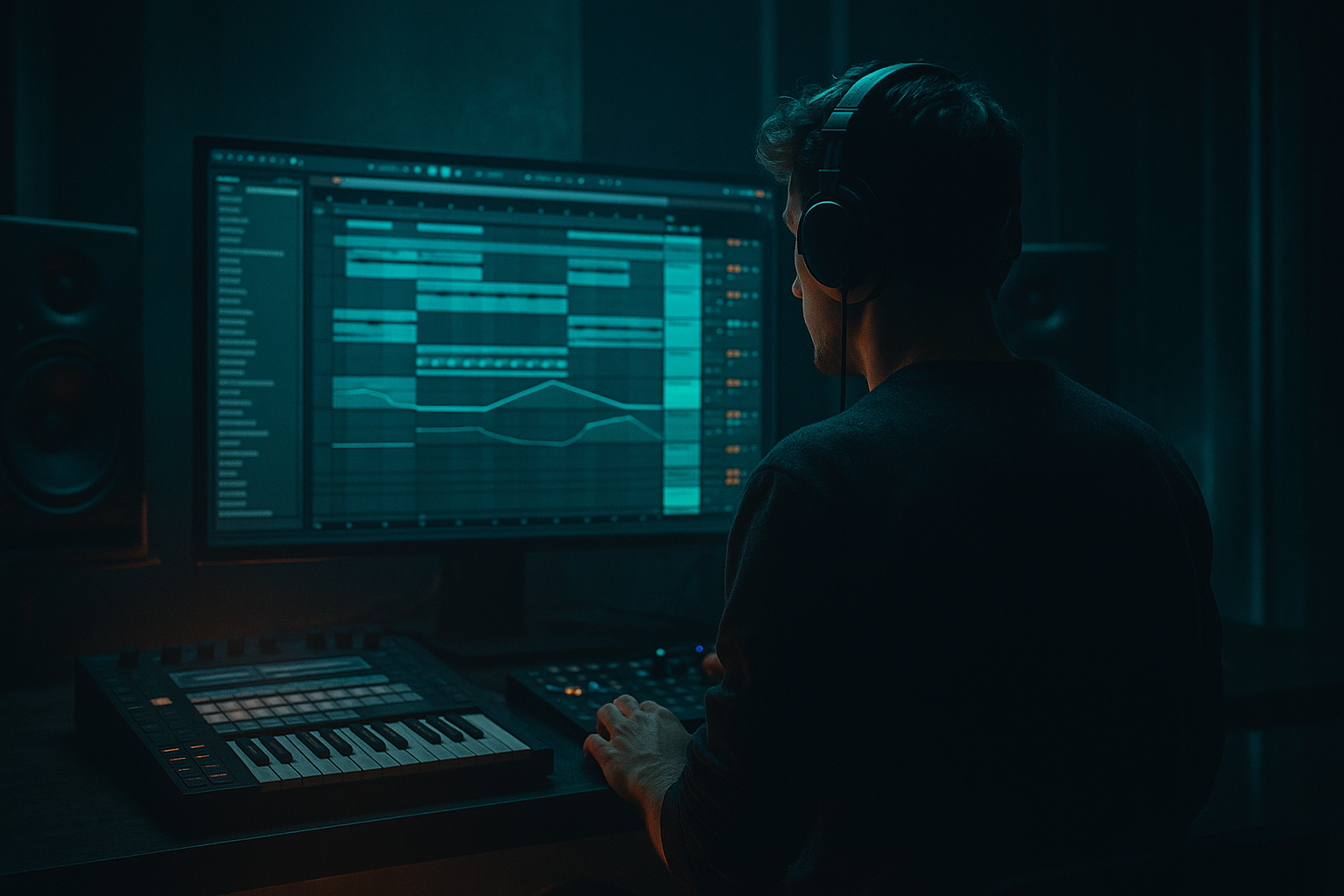
Main tutorial
Talking Bass Movement Design for Faster Workflow (DnB in Ableton Live)
Energetic, clear, and practical — this lesson teaches you a fast, repeatable workflow for making “talking” / vowel-like bass movement that sits in Drum & Bass, Jungle and rolling DnB productions. We'll use stock Ableton devices, Instrument Racks, MIDI routings and macro mapping to prototype and iterate quickly. 🎛️🔥
---
1) Lesson overview
Goal: Build a versatile talking bass instrument that combines a clean sub + mid “talk” layer + growl texture, with a single macro-driven workflow for rapid iteration. You’ll learn how to:
- Build a 3-chain Instrument Rack (Sub / Talk / Growl)
- Create vowel-like movement using LFOs, filter envelopes, and vocoder-style techniques
- Map multiple controls to macros for quick sculpting
- Arrange quick variations for DnB rolls and drops
- Apply stock Ableton effects for weight and presence
- Provides a mono, clean sub that tracks the root note
- Provides a midrange “talking” layer that forms vowel movement via filter + wavetable position + LFO
- Provides a distorted/resent growl layer for character
- Exposes 6 macros that let you dial entire phrases quickly (cutoff, vowel morph, drive, width, LFO rate, envelope amount)
- Is easy to automate per-section in arrangement (breaks, fills, buildups)
- Macro 1: “Cutoff” — map to Talk chain Filter Cutoff and Wavetable Position (map both, scale ranges so a single knob shifts vowel)
- Macro 2: “Vowel Morph” — map to Wavetable Position (wider range) and Growl pitch/formant if possible
- Macro 3: “Drive” — map to Sub Saturator Drive (light), Talk Saturator Drive, Growl Saturator Drive
- Macro 4: “Size/Width” — map Utility Width (post-rack) and, if you used stereo FX, map their Dry/Wet
- Macro 5: “LFO Rate/Sync” — map Wavetable LFO Rate (if possible sync values), or use an LFO (Max for Live) mapped to change rate values
- Macro 6: “Envelope Amount” — map Talk Filter Env Amount and Amp Decay (makes the tone sharper vs. longer)
- Vocoder trick: Duplicate the Talk chain, put an EQ’d vocal or noise into an Audio track, then use Vocoder (Carrier = bass synth) or Vice versa to impart vocal formants. This is heavier but gives realistic talking vowels.
- Envelope Follower (Max for Live) or Sidechain Gate: Use the drums to trigger Filter Env opening via Envelope Follower mapped to filter cutoff — creates interplay between drums and vowel shape quickly.
- Build sections using macro automation:
- Duplicate clip and change clip modulation for fast variation (copy/paste + tweak macros per clip).
- Build a 3-chain Instrument Rack (Sub / Talk / Growl) to separate low-end from character.
- Use Wavetable (or Operator) + bandpass/resonance + LFO/envelope to create vowel-like movement.
- Map multiple parameters to macros for instant, musical control — that’s the core of faster workflow.
- Use tempo-synced LFOs, routine sidechain, and focused EQ/saturation for clarity in DnB.
- Save presets and quick rack variants so you can drop a working talking bass into future projects fast. 🚀
Target: Intermediate producers who know basic Instrument Rack routing, MIDI clips and Ableton devices (Operator, Wavetable/Simpler, EQ Eight, Saturator, Compressor). BPM example: 170–176 (we’ll reference 174 BPM as classic DnB tempo). 🥁⚡
---
2) What you will build
A single Instrument Rack you can drop into a DnB project that:
Result: A talking bass that lets you iterate shapes quickly across a 16-bar rolling pattern. 🪄
---
3) Step-by-step walkthrough
Set your Live tempo to 174 BPM. Create a new MIDI track.
Step 1 — Create the Instrument Rack skeleton
1. Drag an Instrument Rack into the MIDI track.
2. Right-click the rack title bar → Show Key Zone / Show Chain List so you can add chains.
We’ll build three chains: Sub, Talk, Growl.
Step 2 — Sub chain (clean mono low-end)
1. Create a Chain and rename it “Sub”.
2. Place Operator on that chain (stock synth).
3. Operator settings (fast route to a deep sub):
- Osc A: Sine wave, Level ~ -2 dB
- Osc B/C/D: Off (or very low)
- Amp envelope: Attack = 0 ms; Decay = 250–350 ms; Sustain = 0.0; Release = 80–150 ms (short, punchy)
- Filter: Low-pass 24 dB (use Operator filter), Cutoff ≈ 120 Hz, Resonance ≈ 0%
4. On the Sub chain device chain after Operator:
- Utility (to force mono): Width 0% below 120 Hz (we’ll automate width later)
- EQ Eight: High-pass everything above 35 Hz? No — instead, use EQ Eight to cut anything above ~180–220 Hz by applying a high-shelf or low-pass (set a gentle slope if needed). Keep sub energy focused.
- Glue Compressor (optional): Soft compression — Threshold ~ -10 dB, Ratio 2:1, Attack 5 ms, Release Auto (glues sub).
Key zone: Map this chain to the lower octave range — e.g., set Key Zone from C0 up to C2 so the Sub only plays low notes. (Right-click the chain → Key Zone)
Step 3 — Talk chain (formant / vowel movement)
1. Create a second Chain called “Talk”.
2. Use Wavetable (preferred) or Analog/Operator if you don’t have Wavetable.
3. Wavetable initial settings:
- Osc 1: Choose a formant / vowel-like wavetable (e.g., “Vowel”, “Formant” or any wavetable with harmonics).
- Position ~ 15–30 (start darker)
- Osc 2: Optional for layering (detune slightly -7 to +7 cents)
- Amp envelope: Attack 3–8 ms, Decay 250–400 ms, Sustain ~0.2–0.4, Release 80–140 ms
4. Filter:
- Use Wavetable’s Filter or add Auto Filter after Wavetable set to Bandpass (24 dB).
- Bandpass Center (Cutoff): ~600–1600 Hz (we’ll modulate)
- Resonance: 30–60% (higher gives vowel shape)
5. LFO / Envelope modulation:
- Set LFO 1 (inside Wavetable) to sync: Rate 1/8 or 1/16, Shape = sine or triangle, set Amount to 20–50% and route to Filter Cutoff or Position.
- Map Amp Envelope or a dedicated Filter Envelope to shift the filter per note (shorter decay for more “talk” pluck).
6. Audio FX (after Wavetable):
- EQ Eight: High-pass at ~80 Hz (to avoid clashing with Sub)
- Saturator: Drive ~2–5, Type = Analog Clip or Soft Sine, Dry/Wet ~40–60% (adds harmonics)
- Frequency Shifter: Subtle amount to add metallic formant if needed (Amount ~0.1–0.6)
Key zone: Map this chain to mid/higher notes — e.g., C2 to C5.
Step 4 — Growl chain (distorted character)
1. Add a third Chain named “Growl”.
2. Use Simpler or Sampler with a wavetable/growl sample (you can also use Operator with FM routing).
3. Load a short, resampled growl or use Wavetable with heavy FM/position mod:
- Amp envelope: Attack 1–6 ms, Decay 200–600 ms, Sustain lower for percussive growls.
4. FX chain:
- EQ Eight: high-pass at 120 Hz
- Saturator: Drive 4–8 (more intense), Mode = Analog Clip
- Compressor: Ratio 3–4:1, Attack ~2–6 ms, Release 80–150 ms
- Frequency Shifter / Chorus / Delay (tiny) — add width and movement
5. Tone: keep growl centered but present in the midrange.
Key zone: Map Growl to the same as Talk (C2-C5) or slightly above depending on your melody.
Step 5 — Global processing on Rack output
After the Instrument Rack place a chain of audio effects to glue the whole bass:
1. EQ Eight: Clean up, remove conflicting mids and ensure sub is tight (cut 250–400 Hz if muddy).
2. Saturator: Slight overall drive (Drive 1–3), Dry/Wet 30–50%
3. Glue Compressor: Threshold -8 to -15 dB, Ratio 2:1, Attack 10 ms, Release Auto
4. Utility: Set Stereo Width to taste (sub should remain mono; we’ll control that in macros).
5. Compressor (sidechain): If you want pump with kick/snare set Compressor sidechain:
- Sidechain input: Drums (Kick or Drum Bus)
- Ratio 4:1, Attack 1–5 ms, Release 80–120 ms, Threshold so the bass ducks per kick hits
Step 6 — Macro mapping for fast workflow (the key to speed)
Map the following to Macros 1–6:
Tip: When mapping multiple parameters to one macro, right-click → Map Modulation to scale ranges so the macro behaves musically.
Step 7 — Create quick presets
1. Save this Instrument Rack as “DnB_TalkingBass_Rack”.
2. Duplicate the rack and create quick variants: “Closed Vowel”, “Open Vowel”, “Growl Heavy”, “Sub Heavy” — tweak macros and save each preset. You can now drag them into a project quickly. 💾
Step 8 — MIDI clip & rhythmic movement (fast editing)
1. Create a MIDI clip (16 bars at 174 BPM) with a rolling bass pattern:
- Use 16th notes or 16th triplets; DnB feels great with 1/16 + swing/subtle syncopation.
2. Use MIDI Velocity to control filter envelope amount:
- Map note velocity to Macro 6 (Envelope Amount) via MIDI Effects → Velocity device, set Range.
3. Use Clip Envelopes:
- Automate Macro 1 and Macro 2 inside the clip for per-bar vowel changes (e.g., automate Macro 1 to open on bars 3, 7, 11, 15).
Step 9 — Vowel movement alternatives (fast tricks)
Step 10 — Arrange quickly
- Intro: Macro 1 closed, Macro 3 low (dry)
- Build: Macro 1 opens, Macro 5 rate speeds up
- Drop: Macro 3 drive up, Macro 4 widen, short mute/unmute for risers
---
4) Common mistakes
1. Sub and mid phase cancellation — don’t stereoize the sub. Keep sub mono (Utility width 0% for frequencies < 120 Hz). 🚫
2. Overdriving saturator on the sub — leads to muddiness and loss of low-end. Use parallel saturation or route growl to be more aggressive. ⚠️
3. Unsynchronized LFOs — non-synced LFO rates can clash with DnB’s fast breaks. Use tempo-synced rates (1/8, 1/16, 1/16T) for predictable movement. 🔁
4. Too much resonance — high resonance gives vowel character but can sound thin or whistly; balance with EQ to keep body. 🎯
5. Not key-checking — strong formant/growl content can make bass feel out-of-key. Ensure root note tuning for samples/oscillators and pitch-correct if needed. 🎵
6. Killing dynamics — compressing too hard removes groove. Use moderate ratios and fast attack only where necessary; use sidechain for clarity, not constant squashing.
---
5) Pro tips for darker/heavier DnB
1. Layer more distortion in the 800–2kHz range: use EQ Eight to boost narrow band (~1kHz) then Saturator to accentuate harmonic growl; automate this boost for drops. 💣
2. Use short, sharp filter envelope with high resonance for vowel plosives — attack ~1–4 ms, decay 60–180 ms for percussive bite.
3. Add Frequency Shifter (slightly) on the growl chain for metallic timbre — Amount 0.2–0.6 — unison like artifacts add aggression.
4. Use serial saturation: one subtle saturator before Glue, one heavier on Growl chain. This stacks harmonics without killing the sub.
5. Parallel processing bus: Send the Instrument Rack to a group return with heavy distortion and multiband compression, blend in dry/wet to taste (keeps original sub intact while adding aggression).
6. Create rhythmic gating using an LFO mapped to Filter Cutoff or to a Utility gate (via Compressor hold) synced to 1/16t to enhance DnB rolling feel. 🥀
7. For jungle aggressiveness, add a pitched noise layer gated with the bass rhythm — white noise through a bandpass around 2–4 kHz, short decay, sidechain to drums.
---
6) Mini practice exercise (15–30 minutes)
Build one talking bass loop you can reuse:
1. Set project BPM to 174. Create Instrument Rack with Sub (Operator), Talk (Wavetable), Growl (Simpler).
2. Map 4 macros:
- Macro A: Cutoff (Talk cutoff + wavetable pos)
- Macro B: Drive (all saturators)
- Macro C: LFO Rate (1/16 ↔ 1/8)
- Macro D: Width (Utility width)
3. Program a 2-bar MIDI loop:
- Sub: root note on downbeats (C2 or your root)
- Talk: rolling 16th pattern with velocity variation
4. Automate Macro A to open slightly on the 2nd bar, Macro B to punch on the drop.
5. Duplicate for 8 bars, create two variations: one with Macro A closed (“verse”), one with Macro A open & Macro B up (“drop”).
6. Export a short bounce and listen for sub clarity and vowel movement.
Goal: Be able to switch between “verse” and “drop” vowel shapes in under 60 seconds by tweaking macros. ⏱️🎯
---
7) Recap
Go make those vowels scream in the mix! If you want, I can export a step-by-step Ableton Rack preset (macro map list + recommended values) you can paste into your project or walk you through automating MIDI clips with macros on a sample loop. Want that? 🎚️🙂

