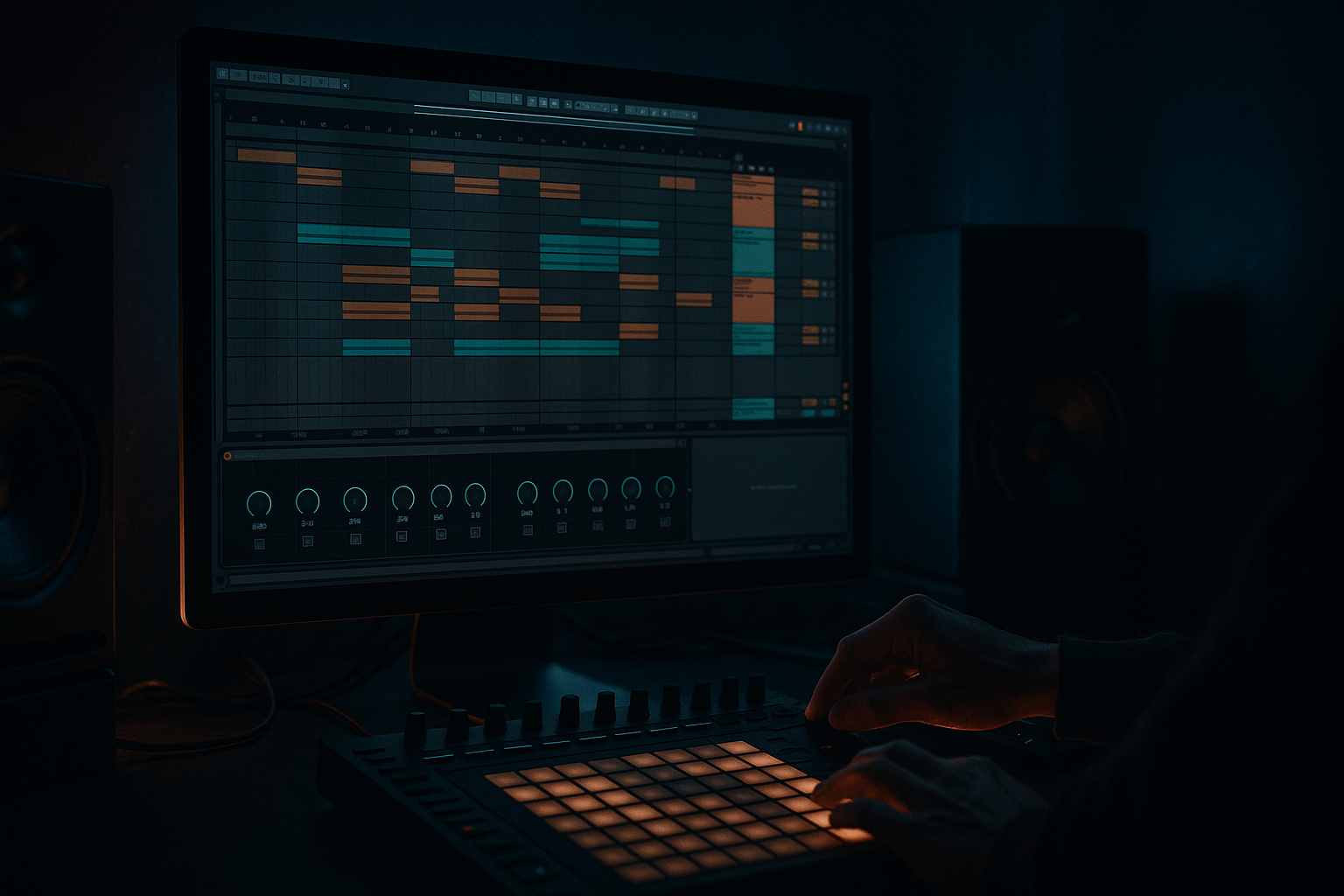
Main tutorial
Tape Dust Jungle FX Chain: Warp + Arrange in Ableton Live 12 (Advanced DnB Arrangement)
1. Lesson overview
In this lesson you’ll build a tape-dust / worn-jungle FX chain and learn how to warp, resample, and arrange those textures into proper drum & bass/jungle transitions inside Ableton Live 12. We’re not doing “random vinyl noise”—we’re making musical, tempo-locked grit that supports drops, switches, reloads, and 16-bar energy shaping. 🧨
You’ll work with:
- Warp modes + transient control (so dust hits land rhythmically)
- Resampling workflows (print the chaos, then arrange it)
- A stock-device jungle FX rack you can reuse in every project
- Arrangement tactics tailored to rolling DnB and jungle structures
- dust ticks, crackle bursts, drop-swell grime
- pitch dips, wow/flutter, degraded top-end
- width modulation + gated movement
- Warp your raw texture to your project groove
- Resample multiple “takes”
- Arrange them into classic DnB moments:
- A short recording of needle drop, room tone, cassette hiss
- A tiny slice of an old break (even 1 bar) to “ghost” through
- Foley: paper rub, fabric, mic handling (great for mid grit)
- Texture (best for noise beds & crackle):
- Beats (best if it has ticks/transients):
- Nudge some warp markers slightly late on 2 and 4 (or the offbeats) to mimic sloppy tape motion and old sampler drift. Keep it subtle: 5–15 ms.
- Mode: HP24 (high-pass)
- Freq: 250–600 Hz (keep sub clean)
- Resonance: 0.70–1.20
- Drive: 2–6 dB (adds bite)
- Envelope: subtle (optional)
- Style: start with a Tape/Saturator-ish feel (choose a softer model, then push)
- Drive: 10–25% (or more if you resample)
- Tone/Filter: roll off harsh top if needed
- Modulation: slow LFO on Drive or Filter:
- Downsample: 2–6
- Bit Reduction: 10–14 bits
- Soft Clip: On (if available in your setup) or compensate with Limiter later
- Mode: Pitch
- Fine: -10 to +10 cents (keep it subtle)
- Add LFO (if available): slow random-ish movement
- Sync: On
- Time: 1/8 or 1/4 dotted
- Feedback: 15–35%
- Filter: HP around 300 Hz, LP around 6–10 kHz
- Modulation: 5–15%
- Wobble: 0.2–1.0 (tasteful)
- Algorithm: Plate/Chamber
- Decay: 0.8–1.8s
- Pre-delay: 10–30 ms
- HP: 250–500 Hz
- Early Reflections: moderate
- Width: 80–120%
- Bass Mono: On (if you’re letting any low-mid through)
- Threshold: set so it opens on the loud dust/ticks
- Attack: 0.1–1 ms
- Hold: 10–30 ms
- Release: 30–120 ms
- Click the Gate’s Sidechain.
- Audio From: your drums group (or ghost trigger track).
- Sidechain input: `DUST_TRIGGER`
- Route `TAPE_DUST_SRC` to Audio To → DUST_PRINT and record just that channel.
- Warp On
- Use Beats mode for rhythmic ticks (Preserve Transients)
- Use Texture mode for beds
- 1 bar “risers”
- 1/2 bar “pre-drop ticks”
- 1/4 bar “impact grit”
- 2–4 bar “post-drop bed”
- `DUST_RISE_1BAR_HP_OPEN`
- `DUST_IMPACT_CRUNCH_1_4`
- `DUST_BED_SIDECHAIN_4BAR`
- Bars 1–8: dust bed low in mix, HP at ~500 Hz
- Bars 9–16: start gated ticks with subtle Echo throws
- Add Downsample spikes (Redux automation) every 2 bars
- Increase Echo feedback slightly in the last 2 bars
- Add a tape-stop style dip:
- Place a 1/4 bar crunchy dust hit exactly on 1.1.1 layered with your main impact.
- Immediately cut reverb/echo to keep the drop clean.
- Use dust as movement, not clutter:
- Bring back the dust bed + dubby Echo
- Use Utility width automation (widen in breakdown, narrow at drop)
- Make dust mid-forward, not bright:
- Use parallel grime:
- Phrase-lock your dirt:
- Sidechain to snare for space:
- Print “one-shots” for impacts:
- You warped dust musically (Texture vs Beats) so it locks to jungle rhythm.
- You built a stock-device tape dust rack using Auto Filter → Roar → Redux → Shifter → Echo → Hybrid Reverb → Utility → Gate.
- You used sidechain gating (optionally with a ghost trigger) to turn noise into rolling DnB movement.
- You resampled and chopped the best chaos into arrangement-ready clips.
- You placed FX with phrase awareness (8/16 bars) to enhance transitions, not clutter the drop. 🚀
---
2. What you will build
You’ll end up with:
1) A reusable “Tape Dust FX Rack” (100% stock devices) that turns any noise/foley/old break fragment into:
2) A workflow to:
- pre-drop tension (8/16 bars)
- impact accents
- post-drop bed + ear candy
- section transitions (every 8 bars)
---
3. Step-by-step walkthrough
Step 0 — Session setup (so everything locks to DnB timing)
1. Set tempo to something realistic:
- Jungle: 160–170 BPM
- Modern DnB: 172–176 BPM
2. Decide your core grid:
- Keep 1/16 visible (for dust ticks)
- Use 1/8 triplet occasionally (for jungle swing moments)
Arrangement tip: DnB is phrase-driven. Build FX around 8-bar and 16-bar markers—your dust FX should “announce” changes.
---
Step 1 — Choose source material (the “dust” needs character)
Good sources:
Put it on an Audio Track called: `TAPE_DUST_SRC`.
---
Step 2 — Warp it like a producer (not like a librarian)
Open the clip and enable Warp.
#### Pick Warp Mode based on content:
- Grain Size: 20–40 ms (smaller = more “dusty” detail)
- Flux: 10–25% (adds movement without washing timing)
- Preserve: Transients
- Envelope: 20–50% (lower = crisp ticks; higher = smoother)
#### Find an “anchor transient”
If your clip has a click/pop:
1. Zoom in, find a strong transient you want as the “downbeat”.
2. Right-click → Set 1.1.1 Here (or set a Warp Marker at 1.1.1).
3. Add warp markers every 1 bar or 2 bars to keep it stable.
Advanced timing trick (jungle feel):
---
Step 3 — Build the Tape Dust Jungle FX chain (stock devices)
On `TAPE_DUST_SRC`, add this chain in order:
#### 1) Auto Filter (shape what the dust occupies)
Automation idea: open HP slightly during build-ups to “reveal” dirt.
#### 2) Roar (tape-ish destruction + movement)
Roar is perfect for aggressive “tape abused by jungle pirates” energy.
- Rate: 0.10–0.30 Hz
- Amount: small (you want drift, not wobble bass)
#### 3) Redux (old sampler grit)
Automation idea: spike Downsample for 1/8 bar right before the drop for a crunchy “stuttered tape tear”.
#### 4) Shifter (micro pitch drift / wow)
- Rate: 0.05–0.20 Hz
- Amount: 2–6 cents
This gives that “tape is struggling” vibe without turning into a chorus.
#### 5) Echo (dubby jungle space, tempo-locked)
DnB arrangement use: automate Echo Dry/Wet up only in gaps, then snap it down at drop.
#### 6) Hybrid Reverb (space without mud)
#### 7) Utility (control width and mono compatibility)
#### 8) Gate (make dust rhythmic)
This is the jungle secret: turn continuous noise into groove.
Sidechain Gate method (very DnB):
Now dust “breathes” with your breaks.
---
Step 4 — Create a ghost trigger for tight jungle gating (optional but elite)
Make a new MIDI track: `DUST_TRIGGER`.
1. Load Drum Rack with a short closed hat or click.
2. Program a groove:
- 1/16 ticks with gaps
- Add extra hits before snare (classic jungle anticipation)
3. Turn the track volume down (or route to Sends Only / no output).
On the Gate (on your dust track):
Now your tape dust becomes a percussive layer that can follow your roll. 🔥
---
Step 5 — Resample the FX (print chaos, then arrange)
Create an Audio Track: `DUST_PRINT`.
Method A (fast):
1. Set `DUST_PRINT` input to Resampling.
2. Arm `DUST_PRINT`.
3. Record 2–5 minutes while you:
- tweak Roar drive
- automate Echo wet
- tweak Gate threshold
- move warp markers a bit
Method B (cleaner):
Now you have a long performance to chop like an old-school sampler tape pass. 🎛️
---
Step 6 — Warp the resample for “arrangement-ready” hits
On the printed audio:
Then slice into clips:
Name clips like:
This naming pays off when arranging fast.
---
Step 7 — Arrange it into a rolling DnB structure (practical placement)
Here’s a solid template (example at 174 BPM):
#### Intro (16 bars)
Automation: slowly open filter + increase Gate sensitivity so it “wakes up”.
#### Build (8–16 bars)
- Use Shifter automation: pitch down over 1/2 bar right before drop
- Or warp a printed hit and stretch it (old-school slow-down)
#### Drop impact (1 bar moment)
- Automation: Echo Dry/Wet to 0% at drop
- Reverb to near 0% at drop
#### Drop (32 bars)
- Every 8 bars, add a 1/2 bar glitch burst before the phrase change
- Between snares, tiny gated ticks can fill space (but keep them quiet)
Mix tip: in heavy DnB, dust often sits around -24 to -18 LUFS short-term relative—barely audible until muted.
#### Breakdown / Switch
---
4. Common mistakes
1. Dust fighting your hats/shakers
Fix: high-pass higher (even 800 Hz) or narrow width.
2. Warping noise with the wrong mode (smears transients)
Fix: use Beats for ticks, Texture for beds.
3. Too much Echo/Reverb into the drop (kills punch)
Fix: hard automate wet to near zero on the downbeat.
4. Overdoing bitcrush (turns into harsh fizz)
Fix: reduce Downsample, or low-pass post-Redux.
5. No resampling (endless tweaking, no arrangement commitment)
Fix: print 3–5 takes and chop the best moments.
---
5. Pro tips for darker/heavier DnB
After distortion, use Auto Filter LP12 at 7–10 kHz to avoid brittle top.
Put your FX chain on a Return track and send breaks/bass hits into it lightly. Great for unified “tape room”.
Put the best glitches only at bar 8/16/24/32 transitions. Jungle listeners feel structure.
Gate/duck the dust on snare hits so your snare remains king 👑.
A single perfect 1/4 bar crunch hit is more useful than a constant layer.
---
6. Mini practice exercise (15–25 minutes)
1. Grab a 10–30s noise/needle clip and warp it to 174 BPM.
2. Build the FX chain exactly as above.
3. Create a `DUST_TRIGGER` pattern that complements an Amen-style break (extra ticks before snare).
4. Resample 2 minutes of live tweaking.
5. Arrange a 16-bar build → 32-bar drop:
- 1 dust bed clip in intro
- 2 gated tick clips in build
- 1 impact crunch at drop
- 1 phrase-transition glitch every 8 bars in the drop
6. Export a quick bounce and check:
- Does the drop still hit hard?
- Can you mute dust and “miss it”?
---
7. Recap
If you want, tell me your subgenre (deep/techstep/jungle revival/neuro-influenced) and whether your drums are more break-led or 2-step, and I’ll tailor a specific 64-bar arrangement map + automation plan.

