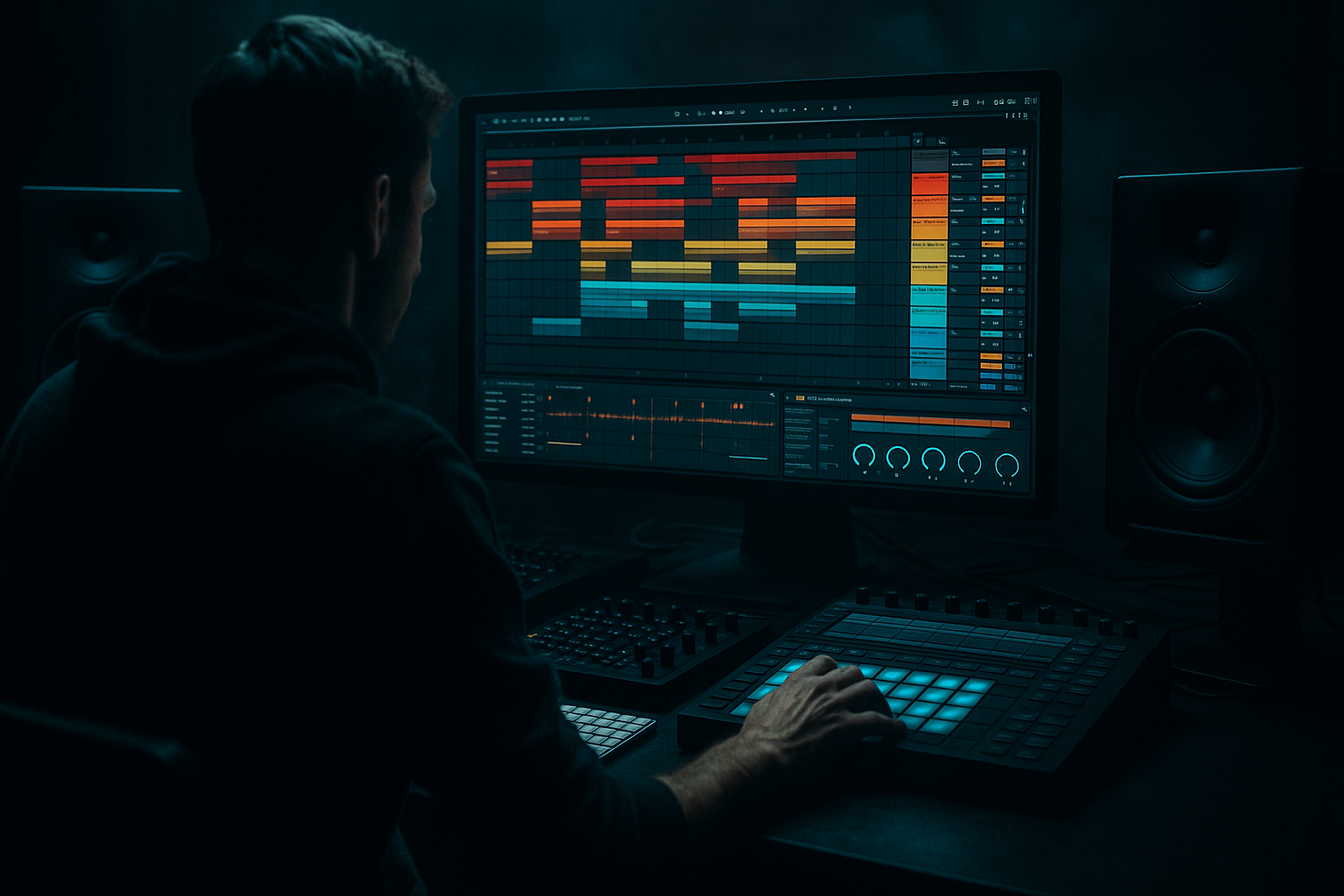
Main tutorial
```markdown
Template Building for DnB Sessions (Jungle Rollers) — Ableton Live (Advanced) 🥁⚡️
1) Lesson overview
A solid DnB template is about speed and consistency: you want to open Live and be writing immediately, not routing, gain-staging, or hunting for the right break layers.
In this lesson you’ll build an Ableton Live template specifically for jungle roller workflows:
- Fast drum programming + break manipulation
- Clean low-end routing for rolling subs/reese
- Mix-ready buses with controlled dynamics
- Arrangement scaffolding that encourages “roller” momentum (movement, fills, call/response)
- DRUMS Group
- BASS Group
- MUSIC Group
- VOCALS/SHOTS Group (optional)
- RETURN tracks (send FX)
- BUS processing (Drum Bus, Bass Bus, Music Bus, Master Prep)
- Break processing rack for jungle crunch
- Sidechain system for kick/sub clarity
- Parallel drum smash return
- Reverb/delay returns tuned for 170–175 BPM
- Utility + metering everywhere (gain discipline)
- Marker locators for Intro / Drop / Mid / 2nd Drop / Outro
- “Roller automation lanes” ready: break filtering, reese movement, send throws
- DRUMS (Group)
- BASS (Group)
- MUSIC (Group)
- `REFERENCE` (audio track, set to Ext. Out or routed to master with -inf send)
- `PRINT` (audio track for resampling bounces)
- Everything → its Group → PREMASTER
- PREMASTER → Master
- Set each Group’s `Audio To: PREMASTER`
- On PREMASTER set `Audio To: Master`
- Hybrid Reverb
- EQ Eight: cut `200–400 Hz` if it clouds snares
- Hybrid Reverb
- Echo
- Add Utility after Echo: keep return gain sane
- Drum Buss
- Saturator
- Glue Compressor
- Redux (very subtle)
- Auto Filter (HP to keep it airy)
- Blend lightly from hats/ride loops for texture
- Use a different break or the same break resampled and processed.
- Consider Slice to New MIDI Track (right click clip → Slice to New MIDI Track)
- Wavetable: Basic Sine (or Operator sine)
- Voices: 1
- Glide: subtle if you like slides
- Osc 1: Saw
- Osc 2: Square/Saw (detune slightly)
- Unison: 2–4 (don’t go crazy)
- Filter: LP24 with mild drive
- Audio track named `SC TRIG`
- Put a short click/placeholder kick sample on every kick hit
- Set `Audio To: Sends Only` (so you don’t hear it)
- Use `SC TRIG` as sidechain source for:
- `Intro 0:00–0:32`
- `Build 0:32–0:48`
- `Drop 1 0:48–1:52`
- `Break 1 1:52–2:08`
- `Drop 2 2:08–3:12`
- `Outro 3:12–3:44`
- On BREAK B: fill clips every 8/16 bars
- On DRUM FX: impacts before drops
- On BASS FX: one-shot reese rises, pitch-down fills
- File → Save Live Set as Template…
- Name: `DnB Jungle Roller Template v1`
- Also save:
- Reese intimidation without mud:
- Controlled aggression:
- Drum darkness:
- Create “pressure” with short rooms:
- Automate negative space:
- Resample edits:
- Fast drum + break workflow (warp, slice, macro control) 🥁
- Clean low-end architecture (sub/mid separation + sidechain) 🔊
- Mix-ready returns for space, throws, and parallel smack 🌌💥
- Arrangement scaffolding that naturally produces rolling momentum 🧭
Goal: a session that sounds 70% mixed the moment you start creating. ✅
---
2) What you will build
You’ll end up with a reusable Live template containing:
Track groups + routing
- Kick, Snare, Hats/Top, Perc, Break A, Break B, Drum FX
- Sub (mono), Reese/Mid, Bass FX (fills/one-shots)
- Pads/Atmos, Stabs/Riffs, FX/Noise
Built-in devices + chains
Arrangement scaffold
---
3) Step-by-step walkthrough
Step 0 — Global project settings (set this once)
1. Tempo: `172 BPM` (rollers typically 170–175)
2. Time signature: `4/4`
3. Sample rate: 48 kHz (optional but common for modern bass weight)
4. Warp mode defaults (Preferences):
- Drums/loops: Complex Pro OFF (use Beats for breaks)
- Long atmos: Complex/Complex Pro if needed
Pro workflow: In Live, set default warp mode per clip type manually (breaks = Beats, pads = Complex). Saves you from accidental break smearing.
---
Step 1 — Build the track layout + color code 🎛️
Create these Audio/MIDI tracks and Group them. Suggested naming + colors:
- `KICK` (audio or drum rack)
- `SNARE`
- `TOPS` (hats, rides, shakers)
- `PERC`
- `BREAK A`
- `BREAK B`
- `DRUM FX` (impacts, fills)
- `SUB` (MIDI)
- `REESE MID` (MIDI)
- `BASS FX` (MIDI/audio)
- `ATMOS`
- `STABS`
- `SYNTHS`
Routing setup (core idea):
Create an Audio track named PREMASTER and route groups into it:
Why? You can A/B master chain and keep the master clean for exporting.
---
Step 2 — Return tracks (your “instant vibe” toolkit) 🌌
Create these Return tracks:
#### Return A — Short Room (drum space)
- Mode: Convolution
- IR: Small Room/Studio (short)
- Decay: `0.3–0.6s`
- Pre-delay: `5–15ms`
- HP filter: `250–400 Hz` (keep low end clean)
#### Return B — Plate/Long (snare throws, atmos)
- Plate or Hall
- Decay: `1.8–3.5s`
- Pre-delay: `20–35ms`
- HP: `300–600 Hz`
- LP: `8–12 kHz` (tame fizz)
#### Return C — Tempo Delay (classic roller throws)
- Time: `1/8` or `1/4`
- Feedback: `25–45%`
- Filter: HP `250–500 Hz`, LP `6–10 kHz`
- Mod: small (adds movement)
#### Return D — Parallel Drum Smash 💥
- Drive: `10–25%` (taste)
- Crunch: `10–30`
- Boom: OFF or very low (Boom can mess with sub)
- Soft Clip: ON
- Drive: `2–6 dB`
- Attack: `1–3 ms`
- Release: `Auto` or `0.1–0.3s`
- Ratio: `4:1`
- Aim: `5–10 dB` GR on return (it’s parallel)
#### Return E — “Air/Noise” (optional, for tops)
Rule: Returns should be “mix-ready.” You don’t want to redesign effects every session—just automate sends.
---
Step 3 — Drum core: one-shots + breaks working together 🧨
This is jungle roller territory: tight modern one-shots + break energy.
#### 3A) Kick track chain (tight + controlled)
On `KICK`:
1. EQ Eight
- HP: `20–30 Hz` (gentle)
- Small cut if boxy: `200–350 Hz` (Q ~1.5)
2. Drum Buss
- Drive: `5–15%`
- Transients: `+5 to +15` (if needed)
3. Glue Compressor (optional)
- Attack: `10 ms`
- Release: `Auto`
- Ratio: `2:1`
- GR: `1–2 dB` max
#### 3B) Snare track chain (crack + body)
On `SNARE`:
1. EQ Eight
- Cut mud: `250–450 Hz`
- Add crack: `2–5 kHz` (small bell)
- Add air: `8–12 kHz` shelf (tiny)
2. Saturator
- Drive: `2–5 dB`, Soft Clip ON
3. Transient Shaper (use Drum Buss Transients)
- Transients: `+5 to +20` if snare needs bite
#### 3C) Break tracks: warp + slice + destroy (musically)
On `BREAK A` (main groove break):
1. Drop in a classic-ish break (Amen, Think, Hot Pants, etc.).
2. Warp mode: `Beats`
- Preserve: `1/16` (or `1/32` for tighter detail)
- Transients: 100
3. Add Audio Effects Rack called: `BREAK RACK (ROLLER)`
- Chain 1: Clean
- EQ Eight (HP `80–120 Hz` to avoid fighting kick/sub)
- Chain 2: Crunch
- Saturator (Drive `4–10 dB`, Soft Clip ON)
- EQ Eight (tiny dip `3–5 kHz` if harsh)
- Chain 3: Bite
- Overdrive (Freq `1–2 kHz`, Drive low)
- Auto Filter (BP or HP automation-ready)
4. Macro map:
- Macro 1: HP Filter (Auto Filter freq)
- Macro 2: Crunch amount (Saturator Drive)
- Macro 3: Break Level (Rack volume)
On `BREAK B` (fills/variation):
- Slicing preset: Built-in “Slice to Drum Rack”
- This is perfect for retriggering ghost hits and jungle edits.
Key template move: Keep breaks high-passed in the template; let kick + sub own the real low-end.
---
Step 4 — Drum bus (glue + headroom)
On DRUMS Group:
1. EQ Eight
- Optional gentle tilt: tiny cut `300 Hz` if it stacks
2. Glue Compressor
- Attack: `3 ms` (fast enough to catch, not kill transients)
- Release: `0.1–0.3s` (or Auto)
- Ratio: `2:1`
- GR: `1–3 dB`
3. Drum Buss
- Drive: `5–10%`
- Crunch: `5–15`
4. Limiter (safety only)
- Ceiling: `-0.5 dB`
- Should barely touch
---
Step 5 — Bass system: sub + mid separation (roller-ready) 🐍
Jungle rollers live or die by consistent sub + moving mid bass.
#### 5A) SUB track (mono, clean, consistent)
Instrument: Wavetable (or Operator)
SUB chain:
1. EQ Eight
- HP `20–30 Hz`
- Optional: slight dip `60–90 Hz` if kick dominates there
2. Compressor (sidechain from KICK)
- Sidechain: ON → Input: `KICK (Pre-FX)`
- Ratio: `4:1`
- Attack: `1–5 ms`
- Release: `60–120 ms` (tempo-dependent; adjust to groove)
- Aim: `2–5 dB` GR on kick hits
3. Utility
- Bass Mono: `120 Hz`
- Width: `0%` (or leave width, but keep it mono)
#### 5B) REESE MID track (movement + stereo while staying controlled)
Instrument: Wavetable
REESE chain:
1. Saturator (Drive `2–8 dB`)
2. Auto Filter (for movement)
- Map cutoff to Macro for quick “opening” in drops
3. Chorus-Ensemble (optional)
- Keep it subtle; you want motion, not wash
4. Utility
- Bass Mono: `150–200 Hz`
- Width: `80–120%` above that (careful)
Routing: Both SUB and REESE MID → BASS Group.
#### 5C) Bass bus (control + pocket)
On BASS Group:
1. EQ Eight
- Cut any sub build-up if needed (don’t over-EQ)
2. Glue Compressor (very gentle)
- Attack `10 ms`, Release `Auto`, Ratio `2:1`, GR `1–2 dB`
3. Optional: Saturator for density (small amounts)
---
Step 6 — Sidechain system beyond the sub (advanced clarity)
Create a ghost trigger track:
- Bass (if kick patterns vary)
- Reverb returns (duck reverb on snare/kick)
- Pads/atmos (sub stays clean)
Why ghost? You can change kick samples without breaking sidechain timing.
---
Step 7 — “Roller arrangement” scaffold (locators + lanes) 🧭
Set locators (top of arrangement):
Add empty MIDI clips as reminders:
Classic jungle roller trick: Every 16 bars, do one bar of break edit (stutter, reverse, or filtered) to keep momentum without “festival” over-arrangement.
---
Step 8 — Pre-mix master prep (not final mastering)
On PREMASTER:
1. EQ Eight (optional)
- Tiny low shelf if needed (avoid heavy master EQ)
2. Glue Compressor
- Ratio `2:1`
- Attack `30 ms`
- Release `Auto`
- GR `1–2 dB`
3. Limiter
- Ceiling `-1.0 dB`
- Only catching peaks, not smashing
Template target: At drop, you should naturally land around -6 to -8 LUFS short-term before pushing loudness. Keep headroom for later.
---
Step 9 — Save as your default template ✅
- Default audio track (with Utility + meter)
- Default MIDI track (with your go-to instrument and gain staging)
---
4) Common mistakes 🚫
1. Breaks fighting the kick/sub
- Fix: HP breaks at `80–150 Hz` and let one-shots own the punch.
2. Too much stereo in low end
- Fix: Utility Bass Mono `120–200 Hz` on bass and music groups.
3. Overcooking Drum Buss on everything
- Fix: Use it strategically. Parallel return is safer than smashing the drum bus.
4. Warp mode wrong on breaks
- Fix: use Beats; avoid Complex/Pro for crisp break transients.
5. No gain staging
- Fix: keep individual channels peaking roughly `-12 to -6 dBFS`; groups around `-6 dBFS` peaks.
---
5) Pro tips for darker/heavier DnB 🖤
Distort mids (Saturator/Overdrive) then HP at `80–120 Hz` so the sub stays pure.
Use Roar (if you have it) on REESE MID with multiband distortion—keep low band clean, distort mid band.
Low-pass breaks slightly (`10–14 kHz`) and add texture with subtle Redux or Saturator instead of bright hats.
Short room reverb on snare + breaks makes drums feel in front without washing out.
In drops, automate reverb sends down on busy sections and up on gaps—dark rollers breathe through contrast.
Print 4–8 bars of drums into `PRINT`, then chop/reverse for instant jungle flavor.
---
6) Mini practice exercise (20 minutes) ⏱️
1. Start from your new template.
2. Program a 2-step kick/snare (classic roller):
- Snare on 2 & 4
- Kick pattern: start simple, add a ghost kick before snare occasionally
3. Add BREAK A: warp it, HP it, blend under the one-shots.
4. Create a 16-bar loop:
- Bars 1–8: steady groove
- Bars 9–16: add a BREAK B fill on bar 16
5. Add SUB (long notes) + REESE MID (simple two-note pattern).
6. Automate:
- Break rack HP macro (slightly opening over 8 bars)
- Echo send throw on a snare at bar 16
7. Bounce a quick reference:
- Resample PREMASTER into PRINT for 16 bars.
---
7) Recap
You built a jungle roller-focused Ableton template that gives you:
If you want, tell me your preferred sub style (pure sine, sine+2nd harmonic, or distorted sub), and I’ll tailor a SUB rack + sidechain settings specifically for your kick and target loudness.
```

