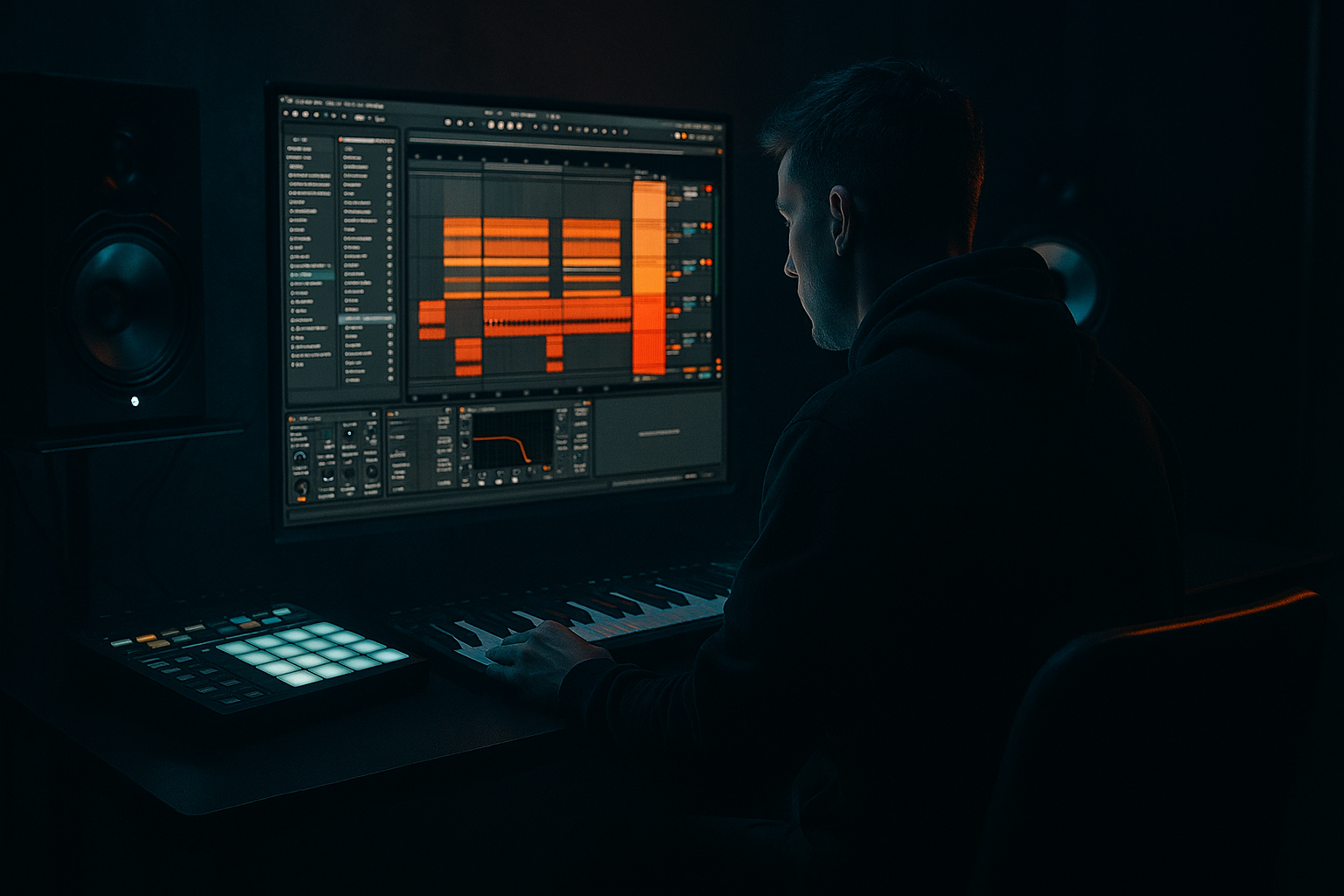
Main tutorial
```markdown
Tension & Release at Fast Tempos (DnB) — From Scratch with Clean Routing (Ableton Live) ⚡🥁
1. Lesson overview
Fast tempos (170–175 BPM) can make everything feel “already intense,” so real tension and release has to be designed, not assumed. In drum & bass, tension is often created by:
- Rhythmic pressure (denser drums, syncopation, swing, ghost notes)
- Spectral pressure (rising mids/highs, controlled sub, brighter noise)
- Dynamic pressure (automation, transient shaping, sidechain movement)
- Expectation management (withholds the “one,” removes kick/sub, teases motifs)
- Clean bus routing: Drum Bus / Bass Bus / Music Bus / FX Bus / Pre-Master
- A drop that hits hard and clean
- Tension tools: risers, drum fills, filter automation, reverb throws, break edits, sub removal, perceived tempo tricks (half-time → full-time)
- Ableton stock devices used intentionally (no mystery chains)
- Bars 1–8: intro tease
- Bars 9–16: build with escalating pressure
- Bars 17–32: drop + mid-drop variation
- Tempo: 174 BPM
- Set global quantize: 1 Bar (then switch to 1/4 later for edits)
- If using break samples, set Warp mode:
- `Kick`
- `Snare/Clap`
- `Hats`
- `Break (Amen/Think/etc.)`
- `Perc/Ghosts`
- `Sub`
- `Reese/Neuro Mid` (or “Bass Mid”)
- `Bass Top/Noise` (optional)
- `Pads/Atmos`
- `Stabs/Chords`
- `Leads` (optional)
- `Risers`
- `Impacts`
- `Downlifters`
- `Noise/Whooshes`
- A: ShortVerb (tight room)
- B: LongVerb (for throws)
- C: Delay (ping-pong/echo)
- D: Parallel Crunch (optional)
- Every audio/MIDI track → its Group
- Every Group output → `PREMASTER` audio track
- `PREMASTER` → `MASTER`
- Utility: set Gain so peaks hit around -6 dBFS (room for later)
- Glue Compressor:
- Limiter (optional during writing): ceiling -0.8 dB, no more than 1–2 dB GR
- Place kicks on 1 and 3 (classic DnB anchor).
- Add optional ghost kick before snare (tasteful): e.g., 1.3.3 (very low velocity).
- Strong on 2 and 4
- Layer: one tight snare + one clap/noise layer.
- Closed hats: 8ths or 16ths with velocity variation.
- Add a tiny swing (Groove Pool):
- Load an Amen/Think break to `Break`.
- Warp mode: Beats, Preserve Transients.
- High-pass it with EQ Eight:
- Blend quietly for texture.
- Instrument: Operator
- MIDI: follow your root notes (simple 1–2 note motif works great)
- Processing:
- Instrument: Wavetable (stock, powerful)
- Processing:
- EQ Eight: mono the low end (use Utility below)
- Utility:
- Glue Compressor: gentle, 1–2 dB GR
- In build (bars 9–16), remove the kick on 1 & 3.
- Keep snare on 3 only (half-time feel).
- Add a teasing break slice that hints at the full groove.
- Add a 1/2 bar or 1 bar fill:
- Beat Repeat (automation-friendly!)
- On Music Group or FX:
- On Bass:
- Last beat before drop: remove sub + kick, keep only noisy highs + reverb tail → drop feels twice as heavy.
- Return A (ShortVerb): Reverb
- Return B (LongVerb): Reverb
- Return C (Delay): Echo (or Delay)
- In build: increase sends to LongVerb on snare fills, vocal chops, stabs.
- Right before drop (last 1/4–1 bar): hard cut LongVerb send and mute FX tails with a Utility automation (or automate Return track volume).
- At the drop: keep drums/bass dryer than the build.
- Atmos pad (Music Group) + filtered break (HP at 200 Hz)
- No full kick pattern yet
- Add a simple motif: 2-note reese stab or jungle stab hit every 2 bars
- Keep Sub off
- Slowly open a filter on the break (Auto Filter)
- Add tiny vinyl/noise (Analog noise sample) rising subtly
- Switch to half-time drum impression:
- Add riser (white noise) + pitch riser (Operator)
- Increase hat density:
- Bar 15: small fill (break stutter)
- Bar 16: big fill + sub/kick removal for the final beat
- Full kick + snare pattern returns
- Sub returns (clean, solid)
- Mid bass opens up (filter opens, distortion engages)
- Reduce reverb space compared to build (drier = heavier)
- Swap bass rhythm (syncopate)
- Add a call/response stab
- Or introduce a second break layer for 4 bars
- Only sidechain what needs it:
- Use Compressor sidechain or Shaper (if you have it) — stock Compressor is fine.
- Sub track: <90–110 Hz (mono)
- Break layer: mostly 150 Hz+
- Hats/percs: control harshness around 7–10 kHz with EQ Eight
- Put risers, noise, impacts here
- Processing:
- Make the build brighter, not louder: automate a gentle high shelf up, then remove it at the drop so the drop feels weightier.
- “Airless drop” trick: cut some highs (tiny shelf down) at drop start, then bring air back after 4–8 bars. Dark rollers love this.
- Distortion staging (heaviness without fuzz):
- Tonal tension with one note: hold a droning note (root or tritone flavor) in an atmosphere, then remove it at the drop.
- Jungle pressure: automate break HP filter down (200 → 120 Hz) through the build, but still keep true sub off.
- Start with a clean routing template: groups + returns + pre-master.
- Build the drop first so you know what release should feel like.
- Create tension using rhythm density, spectral brightness, and space, not just volume.
- Use classic DnB contrast tricks: half-time tease, sub/kick removal, break stutters, reverb throws, and dry drop transients.
- Keep it controlled with stock devices: EQ Eight, Auto Filter, Drum Buss, Glue Compressor, Saturator, Beat Repeat, Reverb, Echo, Utility.
Release is when you pay off: drop returns, sub locks in, transient clarity, groove “breathes.”
This lesson builds a clean Ableton routing template and a repeatable workflow for arranging tension/release without muddy mixes or chaotic gain staging.
---
2. What you will build
A 32-bar DnB arrangement (jungle/roller friendly) with:
You’ll end with something like:
---
3. Step-by-step walkthrough
A) Session setup (clean routing first) 🧼
1) Set tempo & warp
- Breaks: Beats mode, Preserve: Transients, Envelope: ~40–70
- Bass one-shots: often Off warp if not time-stretching
2) Create tracks & groups
Create these tracks, then group/bus them:
Drums Group
Bass Group
Music Group
FX Group
Returns (Sends)
Routing rule
3) Pre-master chain (light, intentional)
On `PREMASTER` (not Master), use:
- Attack: 10 ms
- Release: Auto
- Ratio: 2:1
- Threshold: just kissing 1–2 dB on loudest sections
> Why: You’re building tension via arrangement and movement, not crushing the master.
---
B) Build a “release-ready” drop core first 🎯
You can’t design tension if you don’t know what “release” sounds like. Make 8 bars of drop first.
#### 1) Drop drums (roller + break layer)
Kick pattern (simple, stable)
Snare
Hats
- Try MPC 16 Swing 57–60 at 20–40%.
Break layer
- HP at 120–180 Hz (12/24 dB slope)
Drum Group processing (clean + punchy)
On Drums Group:
1. EQ Eight
- Sub cleanup: gentle cut below 25–30 Hz
- Optional small dip around 250–400 Hz if boxy (depends on samples)
2. Drum Buss
- Drive: 3–8%
- Crunch: 0–10%
- Boom: 0–10% (keep it subtle; sub comes from Sub track)
- Transients: +5 to +20 (watch harshness)
3. Glue Compressor
- Attack: 3 or 10 ms
- Release: 0.1–0.3s or Auto
- GR: 1–3 dB max for cohesion
#### 2) Bass: sub + mid (separation = clarity)
Sub track
- Osc A: Sine
- Add tiny saturation later, not inside Operator first.
1. EQ Eight: low-pass around 80–120 Hz (depending on mid bass)
2. Saturator: Soft Clip on, Drive 1–4 dB
3. Compressor (sidechain from Kick):
- Ratio 4:1
- Attack 3–10 ms
- Release 50–120 ms (tempo-dependent)
- Aim 2–5 dB duck on kick
Mid bass track (Reese/Neuro-ish)
- Osc1: Basic Shapes (saw), Osc2: slightly detuned
- Unison: 2–4, Amount small
- Filter: MS2 or PRD, drive slightly
- Add LFO to filter cutoff at 1/8 or 1/16 for movement
1. EQ Eight: cut lows below 90–120 Hz (leave room for sub)
2. Saturator or Overdrive: for harmonics
3. Auto Filter: map cutoff to Macro for arrangement automation
4. Optional Chorus-Ensemble (tiny) for width above 200 Hz
Bass Group processing
- Width: 0% below 120 Hz (use Utility’s Bass Mono if available, or a second Utility + EQ trick)
> Now you have a drop that feels like a “release target.” Next: build tension that earns this.
---
C) Tension design: 3 core levers (Rhythm / Spectrum / Space) 🔧
#### Lever 1: Rhythmic tension (density + expectation)
Technique: Half-time tease → full-time drop
How in Ableton (break edits)
1. Right-click your break clip → Slice to New MIDI Track
- Slicing preset: Transients
2. In build section:
- Use fewer slices (sparser rhythm).
- Increase density every 2 bars (add ghost slices, hats, little fills).
Micro-fill on bar 16
- Snare rush: 1/16 notes with velocity ramp
- Or break chop stutter (1/8 → 1/16 → 1/32)
Stock devices for tension:
- Interval: 1 Bar
- Grid: automate 1/8 → 1/16 → 1/32
- Chance: 10–30% (or 100% for a deliberate fill)
- Filter on, automate to brighten toward drop
#### Lever 2: Spectral tension (rising energy without muddying sub)
Rule: During build, push upper mids + highs, not sub.
Build automation ideas
- Auto Filter: slowly open cutoff across 8 bars
- EQ Eight: automate a gentle high-shelf up +2 to +5 dB from ~6–10 kHz
- Temporarily high-pass the Mid bass more aggressively during build (e.g., from 120 → 200 Hz)
- Keep Sub muted in the last 1–2 beats before drop
Classic DnB move
#### Lever 3: Spatial tension (reverb/delay throws + sudden dryness)
Tension often increases with space, release often hits with dry punch.
Return tracks setup
- Decay: 0.4–0.8s
- Pre-delay: 10–25 ms
- HP filter in Reverb: 150–250 Hz
- Decay: 2–5s
- Pre-delay: 20–40 ms
- HP: 200–400 Hz
- Time: 1/8 or 1/4 dotted
- Feedback: 25–45%
- HP/LP inside Echo to keep it clean
Automation moves
---
D) Arrange a practical 32-bar tension/release blueprint 🧱
#### Bars 1–8: Intro tease (low commitment)
Automation
#### Bars 9–16: Build (pressure ramps every 2 bars)
- Snare on 3
- Sparse break chops
- 8ths → 16ths
- Add shaker loop quietly
Key tension moments
#### Bar 17: Drop hit (release)
#### Bars 25–32: Mid-drop variation (keep it moving)
To avoid “loop fatigue,” change one major parameter:
> Tension isn’t only pre-drop—micro-tension inside the drop keeps it rolling.
---
E) Clean routing tricks that keep tension loud but not messy ✅
1) Sidechain discipline
- Sub: yes (to kick)
- Mid bass: usually yes (lighter)
- Pads: optional (subtle)
2) Frequency ownership
3) “Tension bus” option
Create an Audio Track called `TENSION BUS` (or a Group inside FX):
- EQ Eight (HP at 200–400 Hz)
- Saturator (tiny)
- Limiter (catch peaks)
This lets you push tension FX without wrecking the mix.
---
4. Common mistakes 🚫
1. Building tension by adding sub
Result: drop doesn’t feel bigger. Save sub for release.
2. Too much reverb during the drop
Reverb smears transients. Use it as a build tool and for throws.
3. No contrast in drum density
If your build already has full hats + full break + full kick, you’ve left no headroom for excitement.
4. Over-compressing the master while arranging
It flattens tension/release. Keep pre-master gentle.
5. Messy routing / random sidechains
You’ll fight pumping and phase issues. Group by function and keep it consistent.
---
5. Pro tips for darker/heavier DnB 😈
- Mid bass: Saturator/Overdrive
- Bass Group: light glue
- Drums Group: Drum Buss with controlled transients
---
6. Mini practice exercise 🧪
Goal: Create a 16-bar build into an 8-bar drop using only stock devices.
1. Build an 8-bar drop loop:
- Kick on 1 & 3, snare on 2 & 4
- Sub (Operator sine) + mid bass (Wavetable)
2. Duplicate backwards to create a 16-bar build section.
3. In the build:
- Remove kick entirely for bars 9–16
- Make it half-time (snare on 3)
- Add Beat Repeat to the break for bar 16 only (automate Grid tighter)
4. Automate:
- Auto Filter opening on a noise riser
- Reverb send increases on snare fill (Return B), then hard cut 1/4 bar before drop
- Mute Sub for the last beat before the drop
5. Compare A/B:
- Does bar 17 feel bigger without being louder?
- If not, reduce build density or reduce build low end.
---
7. Recap 🔁
If you want, tell me your preferred sub style (pure sine vs. saturated, or 808-ish) and whether you’re going for rollers, techstep, or jungle, and I’ll tailor a bar-by-bar tension map and device macros for that sound.
```

