Main tutorial
1. Lesson overview
-------------------
Goal: Learn how to design and paint automation curves that create and release tension in neuro / neurofunk drum & bass using Ableton Live. You’ll get practical, repeatable techniques for sculpting energy across drops, fills, and risers so your tracks sound purposeful, dark, and dangerous — not random. Expect device chains, concrete parameter ranges, arrangement placements, and workflows you can use immediately. 🎛️⚡
Skill level: Intermediate — you know Ableton’s basics (tracks, devices, automation lane visibility) and you can patch a bass + drum rack. This lesson focuses on automation artistry: curves, timing, and device choices specific to DnB.
What you will build
-------------------
A 16–32 bar “tension automation” template for a neuro DnB section (pre-drop → drop). It includes:
- A neuro bass track with multi-stage automation (filter, distortion, band boost) using a single Macro knob.
- Drum automation: hi-hat/open-hat lowpass and beat-repeat gating in the buildup.
- FX automation: reverb send ramp with an exponential curve, delay feedback and filter sweep.
- Master/Group automation: stereo width and subtle glue compression wet/dry ride for perceived loudness/energy.
- Set your arrangement loop to the section you want to tension build (common neuro pattern: an 8–16 bar buildup leading into drop at bar 17 or 33). Tempo typically 170–176 BPM.
- Work in Arrangement view. Press A to show automation lanes. Toggle B to use Draw Mode for freehand if you prefer. We’ll use breakpoints for precision and draw for feel.
- Instrument: Wavetable or Operator (stock). Example patch approach:
- Device chain (order matters):
- Group the bass chain into an Instrument Rack and map these key parameters to one Macro (call it “Tension”):
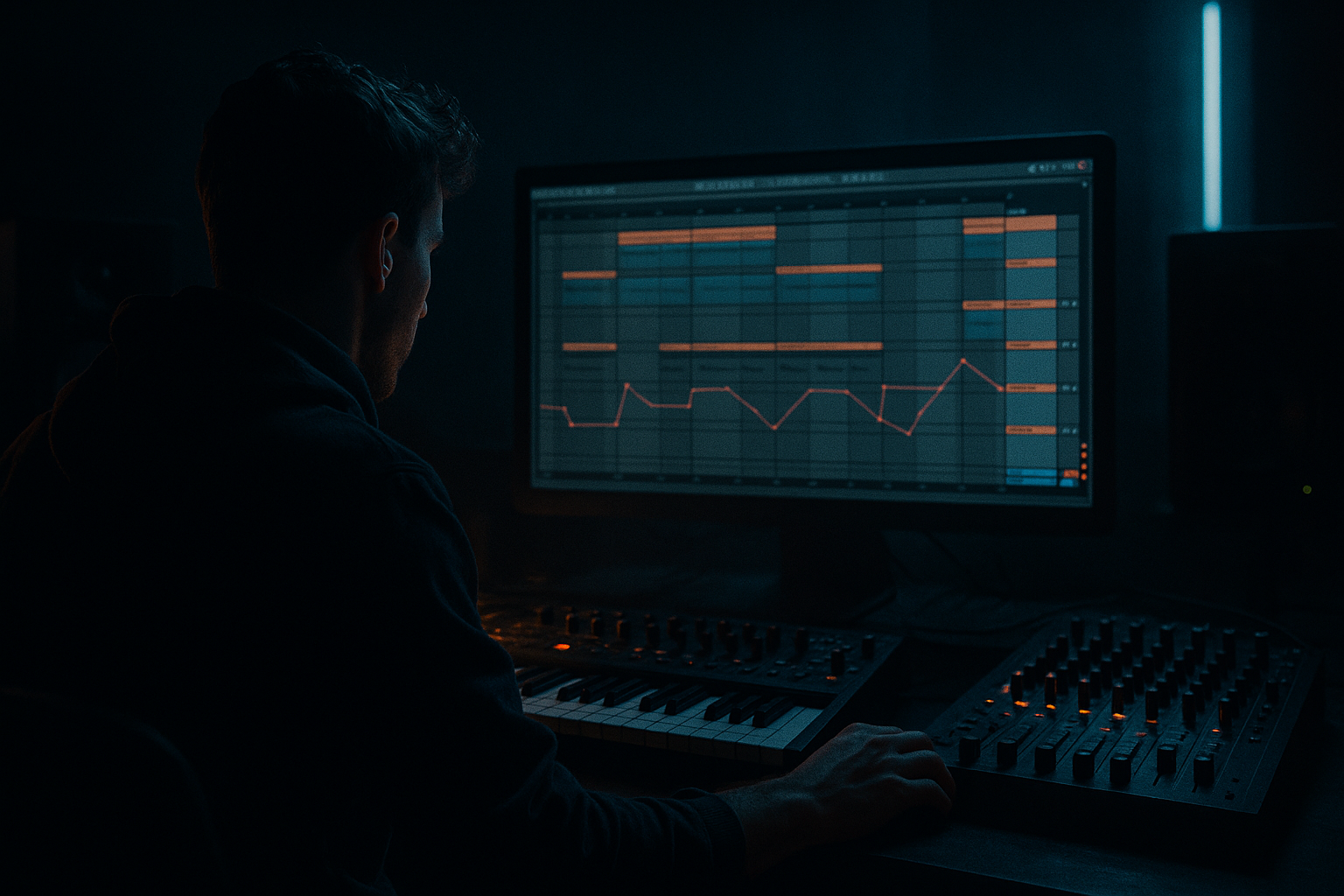
- Create an automation lane for the Macro “Tension” knob. This is your master tension envelope.
- Structure: if your buildup is 16 bars:
- How to draw: you can click to add breakpoints and drag segments to approximate S and exponential shapes. Use Draw Mode (B) for organic curves, or place 3–6 points and adjust their heights for predictable interpolation.
- Filter cutoff mapped range: 250 Hz → 5 kHz
- Saturator drive: 0 → +6 dB equivalent
- EQ boost: -3 dB → +6 dB (Q narrow)
- Redux dry/wet: 0% → 40%
- Low-End Mono Width: Put Utility at the start of your bass chain and map Width to Macro or automate:
- Compressor/Glue Wet/Dry (on group): Automate “Wet” or compressor threshold slightly to increase perceived pump as tension rises (e.g., threshold lowers 1.5–3 dB across bars 12–16). This gives dynamic squash that increases aggression.
- Highpass/Lowpass automation on hat group: put Auto Filter after drum samples in a Drum Rack return:
- Beat Repeat for glitch gating:
- Reverb send (Return track with Hybrid Reverb or Reverb):
- Delay (Echo/Ping Pong Delay) automation:
- Master Bus Saturation: place Saturator on Drum+Bass group with Dry/Wet mapped to a Macro:
- Stereo Width collapse: add Utility on master group and automate Width:
- Micro automation: automate short-time pitch transposition on a copy of the bass for “pitch blow” pre-drop:
- Fades to prevent clicks: very fast fades (5–15 ms) on audio clips when doing instant parameter jumps prevent clicks. Use Clip fade handles or place a utility fade.
- Common placements:
- Alternatively use 32-bar structures for more subtle builds: two S-curves — first to lure, second to strike.
- Automating too many parameters independently — causes phase/over-processing. Fix: map related parameters to a single Macro and automate the Macro.
- Using only linear ramps — they feel robotic. Use S-curves and exponential ramps (via many breakpoints or drawn curves) to mimic organic tension.
- Forgetting to check phase or stereo collapse when adding distortion and width automation — always mono-compatibility check.
- Clipping the master bus with multiple saturators and feedback ramps — insert utility gain staging and limiter; automate limiter only as last resort.
- Not using fades for abrupt changes — causes clicks/pops. Use 5–20 ms fades on clip edges or automate device parameters smoothly (e.g., filter resonance).
- Overdoing FX tails — long reverbs and delays can wash out drop clarity. Automate returns to cut instantly at drop or duck with sidechain.
- Emphasize narrow-band resonances: automate a narrow EQEight boost (Q 4–6) that sweeps 300–900 Hz across the build. This creates a vocal-esque formant resonance typical in neuro.
- Automate distortion character, not just amount: toggle between Saturator types (Analog Clip → Soft Sine) by mapping a Rack Chain selector to transition grit flavors as tension increases.
- Multi-band tension: use Multiband Dynamics and automate band gain thresholds—more compression on mid-highs during build emphasizes grit but keeps sub intact.
- Stereo mid/side automation: automate an EQEight in M/S mode — narrow the side channel below 200–300 Hz as tension grows so the sub remains solid while the mids get aggressive.
- Tempo-synced micro-automation: automating Beat Repeat/Grid to 1/32 or 1/64 with changing Gate/Interval creates neuro stutters that read as mechanical tension.
- Use transient shaping automation: increase attack transient on drums slightly during last bar to bite more — use Compressor with slower attack as automation or third-party transient shaper idea (stock: try Audio Effect Rack with Compressor and Utility).
- Automate sidechain release time: shorten release as tension increases for a tighter pump.
- Use mapped Macros to control multiple parameters with a single musical envelope — this keeps tension focused and editable.
- Shape curves intentionally: S-curves for slow-breathing rises, exponential for sudden escalation, and micro-automation (pitch/pulse) for last-bar drama.
- Automate rhythm elements (Beat Repeat, filter on hats) and FX (reverb/delay feedback) in tandem with tonal changes for convincing neuro tension.
- Always check mono compatibility, manage gain staging, and use fades to avoid clicks.
- Apply the mini exercise to lock in the technique; once comfortable, scale to 32-bar sections, incorporate chain-select morphs, and refine with mid/side EQ automation for darker, heavier impact.
At the end you’ll have a usable template to drop into your tracks and tweak for mood and tempo.
Step-by-step walkthrough
------------------------
Preparation
1) Build the core neuro bass chain (MIDI track)
- Osc A: wavetable/oscillator with an aggressive partial (saw/complex wavetable).
- Osc B: add sub sine one octave below.
- Filter: 12/24 dB lowpass with drive or formant bandpass for vocal-ish movement.
1. Utility (stereo/mono control)
2. EQ Eight — high shelf cut above 10 kHz (-6 dB) to kill highs pre-distortion
3. Saturator — Drive ~2–6 dB (Soft Clip), Warmth preset
4. Overdrive (light) — Drive ~1–3
5. EQ Eight — surgical boost: +3–6 dB narrow (Q 3–6) around 400–900 Hz for mid-bite
6. Compressor (Glue) — fast attack, medium release for glue
7. Multiband Dynamics (optional) — tame extremes
8. Redux (bit reduction) for glitch moments (bypass normally)
- Macro Map A: Filter cutoff (mapped range: closed ~200–400 Hz to open ~4–6 kHz)
- Macro Map B: Saturator Drive (map 0–60% of the device parameter)
- Macro Map C: EQ Eight narrow band gain (map -3 dB to +6 dB)
- Macro Map D: Redux Dry/Wet (map 0% to 50% for gritty moments)
Why map to one macro: one automation controls tonal, harmonic and distortion content in a musical curve — far easier than drawing many autoparameters.
2) Draw the primary tension curve (Macro automation)
- Bars 1–12: slow S-curve from 0% → 45% (gradual tension)
- Bars 13–15: steeper exponential ramp from 45% → 85% (rapid escalation)
- Bar 16 (pre-drop): short, very fast peak to 95–100% for a momentary “teeth-bared” sound, then immediate cut to 0% (drop)
Parameter suggestions (starting points)
3) Add complementary automation for size & movement
- Bars 1–12: width 60% → 40% (narrowing creates perceived focus)
- Bars 13–16: width dips to 25% on final bar for tighter punch
4) Drum automation — hats / percussion movement
- Start open, slowly close with a lowpass toward ~4–6 kHz during bars 1–12, then rapidly open in bars 13–15 to emphasize top end when the main energy ramps.
- Add Beat Repeat on a send or insert on a percussion bus. Keep it off/bypassed early. Automate the device’s “Interval” or “Grid” and “Repeat” on the last 2 bars to create stutter. Set Repeat interval to 1/16 or 1/32 for neuroy stutters.
- Settings: Grid = 1/16, Interval = off → triggered automation at bar 15–16, Filter in Beat Repeat cut low frequencies to retain punch.
5) FX automation — reverb/delay for space & claustrophobia
- Pre-drop (bars 12–16) automate send from 0% → 30% with an exponential curve so the tails become massive just before the cut. Exponential (fast late) feels like a sudden jump in space.
- On the final beat, automate the return’s Dry/Wet or send to 0% instantly for dramatic cut.
- Automate delay feedback from 20% → 45% over the last 4 bars and lowpass the delay’s filter cutoff to sweep down (around 6 kHz → 1 kHz).
- For a unique neuro feel, automate feedback to self-oscillate slightly (watch for clipping; add Utility or EQ to tame).
6) Master/Group automation for perceived tension
- Automate dry/wet from 0 → 15% across bars 13–16 for subtle harmonic push.
- Collapse to 60% in the final bar to make the drop hit harder mono-sub-wise.
7) Timing details and micro-automation
- Copy the bass track, transpose +1–3 semitones for the last 1/4–1/2 bar, then cut. Automate volume fade to avoid clicks.
Arrangement ideas / where to place curves
- Bars 1–12: Textural tension (slow S-curve)
- Bars 13–15: Energy spike (fast ramp + adds like delay/reverb feedback and beat-repeat)
- Bar 16: Momentary full-open + total cut to 0% for drop impact
Common mistakes
----------------
Pro tips for darker/heavier DnB
-------------------------------
Mini practice exercise
----------------------
Goal: Create a 16-bar tension build for a neuro bass + drums using one macro + two effects automations.
Steps:
1. Make a 16-bar loop at 174 BPM. Create a bass with Wavetable + sub sine.
2. Create an Instrument Rack and map:
- Macro 1 -> Filter Cutoff (250 Hz to 5 kHz)
- Macro 1 -> Saturator Drive (0 → 5 dB)
- Macro 1 -> EQ Eight narrow boost (+0 → +5 dB)
3. Automate Macro 1:
- Bars 1–10: slow ramp to 40% (S shape)
- Bars 11–14: quick ramp to 80% (steeper)
- Bar 15 (last beat): jump to 100% and immediately cut to 0% on downbeat of bar 16
4. Drum bus:
- Add Auto Filter on drum group, automate lowpass closing slowly then opening in bars 13–15.
- Put Beat Repeat on a return; automate send to create stutter on bars 15–16.
5. FX:
- Add Reverb on return; automate send 0 → 30% exponential on bars 12–16.
6. Listen back, adjust Macro ranges if the bass gets too fizzy or too quiet. Tighten low-end if needed with Utility.
Recap
-----
Go build a nasty-sounding pre-drop and post it back into your session — I’ll give feedback on improving the curve shapes and device ranges if you want. Let’s make it sick. 🔥🖤

