Main tutorial
Tension Automation Curves — Drum & Bass in Ableton Live
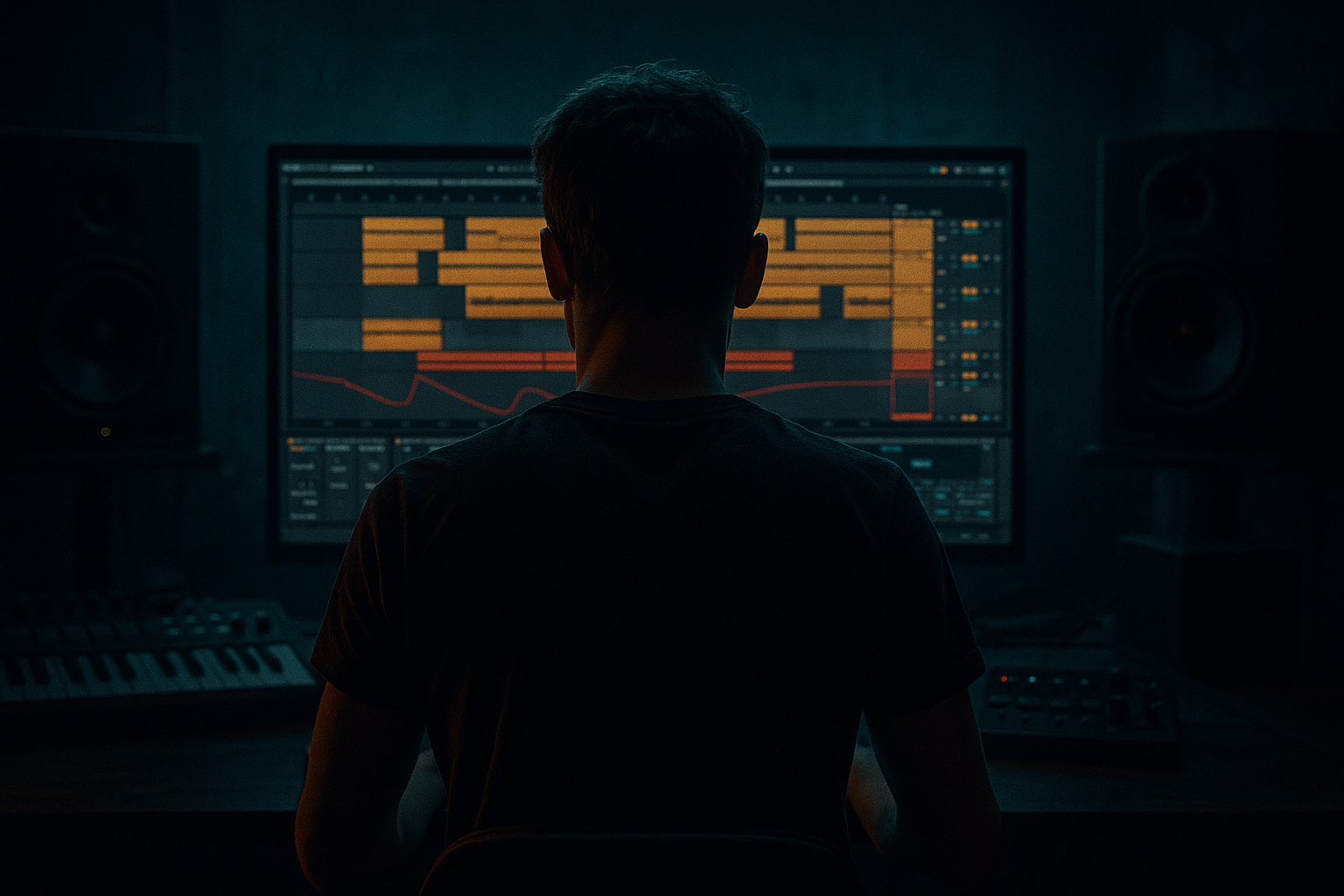
Energetic, punchy, and precise — this lesson teaches intermediate DnB producers how to shape tension with automation curves in Ableton Live. We’ll focus on practical workflows, device chains, and arrangement techniques you can drop into your next rolling, dark, or neuro DnB track. ⚡️
---
1. Lesson overview
Tension automation curves are time-based changes applied to plugin parameters, track volume, sends, or clip envelopes that create motion and emotional momentum. In drum & bass, these curves are essential for risers, pre-drop builds, snare rolls, filter sweeps, moving bass textures, and dynamic drum fills.
This lesson shows:
- How to draw and sculpt automation curves in Ableton (Clip + Arrangement).
- Which parameters to automate for maximum effect in DnB.
- Device chains and exact settings using Ableton stock devices.
- Arrangement ideas and a short practice exercise to internalize the technique. 🎛️
- Drum Rack + samps: kick, snare/snare roll, hi-hats, percussion.
- Bass (Wavetable or Operator) with filter/drive chain.
- Two return FX: Auto Filter → Reverb (Return A), and Grain Delay / Beat Repeat (Return B).
- Automation lanes: lowpass sweep on the main music group, send wet ramps, snare roll velocity/Utility gain curve, and a Beat Repeat probability curve for glitchy tension.
- Use many nodes to approximate an exponential or logarithmic curve: place nodes densely where you want acceleration.
- Use Draw Mode for organic S-curves (gentle rise then steep ramp).
- Where you need snap/impact, use a very steep curve or an instant jump in automation at the drop moment.
- Over-automating everything: too many moving parameters distract and clutter the mix. Automate the 2–4 most important items per section (filter, send reverb, drum density, and an effect).
- Using purely linear ramps: they sound mechanical. Prefer exponential-ish curves that accelerate into the drop.
- Too much resonance on Auto Filter: it can overpower and mask the drop if not tamed; automate Resonance carefully.
- Forgetting to check in mono or on small speakers: big filter sweeps can shift perceived low frequencies — always check the low-end after automation.
- Ignoring CPU: long, high-resolution automation with many device modulations can spike CPU — bounce complicated layers or freeze tracks when necessary.
- Mid-side automation: automate an EQ Eight band in Mid/Side mode to open up the sides (adds width) during the build and slam the mids at the drop for punch.
- Parallel distortion: duplicate bass, heavily distort the duplicate, and automate the duplicate’s Utility gain from -12 dB → -2 dB into the drop for sudden grit.
- Use Redux/Erosion sparingly: automate Redux Wet from 0% → 25% in the last bar to add crunchy digital tension.
- Automate transient shaping: place a Drum Buss or Compressor and automate Attack time to tighten hits as you approach the drop.
- Layered stair-step curves: stack two filter sweeps at different speeds (one slow, one fast) to create complex motion — e.g., slow sweep on synth pad, faster sweep on bass.
- Beat Repeat tricks: set Beat Repeat to capture short bursts and automate the Grid to speed up repetitions in the last 2 bars — makes snares feel frantic without reprogramming MIDI.
- Tempo-synced automation: for wobble-like tension, modulate parameters at rhythmic rates (e.g., 1/8 → 1/16) using Beat Repeat or Delay automation.
- Snare roll feels louder and tighter (velocity + Utility).
- Reverb widens energy but doesn’t wash the low end.
- Drop lands cleanly with a sudden restore of low-end content.
- Tension comes from how an automation curve moves, not just that it moves. Exponential/eased curves feel more musical for builds; linear ramps feel mechanical.
- Focus on a few high-impact automations: filter frequency, send levels, drum density, and character (distortion, saturation).
- Use Draw Mode for organic curves, many nodes for precision, and Ableton stock devices like Auto Filter, EQ Eight, Saturator, Utility, Beat Repeat, and Reverb.
- For darker/heavier DnB, use parallel distortion, mid-side EQ automation, transient shaping, and rhythmic FX automation.
- Practice the 16-bar exercise to lock down the feel — tension is a listening skill as much as a technical one. 🎧
- Create a downloadable template Ableton set that follows this exact chain and automations.
- Walk through the exercise in a private screen-share style step-by-step (or with annotated screenshots). Which would you prefer?
---
2. What you will build
A short 16-bar pre-drop build into a drop (tempo: 174 BPM, classic DnB). Elements:
Outcome: A clean, rising build that accelerates into a hard drop with controlled release.
---
3. Step-by-step walkthrough
Assumes Live 10/11 stock devices. Tempo = 174 BPM.
Project setup
1. Create tracks:
- Track 1: Drums (Drum Rack).
- Track 2: Bass (Wavetable or Operator).
- Track 3: Synth/Pad (Simpler, Wavetable).
- Returns: A = Auto Filter → Reverb (Plate/Hall). B = Beat Repeat (or Grain Delay) → Saturator.
2. Set clip grid and draw mode:
- Right-click grid in Arrangement/Clip view → set to 1/16 or 1/32 for detailed automation.
- Press B to toggle Draw Mode for freehand curve drawing (useful for organic curves).
- Hold Shift while dragging for fine movement (finer control of nodes).
3. Build a basic 8-bar loop (kick + snare + hats + bass) then duplicate to make 16 bars. On bars 9–16 we’ll create the build.
A. Create a main frequency tension sweep (Auto Filter)
1. Insert an Audio or Return channel and place Auto Filter on the music bus (or on the Bass/Synth tracks individually).
2. Settings:
- Type: Low Pass (24 dB slope) or Band Pass for brighter risers.
- Resonance: 2.5–4.0 (boost at the peak).
- Drive: 0 for the filter itself, apply Saturator after filter if needed.
3. Automation:
- In Arrangement, show the Auto Filter Frequency automation lane for the track.
- On bars 9–16: draw automation from ~200 Hz up to ~12 kHz.
- For curvature: use Draw Mode (B) to make a gentle exponential curve — start slow, accelerate in the last 2 bars (i.e., the curve should be shallow then steep).
- Tip: right-click segments → choose grid resolution for node placement; place more nodes near the end to create a steeper curve.
Why this works: Exponential curves feel like a rising tension because energy accelerates near the drop.
B. Snare roll tension (velocity + Utility -> Gain)
1. Create a MIDI clip on the Drum Rack for bars 13–16 with 1/16 or 1/32 snare hits that increase in density.
2. Automate velocity:
- Open the MIDI clip → Envelope box → choose Notes → Velocity.
- Use Draw Mode to increase velocity gradually from 40 → 115 across bars 13–16, with a sharper increase in the final bar.
3. Add a Utility device after Drum Rack:
- Automate Utility Gain: -10 dB at bar 13 → -2 dB at bar 15 → 0 dB at bar 16. This yields a perceived crescendo on top of velocity automation.
4. Add a snare pitch rise:
- If using Simpler or Sampler, automate Transpose: +0 semis → +4 semis across the roll (quick last-bar slide creates urgency).
C. Reverb / Delay send wet ramps
1. On Return A (Auto Filter → Reverb):
- Set Reverb Dry/Wet = 0% as default.
- Automate Send A from 0% → 35–45% across bars 9–16 (faster ramp in last 4 bars).
- In addition, automate Auto Filter cutoff on the return if you want the reverb to become brighter as the build peaks.
2. On Return B (Beat Repeat or Grain Delay):
- Automate Send B chance or dry/wet to 0% → 40% at the end of the build.
- For Beat Repeat: automate Interval (1/16 → 1/32) and Grid/Chance to create rhythmic stutters in the final bar.
D. Bass modulation & transient control
1. Bass chain (example):
- Wavetable → EQ Eight (high-pass at 30 Hz) → Saturator (Drive 3–6) → Glue Compressor → Utility.
2. Automations to make it darker/heavier:
- Automate EQ Eight Low-mid dip: cut 200–400 Hz slightly during build or use an automation to uncut at the drop for punch.
- Automate Saturator Dry/Wet or Drive: 0 → +3 dB in last 2 bars to add grit.
E. Glue/Compressor sidechain automation for pumping tension
1. Place Glue Compressor on the master or group bus with sidechain = Kick track.
2. Automate Compressor Ratio or Threshold:
- Make Ratio slightly higher in the build (e.g., 2:1 → 4:1) to push more pumping as tension climbs.
- Alternatively, automate the sidechain input gain or the Attack/Release for tighter or looser pumping.
F. Creating curve finesse
G. Arrangement idea: Silence cut for impact
1. On the bar immediately before the drop, automate Utility Mute (or track Volume) down to -inf for 1/4 or 1/8 note, then snap back to 0dB at the drop.
2. Combine with a transient-reduced snap by automating EQ or lowpass open at the exact drop moment.
---
4. Common mistakes
---
5. Pro tips for darker/heavier DnB
---
6. Mini practice exercise (30–60 minutes)
Goal: Build a 16-bar pre-drop that uses 3 automation curves for strong tension.
1. Set tempo = 174 BPM. Create an 8-bar loop and duplicate to 16 bars.
2. Drums:
- Program kick on 1 and snare on 3 of each bar.
- Create a snare roll from bar 13–16 (1/32 hits). Use MIDI velocity automation: 40 → 120.
3. Bass:
- Create a simple Wavetable bass sustaining root notes.
- Insert Auto Filter on the Bass track (Low Pass 24 dB; Resonance 3).
- Automate Frequency from 200 Hz (bar 9) → 10 kHz (bar 16). Make the curve slow until bar 15, then steep to bar 16.
4. Sends:
- Return A: Reverb (Hall) – set Dry/Wet 30% max.
- Automate Send A from 0 → 35% across bars 9–16 with a faster rise last 4 bars.
5. FX:
- Put Beat Repeat on Return B. Automate Send B chance: 0 → 60% in the last bar. Also automate Beat Repeat Grid 1/16 → 1/32 for faster stutters.
6. Final touch:
- On the last 1/4 measure (just before drop), drop Master Utility -inf for 1/16 note and bring back to 0 at the drop.
7. Export a quick mixdown and listen for the perceived acceleration — does it feel like it builds and releases? If not, adjust nodes to make the filter sweep accelerate more at the end.
Checkpoints:
---
7. Recap
If you want, I can:

