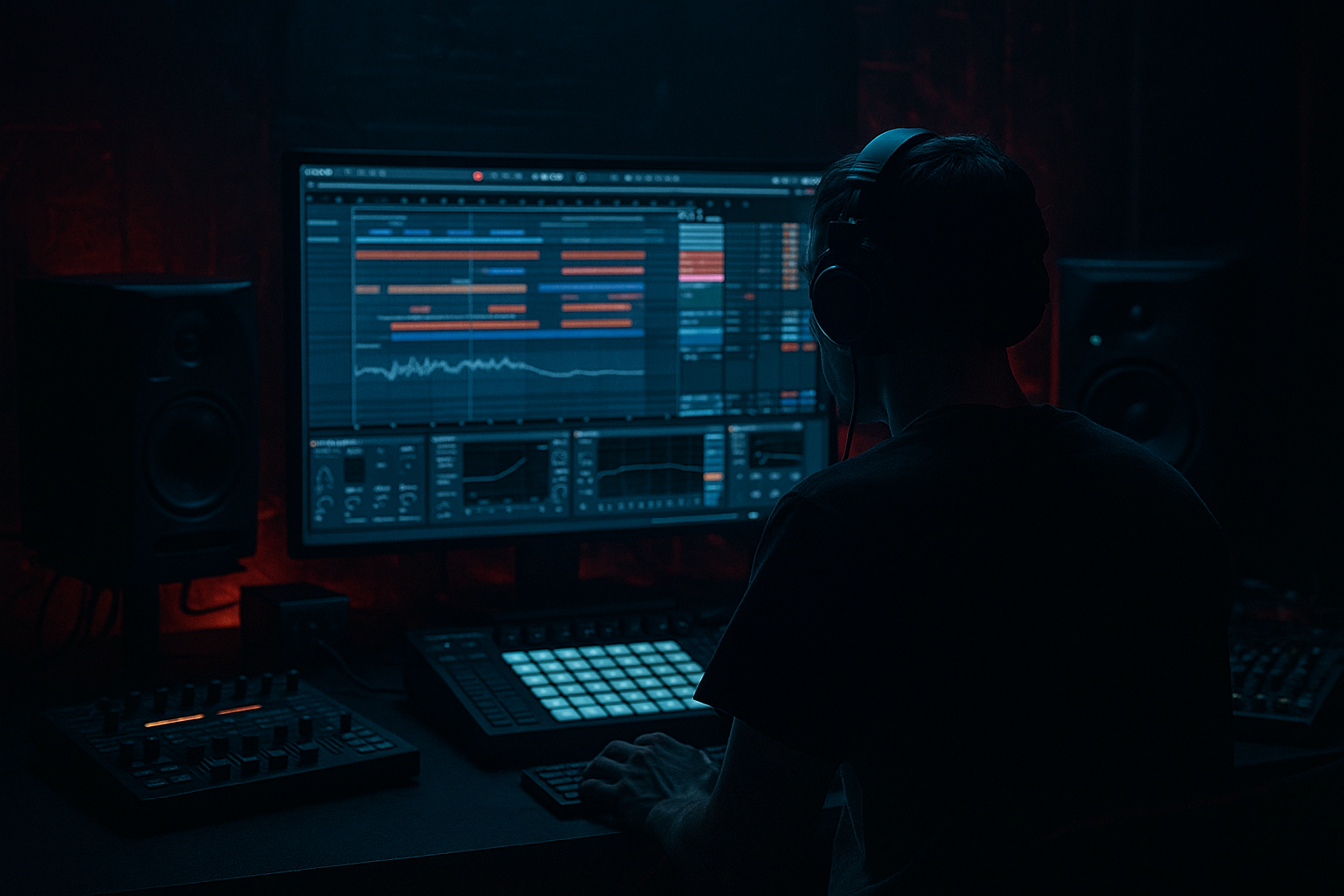
Main tutorial
```markdown
Tension Before the First Drop Masterclass (Session View) — Drum & Bass in Ableton Live ⚡️
1) Lesson overview
This lesson is about engineering maximum anticipation before your first drop using Ableton Live Session View — not by “adding random risers,” but by controlling energy, density, space, and expectation like a proper DnB arranger.
We’ll build a pre-drop that:
- Feels rolling and alive, not static
- Uses DJ-friendly phrasing (8/16/32 bars) and DnB tension tropes (cut drums, filtered bass, vocal chops, impacts)
- Is performed and recorded from Session View so you can audition variations fast and keep creative momentum 🎛️
- 3–4 tension stages (each 8 bars) that intensify
- A controlled “hole” right before the drop (space = impact)
- Automation performance recorded into Arrangement (filter sweeps, reverb throws, drum density, sub management)
- Fallback options: you’ll create multiple clip versions so you can switch directions instantly
- Return A (Short Verb): Reverb
- Return B (Long Verb / “Throw”): Hybrid Reverb (Convolution + Algorithm)
- Return C (Delay): Echo
- Drums: Use a reduced groove:
- Bass: Sub very minimal or muted; mid bass teased with filter closed
- Music: Atmos/pad, tiny vocal chop, subtle stab
- FX: A quiet riser or noise bed
- Mode: LP24
- Freq: start around 14–18 kHz (barely filtering)
- Drive: 0–2 dB
- Add hat ticks, ghost snares, percussion loops
- Bring in a break layer (classic jungle texture) but controlled
- Introduce call-and-response with bass mids (still not full)
- Tune to key-ish, Dry/Wet 5–15%
- Map Bass Mono ON
- Map Gain to a macro for quick dips
- Add Auto Filter (LP12 or HP12 depending on vibe)
- HP around 25–40 Hz rising to 60–90 Hz near the end
- On pad/atmos track: Auto Pan
- Add sends to Return B gradually (long verb = height)
- Reduce kick presence in the last 2 bars (or remove entirely)
- Snare roll / build that accelerates
- Massive reverb throws on vocal stab / snare
- Filter closes on the full mix (but not too early)
- Last bar “airlock”: remove low end + narrow stereo for a moment
- Clip 1: 1/8 notes (2 bars)
- Clip 2: 1/16 notes (1 bar)
- Clip 3: 1/32 notes (last 1/2 bar)
- Most drums (leave a tiny hat tail or reverse cymbal)
- Sub and low mids
- Wide stereo
- Create a “PreDrop Kill” clip on a dedicated Automation/Control track (an audio track with no input is fine).
- Map key parameters to Macros (via an Audio Effect Rack on the Master or groups):
- Then automate macro envelopes in the clip.
- Audio Effect Rack with 4 macros:
- Hats A: straight 1/16 closed hats
- Hats B: shuffled hats + occasional open hat
- Break A: filtered break (HP at 300–600 Hz)
- Break B: full-range break but sidechained to kick
- Compressor → Sidechain ON
- Input: Kick
- Ratio 4:1, Attack 3–10 ms, Release 60–120 ms
- Aim 2–5 dB GR when kick hits
- Remove sub (HP bass to 80–120 Hz)
- Remove kick
- Narrow stereo (Width 50% or less)
- Increase reverb tail (then cut it at drop if you want clean punch)
- Bring back full width
- Bring back full sub
- Bring back transients (no filter, no limiter pumping)
- Constant energy: if everything is loud and full for 32 bars, there’s no tension curve.
- Risers doing all the work: risers help, but tension mostly comes from rhythm manipulation + low-end control.
- Too much low end in the build: kills perceived drop weight. High-pass intelligently.
- Over-widening pre-drop: if the build is already max wide, the drop can’t expand.
- Uncontrolled reverb mud: long verbs without HP filtering make the mix collapse right before the drop.
- Tease the bass motif with band-pass:
- Fear-factor pauses:
- Texture stack for menace:
- Distorted impacts:
- Pitch dive on the last hit:
- Session View is perfect for pre-drop tension because you can audition structure + density in real time.
- Build tension in stages (8-bar scenes) using:
- Record the performance into Arrangement and keep the best take.
> Assumption: You already have a drop loop (drums + bass + main hook) and a rough intro vibe. We’ll focus on the build into Drop 1.
---
2) What you will build
A 32-bar pre-drop made from Session View clips with:
You’ll end with a Session View “performance rig” that you can reuse across tunes.
---
3) Step-by-step walkthrough
Step 0 — Prep your Session View like a DnB performance grid
1. Set tempo: 172–176 BPM.
2. In Session View, create these groups/tracks:
- DRUMS (Group): Kick, Snare, Hats/Break, Perc, Fills
- BASS (Group): Sub, Mid/Reese, FX Bass
- MUSIC: Pads/Atmos, Stabs/Hook, Vocal chops
- FX: Risers, Downlifters, Impacts, Noise
- RETURN tracks: A = Short Verb, B = Long Verb, C = Delay (optional)
3. Set global quantization: 1 Bar (top-left).
For fast fill triggering later, you can temporarily switch to 1/4 or 1/2.
Return tracks (stock devices)
- Decay: 0.8–1.2s, Predelay: 10–20ms, HP filter ~ 250 Hz
- Decay: 4–8s, Predelay: 20–40ms, HP ~ 300 Hz, Wet: 100%
- Time: 1/4 or 1/8 dotted, Feedback 25–40%, HP ~ 300 Hz, Mod small
> These returns are your tension multipliers. Most “builds” are just increasing sends + removing lows at the right moments.
---
Step 1 — Build 4 tension stages as Scenes (8 bars each)
Create 4 Scenes (rows) named:
1. Stage 1 — Hint
2. Stage 2 — Pressure
3. Stage 3 — Lift
4. Stage 4 — Cliff (pre-drop)
Set each clip length to 8 bars (except special fill clips later).
#### Stage 1 — Hint (8 bars): establish groove but hold back
- Kick + Snare, light hats, maybe a filtered break layer
Practical move:
On the DRUMS Group, add Auto Filter:
This gives you something to “close” later.
---
#### Stage 2 — Pressure (8 bars): density up, space down
Drum bus chain suggestion (stock)
On DRUMS Group:
1. Drum Buss
- Drive: 5–15
- Boom: 0–20 (careful pre-drop)
- Transients: +5 to +15
2. Glue Compressor
- Attack: 3 ms, Release: Auto
- Ratio: 2:1
- Aim for 1–2 dB GR (just knit)
Tension trick: Add Corpus lightly on a perc or hat for metallic edge:
---
#### Stage 3 — Lift (8 bars): start removing sub + increase motion
This is where you emotionally say “we’re going somewhere.”
Bass control (important for DnB impact)
On BASS Group, add Utility:
Now, high-pass the bass group slightly during the lift:
This makes the drop sub feel huge when it returns.
Add motion to atmos:
- Rate: 1/2 or 1 bar
- Amount: 20–40%
---
#### Stage 4 — Cliff (8 bars): maximum tension, then a hole
This is where advanced arrangement earns its money 💥
Goal: make the listener lean forward.
Core moves:
##### 4A) Snare roll (Session clips)
On a snare build track, create 3 clips:
Use Session View to trigger these as you approach the end.
Device chain on snare build track
1. EQ Eight
- HP at 150–250 Hz
- Small boost 2–5 kHz if needed
2. Saturator
- Soft Clip ON
- Drive 2–6 dB
3. Reverb (or send to Return B)
- For the final hits: push send hard
##### 4B) The “hole” (the moment before Drop 1)
This is the pro move: contrast.
At last 1 beat (or last 1/2 bar), kill:
How to do it cleanly in Session View
- Master Auto Filter freq (LP)
- BASS Utility Gain
- DRUMS Group Utility Gain
- Master Utility Width
Suggested Master “Tension Rack” (stock)
On Master:
1. LP Filter (Auto Filter LP12): 20k → 200 Hz
2. Width (Utility Width): 120% → 0–60%
3. Reverb Throw Send (map send knobs on key tracks)
4. Volume Dip (Utility gain): 0 → -inf (careful)
> Use this rack sparingly: the goal is a brief, intentional choke right before the drop.
---
Step 2 — Create variation clips (Session View = fast options)
For each stage, create A/B clip variations:
Sidechain (stock Compressor)
On the break track:
Now you can “perform” the build by swapping clips.
---
Step 3 — Build tension with performance automation (record it!)
1. Click Arrangement Record (top transport).
2. Launch Scenes in order:
- Stage 1 → Stage 2 → Stage 3 → Stage 4
3. While launching, perform:
- Filter sweeps (Auto Filter on Drum/Bass groups)
- Send throws to Return B on the last vocal/snare hit
- Width narrowing with Utility on Master
- Quick mute/solo moments (tiny dropouts are gold in DnB)
Then go to Arrangement View and keep the best take.
This workflow keeps creativity high and avoids over-editing too early.
---
Step 4 — Make the drop hit harder using “pre-drop subtraction”
Right before Drop 1 (last 1–2 bars):
At the drop:
That contrast is the “DnB slap.”
---
4) Common mistakes
---
5) Pro tips for darker/heavier DnB 🖤
On mid-bass, use Auto Filter (BP), Resonance 20–40%, automate frequency to “speak” the hook without full weight.
1/4-bar silence (or just reverb tail) before the drop is brutal when timed right.
Layer a quiet noise/reese air (high-passed at 300–800 Hz) that rises in level across stages.
Put Saturator on an impact bus, Soft Clip ON, Drive 4–10 dB, then low-pass at 8–12 kHz for weight.
Use clip envelope pitch (or transpose automation) on a vocal stab/impact down -2 to -12 semitones right before drop.
---
6) Mini practice exercise (15–25 minutes)
1. Take any existing DnB drop loop.
2. In Session View, create 4 scenes (8 bars each).
3. Create two “hole” options:
- Hole A: last 1 beat silence + reverb tail
- Hole B: last 1/2 bar with only filtered hats + vocal throw
4. Record yourself launching scenes and performing:
- Bass HP automation up to ~90 Hz by end
- Master width down to ~50% in last bar
- One huge Return B throw on the final snare
5. Listen back and choose the best tension arc.
Deliverable: export Build → Drop 1 and check: does the drop feel at least 20–30% bigger than before?
---
7) Recap
- Density (more rhythm layers)
- Subtraction (remove lows/kick right before drop)
- Space (reverb throws + brief holes)
- Contrast (width + filtering + transient control)
If you want, tell me what subgenre you’re aiming for (rollers, jungle, neuro, dancefloor), and what your drop contains (reese? foghorn? chopped breaks?), and I’ll suggest a scene-by-scene tension script tailored to your sound.
```

