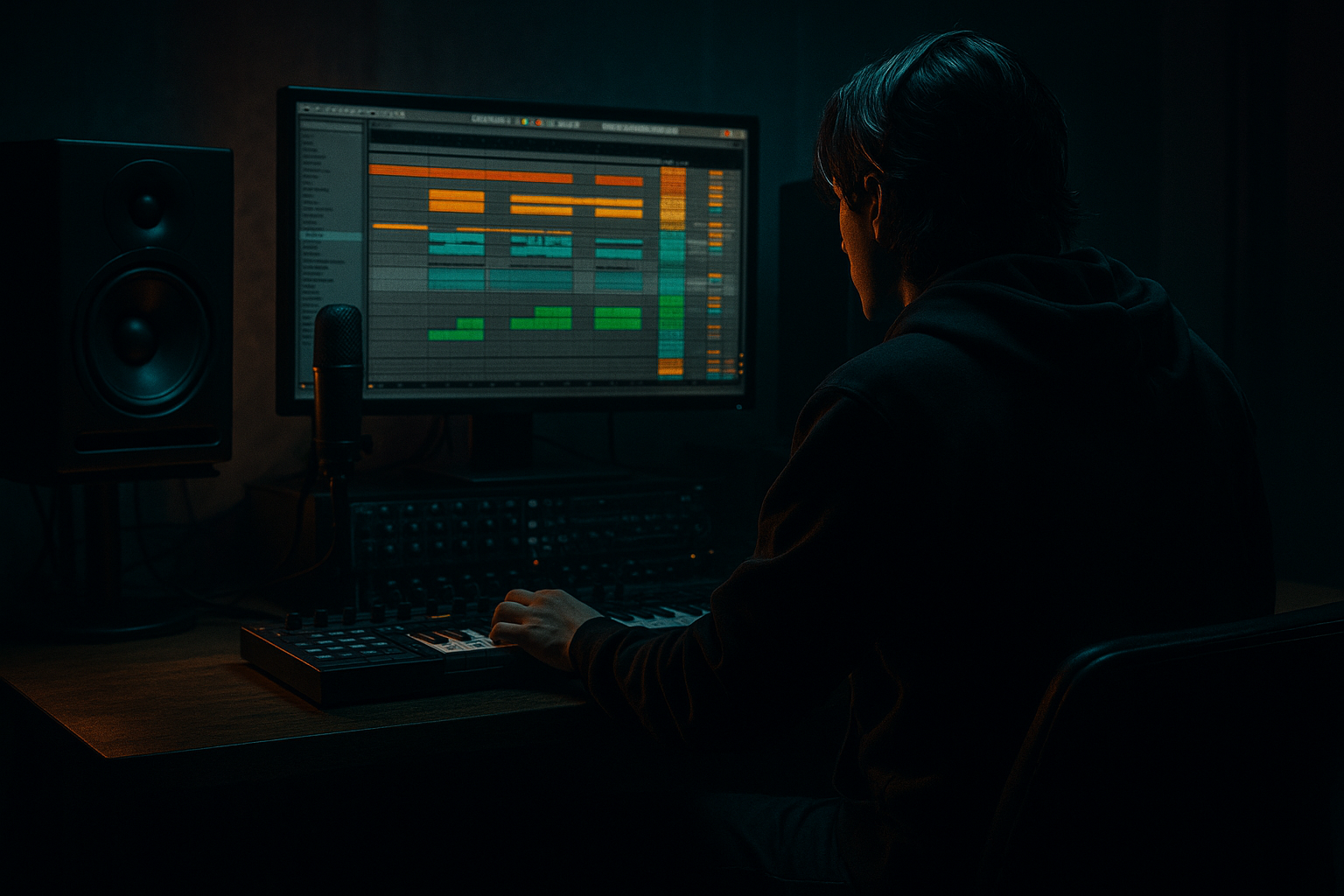
Main tutorial
```markdown
Theme Writing on Piano Before Production (DnB in Ableton Live) 🎹⚡️
Skill level: Advanced • Category: Composition • Context: Drum & Bass / Jungle / Rolling Bass
---
1. Lesson overview
In drum & bass, the best tunes usually have a strong theme—a melodic idea that survives any sound choice: reese, pads, stabs, vocals, whatever. The fastest way to get that is to write on piano first, before you touch serum patches, resampling, or heavy drum programming.
This lesson focuses on building a piano-led theme sketch inside Ableton Live that:
- Locks to DnB phrasing (16/32 bar logic)
- Leaves space for bass movement and drums
- Translates cleanly into stabs, leads, atmos, and even bass motifs
- Is easy to arrange into a full rolling track
- 8-bar A theme (hook)
- 8-bar A variation (answer/extension)
- 8-bar B theme (contrast / darker turn)
- 8-bar return / lift (setup for drop or main section)
- Piano MIDI that’s rhythmically “DnB tight”
- A voicing strategy that avoids fighting the sub
- A harmony + motif system that’s easy to re-orchestrate into DnB sounds
- Decide if your hook is:
- Short (1–2 bars)
- Recognizable
- Easy to mutate (rhythm, inversion, displacement)
- Limit yourself to 3–5 pitch classes initially.
- Then add one “color note” as the signature (e.g., b2 in Phrygian, or raised 7 in harmonic minor).
- Keep your left hand (or low notes) mostly above 100 Hz in the sketch
- Prioritize shell voicings and open intervals:
- Use cluster tension sparingly, and usually higher up.
- Put the motif in mid register (C4–C6).
- Put harmony support in upper-mid (E4–A5) with wide voicings.
- Avoid dense chords around C3–C4—that’s where reeses and snares live.
- Bars 1–2: motif statement
- Bars 3–4: repeat with micro-change (rhythm or last note)
- Bars 5–6: lift (higher register, or harmonic shift)
- Bars 7–8: cadence that doesn’t fully resolve (keeps energy)
- Displace the motif by an 8th note (classic DnB push/pull)
- Invert the contour (up becomes down)
- Sequence it up/down a scale degree
- Rhythmic augmentation: double note lengths briefly to create contrast
- Keep motif rhythm, change harmony underneath
- Switch from natural minor to Phrygian flavor (b2 emphasis)
- Introduce a pedal tone (one repeated note) while chords move
- Use a more “questioning” cadence (avoid resolving to i)
- The bass guide root notes
- One or two motif notes (color notes)
- Register (drop it down or push it up)
- Osc A: Sine
- Env A:
- Mono: On (in the track or via Glide if desired)
- Add EQ Eight HPF off (keep full low end here)
- Hits roots on strong beats
- Avoids stepping on the motif rhythm constantly
- Creates the rolling feel through offbeat or syncopated hits
- Hat pattern: offbeats or 16ths (very quiet)
- Kick on 1, snare on 2 and 4 (DnB backbeat)
- No fancy fills yet
- Drum Rack with core hits
- Or Session view: drop in a simple top loop at low volume
- Keep main motif notes fairly tight
- Nudge support notes slightly late/early by `5–15 ms`
- Use velocity shaping:
- Add a groove with subtle swing (not house swing).
- Apply at 10–20% and reduce timing randomness.
- `THEME_STAB` (chords)
- `THEME_LEAD` (top line)
- `ATMOS_PAD` (long notes)
- `MID_BASS_MOTIF` (rhythm from motif)
- Wavetable for a clean lead layer
- Analog for warm pad support
- Saturator to bring harmonics forward
- Auto Filter for movement (map to Macro)
- Echo (very subtle) for space without washing rhythm
- Intro (16): tease motif as pad or filtered piano
- Build (16): motif becomes clearer, add variation
- Drop (32): motif as stabs/lead + bass answers it
- Breakdown: piano returns briefly for identity
- Second drop: motif inverted or displaced
- Pedal tone tension:
- Phrygian/harmonic minor “signature note”:
- Octave displacement for aggression:
- Rhythmic negative space = weight:
- Translate motif into bass callouts:
- Write the motif first, not the sound.
- Use piano to prove the theme has identity, groove, and phrasing.
- Voice like a producer: leave sub space, avoid low-mid clutter.
- Build A / A-var / B / return in 32 bars for DnB-ready structure.
- Stress test with guide bass + minimal drums before full production.
---
2. What you will build
A 32-bar theme sketch (piano-only first) designed for 174 BPM DnB:
Then you’ll convert it into a production-ready Ableton Session + Arrangement workflow with:
---
3. Step-by-step walkthrough
Step 0 — Set the DnB writing environment (Ableton template)
1. Tempo: `174 BPM` (or 172–176 if you prefer)
2. Time signature: `4/4`
3. Create tracks:
- MIDI 1: `PIANO_THEME`
- MIDI 2: `PAD/HARMONY (optional)`
- MIDI 3: `BASS GUIDE (mono)`
- Audio/MIDI: `DRUM GUIDE` (optional click/hat loop)
4. Load a piano:
- If you have Suite: Instrument → Piano & Keys (pick something clean)
- Or: Electric set to a neutral tone (not too vibey)
- Keep it honest: no big reverbs yet.
5. Add a “composition glue” chain (subtle):
- On `PIANO_THEME`:
- EQ Eight
- HPF at ~`80–120 Hz` (so your left hand doesn’t trick you into writing sub conflicts)
- Small dip around `250–400 Hz` if it gets boxy
- Glue Compressor
- Ratio `2:1`, Attack `10 ms`, Release `Auto`, GR ~`1–2 dB`
- Utility
- Width `80–100%` (keep centered-ish)
✅ Goal: a piano that’s clear and honest, not “produced.”
---
Step 1 — Establish the grid feel DnB themes want
DnB themes typically feel strongest when they lock into 2-bar and 4-bar call/response, with rhythmic tension against the drums.
Set your clip loop to 8 bars for your A theme.
Make a simple rhythmic scaffold first (no notes yet):
- Offbeat-driven (syncopation), or
- Downbeat-driven (anthemic), or
- Triplet/jungle swing inspired
Practical tip: Create a “rhythm-only” MIDI clip using one note (e.g., C3) to map your motif rhythm. Then you can swap pitches later without losing the groove.
---
Step 2 — Write a motif that survives sound design 🎯
A DnB motif should be:
Workflow:
1. Choose a key/mode that supports darker DnB:
- F minor, G minor, D# minor, or Phrygian / harmonic minor flavors.
2. Build a 2-bar motif:
- Bar 1 = statement
- Bar 2 = answer (slight change)
Advanced writing constraint (use this):
This prevents the common “too many notes, no identity” problem.
---
Step 3 — Voicing: write like a producer (not a pianist) 🧠
In rolling DnB, your bass and drums need space. So your piano writing must behave.
Rule set for voicing:
(you’ll write actual sub later).
- 5ths, octaves, 10ths (3rd + octave)
Practical approach:
---
Step 4 — Bake in DnB phrasing: 8-bar A + variation
Now make it feel like a real DnB hook.
A theme (Bars 1–8):
A variation (Bars 9–16):
Do one of these (not all):
✅ The goal is identity + forward motion, not “new melody every bar.”
---
Step 5 — Create a B section that’s darker, not random 🌑
Bars 17–24: contrast without losing the track’s DNA.
Good B-section moves for DnB:
Ableton technique:
Duplicate the A clip → rename B → change only:
---
Step 6 — Add a bass guide line (not your final bass) 🔊
Create `BASS GUIDE (mono)` with Operator (simple sine).
Operator settings (fast):
- Attack `0 ms`
- Decay `300 ms`
- Sustain `-inf` (or very low)
- Release `60–120 ms`
Write a guide bass that:
DnB reality check:
If your piano theme only sounds good with bass doing nothing, it’s not production-ready. The theme must coexist with motion.
---
Step 7 — Stress test your theme with a drum guide 🥁
Even though we’re composing first, a minimal drum guide reveals if your motif fights the groove.
Add a basic drum loop or build a quick guide:
Ableton stock tools:
Mix level tip: keep drums low. This is composition validation, not production.
---
Step 8 — Humanize like DnB: micro-timing + velocity (controlled) 🎛️
Advanced mistake: “humanize everything.” DnB needs intentional looseness.
In MIDI Clip View:
- Accents on motif “identity” notes
- Ghost notes 10–25 velocity lower
Groove Pool (optional):
---
Step 9 — Convert the piano theme into production lanes (without losing it) 🚀
Once the theme works on piano, orchestrate it.
Duplicate the MIDI clip to multiple tracks:
Stock device suggestions:
Arrangement idea (32 → 64 bars):
---
4. Common mistakes
1. Writing “a chord progression,” not a theme
DnB hooks usually come from a motif—rhythm + contour—not just changes.
2. Too much low-mid information in piano
If your sketch relies on thick C3–C4 chords, it won’t survive a reese + snare.
3. No call/response
DnB loves questions and answers over 2 and 4 bars. If everything is constant, it feels flat.
4. Over-resolving
If every 4 bars lands perfectly on the tonic, the drop can feel less hungry.
5. Theme fights drum phrasing
If your motif accents are constantly on snare hits, it can feel clumsy unless intentional.
---
5. Pro tips for darker/heavier DnB 🌒🔧
Hold a constant note (like the 5th) under changing chords to create dread without complexity.
Add one spicy scale degree as your identity (b2 or major 7 in minor). Use it sparingly—make it a moment.
Take one motif note and drop it an octave occasionally—instant menace, especially when later mapped to mid-bass.
Heavier DnB often means fewer notes with stronger placement. Let the drums and bass breathe.
After piano works, copy motif rhythm to a mid-bass layer (later resample). Keep sub simpler.
---
6. Mini practice exercise (15–25 minutes) ⏱️
1. Set Ableton to 174 BPM, create `PIANO_THEME` with a clean piano.
2. Write a 2-bar motif using only 4 notes (plus one optional color note).
3. Expand to an 8-bar A section using repetition + micro-variation.
4. Duplicate and create 8-bar A variation using displacement (shift motif by an 8th).
5. Create a B section by:
- keeping rhythm
- changing harmony (try b2 emphasis if dark)
6. Add `BASS GUIDE` with Operator sine and write a rolling pattern that doesn’t copy the piano.
7. Add a minimal drum guide and confirm the motif still feels like DnB.
Deliverable: one 32-bar arrangement that feels hooky even with piano only.
---
7. Recap ✅
If you want, tell me a reference vibe (e.g., “roller like Alix Perez,” “jungle like 90s Metalheadz,” “neuro like Noisia”), and I’ll suggest a specific scale/mode choice and a motif rhythm template you can drop straight into Ableton.
```

