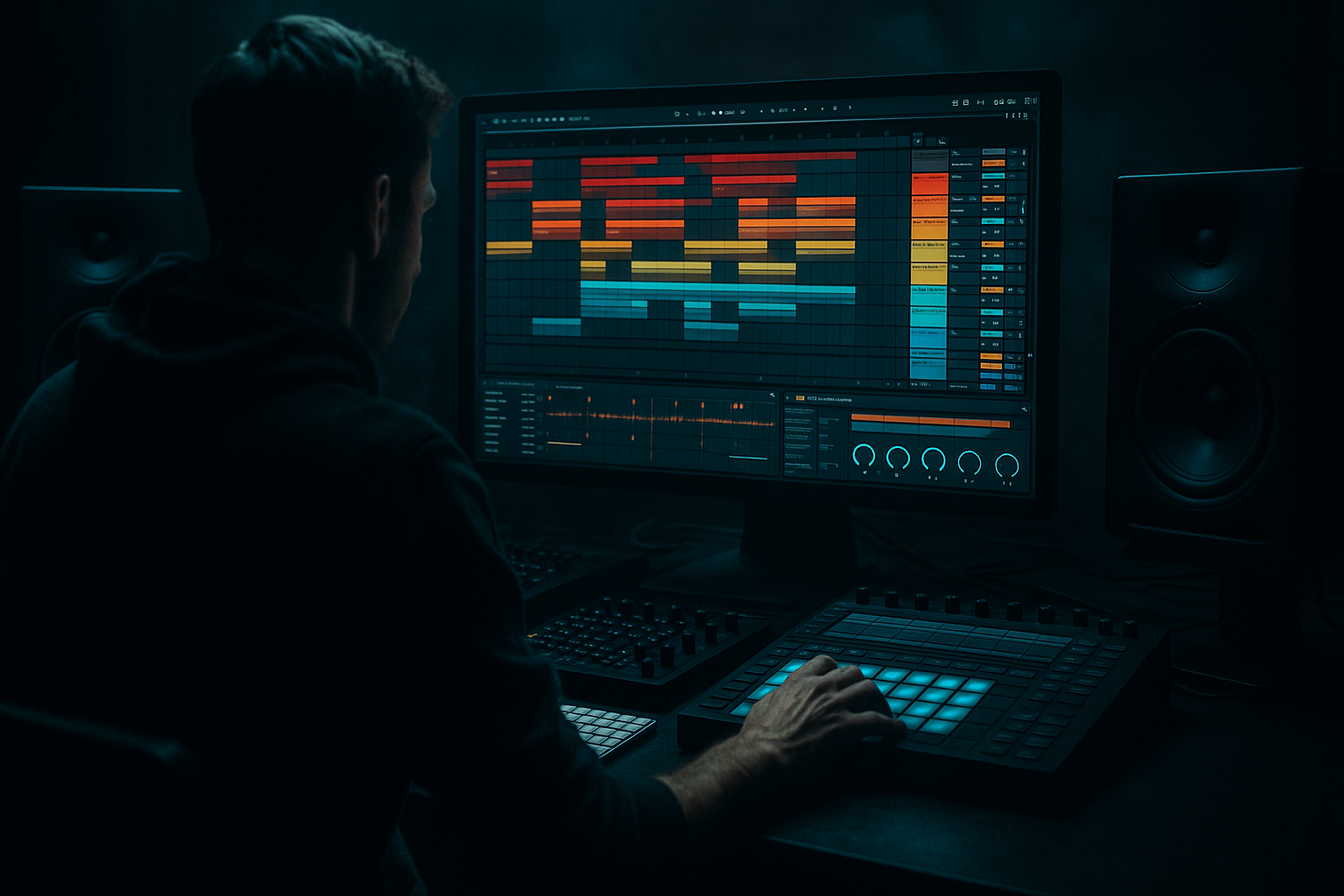
Main tutorial
Think Ableton Live 12 Jungle Arp Session for Ragga‑Infused Chaos (Edits) 🥁🔥
1. Lesson overview
This lesson is about editing—not writing a whole tune from scratch. You’ll take a ragga/jungle vibe and build a chaotic but controlled arp-driven hook that feels like classic jungle stabs meeting modern DnB energy.
We’ll use Ableton Live 12 stock tools to:
- Turn single notes/stabs/vocals into a jungle “arp” pattern
- Make it swing hard, rush into fills, and glitch on command
- Keep it mix-safe and arrangement-ready for a DnB drop
- A ragga-friendly jungle arp made from a stab/rave chord or resampled vocal
- Call-and-response with breaks (Amen-style or tight modern breaks)
- Macro-controlled chaos (ratchets, stutters, filter yanks, dub delays)
- A DJ-friendly edit structure (clean intro/outro, impact points, fills)
- Reverse a single stab before a snare: right-click → Reverse
- Micro-stutter: duplicate a 1/16 slice 3–6 times
- Create a “tape stop” vibe: use Clip Transpose automation (downward pitch ramp)
- Macro 1: “HP Sweep” → Auto Filter Frequency (HP mode)
- Macro 2: “Muffle” → Auto Filter Frequency (LP mode) (use one filter or two; keep simple)
- Macro 3: “Ratch” → Beat Repeat Chance (0–35%)
- Macro 4: “Grid” → Beat Repeat Grid (1/16 ↔ 1/32)
- Macro 5: “Dub Send” → Echo Dry/Wet (0–35%)
- Macro 6: “Crush” → Redux Downsample (0–40%)
- Macro 7: “Width” → Utility Width (80–140%)
- Macro 8: “Panic Cut” → Utility Gain (-inf to 0 dB) for hard mutes
- Full drums + bass
- Arp loop steady, minimal macros
- One vocal chop every 2 bars
- Increase HP Sweep slightly (tension) then open it
- Add Beat Repeat Chance to 10–15% in bar 8
- Add a crash + snare fill at bar 8 end
- Swap to a different arp resample slice (variation)
- Bring in a more aggressive vocal call
- Add a 1/2 bar dropout before bar 12 snare (classic)
- Short “ratchet” moments (1/32 grid for 1 beat only)
- Dub delay throws
- Final bar: hard mute arp for 1/2 bar, let drums+bass punch, then arp hit as a button
- EQ Eight
- Compressor (or Glue Compressor)
- Sidechain the arp to the snare (very jungle):
- Over-randomizing Beat Repeat: Chance too high turns it into glitch soup. Keep it selective.
- Too much low-end in the arp: If it’s fighting your bass, it’ll never feel “rolling.”
- No gaps: Jungle needs air. Leave spaces so the breaks speak.
- Warp artifacts on resamples: If audio sounds crunchy in a bad way, check Warp mode and transient markers.
- Too wide and phasey: If you widen the arp, keep the low mids controlled (use EQ + Utility width).
- Minor keys + tritone notes: Slip in a passing note a tritone away (briefly) for menace.
- Band-limit for authenticity: Try Auto Filter LP around 8–10 kHz during sections to emulate old sampler vibe, then open it for impact.
- Parallel dirt: Duplicate the arp track:
- Reese-friendly carving: If you run a wide reese, keep the arp more center-focused (Utility width ~90–110%).
- Hard edits hit harder: Don’t fade everything—use hard cuts into reverb/delay throws for that DJ-edit aggression.
- You built a jungle arp hook designed for edits/VIPs, not just looping.
- The magic is: tight MIDI rhythm → resample → audio slicing → macro-controlled chaos.
- Stock devices that do the heavy lifting: Simpler, EQ Eight, Saturator, Auto Filter, Beat Repeat, Echo, Hybrid Reverb, Utility.
- Final mindset: ragga + jungle = attitude + space + controlled destruction 😤
You’ll end with a reusable “Jungle Arp Rack” you can throw into edits, VIPs, and bootlegs.
---
2. What you will build
A 16-bar drop section featuring:
---
3. Step-by-step walkthrough
A) Session prep (tempo, swing, and routing)
1. Set tempo: `170–174 BPM` (try 172 for a sweet spot).
2. Global Groove:
- Open Groove Pool.
- Add MPC 16 Swing 57–63 (start at 59).
- Later, you’ll apply this groove mainly to the arp MIDI clip and selected drum hits.
3. Create tracks:
- `DRUMS (break)` audio track
- `KICK/SNARE (reinforcement)` MIDI or audio
- `BASS` (your usual rolling sub/reese)
- `ARP STAB` (Instrument track)
- `RAGGA VOX` (audio track)
- `FX BUS` (return track with delay/reverb)
4. Return tracks (simple but effective):
- Return A – Dub Delay: Delay (or Echo)
- Time: 1/8 dotted or 1/4
- Feedback: 25–45%
- Filter: HP around 250–400 Hz, LP around 6–9 kHz
- Return B – Plate/Space: Hybrid Reverb
- Decay: 1.2–2.5s
- HP: 300–600 Hz
- Mix: keep subtle; use sends for energy spikes
---
B) Build the “Jungle Arp” source (stab or vocal) 🎛️
You need a sound that reads like jungle: rave stab, organ stab, hoover-ish chord, or a resampled ragga shout.
#### Option 1: Classic stab via Simpler
1. Drag a stab sample onto Simpler (Instrument track).
2. In Simpler:
- Mode: One-Shot (for stabs) or Classic (if you want note-length control)
- Warp: On (if needed), keep it tight
- Filter: LP24
- Freq: start around 3–6 kHz
- Res: 10–25%
- Amp envelope:
- Attack 0–5 ms
- Decay 200–600 ms
- Sustain 0
- Release 50–120 ms
3. Add Saturator after Simpler:
- Drive: 2–6 dB
- Soft Clip: On
- Output: trim so it’s not nuking your bus
#### Option 2: Ragga vox as “arp material” (resampled chops)
1. Take a ragga phrase (“rudeboy”, “come again”, etc.).
2. Right-click → Slice to New MIDI Track:
- Slicing preset: Transient or 1/8 (try transient first).
3. You now have a Drum Rack of slices—perfect for call/response and “arp-like” repetition.
> For this lesson, we’ll proceed with a stab in Simpler, then you can swap the source later.
---
C) Create the arp pattern (MIDI editing that screams jungle) ✍️
1. Create a 1-bar MIDI clip on `ARP STAB`.
2. Set grid to 1/16.
3. Write a pattern that alternates root + fifth + octave style movement.
Example in F minor (works great for dark ragga vibes):
- Notes: F2, C3, F3, Ab3 (don’t overthink it)
4. Rhythm idea (one bar):
- Put notes on 1e&a 2& 3e&a 4& style placements
- Then add 2–3 16th repeats at the end of bar for a “ratchet” feel
Key jungle move:
Add a few intentional gaps. Jungle is as much about what drops out as what hits.
---
D) Make it feel like an “arp” without relying on the Arpeggiator device 🤺
You can use Arpeggiator, but jungle edits often feel tighter when you hand-place the rhythm and then add controlled chaos.
That said, here are two approaches:
#### Approach 1: Hand-program + Groove (recommended for edits)
1. Apply your Groove Pool swing to the MIDI clip:
- Groove amount: 30–60%
- Timing: +10 to +20 (subtle)
2. Manually nudge a couple notes early (like 5–10 ms) right before snares to add “rush”.
#### Approach 2: Use Arpeggiator device (fast and savage)
Device chain on `ARP STAB`:
1. Arpeggiator
- Style: Up or UpDown
- Rate: 1/16
- Gate: 35–60%
- Steps: 3–5
- Retrigger: On
2. Feed it with held chords (like Fm: F–Ab–C), then resample the output (next step).
---
E) Resample the arp for edit-style control (this is where it gets serious) 🔪
Jungle edits love audio manipulation because it’s immediate and punchy.
1. Create a new audio track: `ARP RESAMPLE`.
2. Set its input to “ARP STAB” (or “Resampling” if you prefer).
3. Record 8 bars of arp running through your chain.
4. Now flatten to audio and start editing:
- Consolidate interesting bits into 1-bar and 2-bar loops
- Create “hit points” on bar 1, bar 5, bar 9 for arrangement
Editing tricks:
---
F) Add chaos with a macro rack (stock-only, performance-ready) 🎚️😈
On `ARP RESAMPLE`, build this chain:
1. Auto Filter
- Type: HP12 (for dropouts) or LP24 (for muffled tension)
2. Redux
- Downsample: subtle to medium (adds grit fast)
3. Beat Repeat
- Interval: 1 Bar
- Grid: 1/16
- Chance: 10–25% (controlled chaos)
4. Echo
- Time: 1/8 or 1/8 dotted
- Feedback: 20–45%
- Mod: small
5. Utility
- Width control (mono below a point via EQ, see below)
Then wrap into an Audio Effect Rack and map Macros:
Macro suggestions:
> Keep Beat Repeat Chance low. Too much and it becomes random mush instead of intentional jungle pressure.
---
G) Make it ragga: vocal chops that answer the arp 🎤
On `RAGGA VOX`:
1. Warp mode: Complex Pro (usually safest for vocals).
2. Create tight 1/8 and 1/16 chops. Place them:
- After snares (classic call)
- Before phrase changes (to hype transitions)
3. Processing chain:
- EQ Eight: HP at 120–200 Hz, dip harshness around 2–4 kHz if needed
- Saturator: Drive 1–4 dB (warmth)
- Gate: tighten tail (threshold to taste)
- Send to Dub Delay return for space throws
Jungle edit move:
Automate sends so only the last word hits the delay: “...again” → throws into space.
---
H) Glue it into an edit-style arrangement (16 bars that DJs love) 🧱
Here’s a reliable 16-bar drop blueprint:
Bars 1–4: Establish
Bars 5–8: Escalate
Bars 9–12: Switch-up
Bars 13–16: Maximum chaos → reset
Transition into next section:
End bar 16 with a tape-stop/pitch dip on arp only, while drums stay tight.
---
I) Make room in the mix (fast DnB priorities) ⚙️
Your arp is midrange energy—don’t let it fight the snare and bass.
On `ARP RESAMPLE` add:
- High-pass: 150–300 Hz (depends on your bass)
- Notch around 180–240 Hz if it clouds the low-mids
- Small dip ~2 kHz if it masks snare crack
- Ratio: 2:1
- Attack: 10–30 ms
- Release: Auto or 100–200 ms
- Aim for 1–3 dB GR on peaks
Optional but strong:
- Compressor sidechain input: snare track
- Fast attack, medium release
- 2–4 dB dip when snare hits so your snare stays king 🥁
---
4. Common mistakes
---
5. Pro tips for darker/heavier DnB 🖤
- One clean(ish), one filthy with Overdrive + Redux
- Blend quietly underneath for weight
---
6. Mini practice exercise (15 minutes) ⏱️
1. Make a 1-bar arp loop from a stab (MIDI or Arpeggiator).
2. Resample 4 bars to audio.
3. Create three versions:
- A: Clean groove + swing
- B: Beat Repeat “ratchet” only on last 1 beat of bar 4
- C: Reverse + pitch dip into bar 1
4. Arrange into 8 bars:
- Bars 1–4: A
- Bar 5–6: B
- Bar 7–8: C (big transition)
5. Add two ragga vocal chops that answer the arp, with one delay throw.
---
7. Recap
If you tell me what kind of source you’re starting with (rave stab, organ, hoover, vocal phrase), I can suggest a specific arp rhythm and a macro mapping that matches that vibe.

