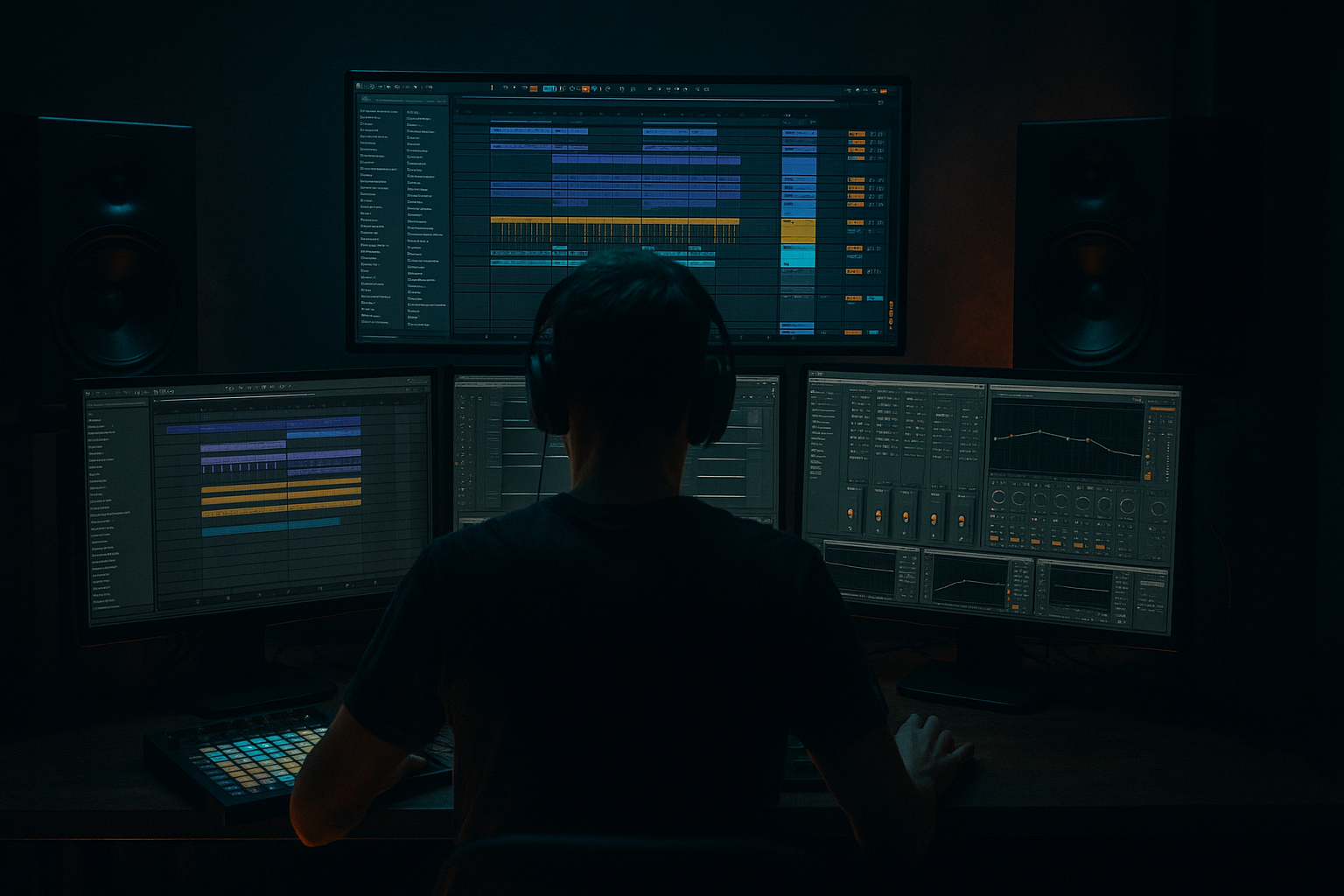
Main tutorial
```markdown
Think Ableton Live 12 Subsine Breakdown for Oldskool Rave Pressure 🔊🌀
1. Lesson overview
In drum & bass, the breakdown is where you tease the bass pressure without dropping the full drum groove. An “oldskool rave pressure” breakdown usually means:
- A pure, physical sub note (often sine-based) that feels like it’s leaning on the room
- Classic jungle/rave signifiers: dubby space, tape-ish saturation, stabs/vox hits, risers
- Controlled tension: less drums, more low-end weight and atmosphere
- A subsine “pressure” bass (mono, clean fundamental, controlled harmonics)
- Automated low-end movement (filter, saturation, subtle pitch, volume shaping)
- A rave atmosphere bed (pads/noise/air + dub space)
- A tension ramp into the drop (snare builds, FX, silence, pre-drop punch)
- Turn on View → In/Out to manage routing easily.
- Use Spectrum (stock) early to see your sub fundamental.
- Use Operator or Wavetable for noise:
- Process chain:
- Add a stab or vox hit every 2–4 bars.
- Put it through:
- A distant break ghost
- A snare build
- Ride/hat air
- EQ Eight: HP at 150–250 Hz
- Drum Buss: Drive 5–15%, Boom OFF (or very low)
- Auto Filter: automate LP cutoff to open slightly over time
- Optional: Roar (if you use it) lightly for texture—keep low end protected
- Sub note enters (simple)
- Atmos bed + distant echo hits
- Very light hats (optional)
- Add ghost sidechain pulse
- Introduce a filtered break ghost (HP + LP so it’s “behind the wall”)
- Start opening sub filter slightly
- Stab/vox call every 2 bars
- Snare build begins (sparse)
- Saturator drive slowly up
- Snare build faster + FX risers
- Reverb up on atmos
- Sub filter opens more (but keep sub fundamental intact)
- 1/2 bar silence or near-silence (kill drums + cut reverb return)
- Sub dips or stops for 1/4–1/2 bar
- Micro fill / vocal “HEY!” / tape stop style moment
- Then DROP
- Add a “harmonic shadow” layer above the sine:
- Use subtle pitch automation (tiny):
- Low-end discipline with Spectrum + EQ Eight:
- Pre-drop “brown note” moment:
- Short room reverb on stabs only:
- You built a subsine breakdown designed for oldskool rave pressure: clean mono low end, controlled movement, dubby atmos, and smart automation.
- The breakdown works because it’s simple, heavy, and arranged for impact—not because it’s busy.
- Your key tools in Ableton Live 12 were: Operator, EQ Eight, Saturator, Auto Filter, Compressor sidechain, Utility, Echo, Reverb, Spectrum.
This lesson shows a practical Ableton Live 12 workflow to build a subsine-driven breakdown that sets up a nasty drop—without muddying your low end.
---
2. What you will build
A 16–32 bar breakdown for a rolling DnB track with:
You’ll end with a breakdown that feels like the sub is already dropping, even before the drums return. 😈
---
3. Step-by-step walkthrough
Step 0 — Session setup (fast but important)
1. Tempo: 170–174 BPM (pick 172 BPM as a standard).
2. Key: Choose a bass-friendly key like F, F# or G (easy club translation).
3. Master headroom: keep your master peaking around -6 dB while building.
Ableton tips:
---
Step 1 — Build the Subsine “Pressure” instrument (stock only)
Create a MIDI track: Sub Pressure (Mono)
#### Option A: Operator (classic + clean)
1. Drop Operator on the track.
2. Set:
- Oscillator A: Sine
- Level: 0 dB
- Voices: 1
- Glide/Portamento: On, Time ~60–120 ms (taste)
3. Envelope (Amp):
- Attack: 0–5 ms
- Decay: ~200–400 ms (optional)
- Sustain: -inf if you want plucks, or 0 dB for sustained notes
- Release: 80–150 ms (tight but not clicky)
#### Add a “pressure chain” after Operator
Add devices in this order:
1. EQ Eight
- HP filter OFF (don’t cut the sub yet)
- Add a gentle dip if needed around 200–350 Hz (mud zone)
2. Saturator
- Mode: Soft Sine or Analog Clip
- Drive: 1–4 dB
- Turn on Soft Clip
- Goal: give the sine just enough harmonics to translate on smaller systems
3. Auto Filter
- Filter type: LP 24 dB
- Cutoff: start around 150–250 Hz
- Resonance: 10–20%
- (We’ll automate this for tension)
4. Utility
- Mono: ON
- Width: 0%
- Gain: set so sub peaks are controlled (don’t slam it yet)
✅ DnB standard: Sub is mono, stable, and centered.
---
Step 2 — Write the breakdown sub pattern (minimal but intentional)
In the breakdown, the sub should feel simple and inevitable.
1. Create a 16-bar MIDI clip.
2. Start with long notes (half notes / whole notes) following your drop’s root movement.
- Example in F: F – Eb – F – C (oldskool vibe)
3. Add one or two tasteful slides:
- Use overlapping notes (if Glide is enabled) to slide into key notes.
- Keep slides rare, like a tease.
Pressure trick: sustain a note for 2 bars, then mute everything for 1/4 bar right before a fill. That tiny vacuum makes the crowd lean in.
---
Step 3 — Make the sub “breathe” without a full kick pattern
You want movement, but not messy pumping.
#### Create a ghost sidechain (no audible kick)
1. Create a new MIDI track: SC Ghost
2. Load Drum Rack with a short clicky kick (any kick sample).
3. Program a simple 4x4 or halftime pulse in the breakdown (choose one):
- Half-time: kick every 1/2 bar (less obvious)
- 4x4: every beat (classic rave tease)
4. Route sidechain:
- On the Sub track, add Compressor
- Enable Sidechain
- Audio From: SC Ghost
- Settings:
- Ratio 4:1
- Attack 5–15 ms
- Release 80–140 ms
- Threshold: adjust for 2–5 dB gain reduction
Now your sub has controlled bounce—no drums required. 🔥
---
Step 4 — Add “oldskool air”: atmos, noise, dub space
Create an Audio or MIDI track group: Rave Atmos
#### A) Noise bed (very low in level)
- Operator: turn up Noise oscillator
1. Auto Filter (HP 12 dB) around 300–600 Hz
2. Echo
- Time: 1/8 or 1/4
- Feedback: 20–35%
- Filter inside Echo: keep it dark (LP around 2–5 kHz)
3. Reverb
- Decay: 3–6 s
- Low Cut: 250–400 Hz
- High Cut: 6–10 kHz
#### B) Rave stab / vocal one-shot (classic tension tool)
- Redux (subtle) OR Saturator (2–6 dB)
- Echo (ping-pong OFF for stability; oldskool tends to be more centered)
- Auto Pan very subtle (Amount 10–20%) for motion
Keep these quiet—the sub is the star.
---
Step 5 — Automate tension like a pro (the “pressure rise”)
This is where Ableton Live 12 shines: automation lanes, macro control, and fast editing.
#### Key automations (choose 2–4, not all at once)
1. Auto Filter Cutoff (Sub track)
- Start: ~120–180 Hz
- Slowly open to: ~250–500 Hz by the end of the breakdown
- This reveals harmonics and “threatens” the drop
2. Saturator Drive (Sub track)
- Ramp from 1 dB → 4–6 dB near the end
- Don’t overcook: too much harmonic = low-end loses authority
3. Reverb Send (Atmos group)
- Increase reverb into the last 4 bars
- Then hard cut reverb 1/2 bar before drop for impact
4. Utility Gain (Sub track)
- Tiny rise of +0.5 to +1.5 dB across 16 bars (subtle but effective)
Classic rave move: in the final bar, do a 1-beat low-pass sweep down (closing filter) right before the drop—like pulling the air out of the room.
---
Step 6 — Breakdown drums: keep it skeletal, jungle-coded 🥁
You don’t need full drums. Use signifiers:
#### Minimal drum layer idea
1. Create a Drum Group: Breakdown Drums
2. Add:
- Closed hat (very low)
- Snare build (riser or repeated snare every 1/2 → 1/4 → 1/8)
- Break slice ghost (filtered and quiet)
Processing chain (Drum Group):
---
Step 7 — Arrangement blueprint (16 bars that work)
Here’s a practical 16-bar breakdown map (DnB club-friendly):
Bars 1–4
Bars 5–8
Bars 9–12
Bars 13–15
Bar 16 (pre-drop moment)
This structure delivers oldskool tension while staying modern and clean.
---
4. Common mistakes
1. Stereo sub ❌
If your sub is wide, it’ll vanish on big systems. Use Utility → Mono.
2. Too much saturation too early ❌
Over-harmonic sub feels smaller and less “floor-shaking.”
3. No headroom ❌
If the breakdown is already clipping, the drop can’t feel bigger.
4. Reverb in the low end ❌
Always low-cut reverb returns (250–400 Hz is a good start).
5. Overcomplicated sub pattern ❌
Breakdown pressure comes from weight + restraint, not 32nd-note bass gymnastics.
---
5. Pro tips for darker/heavier DnB 😈
Duplicate the sub track, high-pass at 120–180 Hz, distort more aggressively, keep it quiet. This gives “presence” without messing the true sub.
Automate Operator’s Pitch Env Amount or add a tiny clip envelope pitch dip (-5 to -15 cents) at phrase ends for unease.
Watch your fundamental (often 40–60 Hz). If it’s wobbling wildly, fix the MIDI notes/velocity/glide.
Hold the root note, then quickly step down 1 semitone for 1/8–1/4 bar before drop. Oldskool menace.
Keep sub dry; let stabs live in space. Contrast = perceived size.
---
6. Mini practice exercise (20 minutes) ⏱️
1. Build the Operator subsine chain exactly as above.
2. Write 8 bars of sustained notes (two-chord loop).
3. Add ghost sidechain and tune it to pump ~3 dB.
4. Add one stab or vox hit every 2 bars with Echo + Reverb (low-cut).
5. Automate:
- Sub Auto Filter cutoff opening across 8 bars
- Reverb send up in bars 7–8, then hard cut at the end
6. Export a quick bounce and check on headphones + small speaker if possible.
Goal: when the sub plays alone, it should still feel like the system is already working. 🔊
---
7. Recap
If you want, tell me your track tempo + key and whether you’re going for classic jungle, rollers, or neuro-leaning, and I’ll suggest an exact 16-bar MIDI note plan + automation curve values to match that vibe.
```

