Main tutorial
Lesson Overview
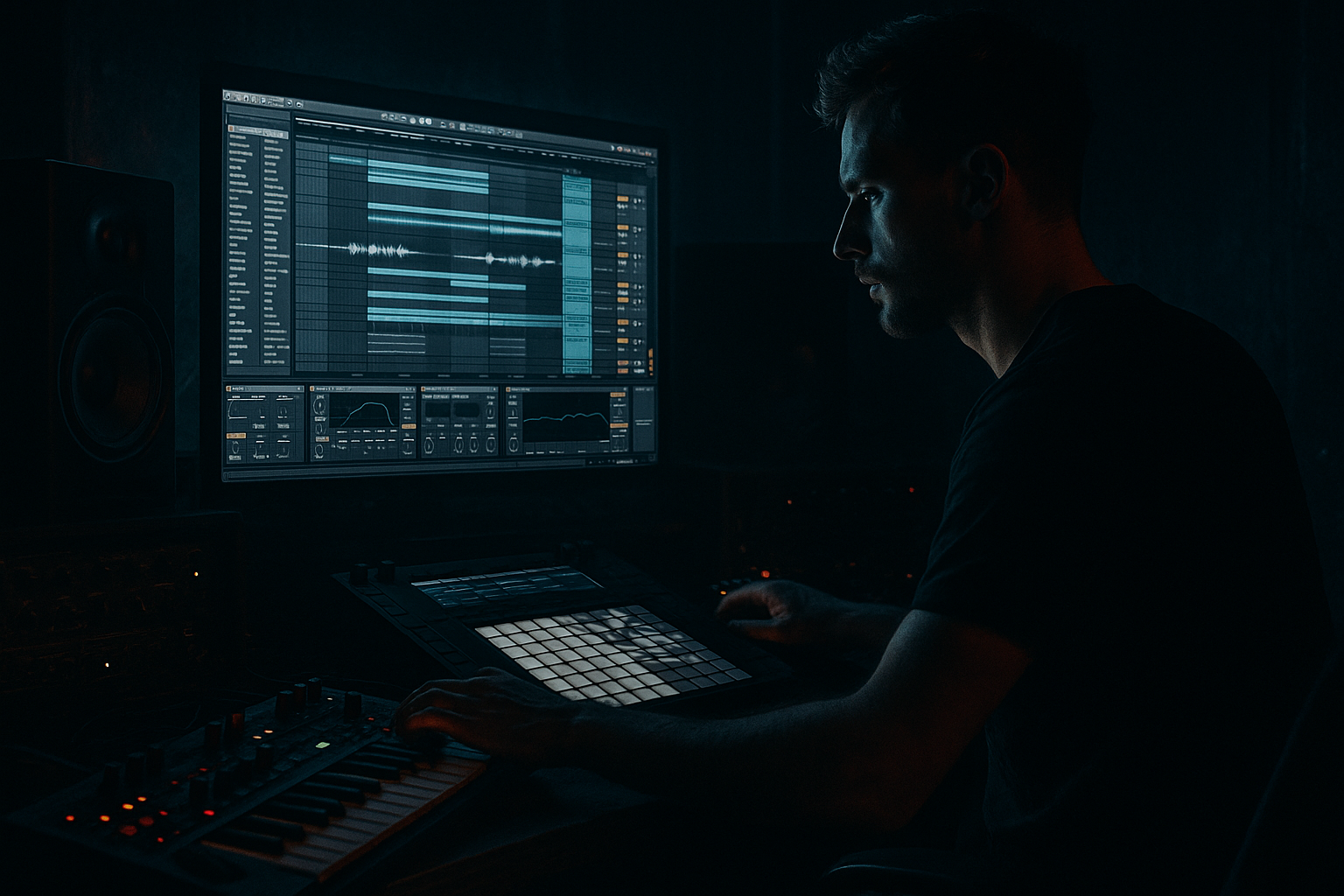
A breakdown is one of the most important pressure points in a Drum & Bass track. In jungle and oldskool DnB especially, it’s not just “the bit without drums” — it’s the setup for the drop, the emotional reset, and the place where you can hint at the next groove without giving everything away. If your breakdown feels too loose, it kills momentum. If it feels too empty, the drop won’t hit. This lesson is about tightening a breakdown by moving from Session View into Arrangement View in Ableton Live 12, so you can turn loop ideas into a controlled, musical DnB section with real phrasing, tension, and edit precision.
This technique matters because DnB arrangement is all about contrast and discipline. A breakdown in a jungle or oldskool roller often has chopped breaks, atmosphere tails, filtered bass hints, and careful automation that makes the return of the drums feel massive. In Session View, you can sketch those ideas quickly. In Arrangement View, you can shape them into a proper 8-, 16-, or 32-bar passage with clear dynamics and DJ-friendly movement. That’s where the edit work happens: cutting drums, tightening reverb tails, shaping bass dropouts, and making every bar feel intentional.
What You Will Build
You’ll build a tight 16-bar breakdown for a jungle / oldskool DnB tune that:
- strips the drums down in a controlled way
- keeps low-end tension alive with filtered bass stabs and sub hints
- uses break edits and ghost notes to maintain groove
- introduces atmospheres and one-shot FX without clutter
- builds cleanly into a drop with clear tension/release
- works as a believable transition in a darker, energetic DnB arrangement
- bars 1–4: break chopped back, kick and snare emphasis reduced, atmos and a filtered break loop carrying the groove
- bars 5–8: bass starts hinting through with short phrases or a reese swell, while the drums thin out further
- bars 9–12: tension rises via automation, fills, reverse effects, and a stronger lead-in motif
- bars 13–16: near-silence around key drum hits, then a clean and heavy re-entry into the drop
- Leaving the breakdown too full
- Using too much reverb on the break or bass
- Not phrasing the section in bars
- Letting the bass drift into the breakdown without a plan
- Making FX louder than the groove
- Ignoring mono compatibility
- Use Saturator on the bass return with Drive around 2–6 dB to make filtered notes audible on smaller speakers without raising the sub too much.
- Add Drum Buss lightly to break layers to enhance smack and grit, but keep the transients intact.
- For a darker roller vibe, automate Auto Filter on a reese from around 300 Hz down to 120 Hz during the first half of the breakdown, then reopen it slightly before the drop.
- Resample your break with a little processing and re-import it as audio. This makes edits faster and gives you one solid clip to cut, reverse, and rearrange.
- Use a very short Echo throw on the last snare or vocal chop, then cut it off abruptly before the drop for that underground “half-broken” feel.
- Keep atmospheres in stereo, but keep the sub and main kick foundation mono. That contrast helps the breakdown feel wide without losing punch.
- If you want a more neuro edge, layer a quiet metallic noise or filtered texture under the breakdown and automate a band-pass sweep for movement.
- For oldskool jungle energy, leave in a few imperfect break slices or ghost hits. Too much quantization can sterilize the vibe.
Musically, the result should feel like:
Think oldskool jungle energy, but with modern arrangement control.
Step-by-Step Walkthrough
1. Start with your Session View loop and identify the “breakdown core”
In Session View, audition the main loop elements that are carrying the breakdown idea: your break beat, sub/bass, atmos, vocal stab, and FX hits. Before you go to Arrangement View, decide which clips are essential and which are just decorative.
A good DnB breakdown usually needs:
- one break or break layer
- one atmospheric bed
- one bass-related element, even if heavily filtered
- one or two transition FX
If you’re working with a jungle vibe, your break might be an Amen-style chop, a Think break edit, or a layered break built from Drum Rack slices. If the loop already feels busy, simplify now. Arrangement View will expose any clutter very quickly.
Practical move: color-code your clips in Session View by function:
- drums
- bass
- atmos
- FX
- vocal/one-shots
This makes the transfer into Arrangement View faster and helps you make edit decisions instead of guessing.
2. Record your loop into Arrangement View and commit the structure
Hit Record and perform the section into Arrangement View for 16 or 32 bars. Don’t try to perfect it live. Your goal is to capture a musical draft with enough material to edit.
For an intermediate workflow, it helps to think in blocks:
- bars 1–8: main breakdown idea
- bars 9–16: tension build toward drop
- optional bars 17–32: alternate version or longer DJ intro/outro
Once recorded, switch to Arrangement View and immediately zoom out. You want to see the full shape. If the breakdown starts too dense, don’t panic — the point is to tighten it now.
Why this works in DnB: the genre depends on phrasing. A strong 16-bar breakdown lets the listener feel the absence of drums while still sensing forward motion. That forward motion is what makes the drop feel physical.
3. Edit the breakbeat so it breathes, not loops endlessly
This is the core “edits” skill. In jungle and oldskool DnB, a breakdown should often keep the break identity alive, but in a reduced and more surgical way.
Open the break audio clip and use Warp mode intelligently. For break loops, Complex or Beats can both work depending on the material:
- use Beats for punchy chopped drums
- use Complex if the break is more textural or you need smoother time-stretching
Then edit the audio clips directly in Arrangement View:
- remove a few kick hits in bars 1–4 to create space
- keep snare backbeats or ghosted snare fragments
- leave small hat or ride tails for momentum
- cut away any low-end rumble that clashes with the bass return
Useful stock devices and moves:
- EQ Eight: high-pass the break around 120–180 Hz if the sub is active elsewhere
- Drum Buss: add a touch of Crunch, around 5–15%, if the break needs more bite
- Utility: narrow the width of the break layer to about 80–100% if the stereo image is too wide
If the break feels static, use clip-level gain changes or Automation Envelopes to make certain hits dip slightly in level. Even a 1–2 dB movement can make the phrase feel edited rather than copied.
4. Use Arrangement View automation to shape the breakdown energy
This is where the section becomes musical instead of just “less busy.” Draw automation on filter cutoff, reverb send, and volume fades to create a clear arc.
Strong automation targets in Ableton stock devices:
- Auto Filter cutoff on the break or bass return
- Reverb Dry/Wet on an atmospheric return track
- Utility gain on the bass or drum group for clean dropouts
- Echo feedback for a rising tail or dubby pre-drop wash
Solid starting ranges:
- Auto Filter on bass: low-pass cutoff from about 180 Hz up to 1.2 kHz over 8–16 bars
- Reverb Dry/Wet on an atmosphere send: 10–25% in the early breakdown, then pull it down before the drop
- Echo feedback: 15–35% for widening tension without turning into mud
Keep the automation purposeful. In oldskool DnB, you often want a simple filter move plus one or two dramatic breaks in the texture. Too much automation can make it feel like a progressive house build instead of a jungle transition.
5. Bring the bass back in fragments, not full force
The breakdown should tease the bass identity. Instead of dropping in the full sub line, use short phrases, filtered notes, or a reese swell.
Good Ableton stock workflows:
- use Simpler in Classic or One-Shot mode for bass stabs
- use Wavetable or Operator for a filtered reese or sub drone
- use Saturator or overdrive-like Drive on the bass return for harmonic audibility on small systems
Arrangement idea:
- bars 1–4: no sub, only filtered bass texture or a high-passed reese
- bars 5–8: introduce a 1-bar bass motif with long gaps
- bars 9–12: increase note density or add a call-and-response with a higher bass layer
- bars 13–16: remove most bass, then let one final phrase hit before the drop
Parameter suggestions:
- low-pass a reese around 250–600 Hz for the first half of the breakdown
- keep sub below 80 Hz controlled and mostly absent until the last 2–4 bars
- use short decay on bass stabs so they don’t smear the edit
For jungle oldskool vibes, a little melodic bass phrasing goes a long way. Don’t fill every gap. The silence between notes is part of the groove.
6. Create tension with FX edits, but keep them DJ-friendly
Use FX to move the listener forward, not to overwhelm the groove. In a DnB breakdown, the best FX often feel like part of the arrangement, not a separate layer.
Try these stock Ableton ideas:
- Reverse a crash or break fragment before a downbeat
- Use an Impulse or Drum Rack one-shot for a short impact on bar 8 or 16
- Add an Echo throw on the last snare or vocal stab
- Automate a Vinyl Distortion or Saturator lightly for grime and character
A useful structure:
- bar 7 or 15: reverse hit
- bar 8 or 16: impact or fill
- final 1–2 beats before drop: mute the break or bass for a split-second
This last tiny gap is important. In DnB, a micro-dropout can make the incoming kick and snare feel much harder. It creates a physical reset for the listener.
7. Use group processing to tighten the breakdown as a unit
Group your drums, bass, and atmos layers so you can make global decisions faster. This is especially helpful in the Edits category because you’re working on timing, balance, and density.
Suggested group workflow:
- Drum Group: Breaks, one-shots, ghost hats
- Bass Group: sub, reese, bass stabs
- Atmos/FX Group: noise, risers, reverbs, impacts
On the Drum Group, try:
- Glue Compressor with gentle settings: 2:1 ratio, 1–2 dB gain reduction
- Drum Buss for a little punch
- EQ Eight to remove unnecessary low-end clutter
On the Bass Group:
- Utility for mono below the low end
- Saturator for harmonics
- Auto Filter for breakdown movement
On the Atmos/FX Group:
- Reverb with a longer decay, but keep the Dry/Wet under control
- EQ Eight to cut lows aggressively if the space gets muddy
Group processing helps the breakdown feel like one engineered section instead of separate clips pasted together.
8. Shape the transition into the drop with clear phrasing
A tight DnB breakdown needs a deliberate handoff. Decide exactly where the drop lands and make the previous 1–2 bars prepare that moment.
Strong arrangement tactics:
- remove the kick 1 bar before the drop
- leave only snare pickup or hat fragments
- mute the bass for the final beat, then slam it back in
- let the atmosphere tail continue while the drums punch through
If your track is more oldskool/jungle, the return can be more organic: a break re-enters first, then the sub joins, then the main bass motif lands a bar later. That’s classic tension/release and often feels more musical than everything hitting at once.
Example context:
- In a 172 BPM jungle roller, the breakdown might hold the break ghostly and chopped, then reintroduce the Amen on the upbeat before the full drop.
- In a darker neuro-leaning DnB tune, the breakdown might use a filtered reese and metallic atmosphere, with the drums almost entirely removed until a hard impact on the one.
Both approaches work, but the edit must be clean.
9. Do a final edit pass for clarity, headroom, and mono control
Once the structure feels right, make a surgical pass:
- trim reverb tails that overlap the drop
- mute any leftover low-frequency noise
- check bass in mono with Utility
- balance drum hits so the breakdown doesn’t suddenly get louder than the drop
Practical checks:
- keep the master peaking with healthy headroom, ideally around -6 dB before final mastering
- mono-check the low end to make sure the sub doesn’t widen or smear
- compare the breakdown level against the drop; the breakdown should feel tense, not louder
If the section still feels loose, use clip fades and micro-edits on the audio regions. Even tiny trims to break tails can make the whole phrase feel more professional.
Common Mistakes
- Fix: remove one element at a time. In DnB, tension comes from controlled absence.
- Fix: keep low-end dry and use sends carefully. High-pass your reverb return if needed.
- Fix: think in 4-, 8-, and 16-bar blocks. DnB listeners feel structure fast.
- Fix: filter it, thin it out, or convert it into short stabs and teaser notes.
- Fix: FX should support the edit, not replace the edit.
- Fix: keep sub centered, narrow wide atmos in the low end, and use Utility to test.
Pro Tips for Darker / Heavier DnB
Mini Practice Exercise
Set a timer for 15 minutes and build a 16-bar breakdown from a Session View loop.
1. Pick one drum break, one bass sound, one atmosphere, and one FX hit.
2. Record them into Arrangement View for 16 bars.
3. Remove at least 30% of the drum activity in the first 8 bars.
4. Automate one filter move on the bass or atmosphere.
5. Add one reverse FX into bar 8 or bar 16.
6. Create a 1-beat or 1/2-beat dropout right before the drop.
7. Mono-check the sub and make sure the breakdown still feels full.
Rule: do not add any new sounds. Tighten what you already have.
Recap
A great DnB breakdown is about controlled energy, not emptiness. Use Session View to sketch the idea, then use Arrangement View to edit the groove, shape the automation, and control the phrasing. Keep the break alive, tease the bass, use FX sparingly, and make the transition into the drop feel deliberate. In jungle and oldskool DnB, the edit is the vibe — if the breakdown is tight, the drop hits harder.

