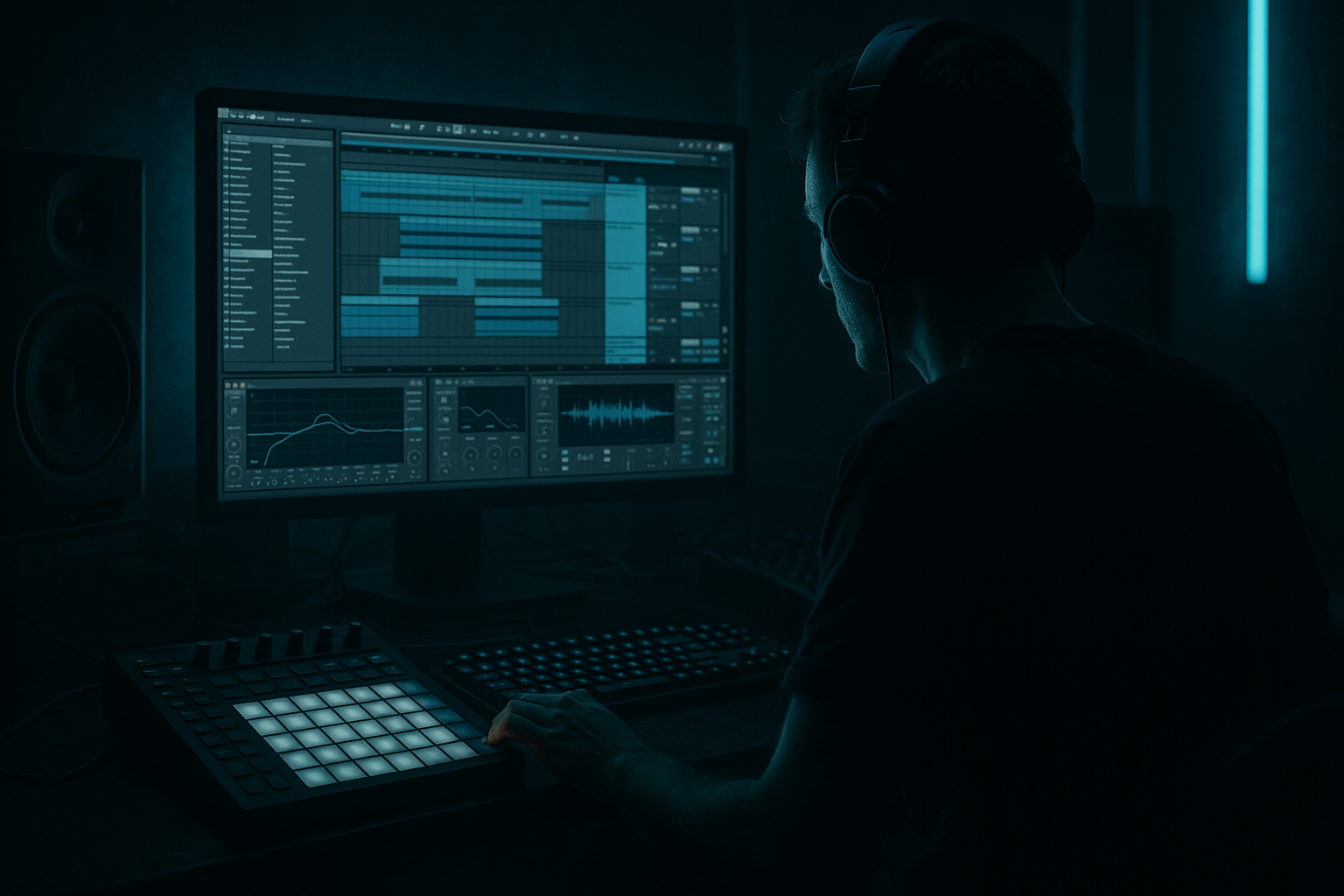
Main tutorial
Tighten a Jungle Sampler Rack for Ragga-Infused Chaos in Ableton Live 12 🥁🔥
1. Lesson overview
In this lesson, you’ll build a tight, playable sampler rack for jungle / drum and bass with a ragga-infused, chaotic edge. The goal is to take messy vocal chops, one-shots, and break snippets and make them feel controlled, punchy, and rhythmic without killing the raw energy.
This is a groove-focused workflow for beginners in Ableton Live 12, so we’ll keep it practical:
- warp and trim samples cleanly
- build a Drum Rack or Instrument Rack for fast triggering
- use stock Ableton devices to tighten timing
- make the rack respond musically to your DnB drum grid
- create variation so it feels alive, not robotic
- ragga vocal stabs
- jungle chatter chops
- amen fill accents
- call-and-response phrases
- broken-up hype layers over a rolling beat 🎛️
- 4–8 vocal/ragga chop slots mapped across a Drum Rack
- a tight transient envelope for punchy playback
- filter + saturation + utility gain control for mix-ready grit
- macro controls for:
- a simple drum-and-vocal groove pattern that sits on top of a jungle beat
- chopped reggae/dancehall vocal slices
- short, clipped, syncopated hits
- aggressive but controlled layering
- the feeling of a hype MC sliced into the rhythm over a rolling breakbeat 🥁
- 170–174 BPM for classic jungle energy
- 174–176 BPM if you want modern rolling intensity
- ragga vocal phrases
- “yeah!”, “wheel up!”, “come again!”
- short sung notes
- small shout-outs or MC-style chops
- single-word one-shots
- tiny ambient vocal textures
- clear transients
- not too much long reverb
- usable even when shortened
- strong rhythmic identity
- Use Warp mode = Complex Pro for longer ragga vocal lines
- Use Warp mode = Beats for short percussive vocal hits
- reduce unnecessary warp markers
- trim silence from the start
- zoom in and line up the first transient exactly
- trigger vocal hits like drums
- sequence them in the piano roll
- process each chop individually
- create call-and-response patterns easily
- Set Mode to One-Shot
- Turn Trigger on
- Shorten Decay so hits stop cleanly
- Set Transpose if needed to fit the tonal center
- Enable Snap if the attack is too soft and you want cleaner starts
- Mode: One-Shot
- Trigger: On
- Decay: 150–350 ms for chopped vocal stabs
- Fade: low or off if you want sharp edges
- Start: adjust so no silence remains at the front
- Reduce Decay so notes don’t smear
- If a sample is too clicky, add a little Attack only if necessary
- If needed, use Release to stop abrupt cutoffs, but keep it minimal
- fast attack
- short decay
- controlled release
- cut low end below 100–150 Hz on vocal chops
- reduce harshness around 2.5–5 kHz if needed
- gently boost presence if the sample feels dull
- Drive: 1–5 dB
- Soft Clip: On
- Output: compensate so it doesn’t get too loud
- Low-pass filter
- Cutoff around 1.5–8 kHz depending on brightness
- Small Resonance boost if you want a more nasal ragga character
- gain staging
- stereo width control
- mono compatibility
- Width: 80–100%
- keep the core phrase mostly centered
- Macro 1: Brightness → Auto Filter cutoff
- Macro 2: Grit → Saturator drive
- Macro 3: Tightness → Simpler decay
- Macro 4: Space → Reverb send or delay send
- Macro 5: Width → Utility stereo width
- Macro 6: Throw → Echo or Delay amount
- Reverb
- Echo
- Saturator
- Auto Filter
- Utility
- Glue Compressor if needed for glue on the rack
- Return A = short Reverb
- Return B = tempo-synced Delay/Echo
- Decay: 0.5–1.2 s
- Pre-delay: 10–25 ms
- Low cut: around 200 Hz
- High cut: around 6–10 kHz
- Sync: On
- Time: 1/8 or 1/16 dotted
- Feedback: 10–30%
- Filter: darken the repeats
- Put vocal hits on:
- Leave gaps for the drums to breathe
- Bar 1 beat 1: “Yeah!”
- Bar 1 beat 2 & : “Come!”
- Bar 1 beat 4 & : “Wheel!”
- Bar 2 beat 1: empty
- Bar 2 beat 2 &: “Up!”
- Bar 2 beat 4: stab or rewind-style hit
- a light MPC-style swing
- or a subtle extracted groove from a breakbeat
- apply groove to the vocal MIDI clip
- set Timing Amount around 15–35%
- keep Velocity Amount modest if you want more consistency
- gaps between snare hits
- pickup notes before the snare
- spaces after ghost notes
- end-of-bar transitions
- drums push
- vocals answer
- bass holds the floor
- use mute/unmute to thin out sections
- automate filter cutoff
- automate reverb throws at phrase ends
- duplicate a chop and reverse one copy for a fill
- use short gaps before drops
- Intro: filtered vocal texture, minimal hits
- Drop A: tight vocal stabs
- Mid section: more reverb throws and call-response
- Breakdown: isolated ragga phrase
- Drop B: more aggressive chopping and higher energy
- use Auto Filter low-pass automation
- add a small amount of Saturator or Drum Buss
- high-pass only the necessary low end, don’t brighten everything
- keep reverb dark with high cut
- layer a chopped vocal with a tight rimshot or snare ghost
- use Glue Compressor lightly on the rack if hits feel uneven
- duplicate the strongest vocal stab and pitch one copy down slightly
- use Echo throws only at phrase endings for impact
- use breakbeat-inspired phrasing
- answer the drums with vocal phrases
- reverse a chop into the snare
- chop in 1/8 and 1/16 fragments, not just full words
- preserve some roughness
- don’t over-polish the vocal
- keep a little mono center and grit
- let certain phrases repeat like a hype chant
- Pad 1: “Yeah”
- Pad 2: “Come again”
- Pad 3: “Wheel up”
- Pad 4: “Selecta”
- One-Shot mode
- Trigger on
- Decay short enough to stop cleanly
- EQ Eight
- Saturator
- Auto Filter
- place hits on off-beats
- add one empty bar section for tension
- repeat one phrase twice for hypnotic effect
- filter cutoff
- or reverb send
- or saturation drive
- choosing strong vocal samples
- warping and trimming them properly
- loading them into Drum Rack
- tightening playback in Simpler
- shaping tone with EQ Eight, Saturator, Auto Filter, and Utility
- controlling space with Reverb and Echo
- sequencing the chops to lock into a DnB groove
- using automation and arrangement to keep the energy moving 🔥
By the end, you’ll have a rack you can use for:
---
2. What you will build
You’ll create a sample rack with:
- brightness
- decay
- grit
- reverb send
- stutter/echo throw
Final sound goal
Think:
---
3. Step-by-step walkthrough
Step 1: Start with the right project tempo
Set your Ableton Live set to a DnB/jungle tempo:
For this lesson, use 174 BPM.
Why?
At this tempo, your chopped vocal rhythm will naturally sit in the pocket with breakbeats and bass movement.
---
Step 2: Find or prepare your source samples
You want short, characterful samples such as:
#### Good sample traits:
If your samples are long, don’t worry — we’ll trim them.
---
Step 3: Warp your samples correctly
Drag a sample into an audio track first.
In the Clip View:
1. Turn Warp on
2. For vocal chops, try Complex Pro if the sample is melodic or full-range
3. For short shouted phrases, try Beats if you want more transient bite
4. Set the Seg. BPM or warp markers so the phrase stays stable
#### Practical rule:
#### Tightening tip:
If the sample feels late or smeared:
This matters because in jungle, even a small timing smear can make the groove feel sloppy.
---
Step 4: Build a Drum Rack for your vocal chops
Create a MIDI track and load Drum Rack.
Then:
1. Drag each vocal chop into a pad
2. Keep the chops short and distinct
3. Label pads clearly:
- C1 = “Yeah”
- C#1 = “Wheel Up”
- D1 = “Come On”
- D#1 = “Ragga Hit”
#### Why Drum Rack?
Because it lets you:
For beginner jungle production, Drum Rack is one of the fastest ways to make samples feel playable.
---
Step 5: Tighten each pad with Simpler
When you drag a sample into Drum Rack, Ableton usually loads it into Simpler.
For each vocal pad:
#### In Simpler:
#### Suggested starting settings:
If a chop is meant to be a rhythmic accent, keep it short and punchy.
If it’s a phrase ender, allow a little longer tail.
---
Step 6: Use envelope shaping to make the rack feel tight
A lot of beginner jungle samples feel loose because the envelope is too open.
In Simpler:
#### General groove rule:
For ragga-infused chaos, you want:
This gives you the “stab” feeling that works so well over breakbeats.
---
Step 7: Add stock Ableton processing to each pad
Now make the rack more usable in a DnB mix.
#### Suggested chain per pad:
1. EQ Eight
2. Saturator
3. Auto Filter
4. Utility
---
#### EQ Eight
Use it to clean up mud.
Typical moves:
For jungle vocals, don’t over-EQ.
You want them gritty, but not messy.
---
#### Saturator
Add controlled aggression.
Good starting points:
This helps vocal chops sit on top of dense drums and bass.
---
#### Auto Filter
Use this for movement and tension.
Suggested starting point:
You can automate this for buildup phrases or create a macro for live control.
---
#### Utility
Use Utility for:
For short vocal chops, try:
If a chop is wide and washed out, it can blur the groove. Tight jungle usually benefits from a solid center image.
---
Step 8: Make a macro-controlled rack
Now we’ll turn this into a performance-friendly instrument.
Group your Drum Rack or selected device chain into an Instrument Rack.
Map important parameters to Macros:
#### Useful stock devices:
This setup makes the rack easy to perform in real time and easy to automate in arrangement.
---
Step 9: Add a small amount of delay or reverb, but keep it controlled
In jungle, too much wash can destroy the groove.
#### Use a Return Track for space
Create:
##### Reverb settings:
##### Echo settings:
This lets you throw one vocal hit into space without washing out the whole rhythm.
---
Step 10: Sequence a basic ragga jungle rhythm
Now program a groove in the MIDI editor.
#### Start with a simple 2-bar phrase:
- off-beats
- the “and” of 2
- the “and” of 4
- a pickup before bar 2
#### Example idea:
The point is not constant motion.
The point is controlled chaos that feels synced to the break.
---
Step 11: Use groove and swing carefully
Open the Groove Pool in Ableton Live.
Try:
#### Beginner-friendly approach:
For jungle, too much swing can make the chops feel drunk rather than energetic.
You want bounce, not drift.
---
Step 12: Layer with the drums so the rack locks in
Your vocal sampler rack should complement the drum pattern.
Try placing vocal chops in:
#### DnB structure tip:
If your snare lands on 2 and 4, use vocal hits to answer those backbeats rather than sit directly on top of them every time.
This creates the classic jungle interplay:
---
Step 13: Add arrangement movement
A good jungle rack should evolve across the track.
In Arrangement View:
#### Simple arrangement map:
This gives your rack a narrative, not just a loop.
---
4. Common mistakes
1. Leaving samples too long
If the vocal tail hangs too long, it smears into the break and bass.
Fix: shorten decay in Simpler and trim silence.
---
2. Overusing reverb
Too much reverb makes the groove feel cloudy and soft.
Fix: use short reverb on a return track, not directly on every pad.
---
3. Not cleaning the sample start point
A tiny gap before the transient can make the chop feel lazy.
Fix: zoom in and align the transient precisely.
---
4. Too much low end in vocal chops
Vocals with rumble can fight the bassline.
Fix: high-pass with EQ Eight.
---
5. Random, unfocused chopping
If every pad fires constantly, the groove loses identity.
Fix: leave silence. Jungle needs space as much as energy.
---
6. Ignoring gain staging
If each chop is too loud, the rack will clip and blur.
Fix: use Utility and keep headroom before saturation.
---
5. Pro tips for darker/heavier DnB
Make it darker
Make it heavier
Make it more jungle
Make it more ragga
---
6. Mini practice exercise
Exercise: Build a 4-pad ragga jungle rack
Use four vocal samples and make a 2-bar loop.
#### Step A
Load these into Drum Rack:
#### Step B
Set each pad in Simpler:
#### Step C
Process each pad with:
#### Step D
Write a 2-bar MIDI pattern:
#### Step E
Automate one parameter:
Goal
Make it feel like a live MC slice bouncing over a jungle drum pattern, not a random sample pack playback.
---
7. Recap
You’ve now learned how to tighten a jungle sampler rack in Ableton Live 12 for ragga-infused chaos by:
The key takeaway:
In jungle and drum and bass, the sampler rack should feel snappy, rhythmic, and alive.
You want the raw energy of ragga vocals, but with the timing discipline of a locked-in breakbeat.
If you want, I can also give you:
1. a MIDI pattern example for this rack, or
2. a full Ableton device chain template for ragga jungle vocals.

