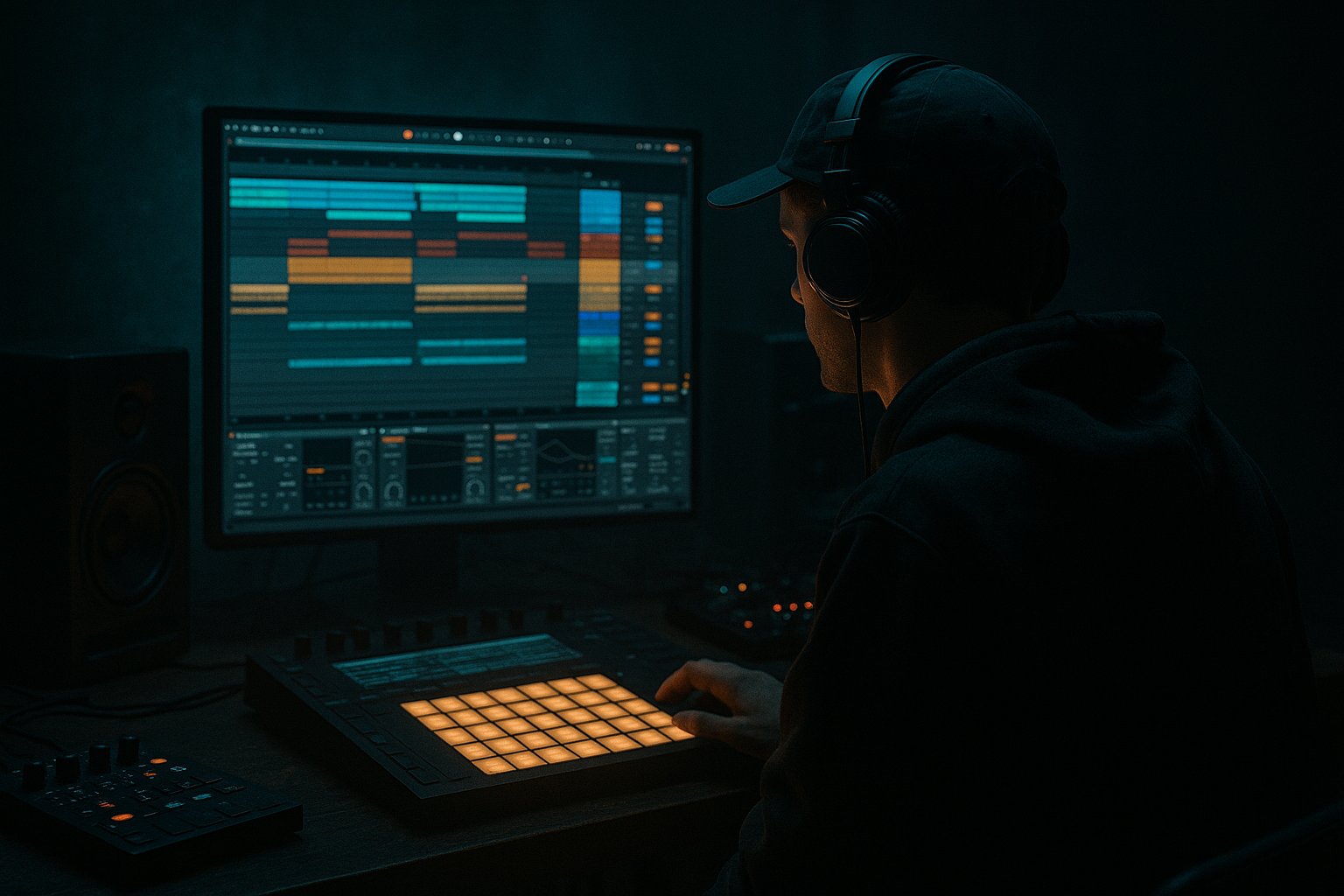
Main tutorial
```markdown
Tonal Risers From Resampling (for Jungle Rollers) 🔥
Ableton Live • Sound Design • Intermediate
---
1) Lesson overview
Tonal risers in jungle/drum & bass don’t have to be cheesy white-noise sweeps. In rollers, the best risers often inherit the tone and grit of your track—the reese, the break, the rumble, the pads—then get resampled, stretched, filtered, and pitched into something that pulls the listener into the drop.
In this lesson you’ll build tonal, “musical” risers using resampling workflows in Ableton Live—fast, controllable, and very “inside the world” of your tune. 🧠
---
2) What you will build
You’ll create 3 riser types that work brilliantly in jungle rollers:
1. Reese-to-Riser: a tonal, gritty pitch-climbing riser from your bass.
2. Breakwash Riser: a stretched, spectral riser from a breakbeat (think classic jungle pre-drop tension).
3. Atmos Riser Stack: a layered riser that combines tonal + noise + stereo movement, glued to your groove.
Each will be resampled into audio so you can edit, reverse, warp, and automate like a pro.
---
3) Step-by-step walkthrough
A) Prep: Set up a clean resampling workflow ✅
1. Create an Audio Track called: `RESAMPLE PRINT`.
2. In the track’s Audio From, choose Resampling.
3. Set Monitor to Off (prevents feedback loops).
4. Arm the track when you want to print.
5. Optional but recommended: On the Master, keep a simple safety chain:
- Limiter (Ceiling -0.3 dB, Lookahead 1 ms)
This prevents accidental clipping while printing.
> Workflow tip: Print risers in place at the same BPM as the project. You’ll warp less and stay tighter with the drums.
---
B) Riser 1: Reese-to-Riser (tonal, dirty, roller-friendly) 😈
This is your go-to for modern jungle rollers—tension that matches your bass palette.
#### Step 1: Build or reuse your reese phrase
- Use your existing bass, or make a quick one:
- Add movement (important):
- Add Gate sidechained from your kick/snare group, OR
- Just fade out hard + tiny reverb tail (see Pro Tips).
- Drum Buss: Drive 5–15, Boom 0–10 (careful), Transients +5 to +15
- EQ Eight: small dip if harsh around 3–6 kHz
- Saturator: soft clip
- Mode: A or B
- Frequency: match your key’s root (e.g., F# = 185 Hz, G = 196 Hz, A = 220 Hz)
- Decay: 0.6–1.8 s
- Dry/Wet: 10–35%
- Keep it mid-focused, less reverb
- Use Operator → white noise (Osc set to Noise)
- Add Auto Filter LP: 2 kHz → 16 kHz
- Add Redux (very subtle): Downsample 6–12, Dry/Wet 10–25% for grit
- Take any printed riser/break, add:
- Resample this layer again if needed (printing reverb tails is a huge control move 💡)
- Glue Compressor
- EQ Eight
- Limiter
- Automate Utility Gain down by -2 to -6 dB (micro-dip)
- Hard mute riser layers (or fade out within 10–50 ms)
- Too much low-end in the riser → your drop loses punch.
- Riser fights the snare build (same frequency + timing).
- Over-warping tonal material into ugly artifacts (unless you want that).
- Risers too wide too early → the drop doesn’t “expand.”
- No tonal anchor (it’s just noise).
- Pitch rise ≠ always up: Try a downward pitch drift (0 → -3 semitones) while the filter opens up. Feels sinister.
- Controlled distortion: Put Roar (if you have it) or Saturator before filtering for aggressive harmonics, then filter sweep to “reveal” them.
- Reverb into resample into gate:
- Mid/Side EQ: Use EQ Eight in M/S mode:
- Break-derived risers feel most authentic: If your tune is break-led, a breakwash riser will always sound more “jungle” than synth noise.
- Resampling gives you risers that match your track’s DNA—perfect for jungle rollers.
- Use warp modes intentionally (Complex Pro = smooth, Texture = gritty).
- Build tension with pitch automation + filter opening + stereo growth.
- Keep risers out of the sub, and out of the snare’s way.
- For darker DnB, lean into break-derived textures, controlled saturation, and reverb resample tricks.
- Instrument: Wavetable (or Operator)
- Wavetable example:
- Osc 1: Basic Shapes (saw-ish), Unison: 3–5, Amount ~20–40%
- Filter: MS2 or OSR, Drive 3–7 dB
- Auto Filter (LP24), Env off, map cutoff to automation
- Chorus-Ensemble (subtle) or Frequency Shifter (tiny, 0.10–0.30 Hz with Fine 5–15) for motion
#### Step 2: Resample a 2–4 bar bass riff
1. Loop 2 or 4 bars of bass (include groove/automation).
2. Arm `RESAMPLE PRINT`.
3. Record 4–8 bars so you have extra tail.
#### Step 3: Make it rise (pitch + filtering)
1. Drag the printed audio into a new track: `Riser - Reese`.
2. Warp Mode:
- Start with Complex Pro (good for tonal material)
- If you want more grain: Texture (Grain Size 80–200, Flux 10–30)
3. Create a 4-bar riser region before your drop.
4. Add Clip Transpose automation:
- Start: 0 semitones
- End: +7 to +12 semitones (try +12 for maximum hype)
You can do this with Clip Envelopes (Clip view → Envelopes → Transposition).
5. Add Auto Filter after the clip:
- Filter: LP24
- Cutoff: automate from ~200 Hz → 10–16 kHz across 4 bars
- Resonance: 0.3–0.6 (don’t whistle)
6. Add Saturator:
- Drive 2–6 dB
- Soft Clip ON
7. Add Utility for controlled stereo:
- Bass Mono: 120 Hz
- Width: automate from 70% → 120% (wider toward the drop)
#### Step 4: Add a quick “pre-drop suck” 🎯
Right before the drop (last 1/8 or 1/4 note):
> Arrangement idea: In jungle rollers, place the riser so it doesn’t fight the snare build. Let it peak between snare hits, not on top of them.
---
C) Riser 2: Breakwash Riser (classic jungle tension) 🥁🌫️
This one sounds like your breakbeat turning into a storm cloud.
#### Step 1: Print a break phrase with processing
Use a break loop (Amen-style or crunchy thinkbreak).
Add a quick chain on your break group first (so the riser matches the track):
Now resample 2–4 bars into `RESAMPLE PRINT`.
#### Step 2: Turn it into a tonal wash
1. Put the printed break audio on `Riser - Breakwash`.
2. Warp Mode:
- Texture (this is the sauce)
- Grain Size: 120–250
- Flux: 15–40
3. Stretch it:
- Take a 1-bar break print and stretch to 4 bars (or 8 bars for longer builds).
4. Filter it:
- Auto Filter HP12: automate from 80 Hz → 600–1.5 kHz (it should get thinner)
- Add a second Auto Filter LP12: automate from 2–4 kHz → 12–16 kHz (it opens up)
#### Step 3: Add tonal center (so it feels “musical”)
Add Resonators (stock) after filters:
This makes the breakwash sing subtly like a tonal riser rather than just noise.
---
D) Riser 3: Atmos Riser Stack (layering + movement) 🌌
This is where your riser becomes “cinematic” but still DnB-functional.
#### Step 1: Duplicate + layer
Make a group called `Riser Stack` with 3 layers:
Layer 1: Tonal (from Reese-to-Riser)
Layer 2: Air/Noise
Layer 3: Spatial smear (resampled FX tail)
- Hybrid Reverb: Algo Hall or Convolution Space, Decay 2.5–6 s, Predelay 10–25 ms
- Delay (stock): Ping Pong, 1/8 or 3/16, Feedback 15–35%
#### Step 2: Glue and control
On the `Riser Stack` group:
- Attack 3–10 ms
- Release Auto
- GR: ~1–3 dB
- High-pass at 80–150 Hz (riser shouldn’t steal sub space)
- Just catching peaks, not smashing it
#### Step 3: Drop impact trick
In the last beat before the drop:
Then at drop:
This makes the drop feel larger without needing a louder master.
---
4) Common mistakes
Fix: high-pass 80–150 Hz, sometimes even 200 Hz for busy rollers.
Fix: carve 180–250 Hz if it’s boxy, and avoid peaks on snare hits.
Fix: try Complex Pro for smoother, Texture for crunchy—choose intentionally.
Fix: automate width from narrower → wider as it builds.
Fix: Resonators or a subtle pitched layer tied to the key.
---
5) Pro tips for darker/heavier DnB 🖤
1) Add big reverb
2) Resample
3) Put Gate with fast settings to chop the tail rhythmically
This creates dark, pumping pre-drop tension without sidechain pumping everything.
- Sides: high-pass ~300 Hz
- Mid: keep the bite (1–5 kHz) controlled
---
6) Mini practice exercise (15 minutes) ⏱️
1. Pick one 2-bar section of your roller (bass + break + atmos).
2. Resample it to audio.
3. Make two risers from the same print:
- Riser A (clean): Complex Pro, +7 semitones, smooth LP open
- Riser B (dirty): Texture warp, +12 semitones, add Saturator + Redux
4. Arrange them:
- Use Riser A for bar 1–3 of the build
- Switch to Riser B for bar 4 (last bar) for intensity
5. Add a micro-dip: Utility Gain -3 dB on the last 1/8 note pre-drop.
Export a quick 16-bar loop and compare: does the drop feel bigger without turning the master up?
---
7) Recap ✅
If you tell me your track key (and whether it’s more break-led or synth-led), I can suggest exact pitch targets (+7 vs +12), resonator frequencies, and a 4-bar build arrangement that fits your roller.
```

