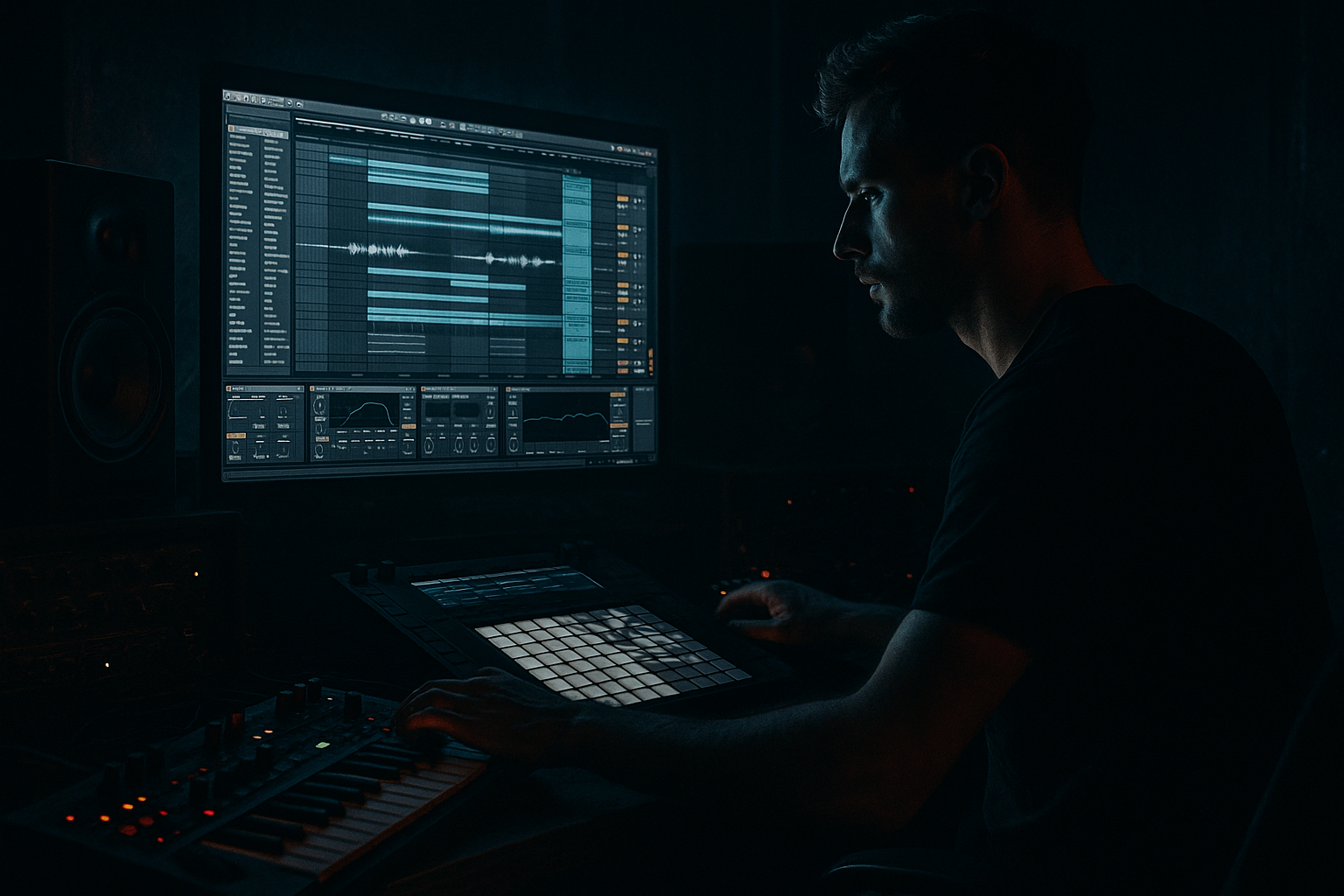
Main tutorial
```markdown
Tonal Risers from Scratch (Resampling-First) — Ableton Live (Stock Only) 🚀
1. Lesson overview
In drum & bass, a tonal riser is more than “noise going up.” It’s pitch-controlled tension that locks to the key of the track, fills space between phrases, and makes drops feel inevitable.
In this lesson you’ll build multiple tonal risers from scratch using only Ableton Live stock devices, then resample and finish them like a proper DnB producer: tight, aggressive, and mix-ready.
We’ll focus on:
- Designing a pitched riser source
- Creating movement (pitch, formant-ish shifts, spectral changes)
- Resampling and printing audio
- Arranging risers in 8/16-bar DnB phrasing
- Getting them dark/heavy without third-party plugins
- Wavetable / Operator
- Auto Filter / EQ Eight
- Saturator / Amp / Overdrive
- Hybrid Reverb / Echo
- Redux (optional texture)
- Utility (width & gain discipline)
- Glue Compressor (optional control)
- Resampling + audio editing
- Osc 1: Basic Shapes → set to Saw (or a bright shape)
- Osc 2: Off (for now)
- Unison: 2–4 voices, Amount 20–35%
- Filter: On → Lowpass 24
- Amp Env (Env 2):
- Draw a single note: F1 or F2 (pick the register that matches your track)
- Make the clip 16 bars long
- Velocity: consistent (e.g. 90–110) to keep automation predictable
- In the MIDI clip, enable Pitch Bend automation (MIDI Ctrl lane).
- Draw a ramp from 0 to +12 semitones over 16 bars (octave rise).
- Automate Wavetable’s Transpose from 0 → +12 over 16 bars.
- This keeps it consistent even if the clip changes.
- First 8 bars: small movement
- Last 4 bars: stronger rise
- Last 1 bar: “panic” jump (micro-surge)
- Automate Wavetable Filter Freq from ~200 Hz → 8–12 kHz.
- Automate Filter Drive up slightly near the end: +2–4 dB final bars.
- Mode: Analog Clip
- Drive: start 2 dB, end 8–12 dB
- Soft Clip: On
- Output: compensate so the printed audio doesn’t get louder just because you drove it (aim consistent perceived rise, not just gain).
- Mode: Bandpass (12 dB)
- Freq: set somewhere mid (we’ll automate subtly)
- Resonance: 0.6–1.2
- LFO: On
- Width: 120–160% (be careful—check mono later)
- Bass Mono: 120–200 Hz (if available in your Live version)
- Gain: keep headroom, peaks around -10 to -6 dBFS pre-print
- Mode: Convolution + Algorithm (or just Algorithm if you want cleaner)
- Decay: 3–8 s
- Pre-delay: 10–30 ms
- Hi Cut: 6–10 kHz (helps keep it dark)
- Low Cut: 150–300 Hz (don’t cloud the subs)
- Mix: 10–25% (we’ll automate)
- Time: 1/8 dotted or 1/4
- Feedback: 15–35%
- Filter: HP around 250 Hz, LP around 6–8 kHz
- Modulation: small, just for smear
- On `Riser Print`, set Audio From → `Riser Source` → Post FX
- Arm `Riser Print`
- Record 16 bars + an extra 2 bars for tail
- Set `Riser Print` Audio From → Resampling
- Mute other tracks to avoid capturing the whole mix.
- Duplicate clip
- Reverse it (R)
- Add a short reverb tail after (or print the tail first, then reverse—classic trick)
- EQ Eight
- Amp
- Redux (optional, subtle!)
- Auto Filter in Bandpass
- Frequency Shifter
- Bars -16 to -1 before drop: long tonal riser (octave or fifth)
- Last 2 bars: add a shorter, more aggressive layer (reese-edge)
- Last 1/2 bar: micro “zip” (shorter clip, faster pitch ramp)
- Bars 1–8: tonal riser low + filtered, mostly mono-ish
- Bars 9–12: widen + add echo movement
- Bars 13–15: distortion rises, filter opens faster
- Bar 16: cut lows, push reverb/echo tail, then hard stop right before drop (silence sells impact)
- Not in key: If your riser ends on a note outside the scale, it will sound random instead of tense.
- Too much sub content: Tonal risers often mask kick/sub. High-pass your riser layer around 120–250 Hz unless you intentionally want low-end lift.
- Only one automation lane: Pitch-only is boring. Combine pitch + filter + harmonic drive + space.
- Getting louder instead of more intense: If intensity = volume, it’ll wreck your mix headroom. Use distortion/filter/width, not just gain.
- Reverb mud: Long verbs without HP/LP filtering will smear everything before the drop.
- Use a fifth rise (0 → +7 semitones) more often than a full octave. It’s tense and less “festival.”
- Print, then distort: Distorting audio (post-resample) often feels heavier and more controllable than distorting the synth live.
- Band-limit intentionally: Put EQ Eight after reverb/echo and low-pass to 6–9 kHz for that dark room feel.
- Add “panic flutter” at the end: On the last bar, add subtle rate increase on Auto Filter LFO (e.g. from 1/8 → 1/16).
- Mid/side discipline: Keep the core tonal content more mid-focused, and let the noisy texture provide width.
- Gate the tail before the drop: Tight stop = heavier drop. Use a short fade out or hard cut 1/16 before impact.
- Bars -8 to -1: Clean musical
- Bars -2 to -1: Add grit layer
- Last 1 bar: Sprinkle formant layer quietly (automation up right at the end)
- Start with a tonal source (Wavetable/Operator) and commit to a key.
- Automate pitch + filter + saturation + space for real tension.
- Resample to audio early, then sculpt like a DnB engineer: warp, reverse, distort, EQ, control width.
- Arrange in 8/16-bar phrases, and use contrast (mono→wide, dry→wet, calm→chaos) to make the drop slam.
---
2. What you will build
You’ll end up with a small riser toolkit:
1. Harmonic Tonal Riser (keyed, musical, wide)
2. Reese-Edge Tonal Riser (gritty, rolling energy)
3. Vocal-ish Formant Tonal Riser (creepy, modern)
4. Printed audio versions ready to drag into your arrangement (with tails, reverse options, and variations)
All made from:
---
3. Step-by-step walkthrough
A) Session setup: DnB context first 🎯
1. Set tempo: 172–176 BPM.
2. Pick a key (example: F minor).
3. Create a new MIDI track: `Riser Source`.
4. Create a new Audio track: `Riser Print`.
5. On `Riser Print`, set Audio From → `Riser Source` (or set to Resampling later—both work; routing is cleaner).
DnB arrangement anchor:
Most risers will be 8 or 16 bars, landing exactly on a phrase boundary (drop, switch, breakdown).
---
B) Build a clean tonal source (Wavetable version)
On `Riser Source`, add Wavetable.
Wavetable settings (starting point):
- Freq: ~200–400 Hz (we’ll automate)
- Drive: 2–6 dB
- Attack: 50–200 ms
- Decay: 1.5–3 s
- Sustain: -inf or very low (depending on length)
- Release: 200–600 ms
MIDI clip (16 bars):
---
C) Make it rise: pitch + filter + harmonic intensity 📈
We’ll automate three things: Pitch, Filter cutoff, Distortion amount.
#### 1) Pitch rise (key-aware)
You have two solid approaches:
Approach 1: Clip Pitch Bend (simple, musical)
- For darker DnB, try +7 semitones (perfect fifth) instead of +12—less “EDM,” more tension.
Approach 2: Wavetable Transpose automation (more controlled)
Tip: Avoid super-linear ramps. In DnB, tension often feels better if the climb accelerates:
#### 2) Filter opening
#### 3) Saturation as “energy automation”
Add Saturator after Wavetable:
---
D) Add movement: chorus-like width + controlled modulation 🌪️
Add these devices after Saturator:
#### 1) Auto Filter (for extra motion)
- Rate: 1/8 or 1/4
- Amount: 5–15%
- Phase: 180° (adds width-ish movement)
This gives the riser that “alive” swirling edge you hear in rolling DnB builds.
#### 2) Utility (width discipline)
---
E) Space + tail: Hybrid Reverb + Echo 🌌
You want size, but controlled.
#### Hybrid Reverb
Automate Mix so it increases toward the end (e.g. 10% → 30%).
#### Echo (optional but very DnB)
Automate Echo Feedback rising slightly in the last 2 bars for that “spiral into drop” feeling.
---
F) Resample/print it like a weapon 🧨
Now we commit it to audio so we can edit, reverse, stretch, and layer.
Option 1 (Routing):
Option 2 (Resampling input):
After recording:
1. Consolidate (Cmd/Ctrl+J) to a clean chunk.
2. Warp mode:
- For tonal content: Complex Pro (Formants around 0–40, Envelope 80–128)
- For gritty/edgy: try Tones or Texture (Texture grain size 20–60, flux 10–30)
3. Fade in/out tiny amounts to prevent clicks.
---
G) “Resample design” stage: turn the print into variants 🔥
Duplicate the audio clip 3 times and do:
#### Variant 1: Reverse riser into impact
#### Variant 2: Reese-edge layer (DnB signature)
On the printed audio track, add:
- High-pass around 120–250 Hz (keep subs clean)
- Boost 1–3 kHz slightly if it needs bite
- Type: Rock or Heavy
- Gain: low to moderate (don’t obliterate pitch)
- Downsample: small amount (e.g. 2–6)
- Bit reduction: minimal; just texture
This gives you that “industrial air” that sits well before a neuro/techy drop.
#### Variant 3: Vocal-ish formant creep (stock-only)
On the printed clip, use:
- Resonance 1.2–1.8
- Automate frequency to “scan” like a throat/formant
- Mode: Ring Mod very subtly or Freq Shift small values (+5 to +30 Hz)
- Automate Amount slightly for uneasy movement
Keep it subtle so it stays tonal, not pure sci-fi.
---
H) Arrangement ideas (DnB phrasing that works) 🥁
Common placements:
Classic DnB build structure (16 bars):
Drop transition trick:
Automate Utility Width down to 0–50% in the last 1/4 bar, then snap back to normal on the drop. The contrast hits harder.
---
4. Common mistakes
---
5. Pro tips for darker/heavier DnB 🖤
---
6. Mini practice exercise 🎓
Build three 8-bar risers in the same key (e.g., F minor), each with a different emotional role:
1. Clean musical: Wavetable saw, 0 → +7 semitone rise, gentle reverb.
2. Grit layer: Resampled audio, Amp + EQ bite, less reverb, more midrange.
3. Creepy formant: Printed audio + bandpass scan + small frequency shift.
Then arrange them:
Export each as audio clips into a “Risers” folder in your project. Build your personal library.
---
7. Recap ✅
If you want, tell me your track key and whether you’re going for roller / jungle / neuro, and I’ll suggest a specific riser chain + automation curve that fits that vibe.
```

