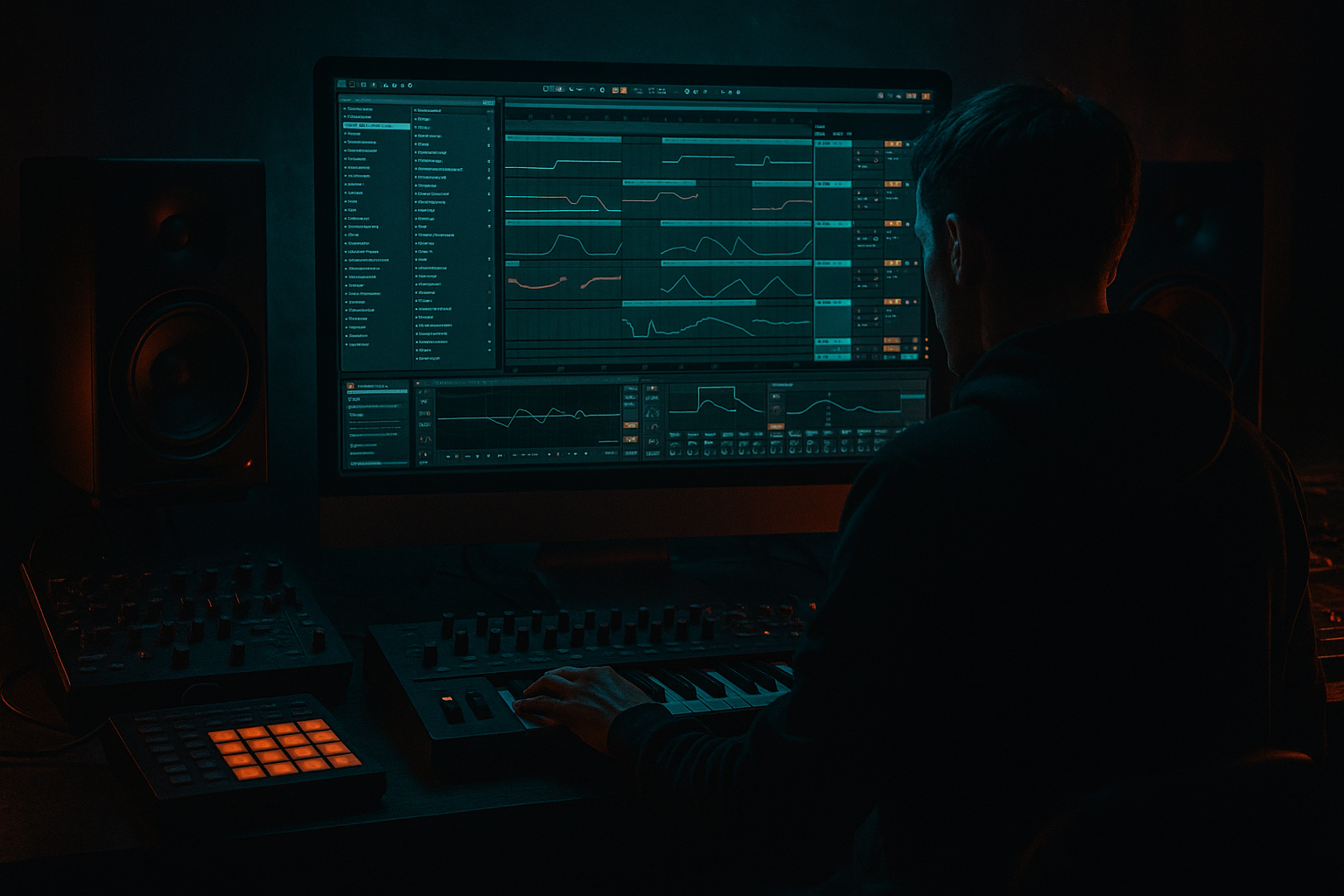
Main tutorial
Top loop in Ableton Live 12: bounce it with jungle swing 🥁⚡
Skill level: Intermediate
Category: Groove (DnB/Jungle)
---
1. Lesson overview
A “top loop” is your high-frequency drum layer—hats, rides, shakers, ghosty percussion, little breaks and fizz—that makes drum & bass feel fast, rolling, and alive even when the kick/snare are simple.
In this lesson you’ll:
- Build a crisp top loop with jungle swing (not generic quantize)
- Use Ableton Live 12 Groove Pool, Warping, and resampling/bouncing to lock a vibe
- Create “performance-ready” variations for drops, fills, and transitions
- Keep it tight, punchy, and mix-friendly 🔥
- A 2-bar top loop (hats + ride + shaker + micro-perc) that swings like jungle
- A bounced audio loop you can slice/rearrange
- 3 arrangement-ready versions: A (steady), B (busier), Fill (turnaround)
- A clean processing chain that sits above your main drums without harshness
- Set Warp: Off for one-shots
- Set Voices: 1 (prevents overlaps on tight hats)
- Use Start to trim initial click if needed
- Closed hat: steady 1/16 but remove a few hits for breathing
- Shaker: sprinkle off-beat 1/16s (ghosty feel)
- Ride: place on 1/8 or every 1/4 in the drop (choose based on energy)
- Strong hats: 95–110
- Ghost hats: 35–70
- Tiny percs: 20–55
- If everything is 100 velocity, it will feel like a typewriter.
- Select 2–6 ghost notes and nudge them late by 5–15 ms (or slightly earlier)
- Keep main hats mostly stable
- Make your shaker feel like it “leans” into the snare
- Turn off grid temporarily (Cmd/Ctrl+4) for micro nudges
- Or use nudge with your keyboard shortcuts
- Duplicate the audio clip into A/B/C lanes
- Add quick Fade edits and reverse tiny hits before snare for tension
- Intro (16 bars): filtered tops (Auto Filter HP ~1–3 kHz), low velocity feel
- Build (8 bars): gradually open filter + introduce ride
- Drop (32 bars): full tops + occasional “B” variation every 8 bars
- Mid-drop reset: 1 bar where tops mute → slam back in (crowd control)
- Second drop: bring in sliced/alternate bounced version for evolution
- Layer “industrial air”: Add a noisy hat layer and run it through Redux (very subtle) or Saturator for grit.
- Sidechain tops to snare: Use Compressor with sidechain from snare track:
- Transient discipline: If tops are clicky, use Drum Buss Damp or EQ Eight narrow notch around harsh bands.
- Dark swing trick: Extract groove from a gritty break, but apply it mostly to ghost notes (keep main hats more grid-true).
- Reverb as space, not wash: Return track with Hybrid Reverb:
- Build tops in Drum Rack with velocity shape and intentional spacing
- Use Groove Pool (or extract from a break) for authentic jungle swing 🌀
- Commit, then do tiny micro-timing edits for producer-level feel
- Bounce/resample to lock vibe and get that sampled glue
- Warp + slice to create variations that drive arrangement energy
- Mix tops with EQ Eight, Drum Buss, Auto Filter, and smart stereo control
---
2. What you will build
By the end you’ll have:
---
3. Step-by-step walkthrough
Step 0 — Session setup (DnB-ready)
1. Set tempo to 172–176 BPM (try 174 BPM).
2. Create these tracks:
- MIDI Track: Tops (Drum Rack)
- Audio Track: Resample Tops
- (Optional) Return A: Short Room, Return B: Dub Delay
3. In Arrangement View, loop 2 bars and turn on the metronome for tight programming.
---
Step 1 — Build a Drum Rack for tops (fast + controllable)
On Tops (Drum Rack):
1. Load a Drum Rack.
2. Add 6–10 slots:
- Closed hat (tight, short)
- Open hat (short)
- Ride (bright but not harsh)
- Shaker (wide-ish)
- Perc tick (tiny transient)
- Optional: “break hat” or “vinyl hat” for texture
Tip: Use Simpler (One-Shot mode) inside Drum Rack pads.
---
Step 2 — Program a classic rolling top pattern (2 bars)
Work in 1/16 grid, but don’t leave it rigid.
Suggested starting pattern (2 bars):
- Keep strong hats on: 1.2, 1.3, 1.4 (and similarly bar 2)
Velocity rules (this is half the swing):
Ableton Live 12 tip: In the MIDI clip, use Velocity Range quickly via the MIDI Note editor (drag velocities in small groups).
---
Step 3 — Add jungle swing using Groove Pool (the right way) 🌀
This is where it becomes “jungle,” not just “quantized.”
1. Find a groove:
- Go to Groove Pool and use Ableton’s built-ins like:
- Swing 16- (try 16-55, 16-60 as starting points)
- Or extract from a break:
- Drop a classic break (Amen/Think-style) onto an audio track
- Right-click the clip → Extract Groove
- This gives you a real “human” template.
2. Apply groove to your Tops MIDI clip:
- Drag the groove onto the clip (or select clip → Groove chooser)
3. Set groove parameters (starter settings):
- Timing: 40–70% (try 55%)
- Velocity: 10–25% (try 15%)
- Random: 5–15% (try 8%)
- Base: 1/16
4. Commit vs. Live groove
- While experimenting, keep it uncommitted.
- Once it feels right: click Commit in the Groove Pool.
- Committing locks the timing into the MIDI so you can edit intentionally.
DnB reality check: Jungle swing usually means late off-beats + push/pull ghosts, not sloppy timing everywhere.
---
Step 4 — Micro-timing by hand (the “producer swing”)
After Commit, do tiny nudges:
Ableton workflow:
---
Step 5 — Make it breathe: filter movement + dynamics (stock devices)
On the Tops track, add this chain:
1. EQ Eight
- High-pass: 24 dB/Oct @ 200–350 Hz (depends on samples)
- Optional harsh control: small dip 7–10 kHz if brittle
- Optional air: gentle shelf +1–2 dB above 12 kHz if needed
2. Drum Buss (yes, on tops—lightly)
- Drive: 2–6%
- Crunch: 0–10 (tiny!)
- Damp: adjust to soften fizz
- Boom: Off (tops don’t need sub)
3. Auto Filter (movement)
- Mode: HP or BP
- Frequency: ~500 Hz (if HP)
- Envelope: subtle, or automate filter for transitions
- Add a tiny resonance (5–15%) for character
4. Utility
- Bass Mono: On, set around 200 Hz (tops should be wide but not messy)
- Width: 110–140% if it’s too narrow (use taste)
Optional: Saturator (Soft Clip on, Drive 1–3 dB) for “hair.”
---
Step 6 — Bounce/resample the top loop (commit to the vibe) 🎛️➡️🎧
Bouncing is how you get that glued, sampled feel.
Method A: Resample (fast and fun)
1. Create Audio Track: Resample Tops
2. Set its input to Resampling (or “Tops” track if you prefer)
3. Arm it, record 2–4 bars of your loop
4. Consolidate (Cmd/Ctrl+J) to a clean 2-bar file
Method B: Export Audio (cleaner control)
1. Select the 2-bar region in Arrangement
2. File → Export Audio/Video
- Rendered Track: Tops
- Normalize: Off
- Sample rate: your project (44.1 or 48k)
- Bit depth: 24-bit WAV
---
Step 7 — Warp the bounced loop for “jungle elasticity”
Drop the bounced audio into Resample Tops and:
1. Turn Warp On
2. Warp Mode:
- Beats mode for percussive material
- Preserve: 1/16
- Transients: try 50–100 (adjust if it flams)
3. Add groove again (yes!)
- Apply the same groove to the audio clip
- Keep it subtle: Timing 20–40%
This “double swing” (lightly) can give that sampled, lively movement without destroying tightness.
---
Step 8 — Slice it for variations (drop energy control)
Now you’ve got audio, treat it like a break:
Option 1: Slice to MIDI
1. Right-click the bounced clip → Slice to New MIDI Track
2. Slicing preset: Built-in
3. Slice by: 1/16 or Transients
4. Rearrange slices for:
- Drop A: steady roll
- Drop B: add extra 1/32 hat bursts before snares
- Fill: remove hats on last 1/4, add a stutter
Option 2: Clip edits
---
Step 9 — Arrangement ideas (DnB practical)
Use your top loop like an energy automation tool:
---
4. Common mistakes ❌
1. Over-swinging everything: If your main hats are drifting too far, the groove will feel drunk instead of jungle. Keep anchors stable.
2. Too much 8–12 kHz: Bright tops are great until they rip your head off. Tame with EQ Eight dips or softer samples.
3. No velocity shaping: Swing needs dynamics. Flat velocities = flat groove.
4. Wide lows: If your shaker has low-mid energy and stereo width, it will smear the mix. High-pass and mono below ~200 Hz.
5. Never committing: If you don’t bounce/print, you’ll keep tweaking forever and your arrangement won’t move forward.
---
5. Pro tips for darker/heavier DnB 🖤🔩
- Ratio 2:1–4:1, Attack 5–15 ms, Release 60–120 ms, just 1–3 dB GR
This makes snares explode through the top loop.
- Early reflections/Room, Decay 0.4–0.9s, HP filter inside reverb
Send only tiny percs/shaker—leave main hats mostly dry for punch.
---
6. Mini practice exercise 🎯
Goal: Make 3 top-loop versions and audition them against the same kick/snare.
1. Build a 2-bar top MIDI clip.
2. Apply Swing 16-60 with Timing 55%, Random 8%, then Commit.
3. Resample to audio (2 bars).
4. Warp in Beats mode, Preserve 1/16.
5. Create:
- Version A: original bounced loop
- Version B: Slice and add one 1/32 stutter before snare on bar 2
- Fill: remove hats in last 1/8 and reverse one slice into the snare
6. Arrange: A for 8 bars → B for 8 bars → Fill → back to A.
Deliverable: a 32-bar drop section that moves even without adding new drums.
---
7. Recap ✅
If you want, tell me your subgenre (liquid / rollers / jump-up / jungle / neuro) and whether you’re using a specific break—then I’ll suggest groove settings and a top-loop pattern that fits that lane.

