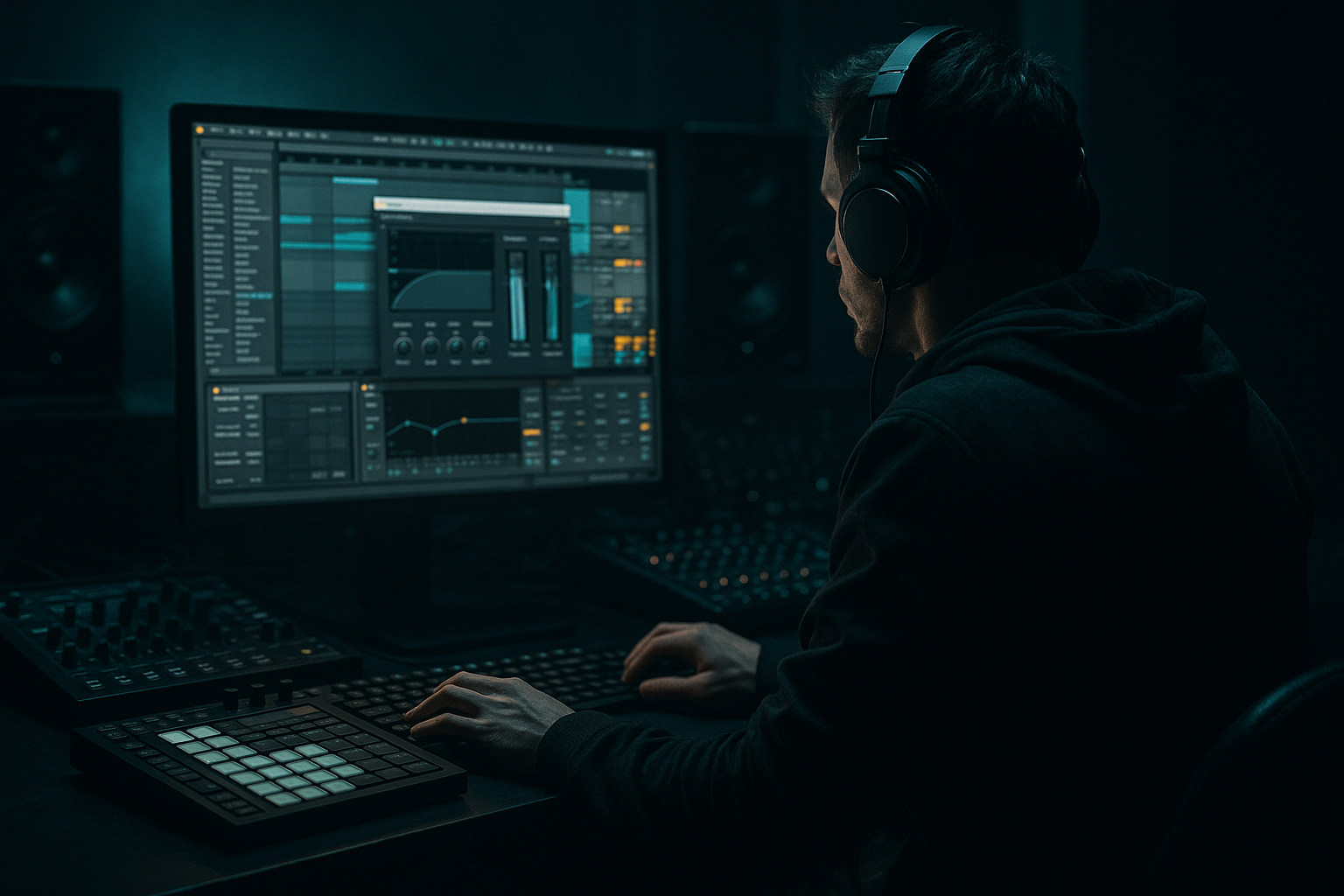
Main tutorial
```markdown
Track Freeze Strategies (90s Rave Flavor) — DnB in Ableton Live 🎛️⚡
1. Lesson overview
Freezing tracks in Ableton Live isn’t just for saving CPU — it’s a creative weapon for 90s rave/jungle flavor. Back then, producers were constantly committing audio, resampling, and reprocessing because the gear demanded it. We’ll recreate that “commit + mangle” workflow in modern Live to get gritty, glued, slightly unpredictable drum & bass.
You’ll learn how to:
- Freeze/Flatten as a sound design step, not just optimization
- Build resample loops that feel like old-school breaks + sampler bounce
- Create generation loss, gritty transients, and crunchy tails
- Use Ableton stock devices to fake “hardware limitations” (in a good way)
- A frozen+flattened break layer that’s been re-chopped and reprocessed
- A resampled “rave stab / pad” bounced to audio and time-stretched for artifacts
- A freeze-driven bass print you can slice, gate, and distort like a 90s bounce
- A workflow template: Commit → Resample → Rework → Arrange
- Tempo: 165–174 BPM (start at 172 BPM)
- Warp Mode defaults:
- Return A: “RAVE VERB” → Reverb + EQ Eight
- Return B: “TAPE DIRT” → Saturator + Redux (subtle)
- EQ Eight
- Drum Buss
- Saturator
- Redux (this is your “90s edge”)
- Put the flattened break into Simpler (Slice mode → Transients).
- Play slices on a MIDI clip to create variation while keeping the printed grit.
- EQ Eight: gently tilt it darker
- Glue Compressor
- Redux: very light (Downsample 2–4)
- Osc A: Sine
- Add Osc B: Sine or Triangle, slightly detuned (very small)
- Filter: LP24
- Add Saturator (Soft Clip, Drive 3–8 dB)
- Add Auto Filter after distortion for movement:
- Bars 1–8: bass audio is clean
- Bars 9–16: duplicate bass audio, add Redux + Reverb send on select hits for “rave smear”
- Bar 16: cut everything for a 1-beat silence, then slam back in
- Bars 1–8: breaks only + tiny stab teases (lowpassed)
- Bars 9–16: bass enters + full break; add 1–2 printed fills
- Bars 17–24: variation block (second-generation printed break with extra dirt)
- Bars 25–32: drop-out + return, plus one “abused warp” stab moment
- “DROP”
- “VARI”
- “FILL”
- “SWITCH”
- Parallel distortion after printing:
- “Wormhole” fills:
- Sub control before you print:
- Mono discipline:
- Commit multiple “editions”:
- Freeze/Flatten is your commit button — it speeds decisions and unlocks audio manipulation.
- For 90s rave/jungle flavor, use generation loss: print, resample, reprocess, print again.
- Flattened audio invites classic DnB moves: micro-chops, reverses, gated bass prints, warp artifacts, printed fills.
- Ableton stock devices that shine here: Drum Buss, Saturator, Redux, Glue Compressor, EQ Eight, Simpler, Gate, Utility, Reverb.
---
2. What you will build
A short 16–32 bar rolling DnB section with:
---
3. Step-by-step walkthrough
Step 0 — Session prep (fast + focused)
- For drums: Beats (Preserve: Transients, Envelope ~ 10–30)
- For stabs/pads: Complex/Complex Pro (or try Texture for grain)
Create 4 audio/MIDI tracks:
1. `BREAK (MIDI or Audio)`
2. `TOPS / SHAKER`
3. `BASS (MIDI)`
4. `RAVE STAB (MIDI)`
Add two return tracks:
---
Step 1 — Freeze the break layer to “commit the vibe” 🥁
Goal: Make a break sound like it’s already been printed through a sampler + mixer.
1. Load a break (Amen, Think, or any crunchy break) into Simpler (Slice mode) or use an audio clip.
2. Add a processing chain (stock devices):
BREAK chain (example):
- HP @ 30 Hz (24 dB/oct)
- Small dip -2 to -4 dB around 250–400 Hz if boxy
- Drive: 5–15
- Crunch: 5–25
- Boom: 0–10 (Freq ~ 55–70 Hz, only if needed)
- Transients: +5 to +20 (if it got dull)
- Mode: Soft Clip
- Drive: 2–6 dB
- Downsample: 2.0–8.0 (start around 4.0)
- Bit Reduction: 0–3 (keep it subtle)
- Tip: automate Redux on fills only
3. Right-click the track → Freeze Track.
4. Now Flatten (right-click → Flatten).
You’ve committed the processing into audio — very “hardware era”.
Why this matters: once flattened, you stop endlessly tweaking and start arranging and mangling like jungle was made.
---
Step 2 — Re-chop the frozen break like a sampler 📼
Now that it’s audio:
1. Consolidate a 1–2 bar loop (Cmd/Ctrl + J).
2. Duplicate it a few times (make an 8–16 bar block).
3. Slice it up:
- In Arrangement view, select the audio and use Cmd/Ctrl + E to cut at key hits.
- Create quick jungle edits:
- Kick dropouts on bar 4 or 8
- Snare double: copy a snare transient and paste 1/16 later
- Little reverse: duplicate a snare tail → Reverse (R) → fade-in
Optional “classic” move:
---
Step 3 — Freeze for “generation loss” (the secret sauce) 🧪
This is where the rave vibe really comes in: freeze → resample → reprocess → freeze again.
#### A) Create a “Print Bus”
1. Create a new audio track: `PRINT`.
2. Set its input to Resampling.
3. Arm it and record 8 bars of your break playing with returns (verb/dirt) engaged.
Now you have a “mastered-to-tape” loop you can chop.
#### B) Do a second bounce pass (optional but spicy)
Take the printed audio and add:
- Shelf down -1 to -3 dB above 10 kHz
- Attack: 3 ms
- Release: Auto
- Ratio: 2:1
- Threshold: aim 1–3 dB GR
Freeze + Flatten again if you like the result.
Each commit is “one more generation” — like copying a cassette.
---
Step 4 — Freeze bass to turn it into audio material 🔥
Goal: stop treating bass like a precious synth patch; treat it like something you can slice, gate, and distort.
1. Build a rolling bass in Wavetable or Operator.
Operator rolling bass (fast recipe):
- Freq: 150–400 Hz (automate)
- Res: 0.8–1.5
- LFO Amount: small (5–15)
- Rate: 1/8 or 1/16 (sync)
2. Freeze the bass track once it’s grooving.
3. Flatten it.
4. Now do audio tricks:
- Gate (classic choppy movement)
- Threshold: set so tails pump with drums
- Return: 0–50 ms
- Utility: mono below 120 Hz (or just keep sub mono)
- Create call/response by reversing small chunks, fading, and adding tiny gaps.
DnB arrangement idea:
---
Step 5 — Freeze rave stabs and abuse Warp artifacts 🎹✨
90s rave stabs often feel “printed” and time-stretched.
1. Make a simple stab in Analog or Wavetable (saw + filter + short amp).
2. Add:
- Reverb (short/bright)
Decay: 1.2–2.5s, Pre-delay: 10–25 ms
- Chorus-Ensemble (subtle width)
3. Freeze + Flatten to audio.
4. Now Warp it:
- Set Warp mode to Complex Pro and lower Formants (try 0–30)
- Or use Texture with Grain Size ~ 80–200
5. Chop one stab into a 1-bar hook, then pitch it around:
- Transpose -2 / +5 / +7 semitones for classic rave movement
6. Print a few variations into audio clips and keep them as “stab palette”.
---
Step 6 — Arrange with “commit blocks” (very 90s mindset) 🧱
Build using printed blocks rather than infinite live synth automation.
A simple 32-bar structure:
Use Locator markers:
This keeps you composing like a sampler-era producer: decisive and fast.
---
4. Common mistakes ❌
1. Freezing too early: commit after you have a stable groove, not before the idea exists.
2. Flattening without saving the source: duplicate the track first (disable the original) so you can revert.
3. Over-Redux on everything: bitcrushing the whole mix kills punch. Use it in moments (fills, transitions, one-shots).
4. Warp mode wrong for the material:
- Beats for drums
- Complex/Texture for stabs/pads
5. Printing returns too loud: when resampling, keep reverb/dirt tasteful or your bounce turns to mush.
---
5. Pro tips for darker/heavier DnB 🖤
Duplicate the flattened break → add Saturator (Drive 8–15 dB) + EQ Eight (lowpass ~8–10k) → blend under the clean break.
Take a printed break fill → reverse → Reverb 100% wet → resample → reverse again. Instant dark tunnel.
On bass: EQ Eight cut everything below 25–30 Hz. Printing uncontrolled sub makes later distortion unpredictable.
Put Utility on your bass print and set Width 0% below ~120 Hz (or just keep bass channel mono).
Print Clean, Dirty, Super Dirty versions of the same break loop. Swap them per section for energy without new patterns.
---
6. Mini practice exercise 🧩
Timebox: 20 minutes. Goal: one 16-bar loop.
1. Build a 2-bar break loop with Drum Buss + Saturator.
2. Freeze + Flatten it.
3. Chop 4 edits (snare double, kick dropout, reverse tail, micro-stutter).
4. Resample 8 bars into `PRINT`.
5. Add a simple Operator bass, Freeze + Flatten it, then add Gate for movement.
6. Add one stab, Freeze + Flatten, Warp it to get artifacts.
7. Arrange 16 bars:
- bars 1–8: clean print
- bars 9–16: dirty print + one fill at bar 16
Deliverable: export a rough bounce and label it `FreezeRave_172bpm_v1.wav`.
---
7. Recap ✅
If you want, tell me your Live version and whether you’re working more “Amen-style jungle” or “rolling techstep,” and I’ll suggest a specific freeze/resample template (tracks + returns) tailored to that sound.
```

