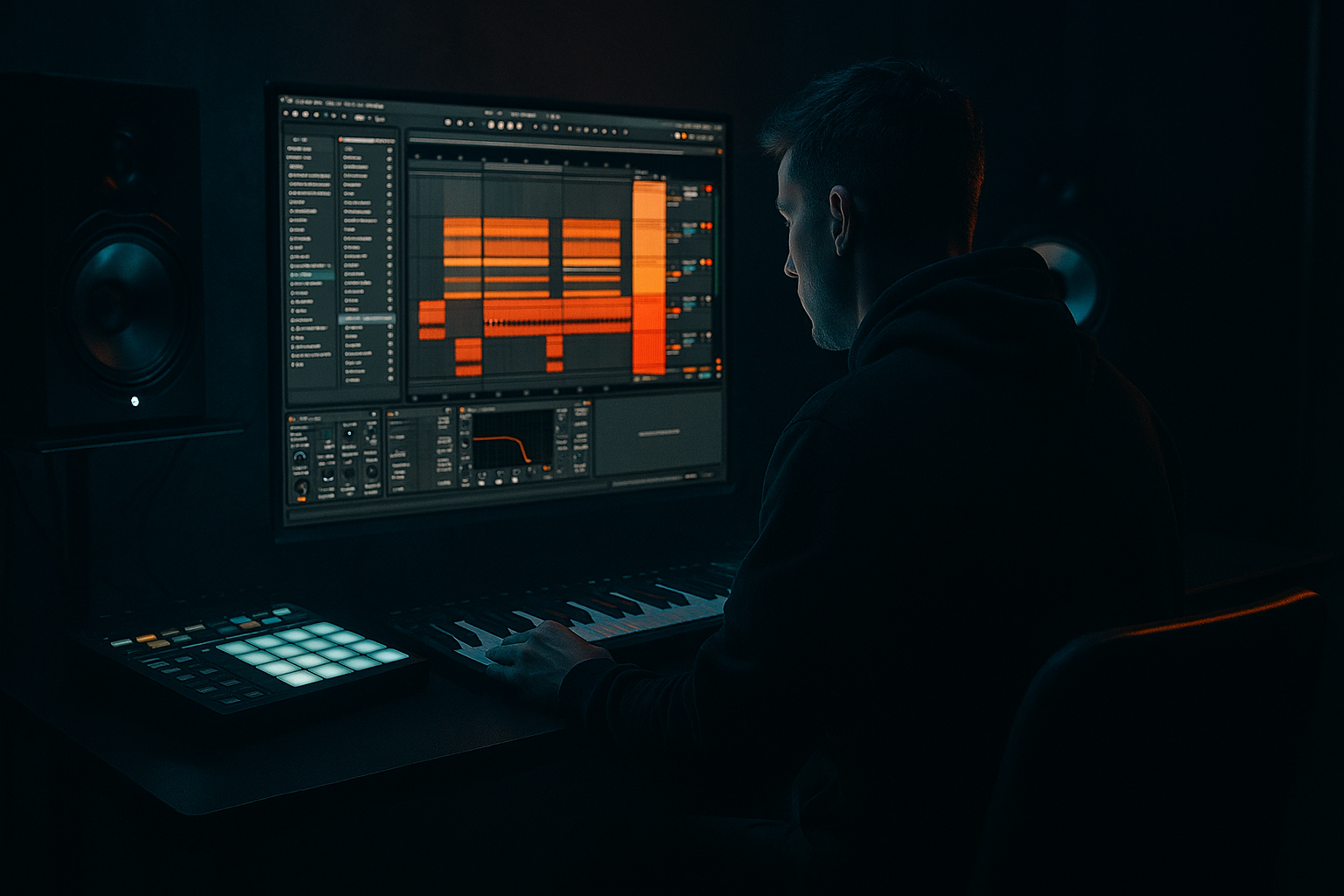
Main tutorial
Transform an Amen-Style Fill Using Groove Pool Tricks in Ableton Live 12 (DnB/Jungle) 🎛️🥁
1. Lesson overview
In drum & bass, the “Amen fill” energy comes from micro-timing, swing, and controlled chaos—not just the raw sample. In this lesson you’ll take a basic Amen-style fill and reshape its feel using Ableton Live 12’s Groove Pool, then “print” it cleanly so it hits like a modern rolling/jungle record while staying tight in the mix.
You’ll learn:
- How to extract and apply grooves
- How to use Timing / Velocity / Random like a producer (not like a preset browser)
- How to commit the groove (without losing control)
- How to make the fill sit with a DnB grid (kick + snare anchors) while still feeling alive
- Bar 1: steady DnB drum groove (kick/snare anchored)
- Bar 2: Amen-style fill that feels swung and human—but still slams on the 2 and 4 (or classic DnB 2+4 snare)
- On Master (temporary, for monitoring only):
- In the sliced MIDI clip, delete any accidental empty triggers.
- Consolidate the region you want to treat as the fill (e.g., Bar 2 only).
- Try Swing 16-55 or similar moderate swing.
- Avoid extreme swing at first—you want “rolling,” not “drunk.”
- A break with tasty ghost notes
- A shuffled hat loop
- Even a funk loop—then apply to your DnB fill for “stolen human feel”
- Timing: `30–60%`
- Velocity: `10–25%`
- Random: `3–10%`
- Base: `1/16` (usually)
- Timing adds swing/push-pull
- Velocity makes ghost notes audible but not dominant
- Random adds human chaos (too much = sloppy)
- Duplicate the snare to a separate track (clean snare layer), keep it perfectly quantized, and let the sliced break fill groove around it.
- EQ Eight
- Drum Buss
- Saturator
- Set clip Groove back to “None” (so it doesn’t double-apply)
- Bars 1–6: main groove (tight)
- Bar 7: add extra hats/ride energy
- Bar 8: grooved Amen fill (your clip), then hard cut into drop
- At the end of Bar 8:
- Auto Filter (HP, automate cutoff)
- Reverb (short plate 0.6–1.2s, low cut ~300Hz)
- Delay (1/8 or 1/16, low feedback)
- Make groove + weight coexist: parallel crush
- Sidechain the break fill to the kick (sub cleanliness)
- Ghost note control = darkness
- Add “metal” hat tension
- Make the fill “answer” the bass
- Use Groove Pool to inject authentic Amen-style movement via Timing/Velocity/Random.
- Extract Groove from real loops for instant jungle DNA.
- Apply groove only to your fill so the main DnB backbeat stays punchy.
- Commit or resample to lock in the feel and move forward like a finisher.
- Use stock tools (Drum Buss, Saturator, EQ Eight, Compressor, Auto Filter) to keep it heavy, controlled, and mix-ready.
---
2. What you will build
A 2-bar drum & bass break section:
End result: a fill you can drop before a switch, drop, or phrase change—perfect for roller, jungle, or techy DnB.
---
3. Step-by-step walkthrough
Step 0 — Session setup (DnB-friendly)
1. Set Tempo to 172–175 BPM.
2. Create a Drum Bus Group (optional but recommended):
- Group your drum tracks into a group called DRUMS.
Suggested master-ish monitoring chain (light touch while producing):
- Limiter (Ceiling: `-0.8 dB`, Lookahead: `1.5 ms`)
- Spectrum (for visual checks)
> Keep the real mastering for later—this lesson is “mastering category” in the sense of finishing and committing groove cleanly, not smashing your mix.
---
Step 1 — Get an Amen-style fill into Live
You have two good beginner options:
#### Option A: Use a break sample (classic jungle workflow)
1. Drag an Amen-style break or break-like loop into an Audio track.
2. In Clip View, set:
- Warp: ON
- Warp Mode: Beats
- Preserve: 1/16 (good starting point for breaks)
3. Set Seg. BPM so the loop locks to the project tempo.
#### Option B: Use MIDI + Drum Rack (clean modern workflow)
1. Load a Drum Rack and use break-style hits (kick/snare/hats).
2. Program a 2-bar clip, with Bar 2 being a fill (extra snare ghost notes + hat chatter).
> This tutorial works for both, but break audio makes the groove extraction feel very “Amen”.
---
Step 2 — Slice the Amen to MIDI (recommended for control)
If you’re using audio:
1. Right-click the audio clip → Slice to New MIDI Track…
2. Choose:
- Slicing preset: `Built-in` (or “Create one slice per: Transient”)
- Warp Slices: ON
3. Live creates:
- A MIDI track with a Drum Rack containing slices
- A MIDI clip triggering those slices
Now you can groove the MIDI with precision and re-balance hits.
Quick cleanup:
---
Step 3 — Open the Groove Pool and load grooves
1. Hit ⌘ + Alt + G (Mac) / Ctrl + Alt + G (Windows) to open Groove Pool.
2. In the Browser:
- Go to Grooves
- Start with something like:
- Swing 16 (subtle roll)
- MPC-style 16 swing (if available)
- Or extract your own groove (next step)
DnB-friendly starting point:
---
Step 4 — Extract a groove from a break (the secret sauce) 🔥
This is where you get authentic jungle movement.
1. Click your original audio break clip (or any groovy percussion loop).
2. In Clip View, find the Groove section.
3. Click Extract Groove.
Ableton creates a new groove in the Groove Pool based on the clip’s timing/velocity feel.
Pro move: Extract from:
---
Step 5 — Apply the groove to ONLY the fill (arrangement control)
Instead of grooving the whole drum part (which can wreck your snare anchors), apply groove surgically.
1. Split your MIDI (or audio) clip so the fill is separate:
- Select Bar 2 region → ⌘E / Ctrl+E to split.
2. Click the fill clip.
3. In Clip View → Groove, select your groove.
Now your groove affects the fill while Bar 1 stays tight.
---
Step 6 — Dial in Groove Pool parameters (the “tricks”)
In Groove Pool, click your groove and tweak:
#### Key controls (use these exact starting values)
- Start at `45%` for a believable roll
- Helps ghost notes “breathe”
- Adds variation—keep low for DnB tightness
- If the fill is very busy, try `1/32`
DnB intention:
---
Step 7 — Keep the snare punch locked (critical for DnB)
Your backbeat must still hit hard and on time.
If working in MIDI:
1. Find the main snare hits (often on beat 2 and 4).
2. Select those notes and nudge them back to the grid:
- Set Quantize to `1/4` or `1/8`
- Quantize with Amount: 100% for those snare notes only
Alternative technique:
Suggested snare layer chain (stock devices):
- High-pass: `~120 Hz`
- Add snap: small bell around `3–5 kHz` if needed
- Drive: `2–6`
- Crunch: `0–20` (taste)
- Boom: `0–10` (watch low-end)
- Soft Clip: ON
- Drive: `1–3 dB`
---
Step 8 — Commit the groove (without losing flexibility)
Once it feels right, print it so it’s stable and mixable.
There are two good “commit” methods:
#### Method A: Commit timing into the clip (MIDI)
1. In Groove Pool, click the groove.
2. Hit Commit.
This writes the groove timing/velocity into the notes.
Then:
#### Method B: Resample to audio (best for “mastering mindset”)
1. Create a new Audio Track called PRINT BREAK.
2. Set Audio From: your break/fill track (or DRUMS group).
3. Arm and record the fill section.
4. Now you can:
- Fade, reverse tiny bits, stretch, and do micro edits like classic jungle.
---
Step 9 — Make it feel like a real DnB phrase (arrangement idea)
A super usable 8-bar pattern:
Transition tricks:
- Add Reverb (short) on snare tail with automation
- Add Delay (Ping Pong) very subtle on a fill hit
- Use Auto Filter high-pass sweep on the break for 1 bar
Stock devices for transitions:
---
4. Common mistakes
1. Grooving the whole drum buss
Your kick/snare anchors drift = your track loses impact. Groove the fill only (or the break layer only).
2. Too much Random
Random at 20–30% makes DnB feel messy fast. Keep it subtle.
3. Over-swinging at 174 BPM
Heavy swing can sound like halftime stumble. Use moderate Timing and focus on ghost notes.
4. Not committing / double-applying groove
If you Commit and still have Groove active, you’re stacking swing twice.
5. Warp mode fighting your groove (audio)
For breaks, Beats mode is usually safest. Tones/Texture can smear transients.
---
5. Pro tips for darker/heavier DnB 🖤
- On your break/fill track, create a Return track:
- Saturator (Drive 6–12 dB, Soft Clip ON)
- Drum Buss (Drive 5–10, Damp as needed)
- EQ Eight (low cut to avoid mud)
- Send the fill harder than the main groove for extra aggression.
- On the break/fill group:
- Compressor with Sidechain from Kick
- Ratio `2:1–4:1`, Attack `5–15 ms`, Release `60–120 ms`
- Keeps low end punchy while the fill is busy.
- Dark rollers often have quiet but present ghosts.
- Use Velocity in Groove Pool + MIDI note velocity edits to keep ghosts consistent.
- Layer a tight hat loop, then apply a different groove at lower Timing (10–25%) for subtle push-pull.
- If your bass is reese/roller, leave space:
- High-pass the break fill at `120–200 Hz` with EQ Eight
- Let sub + kick own the real low end
---
6. Mini practice exercise (10–15 minutes) ⏱️
1. Create a 2-bar break fill (audio slice or MIDI).
2. Extract groove from a funky loop (or from the break itself).
3. Apply groove to Bar 2 only.
4. Try these three settings and A/B them:
- A (tight roller): Timing 35%, Velocity 10%, Random 3%
- B (jungle bounce): Timing 55%, Velocity 20%, Random 6%
- C (chaos fill): Timing 65%, Velocity 25%, Random 10%
5. Commit the best version, resample to audio, and:
- Add a 1/16 stutter on the last 1 beat (manual duplication or Beat Repeat if you like)
- Hard cut into a drop (bar line) and listen: does it hype the transition?
---
7. Recap ✅
If you want, tell me whether you’re working with audio Amen breaks or MIDI drums, and I’ll give you a precise example clip layout (notes/hits) plus recommended groove settings for roller vs jungle.

