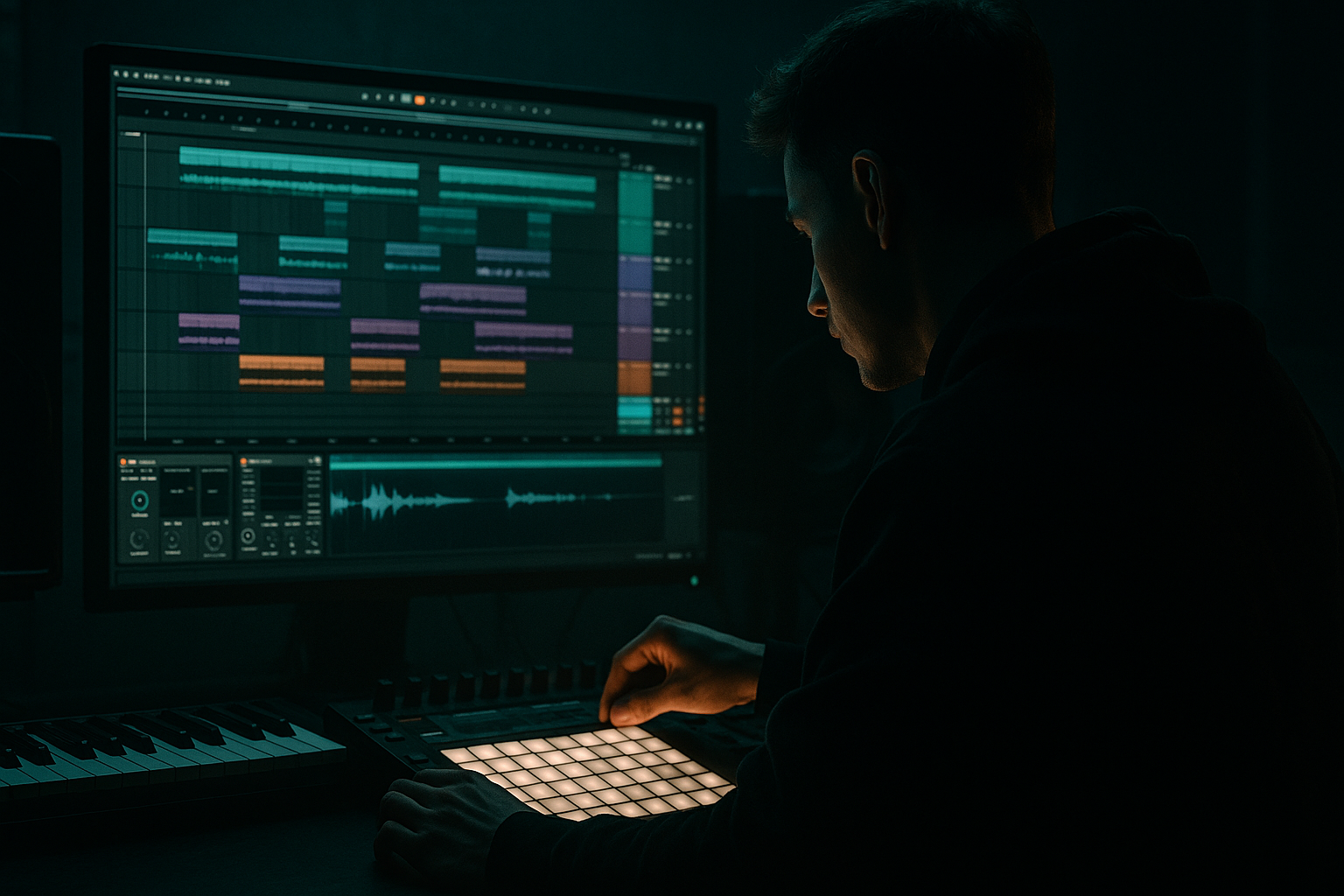
Main tutorial
Transform an Amen-Style Sub for Smoky Warehouse Vibes in Ableton Live 12 🏭🔊
Advanced DnB composition lesson (with real settings + workflows)
---
1. Lesson overview
In rolling DnB and jungle-rooted music, the sub isn’t just “low end”—it’s the engine, the groove, and often the mood. “Amen-style sub” here means a subline that moves with Amen break phrasing: push/pull, ghosted notes, syncopation, call-and-response, and those classic jungle “tail flicks” at the ends of bars.
In this lesson you’ll take a simple sine/triangle sub and transform it into smoky warehouse vibes: thick, warm, slightly distorted, sidechained to the break, and arranged with proper DnB momentum.
---
2. What you will build
You’ll create a two-layer bass system and a compositional approach:
- Sub layer (mono, clean): stable, controlled fundamental (30–70 Hz).
- “Amen movement” layer (mid-bass texture): distortion + filtering + subtle pitch articulation to mimic break dynamics without wrecking your low end.
- A sidechain + groove relationship with the Amen (or an Amen-style drum rack).
- A 4–8 bar bass arrangement with variation that feels like proper rolling/jungle DnB.
- Warp: Beats mode
- Preserve: Transient
- Set “Loop” to 1 or 2 bars.
- Right-click sample → Slice to New MIDI Track
- Slice preset: Transients
- Algorithm: A only
- Osc A waveform: Sine
- Coarse: 0
- Fine: 0
- Level: 0 dB (adjust later)
- Attack: 0.5–2 ms
- Decay: 200–350 ms (depends on pattern density)
- Sustain: -inf if you want plucks, OR -6 to -12 dB for held notes
- Release: 60–120 ms (avoid sub “smearing” across kicks)
- Auto Filter (after Operator)
- Mode: LP24
- Cutoff: 120–180 Hz (just to keep it clean)
- Drive: 0–2 dB
- Anchor notes: hit on 1.1 (downbeat) and somewhere around 1.3.3 / 1.4 (depending on kick placement).
- Ghost notes: short, quiet sub taps on offbeats (but keep them controlled).
- Phrase ends: a tiny “tail note” at end of bar 2 (classic break-responder).
- F1 on 1.1 (long-ish)
- F1 short on 1.2.3 (ghost)
- D#1 on 1.3 (medium)
- F1 short on 1.4.3 (ghost)
- F1 on 2.1 (medium)
- G1 on 2.2.2 (short)
- F1 on 2.3 (medium)
- Quick tail: D#1 → F1 (two 1/16 notes) at 2.4.3–2.4.4
- Main notes: 85–110
- Ghost notes: 20–50
- Osc A waveform: try Triangle (or keep Sine but rely on saturation)
- Add subtle pitch envelope:
- Sidechain: ON
- Audio From: your drum bus (or the kick group)
- Ratio: 2:1 to 3:1
- Attack: 10–30 ms (let the sub transient through slightly)
- Release: 60–140 ms (time it to the groove)
- Gain reduction: aim 1–3 dB (sub should remain stable)
- Ratio: 4:1 to 8:1
- Attack: 2–10 ms
- Release: 80–180 ms
- GR: 3–7 dB
- Automate Auto Filter cutoff over 4–8 bars:
- Normal sections: 15–20%
- Fill moments (end of bar 2/4/8): 25–35% for a bite
- Width: 0% (mono) for Sub (Clean)
- For Texture layer, keep low mids controlled: consider Bass Mono in Utility (if available) or just HP filter as above.
- Bars 1–4: Core sub phrase + texture closed (darker), drums steady.
- Bars 5–8: Add small variation:
- Bars 9–12: Swap the sub ending (tail note changes) + introduce a small call/response with the snare fill.
- Bars 13–16: “Warehouse pressure” peak:
- If the Amen has a busy fill, simplify the sub (hold a note).
- If the Amen is straight, add a tail flick or ghost note.
- Key choice matters: F, F#, G are common because they hit club systems nicely. Don’t go so low the system can’t reproduce it (D#1 can be risky depending on playback).
- Use tiny pitch drops (Operator pitch env) for that “old sampler” weight—keep it subtle, under 70 ms.
- Drum Bus on drums, not on sub: Keep low-end punch by controlling drum harmonics rather than cranking bass distortion.
- Parallel “airless” grit: Put Roar on a return, filter it dark (LP around 2–4 kHz), send texture layer lightly for warehouse haze.
- Groove Pool: Try a shuffled 1/16 groove lightly (Amount 10–20%) on the texture layer only, not the clean sub—keeps low end tight while mids swing.
- You built a clean mono sub (Operator sine) designed for stability and club translation.
- You created an Amen-reactive texture layer with saturation, filtering, and Roar—high-passed to protect the low end.
- You made the bass groove with the break via sidechain, velocity shaping, ghost notes, and phrase endings.
- You arranged it like real DnB: micro-variation every 2–4 bars, bigger energy shifts over 8–16.
You’ll also build:
---
3. Step-by-step walkthrough
Step 0 — Session setup (so the bass behaves)
1. Tempo: 170–176 BPM (start at 174).
2. Warp mode: keep drums crisp (Beats warp for breaks if needed).
3. In Preferences → Audio, keep buffer reasonable for tight timing.
4. Add a Spectrum on your Master early. You’re going to watch the sub as you shape it.
---
Step 1 — Choose your “Amen driver” (the groove source) 🥁
You need a break (Amen or Amen-derived) because the bass movement will reference its rhythm.
Option A (classic): Drop an Amen break sample into audio track.
Option B (more control): Slice to Drum Rack
Now you can rearrange and create fills that your bass can answer.
Composition tip: Build a 2-bar loop where bar 2 has a small variation (extra ghost hits / tiny fill). That’s the “call” your bass will “respond” to.
---
Step 2 — Build a proper sub source (simple, stable, playable) 🎚️
Create a MIDI track: Sub (Clean)
Instrument (stock): Operator
Amp envelope (tight but not clicky):
Add a safety filter (optional):
Why Operator: It’s phase-stable and predictable. That’s gold for subs in DnB.
---
Step 3 — Write an “Amen-style” sub pattern (the compositional trick) ✍️
This is the heart of the lesson: your subline should rhyme with the break, not just follow the kick.
#### A. Start with a 2-bar grid
Set MIDI clip length: 2 bars, 1/16 grid.
#### B. Use these rhythm rules (jungle logic)
#### C. Example pattern (text description)
Key: F (common for DnB subs), notes around F1 (43.65 Hz) to A#1/C2 for movement.
Bar 1:
Bar 2 (variation):
#### D. Velocity matters (even on sub)
This will later drive saturation and dynamics differently = more “played” feel.
---
Step 4 — Create the warehouse “smoke” layer (mid texture that follows the sub) 🌫️
Duplicate the Sub MIDI track and name it: Bass (Texture)
On Bass (Texture), keep Operator but change it to create harmonics:
Operator changes:
- Pitch Env Amount: +3 to +8 semitones
- Pitch Env Decay: 30–70 ms
This adds a tiny “thwack” like old sampler basses—great under breaks.
Device chain (stock) for texture:
1) Saturator
- Mode: Soft Clip ON
- Drive: 4–10 dB (use your ears)
- Output: pull down to match level
- Color: ON (if you want slightly brighter grit)
2) Auto Filter
- Mode: LP12
- Cutoff: 180–600 Hz (move with automation later)
- Resonance: 0.7–1.4
- Drive: 2–6 dB (great for grit)
3) Roar (Live 12) 🧨
- Use Tape or Tube style (warehouse warmth)
- Drive: 10–25%
- Tone: slightly darker (pull highs down)
- Mix: 30–60%
- If it gets fizzy, filter before/after.
4) EQ Eight (crucial!)
- High-pass: 24 dB/oct @ 90–120 Hz (remove real sub from this layer)
- Dip muddy zone: 200–350 Hz -2 to -5 dB if needed
- Gentle shelf down above 6–8 kHz to keep it smoky
This layer gives you the vibe without wrecking the low end.
---
Step 5 — Make the sub pump with the Amen (but cleanly) 🫀
You’ll sidechain both layers to the break/kick relationship, but with different intensity.
#### A. Sidechain the Sub (Clean) subtly
Add Compressor to Sub (Clean):
#### B. Sidechain the Bass (Texture) harder
Compressor on Bass (Texture):
This creates that rolling “breathing” against the Amen.
Workflow tip: Put drums into a Drum Bus group and sidechain from that, then if you change kick/snare patterns the bass still grooves.
---
Step 6 — Add “Amen phrasing” via automation (the warehouse movement) 🧪
The vibe comes from slow, deliberate modulation, not constant wobble.
On Bass (Texture):
- Bars 1–2: 250–350 Hz (darker)
- Bars 3–4: open to 450–700 Hz (energy lift)
- Bar 4 end: quick dip back down (smoke drop)
Add subtle Roar Drive automation for fills:
Optional: add Utility at the end:
---
Step 7 — Glue it into a “DnB sentence” (arrangement ideas) 🧱
A warehouse roller typically feels like 8–16 bar statements with internal micro-variation.
Suggested 16-bar drop structure:
- One extra ghost note in bar 6
- Filter opens slightly on texture
- Add a break fill in bar 8
- Texture opens more
- Slightly stronger sidechain pump on texture
- Bar 16: drop bass out for half a bar for impact, then slam back.
DnB composition trick:
Make the subline “answer” the Amen fills:
---
4. Common mistakes ⚠️
1. Distorting the real sub
- If your Sub (Clean) is saturating heavily, you’ll get inconsistent low-end and mastering pain. Keep grit in the texture layer.
2. Too much note length
- Long sub notes across kick transients blur the groove. Tighten release and use sidechain properly.
3. Overcomplicated rhythm
- Amen-style doesn’t mean “random 1/16s everywhere.” Use anchors + a few ghosts.
4. Stereo sub
- Don’t. Keep Sub (Clean) mono (Utility width 0%). Let texture give width above the sub region.
5. Ignoring phase/overlap
- Two layers fighting in 80–150 Hz = mud. High-pass texture and keep the sub clean.
---
5. Pro tips for darker/heavier DnB 🖤
---
6. Mini practice exercise 🎯
Goal: Build a 2-bar sub phrase that evolves into a 16-bar drop.
1. Start with only Sub (Clean) and write a 2-bar “Amen-style” pattern (anchors + 2 ghosts + a tail).
2. Duplicate into Bass (Texture) and build the chain: Saturator → Auto Filter → Roar → EQ Eight (HP at 100 Hz).
3. Add sidechain:
- Sub GR: 2 dB
- Texture GR: 5 dB
4. Arrange 16 bars:
- Every 4 bars, change one thing only (tail note, filter position, or ghost placement).
5. Bounce a quick render and check:
- Is the sub stable and readable on Spectrum?
- Does the texture give “smoke” without harshness?
---
7. Recap ✅
If you want, tell me your target reference (e.g., classic Metalheadz rollers, 90s jungle, or modern deep/techy DnB) and I’ll tailor a specific 16-bar MIDI pattern + device macro mapping for Live 12.

