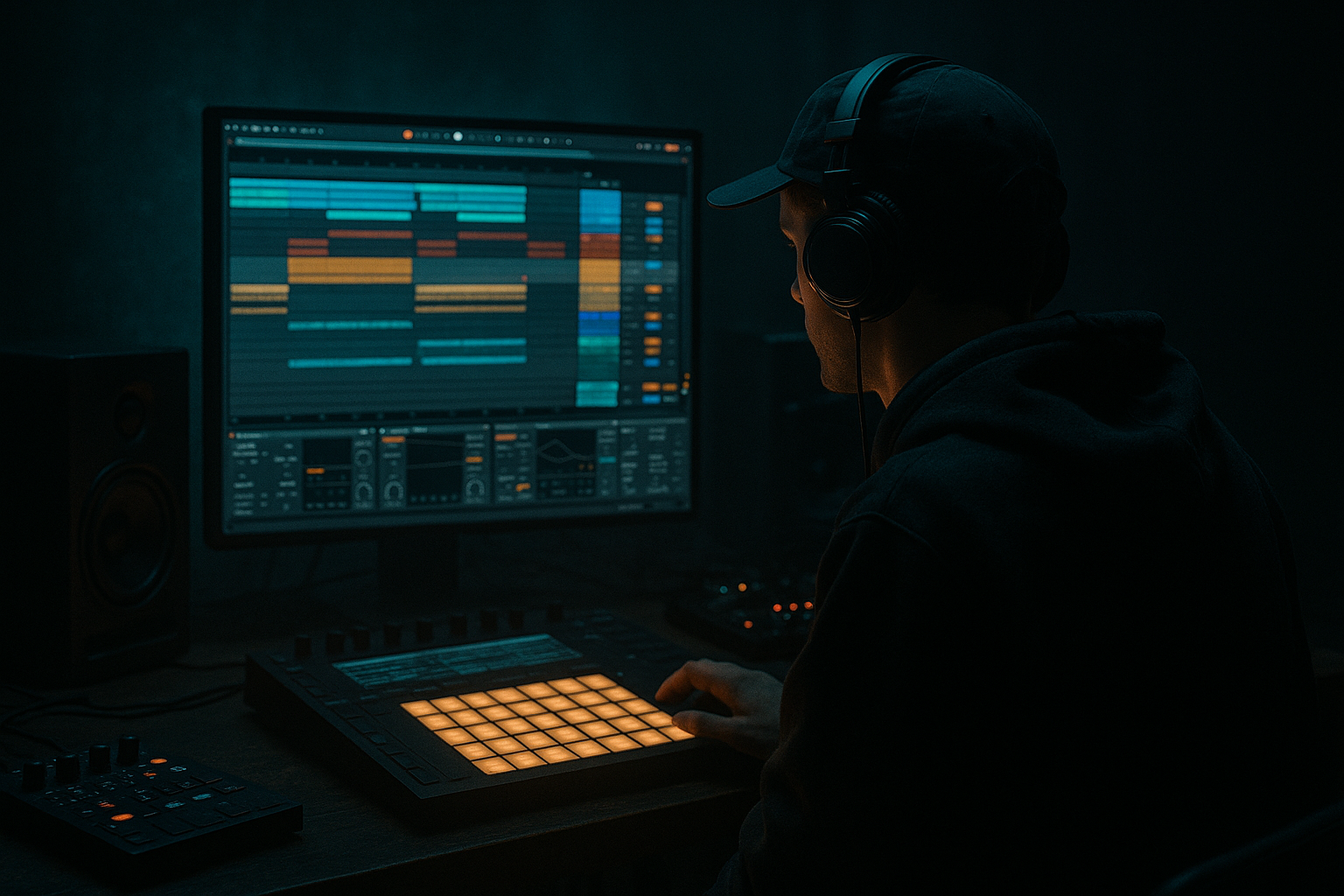
Main tutorial
Lesson Overview
This lesson is about transforming a modern Drum & Bass section into a 90s-inspired jungle darkness transition inside Ableton Live 12, with a workflow that feels fast, controllable, and repeatable. The goal is not to “make it old” in a cheesy way — it’s to create that shadowy pre-drop shift where the groove briefly fractures, the break gets more haunted, the bass narrows and snarls, and the arrangement feels like it just stepped into a darker corridor.
In a DnB track, this kind of transition usually lives in one of three places:
- end of a 16 or 32-bar phrase before the drop
- mid-track switch-up to reset energy without losing momentum
- DJ-friendly transition between sections, where drums and bass re-contextualize the groove
- reshape a drum break into a more frantic, chopped jungle passage
- darken the harmonic field without clutter
- automate bass movement into a tighter, more aggressive space
- create a transition that feels authentic, not random
- edited break fragments with ghost-note energy
- filtered atmospheres and tape-worn texture
- a reconfigured sub / reese answer phrase
- automation that narrows the stereo image before the drop
- a short fill and impact that hand off energy cleanly
- drums getting more syncopated and restless
- snare accents becoming more “live” and less grid-locked
- the bass leaving space, then re-entering with more menace
- a darker tonal center, often with less brightness and more midrange dirt
- a transition that can sit between a rollers groove and a jungle-inflected drop, or act as a switch-up inside a darker track
- Over-chopping the break until it loses groove
- Putting too much low end in the atmosphere layer
- Making the bass constantly active
- Using too much stereo width on sub or low-mid bass
- Over-brightening the break with reverb or distortion
- Ignoring phrase logic
- Print the transition as audio and re-edit it.
- Use one “ugly” layer sparingly.
- Make the snare the emotional pivot.
- Automate bass note length, not just filter cutoff.
- Reference 90s jungle timing, not just sound.
- Use a restrained delay throw on one chopped hit.
- A strong jungle transition is about phrase logic, contrast, and controlled fragmentation.
- Use Ableton stock tools to chop breaks, narrow bass, darken atmospheres, and automate tension.
- Keep the sub mono, the breaks alive, and the bass phrasing intentional.
- Build the section so it feels like a scene change: less brightness, more movement, bigger impact.
- In darker DnB, the most powerful move is often not adding more — it’s removing just enough to make the drop feel dangerous.
Why it matters: darker jungle transitions give your track identity. They create contrast, hint at heritage, and make a drop feel heavier because the listener has been “moved” emotionally first. In modern DnB, that contrast is often what separates a clean arrangement from a track that feels like a proper system tune.
We’ll build a workflow using Ableton stock tools to:
---
What You Will Build
By the end, you’ll have a 16-bar jungle transition that turns a clean rollers or neuro-adjacent section into a 90s-inspired darker passage using:
Musically, the result should feel like:
Think: modern sub pressure + 90s break anxiety.
---
Step-by-Step Walkthrough
1. Set up your transition lane with clear arrangement goals
Before touching sound design, mark the phrase in Arrangement View. For advanced workflow, treat this as a self-contained scene inside the track.
- Identify a 16-bar or 8-bar transition window leading into the drop or switch-up.
- Drop locators at:
- bar 1: “pre-trans”
- bar 5: “break fracture”
- bar 9: “bass pullback”
- bar 13: “impact prep”
- bar 16: “drop / new section”
- Keep your reference track visible if you use one, and compare phrase density rather than exact sounds.
A strong jungle transition usually breathes in layers:
- first 4 bars: subtle tension
- middle 4 bars: break edit + tonal shift
- next 4 bars: bass departure / re-entry
- final bars: fill, impact, or one-bar silence cue
Why this works in DnB: listeners lock onto phrase changes quickly at 170–174 BPM. If your transition is mapped clearly, the energy feels intentional rather than noisy.
2. Resample or consolidate your main break for surgical editing
If you already have a break loop, duplicate it to a new audio track and commit it. In Live 12, working from rendered audio speeds up the jungle-style chop process.
- Right-click the break clip and choose Consolidate if needed.
- Warp it cleanly, but don’t over-fix the natural swing.
- If the break feels too tidy, use Complex Pro only if necessary; for punchier, more percussive breaks, Beats mode can preserve transient character better.
- Create 2–4 duplicate lanes of the break for variation.
Now chop the break into fragments:
- kick/snare anchor hits
- ghost notes
- tiny tail hits
- one-bar fill fragments
Use clip gain to emphasize accent points rather than over-compressing too early. For a darker jungle feel, keep the break a little ragged. Not sloppy — ragged.
Stock tools that help:
- Simpler on a sliced break if you want quick triggering
- Drum Rack if you want pads for fragment performance
- Auto Filter for shaping density before the transition
3. Build the jungle fracture with rhythmic contrast, not chaos
The classic mistake is to just add more hits. Instead, create contrast between regularity and interruption.
Start by designing a 2-bar broken rhythm:
- Bar 1: keep the original groove mostly intact
- Bar 2: remove one strong kick, add a snare ghost, and let a break tail answer the main backbeat
- Repeat with slight variation so the listener can predict the pattern but not fully settle into it
Practical edits:
- Nudge a few chopped hits 5–15 ms late for drag and menace
- Pull one ghost snare slightly ahead to create tension
- Use Clip Envelopes or Automation to bring in a high-pass filter on the break from around 80–120 Hz up to 180–250 Hz during the transition
- Add a short Beat Repeat on a return track or directly on the break buss:
- Interval: 1/8 or 1/16
- Chance: 20–40%
- Grid: 1/16
- Gate: 40–70%
- Mix: keep it subtle, around 10–25%
The goal is to make the break feel like it’s disintegrating and reassembling. That is a very jungle move.
4. Design a darker tonal bed using simple harmonic subtraction
90s-inspired darkness often comes less from “new chords” and more from removing brightness and letting a small tonal motif loom in the background.
Use one of these stock workflows:
- Analog or Wavetable for a low, minor-key stab or tone
- Sampler/Simpler with a detuned hit or reversed texture
- a resampled vocal breath, ride tail, or broken piano fragment
Keep it sparse:
- one note or two-note interval
- minor 2nd, tritone, or minor 9th color
- low-pass the tone with Auto Filter around 300–1,200 Hz, depending on the source
- add subtle movement with LFO in Auto Filter or Wavetable wavetable position
A practical sound chain:
- Auto Filter → Saturator → Hybrid Reverb
- Saturator Drive: 2–6 dB
- Hybrid Reverb Decay: 1.2–2.5 s
- Dry/Wet: 5–15%
- High cut in reverb: keep it dark, often under 6–8 kHz
Keep this layer tucked low in the mix. It should feel like atmosphere with attitude, not a pad lead.
5. Rework the bass into a tension-release call and response
For the transition, the bass should stop being a steady loop and become a conversation. This is where advanced arrangement thinking matters.
Split your bass into two functional layers:
- Sub layer: clean mono sine or near-sine tone
- Mid bass layer: reese, growl, or nasal midrange movement
Stock devices:
- Operator or Wavetable for sub
- Wavetable, Analog, or Drift for the mid layer
- Utility to force mono below the crossover
- Saturator or Overdrive for controlled grit
- EQ Eight to carve low-end and harshness
Suggested setup:
- Sub: sine-based, mono, no stereo width
- Mid bass: high-pass around 90–140 Hz
- Add movement with:
- Filter frequency automation
- Wavetable position automation
- subtle detune on the reese layer
- Bass phrase idea:
- bars 1–4: steady motif
- bars 5–8: silence on beat 1, answer on the “&”
- bars 9–12: more syncopation, shorter notes
- bars 13–16: strip it back, then slam back in on the drop
For darker jungle transitions, less is more. Leaving gaps increases weight because the sub becomes an event again.
6. Shape the transition with buss processing instead of over-processing individual tracks
Route your drums and bass to their own group tracks, then process the transition at the buss level. This keeps the session organized and makes automation cleaner.
On the Drum Bus:
- Glue Compressor
- Ratio: 2:1 or 4:1
- Attack: 10–30 ms
- Release: Auto or 0.1–0.3 s
- Aim for 1–3 dB gain reduction
- Saturator for density
- Drive: 1–4 dB
- Soft Clip: on if needed
- EQ Eight
- tame harshness around 3–6 kHz if the chopped break gets spitty
- small shelf reduction above 10 kHz if you want more 90s grit
On the Bass Bus:
- Utility to manage stereo width
- EQ Eight to keep sub clean
- Saturator for mid presence
- optional Compressor sidechained lightly to kick if needed
On the Transition Return:
- Echo with short feedback throws
- Time: 1/8 Dotted or 1/4
- Feedback: 10–35%
- Filter: dark, not fizzy
- Reverb or Hybrid Reverb
- short-to-medium decay
- low cut to avoid clouding the sub
- Use automation to bring the return up only in the final bars of the transition
Workflow tip: automate the group track levels and filters first before individual clip edits. You’ll make faster musical decisions and keep the transition coherent.
7. Use automation to narrow, darken, and then explode the energy
The “transform” part of the lesson is mostly automation. Your job is to make the section feel like it’s moving through a tunnel.
Automate these parameters over the 8–16 bar window:
- Auto Filter cutoff on the break and atmospheres
- Utility width on the bass bus
- Reverb dry/wet on texture returns
- Send amount to delay or echo throws
- Saturator drive on the drum bus in the final bars
- Masterless pre-drop mute: pull out the kick or sub for a beat or half-bar before the impact
Suggested movements:
- start with wider stereo on texture, then narrow to mono-ish by the impact
- high-pass the break progressively from 80 Hz to 180 Hz
- increase distortion gently in the last 2 bars
- automate a short filter sweep on a snare fill or break reversal
One effective move:
- at bar 15, mute the bass for 1/4 beat
- let a snare roll or break fill occupy the gap
- bring the bass back on bar 16 with a cleaner, heavier note
That brief absence creates a much bigger sense of drop weight.
8. Add a final one-bar fill that sounds like a scene change, not a drum exercise
The last bar should feel like the room tilts.
Build a fill from:
- a snare flam
- a reversed break hit
- one or two tom-like fragments from the break
- a short impact or sub drop
Use Ableton tools:
- Reverse on a clipped break tail
- Simpler in one-shot mode for triggered fill slices
- Drum Buss for punch and crack if the fill needs more smack
- Auto Pan very subtly on noise layers for motion
- Amount: 10–20%
- Rate: synced, usually 1/2 or 1 bar for slow movement
Keep the fill short. In darker DnB, the final bar should hint at violence, not demonstrate it. A single well-placed fill often lands harder than a busy one.
---
Common Mistakes
Fix: keep at least one recognizable anchor pattern. Jungle feels powerful because the listener can still feel the original break inside the mutation.
Fix: high-pass ambience aggressively. Dark doesn’t mean muddy.
Fix: leave gaps. In DnB, silence before re-entry is often what makes the re-entry hit.
Fix: check with Utility and keep anything below the bass crossover effectively mono.
Fix: darken return effects with filters and keep high-end controlled. The vibe should feel worn-in, not shiny.
Fix: if the transition doesn’t resolve into a clear 8- or 16-bar outcome, it will feel like a loop accident instead of an arrangement decision.
---
Pro Tips for Darker / Heavier DnB
Once the MIDI and automation feel right, resample the whole transition. Then cut tiny moments of silence, reverse tails, or transient spikes. This often gives the most authentic jungle drama.
A bit of alias-y or distorted midrange on the break or bass can add underground character. Keep it band-limited so it reads as attitude, not harshness.
In darker DnB, the snare is often more important than the kick during transitions. Shape it with transient control, saturation, and slight room tail.
Shorter notes near the drop create urgency. Longer notes earlier in the phrase create weight.
The swing and gap placement matter as much as the break sample itself. If the rhythm breathes like old jungle, the aesthetic lands faster.
A single echo on a ghost snare or vocal chop can make the whole transition feel deeper. Keep feedback low and filter the return.
---
Mini Practice Exercise
Spend 10–20 minutes building a 16-bar transition from an existing DnB loop.
1. Pick a drum loop and duplicate it to a new audio track.
2. Chop it into 4–8 fragments and make bars 5–8 more fragmented than bars 1–4.
3. Add an Auto Filter automation pass that high-passes the break from around 100 Hz up to 200 Hz by the end.
4. Build a simple sub or reese answer phrase with one gap before the final bar.
5. Add one return track with Echo or Hybrid Reverb for a dark throw.
6. Automate Utility width narrower as the transition approaches the drop.
7. Print the whole section to audio and make one final edit: reverse a tail, mute one beat, or add a fill hit.
Your goal is not perfection — it’s to make the section feel like a believable DJ or rave transition that could live in a real dark DnB tune.
---

