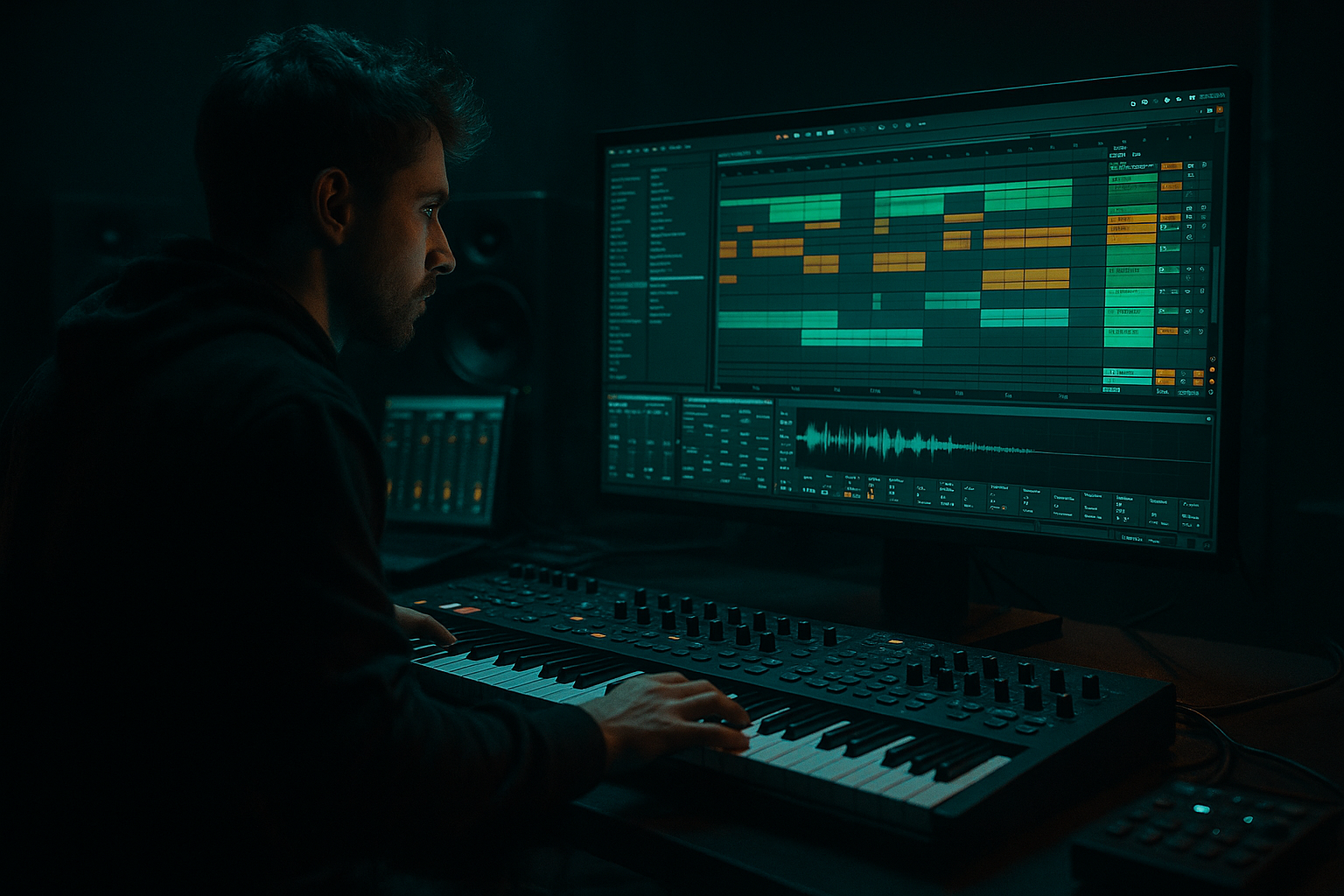
Main tutorial
```markdown
Triplet Fill Timing at Bar Turns (Advanced DnB Groove) 🔥🥁
1. Lesson overview
Triplet fills at bar turns are one of the fastest ways to inject jungle attitude and modern rolling DnB tension into a groove—without wrecking momentum. The trick isn’t “add triplets,” it’s placing them so the downbeat still hits like a hammer.
In this lesson you’ll learn:
- How to write tight 1/8T and 1/16T fills that land perfectly on the next bar
- How to use Ableton Live Groove Pool, swing, and micro-timing to keep the fill musical
- How to layer + process fills so they sound aggressive but controlled
- How to create bar-turn energy (build-up → release) without derailing the drum pocket
- A stable core beat (kick/snare + hats)
- A triplet fill in the last half-beat / last beat of bar 2
- A “landing” into bar 3 that stays dead-on time and feels heavier, not rushed
- Drum Rack with separate chains for transient control
- Return-style parallel smash (inside the rack or via Sends)
- A fill layer bus with tight EQ + transient shaping + short room
- In the MIDI clip, set Grid = 1/16.
- Keep snare exactly on-grid for now. We’ll add character later.
- Option A: last 1/2 beat of bar 2 (sets up the snare/kick on bar 3)
- Option B: last 1 beat of bar 2 (bigger statement; riskier)
- Option C: last 1/4 beat (1/16 note) as a “flick” (minimal but effective)
- 1/16T = tight, technical, neuro/rollers
- 1/8T = more old-school/jungle bounce
- Snare ghost notes on the triplet subdivisions leading into the next bar.
- Then leave space right before bar 3 so the downbeat hits clean.
- Bar 2 Beat 4: place 2–4 hits on 1/16T grid
- Do NOT put a loud hit exactly on the bar line unless you mean it
- Let the main snare at Bar 2 Beat 4 stay dominant; the fill should decorate it
- Ghosts: 25–55
- Accent (if any): 70–95
- Main snare: 100–127
- Rim/clave/tick (short transient)
- Program it to follow the triplet hits but at lower velocity.
- Pan slightly (±5–15)
- High-pass it aggressively
- Use the Note Start field (bottom left) for precise adjustments, or
- Turn off grid and Alt-drag (Windows) / Option-drag (Mac) for fine moves.
- Micro-gap: remove a hat hit right before bar 3 (space = impact)
- Kick drop: remove the last kick before bar 3 so the downbeat kick feels huge
- Crash on bar 3: but filter it so it doesn’t wash the snare
- Add Auto Filter to your hat/ride bus:
- Use Utility on the Drum Group:
- Turn it down inside Drum Rack chain volume, not post-limiter.
- Make the fill “answer” the bass
- Ghosts through distortion—but filtered
- Parallel “metal” bus for fill only
- Reverb as a short smack, not a wash
- Triplet fills work best when they decorate the bar turn and respect the downbeat.
- Use triplet grid only where needed, and keep the main anchors stable.
- Velocity shaping + micro-timing are what make triplets feel pro in DnB.
- Control the fill with EQ Eight, Drum Buss, Saturator, and light Glue so it doesn’t spike.
- Add impact via arrangement space (micro-gaps, hat drops, tiny level dips) rather than “more notes.”
---
2. What you will build
You’ll build a 2-bar rolling DnB drum loop (think 170–174 BPM) with:
You’ll also set up a reusable Ableton workflow:
---
3. Step-by-step walkthrough
Step 0 — Session setup (fast, correct, reusable)
1. Tempo: 172 BPM (classic rolling range)
2. Time signature: 4/4
3. In Arrangement View, create:
- Drums (MIDI track with Drum Rack)
- Drum Buss / Group (Group the drum track later if you add layers)
4. Turn on:
- Metronome
- Clip Loop for a 2-bar region while designing
> Goal: The core loop must feel locked before the fill exists.
---
Step 1 — Build a stable 2-bar DnB backbone
1. Load a Drum Rack on the Drums MIDI track.
2. Add core sounds:
- Kick: short, punchy
- Snare: heavy 200 Hz body + 2–6 kHz crack
- Closed hat: tight, short
- Ride/shaker (optional) for roll
3. Program a classic DnB skeleton:
- Snare: Bar 1 Beat 2, Bar 1 Beat 4, Bar 2 Beat 2, Bar 2 Beat 4 (standard “2 and 4”)
- Kick: choose a rolling pattern (example: 1.1, 1.3.3, 2.1, 2.3.2)
- Hats: consistent 1/16s or 1/8s depending on your vibe
Ableton tips (tightness):
---
Step 2 — Decide where the triplet fill lives (bar-turn placement)
For bar-turn fills, the most reliable placements are:
For advanced DnB, start with Option A. It’s punchy, doesn’t overtalk the groove.
---
Step 3 — Switch to Triplet Grid (the correct way)
1. In the MIDI clip, right-click the grid and choose:
- 1/16 Triplet (for fast fills)
- or 1/8 Triplet (for chunkier, more “jungle” fills)
2. Keep Fixed Grid on while placing notes.
DnB feel guideline:
---
Step 4 — Write a fill that resolves into the downbeat
We’re aiming for tension that snaps back into bar 3.
#### A solid, usable fill (1/16T snare ghost run)
In Bar 2, Beat 4 (the last beat), place:
Practical pattern (conceptual):
Velocity programming (this is 50% of the groove):
> If everything is 127, it’s not a fill—it’s a fight.
---
Step 5 — Layer the fill with a different texture (but keep it narrow)
Classic move: snare ghosts + tiny percussion tick.
In Drum Rack add:
Keep it controlled:
Stock device chain for the fill layer (inside Drum Rack chain):
1. EQ Eight
- HP at 250–500 Hz
- Small dip at 3–5 kHz if it gets stabby
2. Drum Buss
- Drive: 2–6
- Transients: +5 to +20 (careful: too much will click)
3. Saturator
- Soft Clip ON
- Drive: 1–4 dB
---
Step 6 — Micro-timing: make it swing without going sloppy
Triplets can feel “late” or “rushed” depending on the context. In DnB, you want surgical timing with musical intention.
#### Method 1: Nudge only the fill (best control)
1. Select only the fill notes.
2. Use Track Delay? (No—too global.)
3. Instead:
- Nudge notes slightly earlier: -5 to -12 ms (common for urgency)
- Or slightly later: +5 to +12 ms (more lurch/bounce)
In Live:
#### Method 2: Groove Pool (quick vibe)
1. Add a groove (e.g., subtle swing) from the Groove Pool.
2. Apply it only to the fill clip (duplicate the drum clip; keep core drums clean).
3. Groove settings starting point:
- Timing: 10–25
- Random: 0–5
- Velocity: 0–15
> Pro workflow: keep the main drums “engineered,” and the fill “performed.”
---
Step 7 — Make the bar turn hit harder with arrangement moves
This is where fills become musical.
At the very end of bar 2, try one of these:
Ableton stock moves:
- Automate cutoff down slightly in the last 1/2 bar (subtle “duck into the drop”)
- Automate gain -0.5 to -1.5 dB for the last 1/8 note, then back on bar 3
(tiny dip = big perceived punch)
---
Step 8 — Glue + control the fill so it doesn’t spike your master
Triplet fills often create transient clusters that jump out.
On the Drum Group, use:
1. Glue Compressor
- Attack: 3–10 ms
- Release: 0.1–0.3 s (or Auto)
- Ratio: 2:1
- Aim: 1–3 dB gain reduction on the fill peaks
2. Limiter (gentle safety)
- Only catching 1–2 dB on the hottest moments
If the fill still feels too loud but you like the tone:
---
4. Common mistakes 🚫
1. The fill steals the downbeat
- Fix: leave a micro-space before bar 3, or reduce the last triplet note velocity.
2. Triplets feel like they “reset the tempo”
- Fix: keep kick/snare anchors stable; don’t move the main snare off 2 and 4 unless you really mean it.
3. Everything is on the triplet grid
- Fix: only switch grid for the fill notes; the main groove should stay straight (or intentionally swung).
4. Harshness buildup (2–6 kHz)
- Fix: EQ Eight notch + transient control (Drum Buss transients down slightly).
5. Stereo mess
- Fix: keep fill fundamentals mono; widen only the tiny tick layer if needed.
---
5. Pro tips for darker/heavier DnB 🖤
- If your bass phrase resolves at bar 3, mirror that with the fill: less busy right before the landing.
- Put Saturator → EQ Eight (post) so you distort, then remove fizz.
- Create a Return track:
- Overdrive (tone mid)
- Amp (try “Clean” or “Blues” with low gain)
- EQ Eight HP at 300 Hz, LP at 8–10 kHz
- Blend very low (-18 to -12 dB send)
- Hybrid Reverb (or Reverb):
- Decay 0.3–0.7 s
- Pre-delay 10–25 ms
- HP filter up to 250–600 Hz
- Automate more reverb only during the fill for size, then cut on bar 3.
---
6. Mini practice exercise 🎯
Do this in 15 minutes:
1. Create a 2-bar drum loop at 174 BPM.
2. Write three different bar-turn fills, each on bar 2:
- Fill A: 1/8T percussion (chunky jungle vibe)
- Fill B: 1/16T snare ghosts (technical roller)
- Fill C: a single 1/16T burst (minimal, surgical)
3. For each fill:
- Make the last hit 10–30 velocity lower than the previous hit.
- Remove one hat right before bar 3.
4. Bounce/export each version and A/B them:
- Which one hits hardest on bar 3?
- Which one feels fastest without sounding rushed?
---
7. Recap ✅
If you want, tell me your subgenre (liquid, jump-up, neuro, jungle) and whether your drums are sample-based or synthesized—I’ll give you a fill recipe that matches that exact vibe.
```

