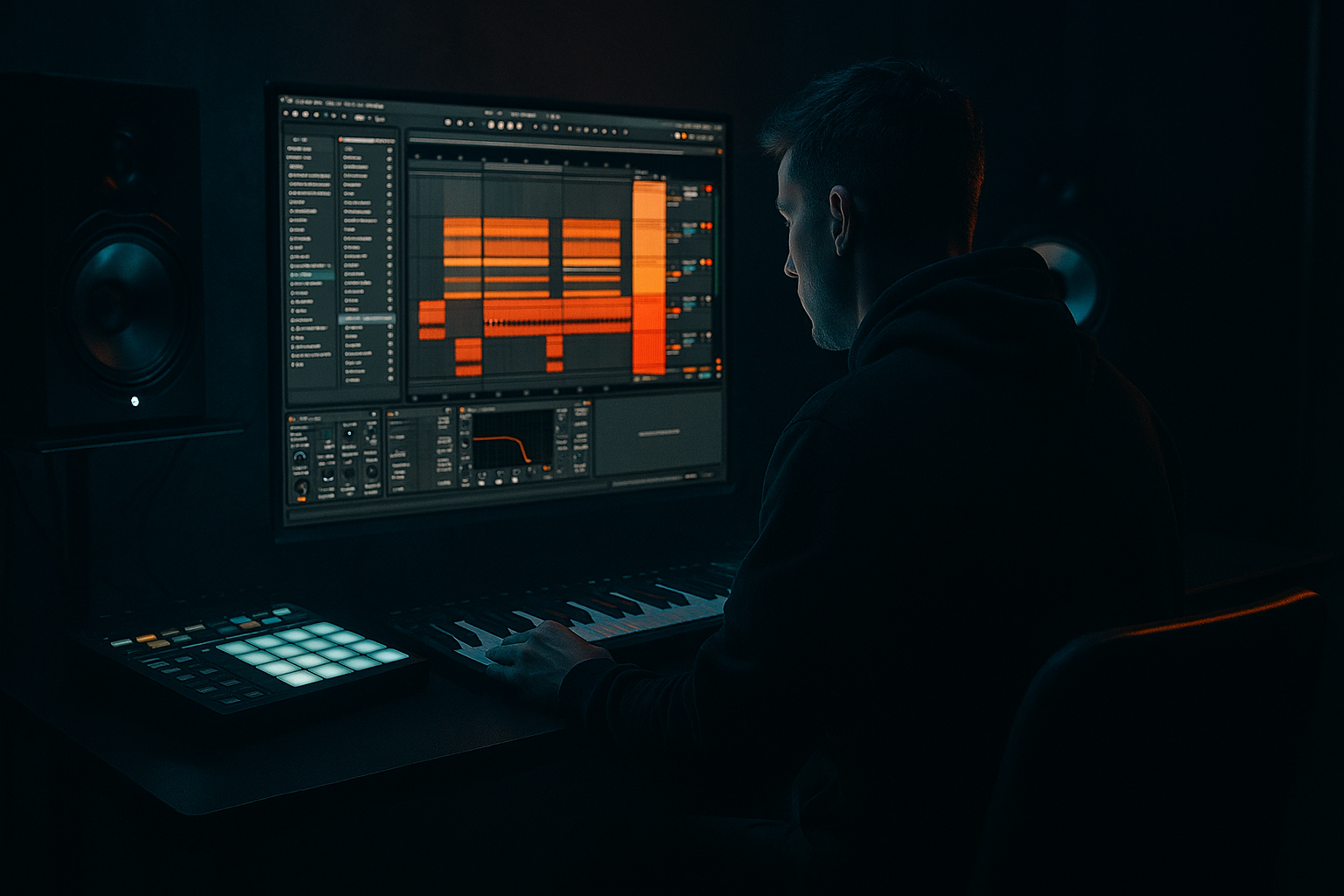
Main tutorial
```markdown
Triplet Gestures Inside Straight Jungle (Advanced Groove) 🥁⚡
1. Lesson overview
Triplets in jungle/DnB don’t mean “turn the whole track into swing.” The power move is injecting brief triplet gestures—tiny rhythmic flurries—inside a mostly straight 16th-grid break. Done right, you get that wicked lurch, roll, and tension without losing dancefloor drive.
In this lesson you’ll learn how to:
- Add micro-triplet fills to breaks (without wrecking the pocket)
- Use Ableton’s Groove Pool, Warp, and MIDI triplet grids surgically
- Create triplet motion in ghosts, hats, rides, bass stabs, and FX
- Keep the groove tight with phase-aware editing + transient control
- A straight, driving break (Amen-style or modern chopped break)
- Triplet “gesture” moments every 2–4 bars (snare drags, hat flurries, tom flicks)
- Optional: a triplet bass pickup into downbeats for extra propulsion
- A tight mix using stock Ableton devices (no fluff)
- Lead into a snare
- Create a drag after a snare
- Add a roll into a drop or turnaround
- Make hats “skitter” for a fraction of a bar
- Every 4 or 8 bars: micro fill into the next phrase
- Bar before a drop: increase frequency (but keep each one short)
- End of 16-bar section: bigger triplet drag + crash stop
- Bars 1–4: straight
- Bars 5–8: 1 triplet gesture on bar 8 beat 4
- Bars 9–12: 2 gestures (bar 10 beat 4 + bar 12 beat 4)
- Bars 13–16: one heavier drag + bass pickup into bar 17 (next section)
- Distort the gesture, not the whole drum mix:
- Gate-reverb on triplet snare drags (dark rinse-out):
- Resample your gesture layer:
- Stereo discipline:
- Tension automation:
- Triplet gestures work because they create momentary contrast inside a straight jungle grid.
- Best workflow: layer MIDI triplets for control, or slice/warp audio for authentic jungle character.
- Apply groove/swing only to the gesture clips, not the entire break.
- For heavier DnB: distort/shape the gesture layer, keep sub straight, and resample for grit.
---
2. What you will build
A 16-bar jungle/DnB loop at ~170–176 BPM featuring:
---
3. Step-by-step walkthrough
A) Set the foundation: straight jungle grid (no swing… yet)
1. Set tempo: `174 BPM`
2. Create a Drum Group called `BREAK CORE`.
3. Drop in a break sample (Amen, Think, or your own resample) onto an Audio Track:
- Enable Warp
- Warp Mode:
- Beats mode for crisp slicing
- `Preserve: Transients`
- `Envelope: 20–40%` (keeps it punchy without flamming)
4. Consolidate a 1-bar or 2-bar loop that feels tight.
5. Add Drum Buss on the break:
- Drive: `5–15%`
- Boom: `10–25%` (tune around `45–60 Hz` depending on your kick)
- Crunch: `5–10%` (optional)
6. Add EQ Eight after Drum Buss:
- HPF: `25–35 Hz`
- Small dip if needed: `200–350 Hz` (mud control)
- Light shelf: `8–12 kHz` if you need air
Goal: a straight, locked break that hits hard and loops perfectly.
---
B) Understand the core trick: “Triplet gestures” = brief rhythmic displacement
You’re not switching the entire grid to triplets. You’re creating momentary triplet clusters (often 1/8T or 1/16T) that:
Think: “one bar straight, 1 beat gets weird, then back to straight.” 😈
---
C) Method 1: MIDI triplet gestures layered over the break (clean + controllable)
This is the most mix-friendly approach.
1. Add a new MIDI Track with a Drum Rack called `TRIPLET TOPS`.
2. Load:
- Closed hat (tight, short)
- Rim/clave (clicky)
- Short snare ghost (quiet, snappy)
3. Grid setup (key move):
- In the MIDI Clip, right-click the grid → choose 1/16 (for normal writing)
- When you want triplets: set Fixed Grid → 1/16T temporarily
4. Program a straight hat pattern first:
- Closed hat on `1/8` or `1/16` depending on how busy your break already is.
- Velocity around `40–70` so you layer rather than override.
5. Add a triplet gesture (example: 1-beat hat burst):
- Pick beat 4 of the bar (classic turnaround spot).
- Place three evenly spaced hats inside the last half-beat using `1/16T`:
- Use 2–4 notes total, not 12. Keep it a gesture, not a solo.
- Velocity ramp: `45 → 55 → 70` (tiny crescendo sells momentum)
6. Glue it with Ableton stock:
- Saturator (Soft Clip on): Drive `2–6 dB`
- Auto Filter: HP around `200–500 Hz` to keep it out of the break body
- Optional Utility: Width `120–150%` for hats (watch mono compatibility)
Why this works: You keep the break straight while the layered tops create the triplet illusion.
---
D) Method 2: Audio slicing + micro-warping (authentic jungle chaos, still controlled)
For classic jungle energy, we’ll create triplet drags from the break itself.
1. Take your break audio and Slice to New MIDI Track:
- Right-click clip → Slice to New MIDI Track
- Slicing Preset: `Built-in` (or transient)
2. Now you have a Drum Rack where each slice is a MIDI note.
3. Find a slice that contains a snare tail, ghost, or hat tick.
4. Create a 1-bar MIDI clip and program:
- Straight break triggering normally
- Then add a triplet drag before the main snare:
- Put 2–3 repeated hits of that snare/ghost slice at 1/16T
- Keep velocities lower than the main snare (e.g., `20–45`)
5. Tighten timing:
- Nudge the whole triplet cluster slightly earlier by `-5 to -12 ms` if it feels late.
- Or use Track Delay on the slice track: `-5 ms` (subtle but huge)
6. Control harshness:
- On the slice chain: EQ Eight dip `3–6 kHz` if it gets brittle
- Transient shaping (stock): use Drum Buss
- Transients: `+5 to +20` for more bite
- If too clicky, pull Transients back and add Saturator instead
Jungle rule: the more you reuse break material, the more it glues.
---
E) Method 3: Groove Pool—only on the gesture, not the whole drum buss
Groove Pool is great, but advanced use = surgical application.
1. Create a clip that contains only your triplet gesture (tops or slices).
2. In Groove Pool, try:
- `MPC 16 Swing 57` or similar (for micro push/pull)
- Or a shuffle groove that emphasizes offbeats
3. Apply with restraint:
- Timing: `10–25%`
- Velocity: `0–15%`
- Random: `0–10%`
Important: Don’t groove your entire break unless you want a full swing feel. We’re doing contrast.
---
F) Bass triplet pickups (rolling DnB weapon) 🎛️
Triplets aren’t only for drums. A tiny bass pickup into the downbeat is deadly.
1. Make a bass track (Operator or Wavetable).
2. Create a 2-bar phrase:
- Bar 1: normal straight rhythm
- End of Bar 2: add a 1/8T pickup (two quick notes leading into 1)
3. Sound design (stock chain):
- Wavetable/Operator → Saturator (Drive `3–8 dB`) → EQ Eight (HP at `25–30 Hz`) → Compressor (light control)
- Optional: Auto Filter with envelope for bite
4. Keep sub clean:
- Duplicate bass into SUB and MID layers
- SUB stays straight (no triplets)
- MID layer does the pickup (HP at `120–180 Hz`)
This keeps the dancefloor weight stable while the mids do the rhythmic flex.
---
G) Arrangement placements (where gestures work best)
Use triplet gestures like punctuation:
Try this 16-bar plan:
---
4. Common mistakes
1. Overusing triplets
If every bar has triplets, your “gesture” becomes the new grid and the track loses contrast.
2. Triplets too loud
Gestures should suggest motion, not replace the main snare/kick narrative.
3. Ignoring transient alignment
Triplet slices can flam with the break. Use small nudges, Track Delay, or adjust warp markers.
4. Swinging the entire break
That changes the genre feel fast. Jungle wants that straight “machine gun” momentum with selective wonk.
5. Letting triplet hats fight vocals/leads
If the mix feels spitty: HP the gesture layer, de-ess with Multiband Dynamics gently, or tame 8–12k.
---
5. Pro tips for darker/heavier DnB 🖤
Put Saturator or Overdrive only on the triplet layer so it bites through without destroying the break.
Triplet snare ghost → Reverb (short 0.4–0.8s) → Gate (fast release) for that metallic snap.
Freeze/Flatten or Resample to audio, then chop that audio for even more authentic jungle phrasing.
Triplet tops can be wide, but keep the main snare/kick centered.
Use Utility: Bass Mono `120 Hz`.
Automate Auto Filter on the triplet layer (HP rising into the fill, then snap back) for “pull then punch.”
---
6. Mini practice exercise (15–20 minutes) 🎯
1. Load a 2-bar Amen-style loop and get it perfectly warped at `174 BPM`.
2. Create a `TRIPLET TOPS` Drum Rack with a tight hat + rim.
3. Write:
- Straight hats for 2 bars
- Add exactly one triplet gesture on bar 2, beat 4
4. Duplicate to 8 bars:
- Add a second gesture on bar 8, beat 4 (slightly different sound/velocity)
5. Add a mid-bass layer with a 1/8T pickup into bar 9.
6. Bounce/resample the whole drum bus for 8 bars and listen:
- Does it still feel straight and driving?
- Do the triplets feel like “flicks” rather than a new time signature?
---
7. Recap
If you want, tell me what break you’re using (Amen/Think/or modern pack) and whether you prefer clean neuro-tight or raw jungle-chop, and I’ll suggest a specific 8-bar pattern with exact hit placements.
```

