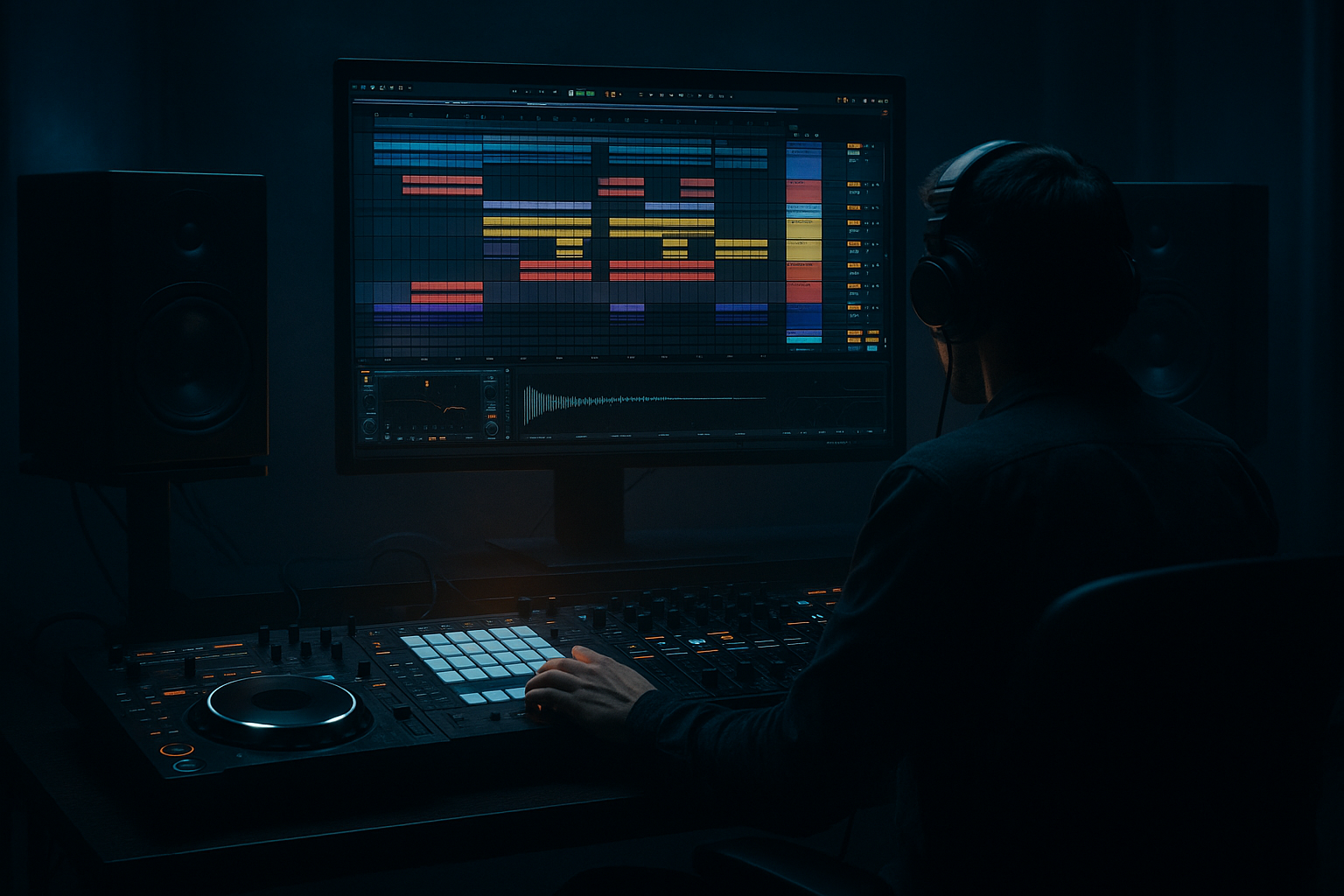
Main tutorial
Lesson Overview
This lesson is about tuning a darkside intro so it actually feels like it belongs in a jungle / oldskool DnB record inside Ableton Live 12. The goal is not “make it scary” in a vague sense — it’s to build an intro that creates tonal tension, locks to the tune’s root, and sets up the drop with the right amount of menace without muddying the drums or confusing the low end.
In a real DnB track, this lives in the intro and pre-drop section: the first 8, 16, or 32 bars before the full rhythm section lands, plus any cold-start atmosphere, filtered bass hint, or chopped break teaser that carries the first minutes of the tune. For jungle and oldskool-flavoured DnB, tuning matters because the intro often contains pitched pads, reese drones, sampled hits, rewinds, sirens, toms, or ghost bass notes that need to sound intentionally “in key” even when they’re rough and raw.
Musically, good tuning gives the intro a center of gravity. Technically, it keeps layered elements from fighting each other, reduces low-mid smear, and makes your drop feel bigger because the ear already understands where “home” is. By the end, you should be able to build a dark intro that sounds like a coherent scene rather than random creepy textures — something tense, DJ-friendly, and properly aligned with the tune’s bass note.
What You Will Build
You will build a darkside intro that feels like oldskool jungle pressure meeting modern DnB control: filtered breaks, a pitched atmosphere, a tuned sub hint, and a tense tonal motif that resolves into the drop key. The character should be grimy, haunted, and rhythmic rather than cinematic or washed out.
The feel should be half-dubwise, half-ravey: enough swing and pulse to sit with breaks, but enough tonal discipline that the intro doesn’t collapse into noise. The role of the section is to establish mood, hint at the bass identity, and make the drop feel like a payoff instead of a hard reset.
By “finished,” this should sound mix-ready in context: the intro sits behind the drums, the tonal layer is clearly tuned but not overpowering, the sub information is controlled, and the whole thing can survive a mono club system. A successful result should feel like the track is pulling the listener toward the drop with purpose, not just filling time.
Step-by-Step Walkthrough
1. Start by defining the tune’s home note before you design the intro
In Ableton, begin with the bass note of the track’s drop. If your tune is built around F minor, F# minor, or G minor, commit that root early. Put a simple MIDI note on a track with a plain sine or a stock Operator patch and hold the root for one or two bars. This becomes your tuning reference.
Why this matters: in darkside DnB, the intro often uses tension against the root, but it still needs a gravitational center. If you don’t define that center first, your atmosphere, risers, and low-end hints will drift into random pitch territory and the drop will feel disconnected.
What to listen for: the note should feel like “the floor” of the tune. If the intro elements feel dramatic but the drop suddenly sounds like a different record, the root is probably wrong or not established early enough.
Quick workflow tip: keep a utility reference rack or a simple MIDI clip labeled with your track root so every intro layer can be checked against it fast.
2. Build a tonal bed using a narrow, controlled source
Create a new MIDI track with Operator or Wavetable and design a simple dark drone. For an oldskool vibe, keep it very basic: one or two oscillators, a low-pass filter, and a slow amplitude envelope. Try a held note with:
- Filter cutoff around 300 Hz to 1.5 kHz depending on brightness
- Resonance kept moderate, not ringy
- Attack around 10–40 ms
- Decay or release around 1.5–4 seconds for a sustained intro feel
If you want a harsher jungle edge, use a slightly detuned second oscillator or a subtle saw layer, but keep the layer filtered so it doesn’t fight the break. If you want a colder, more modern darkside feel, stay closer to a sine-based or band-limited source and add texture later with saturation.
Why this works in DnB: jungle intros often succeed because they imply harmony without filling the entire spectrum. A narrow tonal bed lets drums and break edits stay readable while still creating dread.
What to listen for: the tone should sit behind the kick/snare impact, not blur them. If the snare loses its snap or the break starts sounding cloudy, the bed is too wide or too loud.
3. Tune the atmosphere against the root, not just “by vibe”
Add an Audio Effect Rack or a simple chain with EQ Eight and Frequency Shifter if you need the atmosphere to lock. Use a sampled vinyl wash, field recording, or noise texture and pitch it until it supports the root. If the texture has a tonal center, align it to the track key or place it a minor 3rd or 5th above the root for tension.
Two valid options here:
- Option A: root-centered atmosphere. Use the same note as the track root for a grounded, oppressive intro.
- Option B: tension-centered atmosphere. Tune the atmosphere a minor 2nd or tritone away from the root for a more unstable, haunted opening that resolves only when the drop lands.
Choose A if the track is more deep, rolling, or DJ-functional. Choose B if you want a more aggressive darkside or neuro-adjacent intro.
Practical range: if the atmosphere is overly tonal, cut some low end below 150–250 Hz with EQ Eight and tame harshness around 2.5–5 kHz. If it’s too dead, add a little high-shelf shimmer or a touch of Saturator with Drive around 1–4 dB.
4. Lock the break to the tonal content with careful filtering
Bring in a classic break or chopped jungle loop. Use Warp only as much as needed to keep it aligned; don’t destroy the groove. Then place EQ Eight and Auto Filter on the break bus. High-pass only if the break is clouding the intro bass, usually somewhere in the 30–70 Hz range depending on how much sub is present. For the top end, shape the break with a gentle low-pass or band-pass sweep during the intro.
If you are editing oldskool breaks, make sure the chopped hits still retain their tuning relationship. Many break samples carry a tonal ring in the snare or tom region. That’s useful if it reinforces the root, but it becomes messy if it clashes. If a tom hit or snare tail feels off, transpose the sample section or use simpler pitch correction via Transpose in the clip, then audition it against the root note.
Why this matters: oldskool jungle is full of pitched percussion energy. Tuning the break isn’t about making it melodic — it’s about preventing tonal conflict between the sampled drums and your intro bass bed.
Stop here if the break suddenly feels smaller after filtering. You may have over-thinned it. Bring some 200–500 Hz back, or automate the filter less aggressively so the break keeps body.
5. Shape a dark reese hint that implies the drop without giving it away
Add a reese layer or a detuned bass texture, but keep it restrained. In Ableton, Wavetable is fine for this if you keep the patch simple: two oscillators, slight detune, low-pass filter, and some controlled saturation. Print the idea into audio if you want the intro to feel more committed and less “preset-like.”
Suggested starting point:
- Detune: subtle, not chorus-level wide
- Filter cutoff: often in the 120 Hz to 800 Hz zone for intro hints
- Saturator Drive: around 2–6 dB depending on how much grit you want
- Compression: light, just to stabilize movement if the layer is too spiky
Keep the sub either absent or very focused. The reese should hint at the drop note, not occupy the full low end. If it goes too wide, mono systems will smear it and the intro will lose authority.
What to listen for: in stereo, the reese should feel like movement; in mono, it should still feel like one solid note. If the center collapses or the note seems to vanish in mono, reduce stereo width, simplify detune, or keep the reese above the sub range.
6. Decide how the intro breathes: A versus B phrasing choice
At this stage, choose between two valid intro behaviors:
- A: sustained dread. Hold long tones, slow automation, and let the tension build over 16 or 32 bars. This suits deeper jungle, rollers, and tracks meant for mixing.
- B: call-and-response pressure. Alternate short tonal hits, reverse stabs, and chopped break punctuation every 2 or 4 bars. This suits more aggressive oldskool or rave-leaning DnB intros.
For A, automate filter cutoff slowly over 8–16 bars, with maybe a 10–20% volume rise before the break enters fully. For B, use clip envelopes or MIDI note placement to create negative space between hits so the drums can breathe.
Why this matters: DnB intros have to earn the drop. Sustained dread creates hypnosis; call-and-response creates anticipation. Pick one primary function instead of mixing both blindly.
Check it in context with drums: solo decisions lie. Bring the intro back against the break and the first bass hint. If the tonal layer makes the groove feel slower, it’s too dense; if it makes the intro feel empty, the call-and-response is too sparse.
7. Tune the FX to the key of the tune, not just the transition moment
Any siren, riser, reverse hit, or impact in the intro should support the key center. If you use a riser, keep it short and mean. A 1–2 bar rise is usually enough in DnB; overly long EDM-style ramps often kill the tension. Use Auto Filter, Frequency Shifter, or simple pitch automation on a rendered audio hit to bring it into the harmonic zone.
For a dark oldskool flavour, try a reverse texture that resolves into the root note on the downbeat of bar 9 or bar 17. For a cleaner modern flavour, use a filtered noise lift with a low-pass opening from around 500 Hz up toward 8–12 kHz while the drums stay controlled.
Arrangement example: 16-bar intro — bars 1–4 sparse atmosphere, bars 5–8 break and tonal hint, bars 9–12 bass hint and automation rise, bars 13–16 a short fill or rewind-style punctuation into the drop.
This is where the intro becomes DJ-functional: the energy steps are predictable enough to mix, but the tonal movement keeps it alive.
8. Use EQ and gain staging to keep the darkside weight from swallowing the mix
Put EQ Eight on the intro group and shape roles, not just frequencies. If the sub hint is essential, keep it narrow and leave space for the kick drum’s impact. If the break carries the momentum, let the intro bass stay more mid-focused and avoid overfeeding the 40–80 Hz region.
Practical ideas:
- Cut unnecessary mud around 200–400 Hz on atmosphere layers
- Control harshness around 2–4 kHz if the sample gets metallic
- Keep the intro group peaking comfortably below 0 dBFS with headroom for the drop
- Use Utility to check mono and possibly reduce width on layers that don’t need stereo spread
Why this works in DnB: the intro has to sound big without stealing headroom from the drop. If the intro is already maxed out, the drop has nowhere to go.
What to listen for: the kick and snare should still read clearly even when the dark tonal layer is active. If the kick feels like it’s hitting a pillow, pull down the atmosphere or carve its low mids more aggressively.
9. Commit the useful chaos to audio and edit the phrasing
Once the tonal bed, reese hint, and FX movement are working, stop tweaking them endlessly. Freeze or resample the best 4–8 bars to audio and make edits directly in Arrangement View. This is often the difference between a loop and an intro.
Use audio editing to:
- reverse the last hit before a drop
- chop a tail so the downbeat lands harder
- duplicate a ghost note or rewind in bar 15/31
- nudge a hit a few milliseconds early or late for tension
Commit this to audio if the movement is now musical rather than synthetic. Audio lets you shape the intro like a record, not like a synth demo.
Fix-it moment: if the intro sounds technically correct but emotionally flat, print the best parts and perform the phrasing. Small cut edits and reverses often create more jungle character than extra modulation ever will.
10. Test the intro against the drop and adjust the emotional handoff
Play the intro immediately into the drop. The drop should feel like the tonal pressure releases into rhythm and weight. If the drop feels underwhelming, the intro may be too harmonically resolved already. If the drop feels chaotic, the intro likely left too many unresolved elements in the same frequency space.
A successful result should sound like the listener is being guided into the drop by tension that is pitched, rhythmic, and disciplined — not just noisy. The moment before the drop should make the first snare or bass hit feel larger than itself.
Final check: listen on mono, then on headphones, then against a reference jungle/DnB intro. If your intro still reads as dark, tuned, and punchy in all three, you’ve got it.
Common Mistakes
1. Making every intro layer too tonal
Why it hurts: the intro turns into a muddy chord cloud and the drums lose edge.
Fix in Ableton: use EQ Eight to strip low mids from atmosphere layers, and keep only one or two elements carrying clear pitch.
2. Letting the reese bass dominate the intro sub range
Why it hurts: mono compatibility collapses and the drop loses impact.
Fix in Ableton: keep the intro reese filtered above the sub zone, narrow its stereo width with Utility, or render it to audio and high-pass the non-sub portion.
3. Tuning FX by ear only without checking against the root
Why it hurts: risers and reverse hits may feel exciting alone but clash in context.
Fix in Ableton: hold the root note on a simple reference track and compare the FX pitch against it before committing automation.
4. Over-warping oldskool breaks until they lose their swing
Why it hurts: the jungle feel disappears and the intro becomes stiff.
Fix in Ableton: use the least Warp correction necessary and preserve the break’s natural micro-timing; if needed, edit around the break instead of forcing it.
5. Building too much low-end energy before the drop
Why it hurts: the drop has nowhere to grow, and the intro becomes heavy but not tense.
Fix in Ableton: reduce sustained sub hints, keep the intro bass mid-focused, and reserve the true low-end weight for the drop.
6. Using long, cinematic risers that feel like another genre
Why it hurts: the intro loses DJ usability and the tension becomes generic.
Fix in Ableton: shorten the rise, automate it more subtly, and use a tighter 1–2 bar motion rather than a giant build.
7. Forgetting the intro needs to work with drums, not just sound cool solo
Why it hurts: a dark texture that sounds massive alone can mask snare transients and ghost notes.
Fix in Ableton: audition every new layer with the break and a bass hint active; if the groove loses definition, thin the layer immediately.
Pro Tips for Darker / Heavier DnB
- Use pitch contrast instead of constant density. A single note held against a filtered break can feel heavier than a stack of noisy layers if that note is tuned perfectly and allowed space.
- For menace, move the intro tension in semitone steps or short pitch dips rather than broad sweeps. Small, intentional moves feel more sinister and less generic.
- If the intro feels too clean, add grit with Saturator before EQ, not after. A touch of drive in the 2–5 dB range can create upper harmonic bite that helps the sound survive club playback.
- Keep the stereo image intentionally uneven: atmosphere wide, bass center, key percussion mostly center or just slightly spread. That separation makes the intro feel bigger without smearing the low end.
- Oldskool jungle energy often comes from edited audio more than from sound design. Reverse one hit, mute the next, then let the break answer the phrase — that tiny arrangement move can make the tune feel authentic fast.
- If you want the intro to feel underground rather than polished, avoid over-smoothing transients. Let the break crack a bit, but manage the low mids so it still translates.
- A very effective darkside trick is to let a tuned noise or vinyl texture land on the 3rd or 7th degree of the scale, then resolve it only when the drop starts. It creates psychological pull without needing a huge melodic phrase.
- Don’t widen everything. In DnB, width is a luxury you spend after the center is solid.
- Use only stock Ableton devices.
- Use one break, one tonal bed, one bass hint, and one FX layer maximum.
- Keep the bass hint below a restrained level so the break still leads.
- Make at least one element resolve to the root note at bar 15 or 16.
- A 16-bar intro loop or arrangement sketch that can lead into a drop.
- Render or keep a quick audio bounce of the best 8 bars if you find a strong phrase.
- Does the intro sound clearly in the same key as the drop?
- Can you still hear the break’s swing and snare crack?
- Does the final bar feel like it is pulling into the drop rather than just ending?
Mini Practice Exercise
Goal: build a 16-bar dark intro that clearly tunes to your drop key and transitions into the first bass section cleanly.
Time box: 15 minutes.
Constraints:
Deliverable:
Quick self-check:
Recap
Tune the intro to the track root first. Keep the tonal layers narrow, disciplined, and context-aware. Let the break lead the groove, let the bass hint the identity, and use FX as punctuation rather than decoration. In darkside jungle and oldskool DnB, the best intros feel like controlled pressure: tuned, rude, and ready to pay off.

