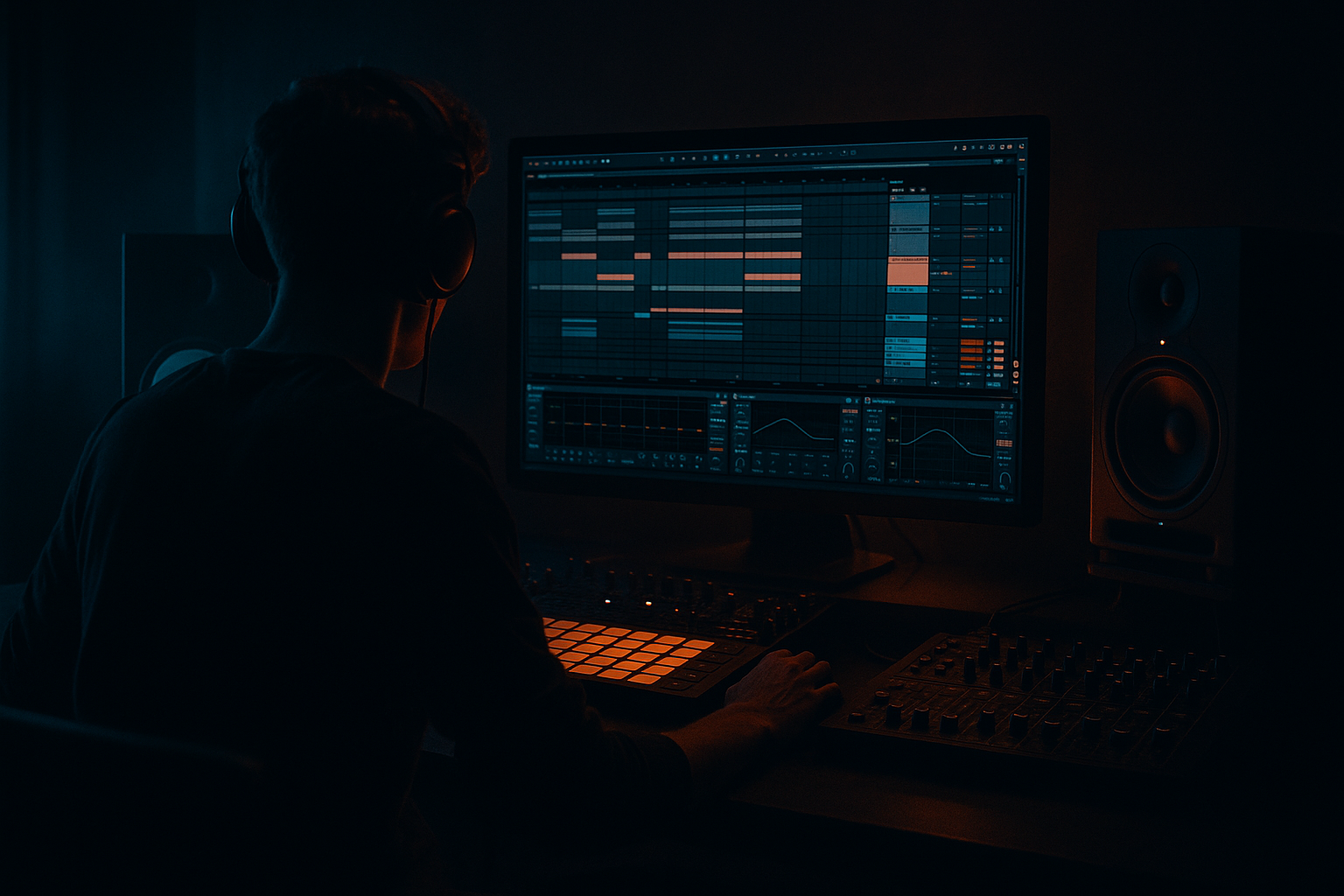
Main tutorial
Tutorial: Minimal-CPU Mid Bass in Ableton Live 12 for Jungle / Oldskool DnB 🎛️🥁
1. Lesson overview
In this lesson, you’ll build a mid bass patch that sounds at home in jungle, oldskool drum and bass, and rolling DnB, while staying light on CPU in Ableton Live 12.
The goal is not a giant modern “super bass” chain with 12 heavy plugins. Instead, we’ll create a focused, punchy, characterful mid bass using mostly stock Ableton devices and efficient sound design choices.
You’ll learn how to make a bass that:
- cuts through breakbeats and drum layers
- has movement and attitude without eating CPU
- works as a reese-adjacent mid bass, a growl layer, or a call-and-response bass phrase
- leaves room for kick, snare, and sub
- Oscillator-based source using a stock synth
- Subtle detune / motion
- Filter movement
- Warm saturation
- Stereo width only where it matters
- Low CPU usage
- Optional macro controls for performance and arrangement
- 8-bar jungle bass riffs
- 2-step oldskool DnB patterns
- rolling 170 BPM phrases
- dark tension sections before the drop
- rough enough to feel gritty
- controlled enough to avoid low-end mess
- simple enough to duplicate and vary across a track
- 2 oscillators is plenty for this style
- very efficient
- great for layering a sub-safe mid bass source
- Osc A: Saw or Sine-Saw-ish harmonic source
- Osc B: Sine or Triangle, detuned slightly, or FM lightly into Osc A
- Filter: low-pass with moderate resonance
- Osc A level: 0 dB
- Osc B level: -12 to -18 dB
- Osc B tuning: +7 to +12 cents or a semitone offset if you want a more unstable edge
- Glide: 40–120 ms for sliding notes
- Voices: 1 for mono bass
- Filter cutoff: around 150–400 Hz to start
- Filter resonance: 10–25%
- Envelope amount: medium
- Oscillator 1: saw-based wavetable
- Oscillator 2: sine or triangle, very low level
- Unison: off or 1–2 voices max
- Warp mode: FM, Sync, or Bend very lightly
- Unison can get CPU-heavy fast, and it can muddy the groove.
- For jungle DnB, a tighter source often hits harder.
- Attack: 0–5 ms
- Decay: 120–300 ms
- Sustain: 60–90%
- Release: 40–120 ms
- lower sustain
- shorten decay
- keep release short so notes don’t blur into the next hit
- slightly longer sustain
- medium glide
- more even note lengths
- Type: Low-pass 12 or 24 dB
- Frequency: 200–800 Hz, depending on the note range
- Resonance: 5–20%
- Drive: small amount if needed
- Filter Envelope inside the synth
- or an LFO/Macro to sweep the cutoff during phrases
- a bass phrase that breathes
- tension before a snare roll or fill
- movement on the offbeats
- Saturator
- Roar if you want more aggressive character, but keep it light
- Drum Buss very carefully for extra punch and harmonics
- Drive: +2 to +6 dB
- Soft Clip: ON
- Output: compensate to match level
- more midrange presence
- a denser sound in the 200 Hz–2 kHz zone
- a bass that speaks on smaller speakers
- Drive: low to medium
- Crunch: subtle
- Boom: usually OFF for a mid bass
- Transients: adjust only if needed
- high-pass gently around 80–150 Hz depending on the arrangement
- cut muddy spots around 200–400 Hz if needed
- tame harshness around 2.5–5 kHz if the bass becomes too rasping
- Band 1: High-pass at 90–120 Hz, 24 dB/oct if necessary
- Band 2: slight dip at 250–350 Hz if boxy
- Band 4 or 5: small cut at 3–4.5 kHz if aggressive resonance appears
- Don’t high-pass so much that the bass loses weight.
- The exact cutoff depends on whether the patch is purely mid bass or carries some low-mid body.
- LFO in Wavetable/Auto Filter if available
- Max for Live LFO if you already use it
- Envelope Follower on a macro for expression
- Automation clips for cutoff or drive
- filter cutoff
- wavetable position
- distortion drive
- chorus amount only if used lightly
- subtle to medium
- avoid constant extreme sweeps unless it’s a special effect
- duplicate the chain into an Instrument Rack
- keep one chain mono and central
- add width only to a high-passed layer
- Chorus-Ensemble
- Utility for width control
- EQ Eight to remove low frequencies from the wide layer
- Macro 1: Cutoff
- Macro 2: Resonance
- Macro 3: Drive
- Macro 4: Glide
- Macro 5: Width of top layer
- Macro 6: Filter envelope amount
- Macro 7: Output level
- Macro 8: Character / Mod depth
- You’ll get variation without loading extra instruments
- You can duplicate the bass MIDI and tweak macros per section
- You keep the session organized and lightweight
- offbeat stabs
- syncopated call-and-response
- short note phrases between snare hits
- slides into root notes
- ghost-note pickup notes
- note on beat 1
- short answer on the “and” of 2
- slide into beat 3
- stuttered tail before the snare
- keep phrases rhythmic and a little sparse
- let the drums breathe
- use note length variation more than heavy automation
- Use one synth and duplicate the MIDI clip if you need variation
- Avoid stacking multiple unison-heavy instruments
- Use render/freeze once the sound is working
- Prefer one filter + one saturator + one EQ over huge chains
- Keep modulation simple and intentional
- Don’t use unnecessarily oversampled effects unless you really need them
- duplicate the bass track
- make a parallel dirt layer
- high-pass it
- keep the main bass clean
- keep sub and core low mids mono
- widen only a high-passed layer
- use less drive
- use EQ after distortion
- compare bypassed vs processed at matched volume
- keep it simple
- one or two oscillators is enough
- avoid thick unison unless it’s truly needed
- high-pass appropriately
- carve the kick/snare zone
- arrange bass notes around the drum accents
- shorten notes for tightness
- let some notes overlap for glide
- use rests to create bounce
- small pitch drift
- very mild FM
- tiny cutoff modulation
- subtle drive variation via macro
- slide into the root note before the snare
- slide down a semitone for tension
- use short portamento on accented notes only
- A phrase: lower, restrained
- B phrase: brighter, slightly more distorted
- high-pass it around 180–300 Hz
- distort it more heavily
- compress lightly if needed
- blend low in the mix
- leave gaps for snare rolls
- answer the kick pattern
- avoid constant bass notes that flatten the groove
- Rack A: cleaner, rounder oldskool bass
- Rack B: darker, dirtier version with more saturation
- Start with a simple synth source
- Use mono for the core bass
- Add filter movement instead of overprocessing
- Use saturation and EQ for character and control
- Keep width subtle and mostly in higher layers
- Write basslines that interact with the drums
- Map a few macros for fast arrangement changes
- a specific Ableton device chain preset recipe
- a jungle reese bass version
- or a step-by-step oldskool DnB bassline MIDI pattern tutorial
This is especially useful if you want that dark, rolling, slightly ragged jungle energy without overprocessing the patch.
---
2. What you will build
You’ll build a single Ableton Instrument Rack that creates a mid bass with:
The final sound will work well for:
We’ll aim for a sound that sits in the range of:
---
3. Step-by-step walkthrough
Step 1: Start with a clean MIDI track
1. Create a new MIDI track.
2. Load Wavetable, Operator, or Analog.
- For lowest CPU, start with Operator.
- For a slightly more animated character, Wavetable is still very manageable if kept simple.
3. Set the instrument to mono if your patch doesn’t need chords.
4. Turn glide/portamento on if you want sliding jungle-style bass phrases.
Recommended starting choice: Operator
---
Step 2: Create the core tone
We want a bass that has harmonic content but doesn’t rely on heavy processing.
#### Option A: Operator setup
Use:
Suggested starting settings:
#### Option B: Wavetable setup
Use:
Keep it restrained:
---
Step 3: Shape the amplitude
Set the Amp Envelope to stay punchy and controlled.
A good starting point:
If you want a more plucky oldskool bass stab:
If you want a rolling bassline:
---
Step 4: Add movement with filter automation, not huge processing
A classic mistake is to over-stack modulation devices. Instead, use one main filter and automate it.
Add Auto Filter after the synth if you want a separate filter stage.
Suggested Auto Filter settings:
Then use:
For oldskool jungle vibes, that slightly opening and closing filter is gold ✨
Use automation sparingly to create:
---
Step 5: Add dirt with efficient saturation
Instead of complex distortion chains, use one or two simple stock devices.
Good choices:
#### Simple Saturator setup
Place Saturator after the synth or filter.
Try:
This gives:
#### If using Drum Buss
Use very lightly:
For a mid bass, you’re usually after harmonic density, not huge low-end enhancement.
---
Step 6: Control the low end so the mid bass stays clean
A DnB mid bass should not compete with the sub or kick.
Use EQ Eight:
Typical EQ moves:
Important:
---
Step 7: Add movement with light modulation
For jungle and oldskool DnB, motion matters. But keep it efficient.
Use one of these:
Best targets for motion:
Recommended modulation depth:
A good move is to map Macro 1 to cutoff and Macro 2 to drive so you can perform the bass line like an instrument.
---
Step 8: Add a tiny stereo layer if needed — but keep the core mono
Oldskool DnB bass should usually stay mostly mono in the low end.
If you want width:
Example:
1. Chain 1: Core bass
- mono
- no widening
- full body
2. Chain 2: Character layer
- high-pass at 200–300 Hz
- light chorus or tiny ensemble
- low mix level
Useful stock devices:
Keep width subtle. Too much stereo on mid bass can make the groove feel weak in a club system.
---
Step 9: Build an efficient Ableton Instrument Rack
Now wrap your sound into an Instrument Rack.
Suggested macro mapping:
This makes the bass playable and easy to automate during arrangement.
Why this matters:
---
Step 10: Write a jungle-friendly MIDI pattern
A good mid bass patch means nothing without a rhythmic phrase that fits DnB.
Try these patterns:
Example groove idea at 170 BPM:
For jungle / oldskool vibes:
A bassline that locks with a chopped break will often feel more “DnB” than a heavily modulated sound that ignores the drums.
---
Step 11: Save CPU with smart workflow choices
Here’s how to keep the patch efficient in real sessions:
If you need more aggression:
That approach often sounds bigger and uses less CPU than one giant all-in-one monster chain.
---
4. Common mistakes
1. Making the bass too wide
If the low-mids are stereo, the bass can lose punch and cause phase issues.
Fix:
2. Overdoing distortion
Too much saturation can turn the bass into harsh noise.
Fix:
3. Using too many oscillators and unison voices
This burns CPU fast and can clutter the mix.
Fix:
4. Letting the bass fight the kick and snare
DnB bass should support the break, not mask it.
Fix:
5. Ignoring note length
In jungle, note timing is huge.
Fix:
---
5. Pro tips for darker/heavier DnB 🔥
Tip 1: Add controlled instability
A dark bass often sounds better when it’s slightly unstable.
Try:
This creates life without turning the patch into a chaotic mess.
Tip 2: Use note slides into accented beats
Slides are a classic DnB language tool.
Try:
Tip 3: Build a call-and-response arrangement
Instead of one repeating bass loop, make two variations:
Alternate them every 4 or 8 bars.
This keeps oldskool jungle arrangements moving without piling on extra layers.
Tip 4: Parallel dirt for weight
Make a duplicate bass chain:
This gives bite without sacrificing the main tone.
Tip 5: Let the break dictate the bass
In jungle, the drums are the engine.
Use the break as your guide:
A bass that converses with the break will feel much more authentic.
---
6. Mini practice exercise
Exercise: Build a 4-bar rolling jungle mid bass
1. Create a mono Operator bass.
2. Use:
- one saw source
- a second quieter harmonic source
- low-pass filter
- medium glide
3. Add:
- Saturator with soft clip
- EQ Eight with high-pass around 100 Hz
4. Write a 4-bar MIDI loop at 170 BPM:
- bar 1: root note + short response note
- bar 2: slide into a lower note
- bar 3: repeat bar 1 with one note changed
- bar 4: leave space for a snare fill or break variation
5. Automate cutoff slightly over the 4 bars.
6. Duplicate the clip and make one version darker, one version brighter.
Challenge version
Create two racks:
Then alternate them every 8 bars in your arrangement.
---
7. Recap
You’ve now got a practical, CPU-friendly method for making a mid bass in Ableton Live 12 that suits jungle and oldskool DnB.
Key takeaways:
If you keep the sound design lean and the rhythm strong, you’ll get a bass that feels heavy, musical, and very DnB without maxing out your CPU. 🎚️
If you want, I can also turn this into:

