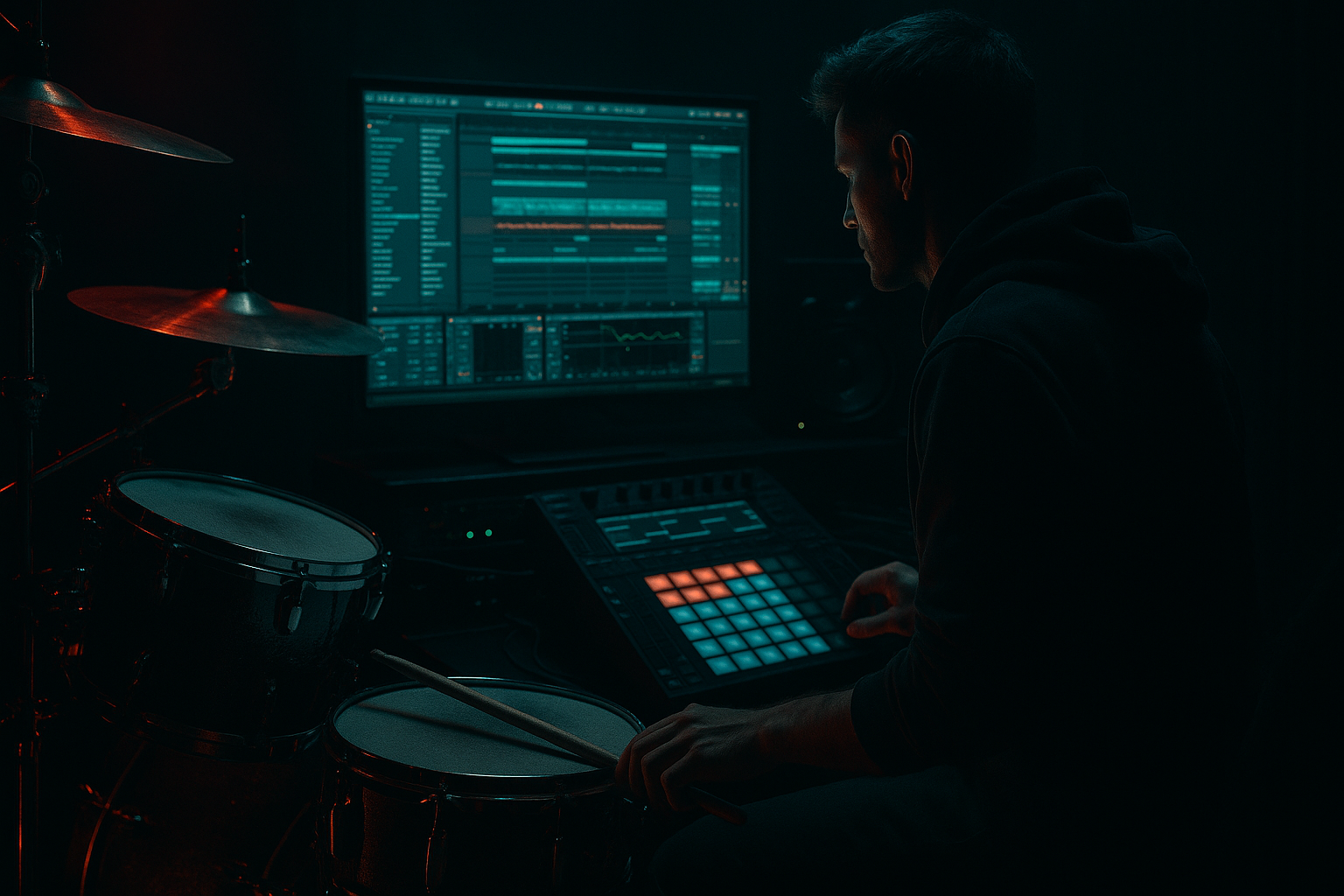
Main tutorial
Urban Echo: Ableton Live 12 Drum Bus Playbook (Resampling for Jungle/Oldskool DnB) 🥁🌆
1. Lesson overview
This lesson is a drum-bus sound design playbook for jungle / oldskool DnB using resampling workflows in Ableton Live 12. We’re going to create that urban echo vibe: snappy breaks, gritty transients, crunchy room tone, dubby tails, and “printed” drum bus character—without losing the roll.
You’ll work like classic jungle producers did: print → cut → reprint, but with modern Ableton speed.
Skill target (intermediate): you already know Drum Racks, audio slicing, and basic routing. Now you’ll level up with multi-stage resampling, parallel chains, and arrangement-ready drum prints.
---
2. What you will build
You’ll end up with:
- A Drum Bus Group with:
- A resampling loop workflow to print:
- A set of arrangement tools:
- For breaks: try Beats warp mode, Transient Loop, Preserve 1/16.
- If the break already sits well, you can even disable warp and just align manually.
- HP filter: 30 Hz, 24 dB/oct (keep sub out of the breaks)
- Optional dip: 250–400 Hz by -2 to -4 dB (reduces cardboard)
- Optional presence: 3–6 kHz +1 to +2 dB (if break needs speak)
- Drive: 6–12%
- Crunch: 0–10% (we’ll do heavier crunch in parallel later)
- Boom: 0–15% (careful—can smear fast breaks)
- Damp: 10–30%
- Trim: adjust so the group peaks around -6 dB (leave headroom)
- Attack: 3 ms (lets transients pop)
- Release: Auto or 0.3 s
- Ratio: 2:1
- Threshold: aim for 1–3 dB gain reduction on peaks
- Makeup: off (gain stage manually)
- Mode: Soft Sine or Analog Clip
- Drive: 1–4 dB
- Turn Soft Clip on
- Output: match level (don’t get fooled by loudness)
- Keep it mostly as-is (the core chain you built above)
- Start at -12 dB and bring up until the break feels “closer” and more aggressive.
- Time: 1/8 dotted or 1/4 (classic jungle space)
- Feedback: 25–45%
- Filter: HP around 250 Hz, LP around 6–9 kHz
- Mod: subtle (2–6) for movement
- Stereo: 80–120% (don’t go too wide if your drums need center)
- Type: Room or Plate
- Decay: 0.8–1.6 s
- Pre-delay: 10–25 ms
- Low Cut: 250–400 Hz
- High Cut: 7–10 kHz
- Wet: keep it subtle (this is a send effect anyway)
- Soft Clip on
- Drive: 2–6 dB
- Set Threshold so the tail closes quickly after hits
- Release: 80–180 ms (tempo-dependent)
- If you want it to pump rhythmically, try sidechaining the Gate to the snare track (optional but 🔥)
- Start with -18 to -12 dB send.
- Automate sends for fills and phrases.
- Slice to New MIDI Track…
- Nudge a few slices late by 5–15 ms (human pull)
- Duplicate a snare slice and pitch it down -1 to -3 st for variation
- Use Velocity changes to create ghost notes
- Layer a clean snare under the printed snare for impact
- PRINT_CRUSH
- PRINT_ECHO
- PRINT_ALLIN (everything together)
- Record 8 bars
- Now you have a dedicated grit loop for layering under clean drums
- Record sections where the echo “throws”
- This gives you tail textures you can place before drops or at phrase ends
- Record a full 32-bar phrase.
- This becomes your arrangement-ready drum stem.
- Bars 1–16: establish groove (minimal echo)
- Bars 17–24: add variation (extra ghost hits, tiny fills)
- Bars 25–32: “turnaround” → echo throws + fill + crash/snare flam
- In bar 31–32, cut the break for 1/8 or 1/4, let PRINT_ECHO tail ring, then slam back on bar 33.
- Just before drop: place a reversed snare (from your print)
- Add a single echoed snare hit (PRINT_ECHO)
- Drop hits with CLEAN + a touch more CRUSH for the first 4 bars
- Over-warping breaks: too much warp = phasey highs and weak transients. Use Beats mode conservatively.
- Too much Boom in Drum Buss: it can smear the fast kick pattern and fight the sub bass.
- CRUSH chain full-range: crushing low end kills punch. High-pass the crush chain.
- Echo return too wide/loud: wide echoes can hollow the center. Keep sends tasteful; filter the return.
- No gain staging before resampling: if you print clipped audio unintentionally, you lock in harshness you can’t undo.
- Roar on the CRUSH chain: go darker by pulling Tone down and driving mids (400 Hz–2 kHz).
- Multiband Dynamics (gentle) on DRUM BUS:
- Add “air-dirt” with noise:
- Make the echo “speak in rhythm”:
- Clip-to-clip micro-variation:
- 2 fills
- 2 echo throws
- one “re-entry” slam (a strong first bar after a break)
- You built a drum bus playbook with clean + parallel crush for oldskool grit.
- You created a dedicated URBAN ECHO return that stays punchy via filtering, saturation, and gating.
- You used resampling as a creative tool: print, slice, reprint special versions, then arrange like a jungle editor.
- The result is that “printed” urban, roomy, dubby jungle energy—but still tight and modern.
- Clean transient path
- Parallel crunch path
- Urban echo send/return (dub-style space)
- “Main drum print”
- “Crush print” (lo-fi / overdriven)
- “Echo print” (space + movement)
- printed fills, ghosted tails, tape-stops, drop impacts, and break “turnarounds”
Everything is rooted in breakbeat DnB: think Amen / Think / Funky Drummer energy with modern punch.
---
3. Step-by-step walkthrough
Step 0 — Session setup (fast + DnB-friendly)
1. Tempo: 170–176 BPM (start at 174).
2. Create tracks:
- Break 1 (Audio) (your main break)
- Break 2 (Audio) (optional layer)
- Kick (MIDI/Audio) (for weight)
- Snare (MIDI/Audio) (for crack)
3. Select all drum tracks → Cmd/Ctrl+G → name group: DRUM BUS.
Ableton tip: Turn on Warp but be careful with artifacts on breaks:
---
Step 1 — Build the Drum Bus “Playbook” chain (core tone)
On the DRUM BUS group, add devices in this order:
#### A) EQ Eight (cleanup + focus)
#### B) Drum Buss (punch + glue)
Start here:
#### C) Glue Compressor (tighten the loop)
#### D) Saturator (print-ready density)
---
Step 2 — Create parallel chains inside the Drum Bus (clean vs crush)
Right-click the device area on DRUM BUS → Group a rack (or just add an Audio Effect Rack) and make 2 chains:
#### Chain 1: CLEAN
#### Chain 2: CRUSH (oldskool grit channel) 🧱
On the CRUSH chain add (after an EQ):
1. EQ Eight
- HP: 120 Hz (keep low end clean)
- Gentle lowpass around 10–12 kHz (vintage air)
2. Redux
- Bit Reduction: 10–14
- Sample Rate: 7–12 kHz (taste)
- Mix: start 100% (we’ll blend with chain volume)
3. Roar (or Overdrive if you prefer simpler)
- Roar style: Tube or Crunch
- Drive: 10–25%
- Tone: slightly dark
4. Glue Compressor
- Ratio 4:1, fast-ish release
- Squash it: 3–6 dB GR (this is the dirty layer)
Blend: Pull CRUSH chain volume down so it’s felt, not obvious.
---
Step 3 — Build the “Urban Echo” return (the space that sells it) 🌃
Create a Return Track named: URBAN ECHO.
Add devices in this order:
#### A) Echo (main dub engine)
#### B) Reverb (room tail behind the echo)
#### C) Saturator (make the tail feel printed)
#### D) Gate (key to “urban” bounce)
This keeps the space punchy, not washy.
Now send your DRUM BUS to URBAN ECHO:
---
Step 4 — Resampling workflow: print → cut → reprint (the magic)
This is where the “oldskool” vibe really happens. You’ll print drum bus audio and treat it like break tape.
#### Option A (cleanest): Resampling track
1. Create a new Audio Track named: DRUM PRINT.
2. Set Audio From: Resampling.
3. Arm it, and record 8 or 16 bars of your drum bus playing.
4. Consolidate (Cmd/Ctrl+J) and name clips like:
- `DRUMPRINT_A_16`
- `DRUMPRINT_B_FILL`
#### Option B (more controlled): Internal routing
If you want only the drum bus (not master):
1. Create audio track DRUM PRINT.
2. Set Audio From: `DRUM BUS` → Post FX.
3. Record.
---
Step 5 — Slice your print like a jungle editor ✂️
Drag the recorded clip into a new track (or right-click it) and:
- Slicing preset: Transient
- Create Drum Rack
Now you have your “printed break kit.”
Playbook moves:
---
Step 6 — Reprint special versions (echo prints + crush prints)
Make three more print tracks:
#### A) PRINT_CRUSH
Solo the CRUSH chain (or temporarily mute CLEAN chain)
#### B) PRINT_ECHO
Keep drums normal but push the URBAN ECHO send (automation works great)
#### C) PRINT_ALLIN (final “tape print”)
Run the full drum bus with both chains blended + echo moments.
---
Step 7 — Arrangement ideas (DnB phrasing that works every time) 🧠
Use 32-bar blocks:
Classic jungle trick:
Drop impact recipe:
---
4. Common mistakes
---
5. Pro tips for darker/heavier DnB 🖤
- Compress Mid band slightly to bring out snare texture
- Keep low band stable (don’t over-squeeze)
- Subtle vinyl/noise layer printed into the loop can feel authentic.
- Use Vinyl Distortion lightly (older but useful) or a quiet noise sample.
- Put Auto Filter after Echo on the return and map cutoff to a macro.
- Automate cutoff to close down at drop for tension.
- Print 2–3 takes with slightly different CRUSH blend and alternate every 8 bars.
---
6. Mini practice exercise (20 minutes) ⏱️
1. Load an Amen-style break and set tempo to 174.
2. Build the DRUM BUS chain (EQ Eight → Drum Buss → Glue → Saturator).
3. Add parallel CRUSH chain (EQ → Redux → Roar → Glue).
4. Create URBAN ECHO return (Echo → Reverb → Saturator → Gate).
5. Record 16 bars into DRUM PRINT.
6. Slice to Drum Rack and program a new 8-bar pattern using only your printed slices.
7. Record PRINT_ECHO with automated sends on bar 7–8.
8. Arrange a 32-bar loop with a turnaround into bar 33.
Deliverable: one 32-bar drum arrangement with at least:
---
7. Recap
If you want, tell me what break you’re using (Amen/Think/etc.) and whether your track leans liquid, rollers, or darkstep, and I’ll suggest a tailored drum bus chain + echo timing that fits your vibe.

