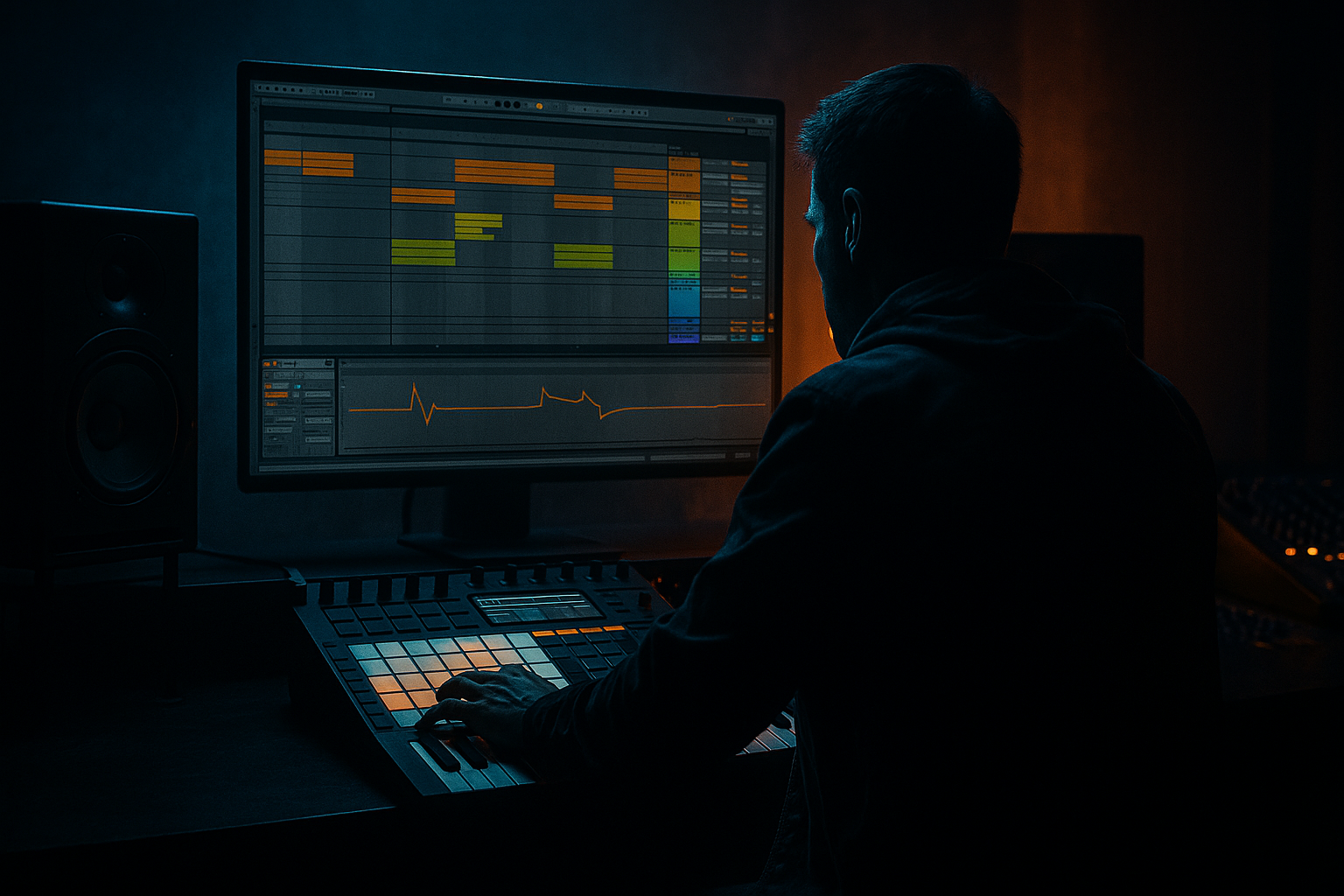
Main tutorial
Lesson Overview
This lesson is about building an Urban Echo transition stack in Ableton Live 12: a layered, groove-driven transition for jungle / oldskool DnB that feels dusty, kinetic, and mix-friendly instead of “EDM huge.” The core idea is to use Groove Pool tricks to make your transition elements swing like chopped break material, then automate them into a tension lift that lands cleanly into a drop, switch-up, or half-time breakdown.
In DnB, transitions are not just “effects between sections” — they’re part of the drum narrative. A strong transition can tell the listener, “the break is coming,” “the bass is about to mutate,” or “we’re moving from 170 full-energy roller mode into a darker B-section.” This technique matters because jungle and oldskool DnB rely heavily on rhythmic identity: the transition should feel like it was born from the drums, not pasted on top.
We’ll build a transition stack that combines:
- chopped break fragments
- vinyl/noise atmosphere
- a reese or low bass swell
- filter and delay automation
- groove-based timing offsets
- a final impact that stays tight in the mix
- a chopped jungle break phrase pulling forward with swing
- short ghost hits and reverse tails breathing in the gaps
- a bass layer rising in tension without muddying the sub
- an atmospheric “urban echo” tail using delay and filtered reverb
- a final impact or stop that lands into the next section with authority
- a drum return track for break edits and echoed hits
- an atmosphere return track for noise, vinyl texture, or field-recording style grit
- a bass automation lane on a reese or mid-bass layer
- Groove Pool-based timing variation to give the whole transition a human, chopped feel
- automation on Auto Filter, Echo, Reverb, Saturator, and Utility
- Over-grooving the break
- Letting sub bass run through the whole transition
- Using too many FX at once
- Building a generic riser that doesn’t sound like DnB
- Ignoring the drop phrase
- Leaving echo and reverb tails uncontrolled
- Use darker delays, not brighter ones
- Layer a low, filtered rumble under the transition
- Add saturation to break fragments, not the entire mix
- Automate small level dips before the drop
- Use ghost notes to imply motion
- Keep bass movement in the mids
- Reference oldskool jungle phrasing
- once with the transition soloed
- once in full arrangement
- Does it sound like part of the drums?
- Is the groove pushing forward?
- Does the drop feel bigger because of the contrast?
- Use Groove Pool to give break chops and bass phrases human swing
- Keep the transition built from drums, texture, and controlled bass movement
- Automate filter, delay, reverb, and volume with intention
- Protect the low end and keep the sub mono and disciplined
- Shape the transition around the 16-bar or 8-bar DnB phrase
- Let the break do the talking, and use FX to amplify the story, not replace it
The result is an automated transition that feels like a smoke-filled, late-night warehouse movement rather than a generic riser. 🔥
What You Will Build
You’ll create a 4- to 8-bar transition stack in Ableton Live 12 that can be dropped before a chorus, drop, or arrangement switch.
Musically, it will sound like:
Specifically, the stack will include:
By the end, you’ll have a reusable Ableton template move for jungle-style transitions that works in rollers, dark minimal DnB, or oldskool break-driven tracks.
Step-by-Step Walkthrough
1. Set up the transition zone and make it phrase-aware
Start by finding a section in your arrangement where the energy needs to shift: usually the last 4, 8, or 16 bars before a drop, a second-drop variation, or a breakdown exit.
In DnB, phrasing is everything. If your main drop is built in 16-bar blocks, your transition should usually begin with a clear change around bar 13 or 15, not randomly in the middle of the phrase. That makes the listener feel the move before it hits.
Action in Ableton:
- Add markers for the section you’re targeting.
- Duplicate your main drum loop or break onto a new track so you can edit the transition without destroying the core groove.
- Keep the low end clean: if the transition overlaps the main drop bass, mute the original bass lane or automate it down.
Musical context example:
- In a 174 BPM jungle roller, use the last 8 bars of the first drop to introduce break chops and atmospheric tails, then let the new bass phrase land on bar 1 of the next 16-bar section.
2. Build the transition stack from three layers: drums, texture, bass
Create three core tracks or groups:
- Drum transition track: chopped break snippets, ghost hits, reverse snares
- Texture track: noise, ambience, vinyl crackle, room tone, distant siren-style tone if appropriate
- Bass transition track: reese, sub swell, or filtered low-mid bass movement
Use stock Ableton tools:
- Simpler or Drum Rack for break chops
- Auto Filter for movement
- Echo for rhythmic tailing
- Saturator for grit
- Utility for mono control and gain staging
- Reverb for short, dark spaces
Keep the transition stack intentionally lean. In jungle and older DnB styles, too many layers blur the impact. The power comes from rhythm and contrast, not sheer size.
3. Create break chops with groove, not rigid quantize
This is where the “groove pool tricks” become the character of the lesson.
Take a classic break or your own edited drum loop and slice it into short pieces:
- kick + snare hits
- snare-only ghost chops
- tiny hat fragments
- a few reversed slices
Then drag a groove from Ableton’s Groove Pool onto the break clips. Good starting points:
- a swingy MPC-style groove with 54–58% feel
- a looser groove with subtle timing deviation if you want a more human, oldskool shuffle
- light velocity variation if your break is sounding too static
Important: use groove sparingly. For jungle, you want the break to feel alive, not sloppy.
Suggested settings:
- Groove timing amount: around 20–45%
- Random velocity: subtle, around 5–12%
- Note length: keep short for chopped slices, especially if you want snappy snare punctuation
Why this works in DnB:
- Jungle and oldskool DnB are built on the tension between machine precision and broken, human-like break movement. Groove Pool lets you keep the break tight enough for a club system while still giving it that swung, cut-up energy that defines the genre.
4. Use automation to make the groove breathe into the transition
Now that your break slices have motion, automate them into the section change.
Focus on three automations:
- Filter cutoff on the break bus
- Dry/Wet on Echo for tail buildup
- Clip volume or track volume for rhythmic fade and emphasis
Practical automation moves:
- Automate Auto Filter cutoff from around 180–400 Hz up to 8–12 kHz across the last 4 or 8 bars, depending on how bright you want the lift.
- Add a resonance bump around 10–20% for a subtle hollow sweep, but don’t overdo it.
- Automate Echo dry/wet from 0% to 15–30% in the last 2 bars so the break fragments start smearing into a cinematic tail.
- On the last hit before the drop, automate the break track volume down slightly while letting the delayed tail ring out.
If you want a tighter oldskool feel, automate short, discrete jumps rather than long smooth ramps. A DnB transition often hits harder when the energy steps instead of gliding endlessly.
5. Shape the bass transition with a reese or low-mid swell
The bass should support the transition, not fight the drums. For this lesson, use a reese, low growl, or filtered bass stab — something with enough midrange texture to be heard during the build, but with the real sub still protected.
Stock Ableton workflow:
- Use Wavetable, Operator, or Analog for the bass source.
- Add Auto Filter to start low and slowly open.
- Add Saturator or Drum Buss for density.
- Keep a Utility after the bass chain to check mono and trim gain.
Suggested bass automation:
- Filter cutoff: start around 120–250 Hz and open toward 1–3 kHz for the mid layer, while keeping sub separate.
- Drive/Saturation: automate a slight increase, around 1–4 dB of extra drive or output density.
- If using a layered patch, keep the sub static in mono and automate only the mid layer.
Arrangement tip:
- Let the bass enter in a call-and-response way: maybe one short motif at bar 2, then a longer filtered note or slide at bar 6. This creates anticipation without stepping on the break edits.
6. Use Groove Pool on the bass and FX to create “urban echo” movement
Here’s the signature trick: apply groove not only to the break, but also to the transition FX and bass clips so the whole stack feels related.
Try this:
- Drag the same groove or a related groove onto your bass MIDI clip.
- Apply a lighter amount than the drums, around 10–25%, so the bass follows the pocket but doesn’t lose foundation.
- Use a short echo FX MIDI or audio clip — a snare hit, vocal stab, metal hit, or filtered noise burst — and groove it slightly late for a falling-back feel.
For the “urban echo” flavor:
- Put Echo on a return track.
- Set delay time to a dotted or sync’d rhythmic value that supports the tempo, like 1/8D or 1/4 depending on density.
- Keep feedback modest, around 15–35%.
- Darken the repeats with the Echo filter so the tail doesn’t clutter the top end.
Then automate the return:
- Raise send amount during the last 2 bars
- Cut it sharply on the drop, or leave one tail hitting through the first hit of the new section if the arrangement can handle it
7. Build the final impact with controlled contrast
A transition needs a finish line. In DnB, that can be:
- a one-shot impact
- a half-bar stop
- a snare flam
- a sub drop
- a reverse crash into silence
Build the ending so it lands against the next groove rather than floating endlessly.
In Ableton:
- Use a crash sample, reversed hit, or short impact layer.
- Put Reverb before the impact tail if you want it to feel deeper.
- Use Utility to automate a quick mono collapse on the last hit if stereo width is making the hit feel vague.
- If you want a classic jungle feel, add a tiny drum fill just before the drop: snare flam, kick pickup, or a chopped break turnaround.
Concrete settings:
- Reverb decay: 1.2–2.8 s for dark transitions, shorter if the mix is already busy
- Reverb pre-delay: 10–25 ms
- Utility gain dip on the pre-drop gap: -2 to -6 dB for contrast before the impact
8. Bus the whole transition stack and automate the final shape
Group your drums, texture, and bass transition elements into a transition bus or return subgroup if your routing allows it. Then process the bus lightly so it feels glued, not crushed.
Good stock chain for the bus:
- Glue Compressor with gentle control
- Saturator for soft density
- EQ Eight to remove unnecessary low rumble and harshness
Suggested bus settings:
- Glue Compressor ratio: 2:1 or 4:1
- Attack: 10–30 ms
- Release: Auto or around 100–300 ms
- Gain reduction: keep it light, around 1–3 dB
- EQ Eight: high-pass around 25–35 Hz if there’s sub buildup; small dip around 2.5–5 kHz if the break is spiky
Automation on the bus:
- Increase saturation slightly in the final 2 bars
- Pull down the bus volume by a small amount right before the main hit if you want a bigger perceived drop
- Automate a filter open on the whole stack, then snap it shut on the last beat for a strong release
This is where the transition becomes one instrument instead of several separate clips.
9. Check the transition against the drop in mono and at low volume
A lot of transition stacks sound exciting soloed and messy in context. DnB especially punishes low-end clutter.
Do a fast quality check:
- Put Utility on your master or bass bus and hit Mono briefly.
- Lower monitoring volume and see if the kick, snare, and bass transition still read.
- Make sure the sub is not fighting the kick during the final bar.
Practical fix:
- If the transition sounds huge but muddy, reduce the bass layer during the last bar and let the drums and FX carry the hype.
- If the break loses energy in mono, reduce stereo widening and reinforce the center with a cleaner transient.
- If the Echo tail eats the drop, shorten feedback or automate its send down faster.
Common Mistakes
- Fix: keep the groove amount moderate. Too much swing can make the transition feel late instead of energetic.
- Fix: mute or automate the sub down before the lift. Keep only the mid-bass or filtered layer active.
- Fix: pick one main motion idea — filter, delay, or reverse tail — and let the drums do the heavy lifting.
- Fix: use break-derived audio, snares, hats, and reese texture. Make the transition feel rhythmically related to the groove.
- Fix: map the transition to the arrangement. The cleanest DnB transitions usually arrive on a strong 8- or 16-bar boundary.
- Fix: automate send levels and feedback so the tail enhances the drop instead of muddying it.
Pro Tips for Darker / Heavier DnB
- Keep Echo filtered so the repeats live in the midrange. That gives you grime without harshness.
- A subtle sub noise or low tom resonance can make the transition feel physically heavier, especially before a switch-up.
- Run the chopped breaks through Saturator or Drum Buss for bite, but keep the main low end cleaner.
- A brief drop of 1–3 dB in the transition bus can make the actual drop feel much larger.
- A few quiet snare ghosts or hat pickups can make a transition feel more “played” and less pasted on.
- The weight should stay center and controlled. Let the movement happen in the mid-bass layer while the sub remains stable and mono.
- Listen to how classic tracks use break edits to pivot between sections. The tension often comes from rhythm changes, not massive sound design.
Mini Practice Exercise
Spend 10–20 minutes building a transition stack in one 8-bar section.
1. Choose a break loop and chop it into 6–10 slices.
2. Apply a Groove Pool groove with 20–35% timing amount.
3. Add one noise or ambience layer and filter it from dark to open.
4. Add a reese or mid-bass clip and automate its filter opening.
5. Put Echo on a return and send the last 2 bars into it.
6. Add one final impact or snare fill on the last beat.
7. Automate the transition bus volume down slightly before the drop, then let the next section hit clean.
Then play it back twice:
Ask yourself:
Recap
The key idea is simple: make your transition feel like a rhythmic mutation of the track, not an external effect layer.
Remember these essentials:
If you want jungle / oldskool DnB transitions that feel authentic, dusty, and heavy, this workflow is a reliable one to come back to again and again.

