Main tutorial
1. Lesson overview
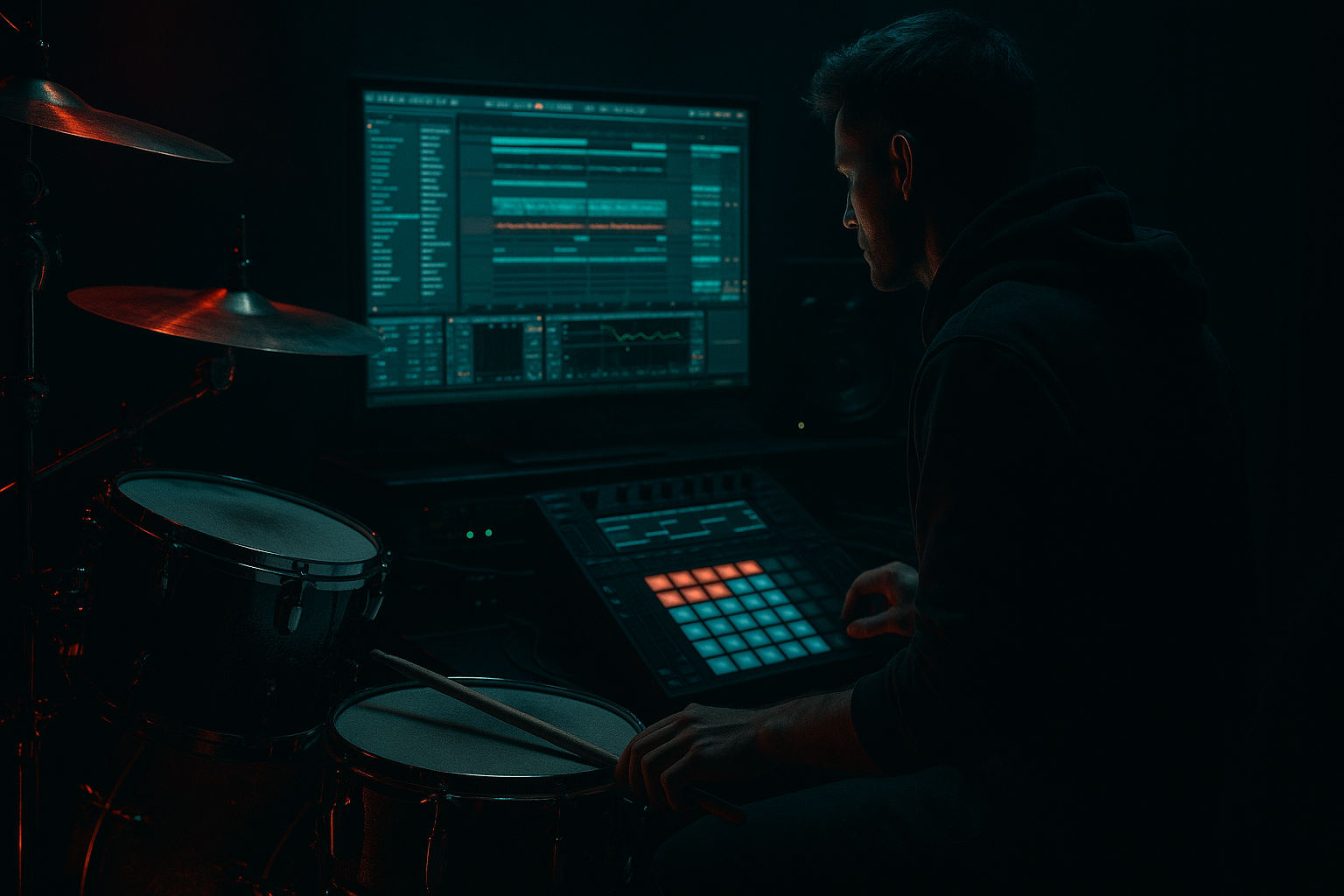
Energetic, punchy drum and bass comes from a marriage of organic breakbeats and precise, synthetic hits. In this lesson you’ll learn an advanced, practical workflow in Ableton Live for combining acoustic (recorded/break) drums with synthetic layers to make full-bodied hybrid DnB drums — tight sub kicks, glassy synthetic snaps, gritty breaks and rolling percussion that sits in a heavy mix. We’ll cover layering, phase/alignment, routing, device chains (stock Ableton devices), transient control, parallel processing, arrangement ideas for jungle/rolling DnB, and darker/heavier finishing tricks. ⚡️
Target tempo: 170–175 BPM (I use 174 BPM in examples).
Required: Ableton Live (Suite preferred for Wavetable & Sampler, but everything here can be done with core devices except where noted).
2. What you will build
A 16-bar hybrid DnB drum loop that combines:
- A sliced, processed breakbeat (acoustic feel)
- A clean sub-kick (Operator/Wavetable) locked to the kick transient
- Layered snares: an acoustic snare hit + synthetic snap + processed transient/metallic body
- Rolling, syncopated percussion (hat grooves + tuned toms) and fills using Beat Repeat
- Group/parallel processing chain (Drum Buss, Saturator, parallel compression) for glue and grit
- Set tempo to 174 BPM.
- Create a Drum Rack on Track 1 (name it DRUMS).
- Create a second audio track for the Break loop (name it BREAKS).
- Create MIDI track for sub-kick (SUB-KICK) using Operator or Wavetable.
- Create Group track “DRUMS GROUP” to route everything through for final processing.
- Bars 1–4: Break + sparse synthetic kick & hats.
- Bars 5–8: Bring in sub-kick and snare synthetic layer.
- Bars 9–12: Add percussion rolls and beat repeats, automate Beat Repeat rate on fills.
- Bars 13–16: Drop everything to a half-bar filtered variant, then reintroduce full drum group for impact.
- Check mono (Utility Width 0%) — snare/kick still present.
- Reference against a busy commercial DnB track at -6 LUFS (rough match for tone & energy).
- Export stems: DRUMS_DRY, DRUMS_PROCESSED, SUB, BREAKS for future mix flexibility.
- Over-layering without phase alignment → loss of punch or weird comb-filtering. Always nudge layers and check polarity.
- Not carving space with EQ for each layer (especially 100–400 Hz). Layers fight here.
- Crushing dynamics too early: aggressive glue/compression before you finish layering flattens the groove.
- Saturating/Distorting the sub sine → you’ll lose clean 60 Hz power. Keep subs clean and mono, distort mids for character instead.
- Overlong reverb on snares in DnB — use short sweeteners and long reverb on sends with low-pass to avoid mush.
- Forgetting to HPF percussion and non-sub elements below ~30–40 Hz → consumes headroom and muddy mix.
- Use subtle distortion on the mid-bass (not the sub). Route mid-bass/low-mids to a parallel bus, heavy Saturator or Overdrive, then blend in. Try Saturator > Soft Clip, Drive 3–6 dB; high-pass the buss at 40–60 Hz to protect sub.
- Use Resonators/Corpus on a duplicate snare for metallic clang and emphasize harmonic content in 900–2.5 kHz.
- Add transient emphasis: Drum Buss Transient +4 and Multiband Dynamics to flatten only mids (400–3k) for aggressive snap while leaving lows free.
- Use automation for energy: automate a lowpass on the Breaks bus to darken the verse and open for the drop; automating Drum Buss Drive can add snap during the drop.
- Mid/Side EQ: add a slight boost +2–3 dB at 2.5–5 kHz on Side for wider hi-hat shimmer; cut 200–400 Hz on Mid for clarity.
- Make fills brutal: freeze a 1-bar section, resample, stretch to half-time, add Beat Repeat with extreme grid 1/128, High feedback for glitchy fills.
- Use Sparkle: subtle upwards saturation (Saturator with Soft Clip, wet 10–20%) on hi-hats and snaps to cut through darker mixes.
- Hybrid drums = intentional layering: sub sine for body, acoustic breaks for groove, synthetic clicks/snaps for attack.
- Phase-align layers, carve space with EQ, protect subs with HPF and mono, and glue with parallel compression + Drum Buss.
- Use Ableton stock devices: Drum Rack, Simpler/Sampler, Operator/Wavetable, EQ Eight, Glue Compressor, Compressor (sidechain), Drum Buss, Saturator, Multiband Dynamics, Beat Repeat and Utility.
- Arrange for tension: use filtering, Beat Repeat rolls, automation of Drive/Transient/Routing for impact.
- For darker/heavier DnB: parallel distortion on mids, resonant metallic snare bodies, multiband transient shaping and careful sub management.
End result: a loud, heavy, yet dynamic drum loop that sits in the mix and supports rolling basslines.
3. Step-by-step walkthrough
Note: I’ll use Drum Rack, Simpler, Sampler, Operator/Wavetable, EQ Eight, Compressor, Glue Compressor, Drum Buss, Saturator, Multiband Dynamics and Beat Repeat (all stock). Use Utility to check mono and polarity.
A. Project setup
B. Prepare the break
1. Drag a break sample into the BREAKS audio track.
2. Warp the break: set Warp mode to Beats; turn on Transients detection. If the break should keep micro-timing, set 1/16 and preserve.
- If using Simpler slicing: drop break into Simpler, set to Slice mode → Slice by: Transients. This gives you MIDI-accessible slices with timing preserved.
3. Clean up:
- High-pass the break above 18–30 Hz (EQ Eight HP at 30 Hz) — keep sub clean.
- Use EQ Eight with a gentle dip at 250–400 Hz if the break is muddy. (Notch ~300 Hz, -2 to -4 dB, Q ~1.0).
- Use transient control: add Drum Buss → Transient knob +3 to +6 to bring out attack; adjust Drive lightly (0.5–1.5).
C. Build the sub-kick (sine body)
1. Create SUB-KICK MIDI track with Operator (or Wavetable).
2. Operator settings (quick starting patch):
- Osc A: Sine, Pitch: -0 st (C3 if you want low sub), Level full.
- Osc B: sine an octave up, very low level for character (or off).
- Pitch envelope: Amp Env — Attack 0 ms, Decay 200 ms, Sustain 0, Release 40 ms.
- Filter: none or very low LPF at 1200 Hz (not necessary).
3. MIDI: make a 1/8 or 1/16 note pattern that aligns with kick transients. For DnB, most producers layer kick + sub for on-beat sub. Use a clean sine at around 40–60 Hz. Tune to your bassline root note.
4. Mono the sub: add Utility → Width 0% on SUB-KICK.
D. Layer an acoustic kick with synthetic transient
1. Inside DRUMS (Drum Rack) allocate a kick chain (C1).
2. Load your sampled acoustic kick into Simpler (Classic).
- Set Filter HP at 22–30 Hz, low-pass at ~8–10 kHz if noisy.
- Warp OFF (you want natural).
3. Create a synthetic click: add another chain with Operator or white-noise click shaped by an envelope (short noise, HPF 2k–4k).
- Operator for click: make a triangle or square at high freq; or use Simpler with a short sample of a 909 click.
4. Phase-align:
- Temporarily route both chains to separate tracks (or use Drum Rack chains with separate outputs) and solo them.
- Zoom waveform and nudge the synthetic click to line up with the transient peak of the acoustic kick. Use Utility + phase invert toggle to check cancelation; if cancellation occurs, nudge by a few ms.
5. Glue:
- Group DRUMS → add Glue Compressor (default) with Ratio 3:1, Attack 10 ms, Release 80–150 ms, Threshold until ~3–6 dB gain reduction. This glues the layers.
E. Snare stacking (acoustic + synthetic + metallic body)
1. Acoustic snare chain (Drum Rack S1):
- Load a snare sample in Simpler. EQ: HP at 120 Hz to remove low rumble; gentle shelf boost around 180–250 Hz (+1.5–3 dB) for body.
2. Synthetic snap (S2):
- Use Operator: Osc A noise (or Simpler noise) through a high-pass at 1.5–2.5kHz. Short envelope: Attack 0 ms, Decay 80–160 ms, Sustain 0.
- Add a little pitch drop on the synthetic body (pitch envelope: start +1–2 semitones decaying quickly) to add snap.
3. Metallic resonator (S3 optional):
- Duplicate the snare and insert Resonator (Audio Effects Rack > Resonators in Live Suite / or Simpler tuned tone). Or use Corpus (if available) with low frequencies to add metallic ring. Subtle is key.
4. Group snare chains via return or dedicated group; process with Drum Buss:
- Drum Buss settings: Drive 1.5–3, Boom 0-1 dB (only if you want sub on snare), Transient +4, Distortion small.
5. Reverb: send to a Short Reverb return (Reverb: Decay 0.4–0.8s, High cut 6–8 kHz, Dry/Wet 0% on channel; use send 8–12% to add space). EQ the return to cut lows (<200 Hz).
F. Hi-hats, percussion, and rolling elements
1. Hi-hats:
- Use two layers: sampled closed hat in Simpler + sequenced synthetic hat in Drum Rack (Operator/Noise with short envelope).
- Use slight swing (Groove Pool: apply a groove from the library, e.g., “swing 8” or “Old School S195”) to the hat/closes for humanized shuffle.
2. Rolling percussion:
- Add a MIDI chain with tuned toms / 808 toms (Operator or Wavetable), use pitch LFOs or mod envelopes for quick pitch slides. Keep decay short.
- For jungle rolls: use Beat Repeat on a percussion return: Interval 1/32, Grid 1/64, Chance 25–50%, Filter 6 dB, Pitch +/- 3–5 cents for variation. Automate Interval/Repeats for fills.
G. Parallel compression & grit
1. Create a Parallel Compression chain:
- Duplicate DRUMS group (or send DRUMS to a Return/Bus). On duplicate, use Compressor (or Glue) with heavy settings: Ratio 10:1, Attack 1–5 ms, Release 80–150 ms, Threshold for 8–12 dB reduction. Then low-pass at 10 kHz, high-pass at 80 Hz to avoid pumping the sub.
- Blend this heavily-compressed track underneath the dry drums (start at -6 dB then mix by ear).
2. Add Drum Buss + Saturator on the group:
- Drum Buss: Drive 1.5–3, Body 0–1, Transient +2 to +4.
- Saturator after Drum Buss: Drive 1.5–3 dB, Curve Soft Clip. Use Dry/Wet <50% for character.
3. Multiband Dynamics (optional): compress mids to make snares punch; leave lows mostly untouched.
H. Tight low-end management
1. On everything except SUB-KICK and bass, HPF at 30–40 Hz.
2. Use Utility on final group: Mono width under ~120 Hz (Utility Width 0% with an EQ Eight lowpass + Utility chain). This keeps sub centered.
3. Sidechain the bass to the kick/sub:
- Put Compressor on bass channel with Sidechain Input → DRUMS group kick bus. Attack 1–3 ms, Release 80–200 ms, Ratio 4:1, Threshold to get 3–7 dB ducking.
- Alternatively, use a Ducking Envelope via Auto Filter (lowpass with inverted envelope follower) if you prefer.
I. Arrangement/clip ideas for rolling DnB
J. Final checks & bounce
4. Common mistakes
5. Pro tips for darker/heavier DnB
6. Mini practice exercise (20–30 min)
Build a 16-bar loop at 174 BPM using these steps:
1. Choose a 1-bar slice from a break sample (use Simpler or slice to MIDI).
2. Create a simple 4-on-the-floor pattern for the sample’s transient (or use the break as-is).
3. Make a sub-kick in Operator: Sine, Decay 220 ms, Mono, check at ~45 Hz. Place sub at bar 1 and 3 of each 2-bar phrase.
4. Layer a synthetic snare (noise + short sine body) with an acoustic snare. EQ the acoustic snare 120 Hz HP, boost 220 Hz by 2 dB, add 3.5 kHz for crack.
5. Add a parallel compressed bus: duplicate drum group, heavily compress (10:1) and mix at -8 dB under main.
6. Add Beat Repeat on a send: Interval 1/16, Grid 1/32, Chance 40%. Trigger the send on bar 12 and automate chance to 70% for a fill.
7. Export 8 bars stem and listen on headphones and monitors; make 3 small changes to the snare stack (EQ, transient, or level) and A/B.
7. Recap
Go make something monstrous — then send me a short stem and I’ll point out one thing to improve. Ready to roll? 🥁🔥

