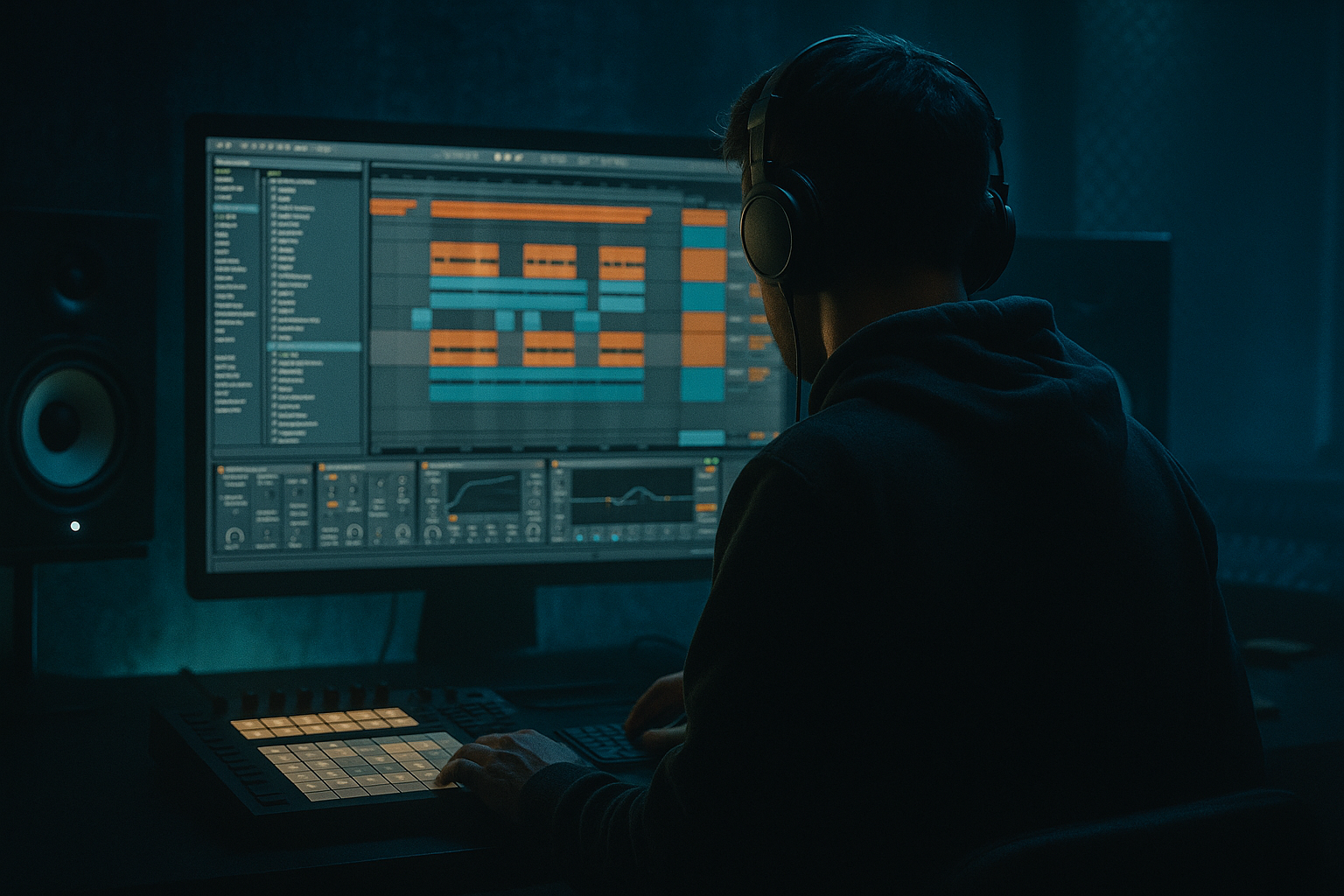
Main tutorial
```markdown
Using Take Lanes (Conceptually) in Audio Editing — Drum & Bass Workflow in Ableton Live
1) Lesson overview
Take Lanes in Ableton Live are often taught as a “comping tool for vocals,” but in drum & bass they’re a power workflow for auditioning edits, variations, and sound design decisions without destroying your main arrangement.
In this lesson you’ll use take-lane thinking to build tight, rolling breaks, alternate fills, and multiple bass resamples while keeping everything organized and fast. ⚡️
Goal: Move from “one risky edit on the timeline” to “multiple safe options you can A/B instantly,” then commit the best.
---
2) What you will build
You’ll create a 16-bar DnB drop section with:
- A main break (tightened and edited)
- 2–3 alternate break edits (different slice choices, ghost hits, swing feel)
- A fill lane (end-of-phrase variation)
- A bass resample lane set (different distortion/processing prints)
- A workflow for auditioning and comping the best parts cleanly
- EQ Eight (HPF 25–35 Hz, sculpt mids)
- Saturator (Soft Clip on)
- Amp (try “Rock” or “Heavy,” keep it subtle)
- Auto Filter (envelope for movement)
- Limiter (only to catch peaks while printing)
- clean sub phrase + nasty mid phrase
- different fills
- alternate distortion for call/response
- Lane “Fill A”: snare rush (1/16–1/32)
- Lane “Fill B”: stop-start + reverb tail
- Lane “No hats”: bass feature moment
- Every 8 bars, change one thing:
- Editing without phrase context: A break can sound sick for 1 bar but ruin the 16-bar flow. Always audition across 4–8 bars.
- Too many “almost identical” lanes: If two lanes differ by 2%, delete or commit. Keep lanes meaningfully different.
- Warp artifacts from wrong mode: Breaks usually behave best in Beats mode; Complex can smear transients.
- Overprocessing while comping: Comp first, then mix. If each lane has wildly different processing, you’ll chase your tail.
- Not consolidating the final comp: If you leave hundreds of cuts, later timing/mixing gets messy.
- Parallel dirt lane for breaks:
- Controlled ambience for menace:
- Make fills hit harder with take lanes:
- Bass comping trick:
- Take lanes are not just “for takes”—they’re decision lanes for DnB editing. ✅
- Build multiple meaningful variations (tight / swing / heavy), then comp the best phrasing.
- Use lanes to store fills, switch-ups, and bass resample prints without cluttering your main arrangement.
- Commit the final result by consolidating, but keep lanes around until the track is nearly finished.
Think: classic jungle “amen-style” movement + modern rolling tightness, with a darker option ready to go. 🥁🖤
---
3) Step-by-step walkthrough
Step 0 — Project setup (fast + DnB-friendly)
1. Set tempo: 172–175 BPM (start at 174 BPM).
2. Set grid: Right-click the grid → 1/16 (and be ready to switch to 1/32 for micro-edits).
3. Turn on Warp defaults you like:
- For breaks: try Beats mode (good transient control).
- For tonal bass resamples: often Complex Pro or Complex.
DnB workflow tip: Create a group called DRUMS and another called BASS early. Your take lanes will stay clearer.
---
Step 1 — Load a break and prep it for take-lane editing
1. Drag in a break (Amen, Think, or your own loop) onto an Audio Track named: `Break_Main`.
2. In Clip View:
- Set Warp Mode: Beats
- Preserve: Transients
- Envelope: start around 40–70 (higher = tighter transients, less tail)
3. Consolidate a clean phrase:
- Select 8 bars (or 16 if you want longer variation) → Cmd/Ctrl + J.
Now you have a stable “main clip” to create variations from.
---
Step 2 — Create take lanes (and the mindset)
In Live’s Arrangement View:
1. Right-click the track header of `Break_Main` → Show Take Lanes.
2. Conceptually, you’re building parallel timelines of options:
- Lane 1: “Main tight break”
- Lane 2: “More jungle swing”
- Lane 3: “Heavier ghost notes”
- Lane 4: “Fill experiments”
Key mindset: Take lanes are a non-destructive option stack. You can get wild without losing the original. ✅
---
Step 3 — Build variation lanes with real edits (the DnB way)
#### Lane A — “Tight modern roller”
1. Duplicate the clip into a lane:
- Alt/Option-drag the clip down into a take lane (or copy/paste).
2. Make it punchy:
- Add Gate (stock) on the track:
- Threshold: adjust until tails tighten (often -20 to -10 dB range)
- Attack: 0.10–0.50 ms
- Release: 30–80 ms
- Add Drum Buss:
- Drive: 5–20%
- Boom: low or off for breaks (unless you want thick low mids)
- Transients: +5 to +20
3. Micro-edit for roll:
- Split (Cmd/Ctrl+E) a few ghost hits and nudge them slightly early/late (use nudge with grid off).
- Swap a snare hit with a different slice (copy/paste a better transient).
You’re aiming for a “clean and urgent” break that supports a modern sub + reese.
---
#### Lane B — “Jungle shuffle / more character”
1. Duplicate clip into a new take lane.
2. Make it looser:
- In Clip View → Groove Pool:
- Try a swing groove (e.g., MPC 16 Swing style) at 10–25%
- Commit by “Groove” feel, but keep kick/snare anchors stable.
3. Emphasize room + grit:
- Add Redux (very subtle):
- Downsample: small amount (try 1.5–4)
- Bit Reduction: mild (try 10–14 bits if you want edge)
- Add EQ Eight:
- HPF around 30–50 Hz
- Small dip around 250–400 Hz if boxy
- Gentle lift around 3–6 kHz if it needs snap
This lane is your “old-school rinse” option. 🌿
---
#### Lane C — “Heavier ghost hits / aggression”
1. Duplicate clip into another lane.
2. Make it heavier:
- Add Saturator:
- Mode: Analog Clip or Soft Sine
- Drive: 2–8 dB
- Turn on Soft Clip
- Add Compressor (or Glue Compressor):
- Ratio: 2:1–4:1
- Attack: 10–30 ms (let transients through)
- Release: Auto or 80–150 ms
- Aim for 1–3 dB of GR on peaks
3. Edit in extra momentum:
- Find a tasty ghost note segment and repeat it once (duplicate a 1/16–1/8 slice).
- Cut low tails between hits if it muddies the bass (short fades help).
This is your “club-pressure” lane. 🧱
---
Step 4 — Comp the best moments into one final performance
Now you’ll build the “perfect break” by choosing the best moments from each lane.
1. Decide your structure: classic DnB phrasing
- Bars 1–4: establish main groove
- Bars 5–8: add variation
- Bars 9–12: push energy (heavier lane)
- Bars 13–16: fill + impact
2. Comp by section:
- Use the lane auditioning workflow: solo lanes and listen at phrase boundaries.
- Select the region you want (e.g., bars 5–8 from Lane B), then copy/paste it into the main lane/clip area you’re committing to.
3. Commit and consolidate:
- Once you’re happy, select the compiled region → Cmd/Ctrl + J to consolidate.
- Rename the consolidated clip: `Break_Comp_Final`.
Pro workflow: Keep the take lanes muted but present until the mix is almost finished. They’re your “plan B” when bass or vocals demand a different drum pocket later.
---
Step 5 — Use take lanes for bass resampling options (huge in DnB)
Take lanes aren’t only for drums. They’re perfect for bass resample prints.
1. Create an Audio Track named `Bass_Resample`.
2. Route your bass group to it:
- On the bass group: Audio To → Bass_Resample
- On `Bass_Resample`: set Monitor = In and arm it.
3. Print 4 versions (each becomes a take lane option):
- Version 1: cleaner (EQ + light Saturator)
- Version 2: heavier (Overdrive + Saturator)
- Version 3: mid-focused (Amp + cabinet vibe)
- Version 4: brutal (Pedal + heavy limiting)
Suggested stock chain ideas (print different chains as “takes”):
Each print can live in its own take lane so you can comp:
---
Step 6 — Arrange with take-lane thinking (drop dynamics)
Use lanes to hold alternate fills and drum switch-ups:
DnB arrangement trick:
- hat pattern
- ghost notes
- snare flam
- break layer level
Using take lanes keeps those choices fast and reversible.
---
4) Common mistakes
---
5) Pro tips for darker/heavier DnB 🖤
Duplicate your final break to a new lane/track and crush it:
- Drum Buss (Drive 20–40%)
- Saturator (harder drive)
- EQ Eight: band-pass-ish focus around 200 Hz–6 kHz
Blend under the clean break for “shadow” energy.
Put Hybrid Reverb on a send, short dark room:
- Decay: 0.4–0.9s
- High cut: 4–7 kHz
Send snare bits (or fills only). Keep it moody, not washy.
Create a fill lane where the last snare has:
- Reverb freeze or delay throw
- then hard cut to dry downbeat
(Classic tension/release.)
Print 2 bass takes:
- Take 1 = sub-safe (clean, mono)
- Take 2 = mid violence (wide/distorted)
Comp them so the same MIDI phrase alternates sonic intensity every 4 bars.
---
6) Mini practice exercise (15 minutes)
1. Load one break and consolidate 8 bars.
2. Create 3 take lanes:
- Lane 1: tight + Drum Buss transients
- Lane 2: swing groove + slight Redux
- Lane 3: heavier saturation + compression
3. Comp a final 8-bar loop:
- Bars 1–4 from Lane 1
- Bars 5–6 from Lane 2
- Bars 7–8 from Lane 3
4. Add a 1-bar fill lane for bar 8:
- snare rush or stop-start edit
5. Export just the drums as a loop and label it:
`174_DNB_BreakComp_v1.wav`
---
7) Recap
If you want, tell me what subgenre you’re aiming for (rollers, jump-up, jungle, techstep, halftime) and I’ll suggest a lane plan + device chains tailored to that sound.
```

