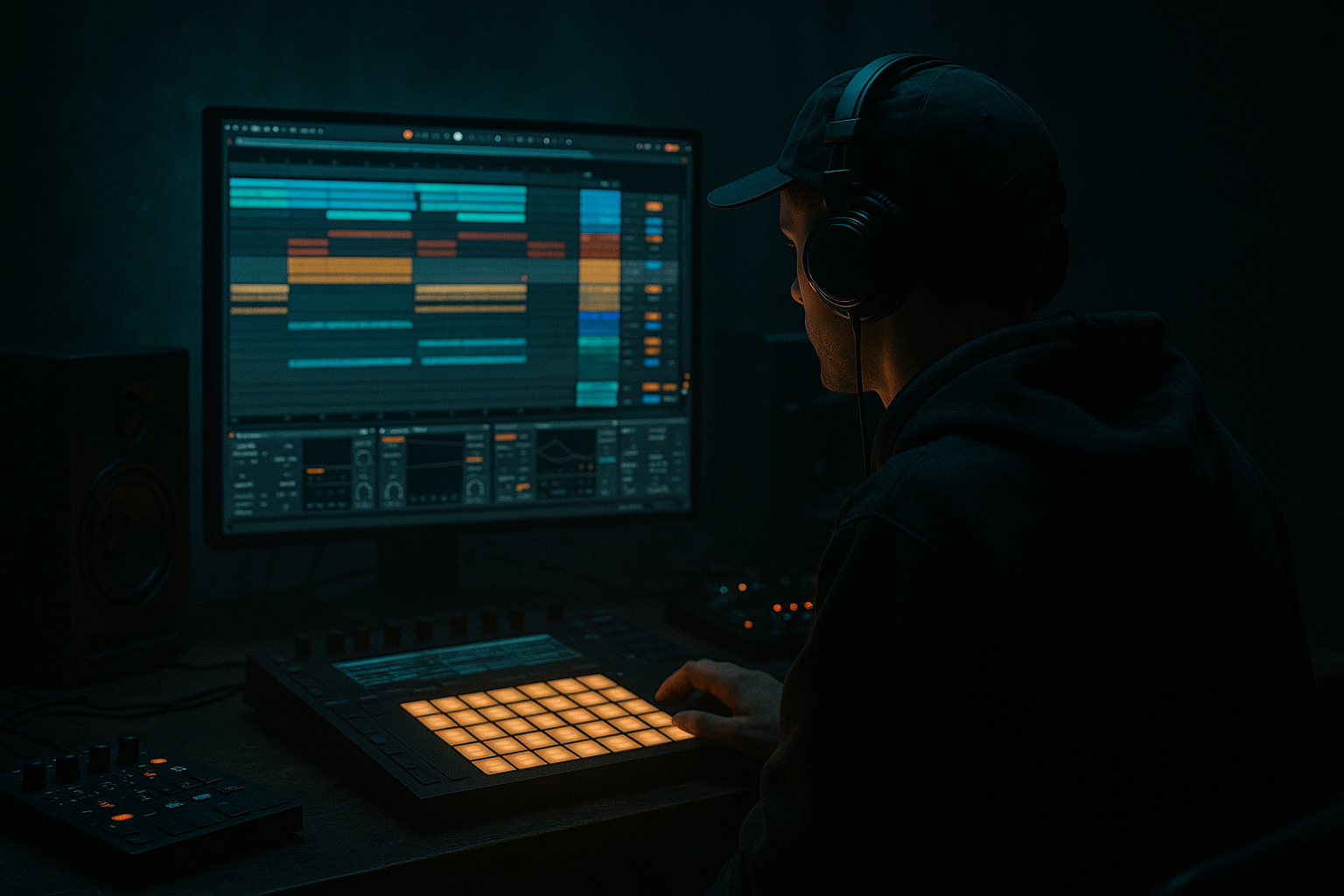
Main tutorial
```markdown
Using Templates for Ragga Vocal Sessions (DnB in Ableton Live) 🎙️⚡
Skill level: Intermediate
Category: Workflow
---
1. Lesson overview
Ragga vocals in drum & bass are all about energy, timing, and attitude—but sessions can get messy fast: multiple takes, ad-libs, call/response, doubles, and heavy FX.
In this lesson you’ll build an Ableton Live template specifically designed for ragga vocal recording, comping, processing, and arranging inside a DnB/jungle context (170–175 BPM). You’ll end up with a repeatable system that gets you from “mic on” to “ready-to-mix” quickly. 🚀
---
2. What you will build
A reusable Ableton Live template that includes:
- Dedicated ragga vocal tracks (Main, Double, Ad-libs, Shouts)
- Comping lanes ready to go (Live 11+)
- Clean recording chain + mix-ready vocal chain
- Return FX tailored for DnB: dub delay, plate reverb, distortion, “radio” tone, throw FX
- Arrangement markers for common DnB structure (16/32 bar phrasing)
- Sidechain-aware FX so vocals sit inside heavy drums + rolling bass
- Export-friendly routing (easy stems)
- Audio From: your interface input (e.g., Input 1)
- Monitor: OFF (if using direct monitoring) or AUTO (if monitoring through Live)
- Arm: only the track you’re recording
- `Vox Group - Ragga Glue`
- Echo
- Saturator (optional) Drive 1–3 dB
- Utility: keep return level controlled
- Hybrid Reverb
- EQ Eight
- Overdrive
- Compressor (optional) to pin it forward
- Hybrid Reverb (darker)
- Saturator after reverb (yes after)
- Echo (ping-pong)
- Auto Filter (automate cutoff sweeps)
- Reverb (small/medium)
- Set each vocal track output to Vocal Group (default).
- Vocal Group output goes to Master.
- If you want printing: set Vox PRINT input to Resampling or Audio From: Vocal Group (post-FX).
- dry takes (per track)
- processed group
- special printed FX
- Intro: filtered “radio” phrases + delays, no full lead yet
- Build: call/response every 4 bars
- Drop:
- Break: longer dub delay throws, half-time feel (even if drums stay 170)
- Second drop: bring back a new vocal layer (double or shouts) for escalation
- `DnB Ragga Vox Session - 172 - Template`
- Over-processing during recording: heavy compression/verb while tracking makes editing painful. Track clean.
- Too much low-mid buildup (200–500 Hz): ragga can get boxy fast once bass + breaks hit.
- Using long bright reverbs in full drops: smears the groove; use short plates and timed delays instead.
- No vocal “pocket” planning: vocals fight snares if you don’t arrange space.
- Not printing FX throws: if you automate extreme throws live, printing them to audio keeps your session stable.
- Sidechain your vocal FX returns (not the dry vocal) from the snare or drum bus:
- Parallel grit for aggression:
- Use “radio” tone sparingly as a contrast tool:
- Tempo-synced delay rhythms:
- Gate chopped adlibs:
- You built a DnB ragga vocal template that’s fast, clean, and repeatable.
- You separated recording safety (light chain) from mix power (group chain + returns).
- You set up DnB-appropriate FX returns (dub delays, tight plates, radio tone, throw channel).
- You organized arrangement with locators and planned vocal placement for drops and transitions.
- You made the session stems-ready and reliable by printing key FX.
---
3. Step-by-step walkthrough
Step 0 — Start with the right Live set foundations
1. Tempo: set to 172 BPM (classic rolling DnB sweet spot).
2. Time signature: 4/4.
3. In Preferences → Record/Warp/Launch:
- Warp Long Samples: OFF (for raw vocal recording; you can warp later intentionally)
- Create Fades on Clip Edges: ON (clean edits)
4. Create Locators immediately (Arrangement View):
- `Intro (16)`
- `Build (16)`
- `Drop 1 (32)`
- `Break (16)`
- `Drop 2 (32)`
- `Outro (16)`
This matches real DnB phrasing and keeps ragga sections locked to bars.
---
Step 1 — Build your vocal track layout (session architecture)
Create a Vocal Group (Cmd/Ctrl+G) containing:
1. Vox MAIN (Lead)
2. Vox DOUBLE (tighter performance layer)
3. Vox ADLIBS (fills, hype, spoken bits)
4. Vox SHOUTS (one-shots: “reload!”, “selecta!”, etc.)
5. Vox PRINT / RESAMPLE (audio track used to record processed vocal passes)
Color-code the group (e.g., orange) so it’s instantly recognizable.
Why this layout works in DnB: you can build hook clarity (Main), density (Double), movement (Adlibs), and impact moments (Shouts) without losing control.
---
Step 2 — Set up clean recording input + monitoring 🎛️
For each vocal track:
Latency tip: If monitoring through Live, keep buffer low during recording (e.g., 64–128 samples).
---
Step 3 — Two-stage vocal chains: “REC” and “MIX”
You want a light recording chain (stable, low CPU) and a heavier mix chain you can toggle.
#### A) REC chain (on each vocal track)
Keep it simple:
1. Utility
- Gain: adjust so peaks hit around -10 to -6 dBFS while recording
2. EQ Eight (safety cleanup only)
- HP filter: 80–110 Hz, 24 dB/oct (depends on voice)
- Optional: dip 200–350 Hz if room tone builds up
That’s it. Don’t over-process during recording.
#### B) MIX chain (build on the Vocal Group, not every track)
Put the main “glue” processing on the Vocal Group so all layers feel like one performance.
Suggested Vocal Group chain (stock devices):
1. EQ Eight
- HP: 90–120 Hz
- Gentle dip: 250–450 Hz (mud control)
- Presence lift: 3–6 kHz (careful—ragga can get sharp)
2. Compressor (or Glue Compressor)
- Ratio: 3:1
- Attack: 10–30 ms (lets transients/words punch)
- Release: Auto or 80–150 ms
- Gain reduction: aim 2–5 dB on peaks
3. Saturator (DnB-friendly edge)
- Mode: Analog Clip
- Drive: 2–5 dB
- Soft Clip: ON
4. De-esser approach using Multiband Dynamics (stock workaround)
- Use Multiband Dynamics preset as a base and tune the high band to tame 6–10 kHz harshness
- Keep it light—ragga bite is part of the vibe 🔥
Workflow trick: Save this as an Audio Effect Rack named:
---
Step 4 — Return tracks: the DnB ragga FX playground 🌌
Create Returns A–E:
#### Return A — Dub Delay (classic ragga space)
- Time: 1/4 or 1/8 dotted
- Feedback: 25–45%
- Filter: HP ~ 200 Hz, LP ~ 6–8 kHz
#### Return B — Short Plate (keep it tight)
- Algorithmic Plate
- Decay: 0.8–1.6 s
- Pre-delay: 15–30 ms
- HP: 200–400 Hz
- Keep it subtle—DnB drums are fast.
#### Return C — “Radio / Soundsystem” Tone 📻
- Band-pass vibe: HP ~ 250 Hz, LP ~ 4.5–6 kHz
- Drive: 10–25%
- Tone: adjust to taste
Great for one-word shouts and callouts before drops.
#### Return D — Distorted Space (dark hype channel)
- Decay: 2–4 s
- LP around 5–7 kHz
- Drive 3–7 dB for crunchy tails
#### Return E — Throw FX (automated moments only)
This is for “one word into the abyss” moments. 😈
---
Step 5 — Routing for clean exports (stems-ready)
Inside the Vocal Group:
This makes it easy to render:
---
Step 6 — Comping workflow (fast and clean) ✂️
For each vocal track:
1. Record multiple passes into Take Lanes.
2. Use Live’s Comping tool to select best phrases.
3. Consolidate (Cmd/Ctrl+J) once you’re happy.
4. Add clip gain adjustments before compressors:
- Aim for consistent vocal level feeding the chain.
DnB-specific comping note: Keep the rhythmic pocket tight—ragga phrasing often hits like percussion. Don’t just pick the “best tone”; pick the take that rides the drums.
---
Step 7 — Arrangement ideas: placing ragga vocals in rolling DnB
Use vocals like arrangement glue:
- Main hook: every 8 or 16 bars
- Adlibs: fill gaps between snare hits (think: off-beat hype)
Locator trick: Add locators named `Vox In`, `Hook`, `Adlib Switch`, `Throw` so your arrangement becomes a checklist.
---
Step 8 — Save it as a real template ✅
1. Remove any copyrighted audio.
2. Keep your track structure + devices.
3. File → Save Live Set as Template.
Name it:
---
4. Common mistakes
---
5. Pro tips for darker/heavier DnB 🖤🔊
- Put Compressor on Return A/B, sidechain from Drum Bus, fast attack, medium release.
This keeps delay/reverb out of the way of the snare snap.
- Duplicate Vox MAIN → `Vox GRIT`
- Add Saturator + Overdrive + EQ Eight band-pass
- Blend quietly under the clean vocal for thickness.
Drop a band-passed vocal right before the drop, then slam back to full-range on the 1.
For rolling DnB, 1/8 dotted and 1/4 throws often feel best against the 2-step pattern.
Use Gate on adlib tracks with fast release for tight, percussive vocal chops (jungle-style).
---
6. Mini practice exercise (15–25 minutes) 🧪
1. Create the template structure (Vocal Group + 5 tracks + Returns A–E).
2. Record 6–10 takes of a simple ragga phrase (e.g., 1 bar repeated).
3. Comp a final lead on `Vox MAIN`.
4. Record a loose double on `Vox DOUBLE`.
5. Add 3 shout one-shots on `Vox SHOUTS`.
6. Automate:
- One Echo throw on the last word before a locator called `Drop 1`
- One Radio FX moment on a shout
7. Print the processed group into `Vox PRINT`.
8. Export stems: `Vox Group`, `Vox PRINT`, and one dry track.
Goal: You should be able to do this without stopping to think about routing.
---
7. Recap
If you want, tell me whether you’re recording a real vocalist or chopping samples, and what subgenre (rollers, jump-up, jungle, halftime-neuro), and I’ll suggest a matching vocal chain + FX timing map.
```

