Main tutorial
Vinyl crackle as texture for jungle rollers (Ableton Live, Advanced) 🎛️🖤
1) Lesson overview
Vinyl crackle in jungle/DnB isn’t just “lo-fi dust”—it’s rhythmic glue and movement. Done right, it:
- Adds forward motion in gaps between drums
- Builds micro-dynamics that make rollers feel alive
- Helps contrast between clean subs/modern drums and raw break character
- A dedicated “Crackle Texture” return or audio track that follows your groove
- A band-limited, sidechained, tempo-locked crackle layer
- Scene/arrangement automation for drops, fills, and breakdowns
- Optional “dark” variants: tape chew, needle thumps, and distorted grit
- Your own vinyl recording (ideal)
- Field recordings of vinyl/tape noise
- A carefully chosen sample pack (fine, but edit it)
- Find a 1–4 bar region with consistent density (not too many big pops).
- Enable Loop and set a 1 bar loop first. If it “cycles” audibly, expand to 2 or 4 bars.
- Duplicate the crackle track and name it CRACKLE POPS
- On POPS:
- Bars 1–17 (Intro): Crackle louder + wider (sets the world) 🌫️
- Bars 17–33 (Drop 1): Crackle tighter + ducked
- Bars 33–49 (Mid): Pull crackle down or filter it (creates contrast)
- Bars 49–65 (Drop 2): Bring it back with extra grit
- EQ Eight low-pass frequency
- Gate Threshold
- Compressor sidechain amount (threshold)
- Utility Width (wide in intros, narrower in drops)
- Too loud: crackle should be felt when muted, not heard as a separate layer. If you “notice it” constantly, it’s probably too hot.
- Full-spectrum noise: leaving lows in crackle muddies kick/bass perception even if meters look fine.
- No sidechain: constant crackle can flatten transients and reduce perceived punch.
- Warp artifacts: extreme warping can create weird chirps that fight hats.
- Stereo overkill: super-wide crackle + wide breaks = messy sides and phasey top end.
- Make the crackle midrange-gritty, not airy: low-pass closer to 7–9 kHz and add Saturator drive. Dark rollers often live in that controlled top.
- Use erosion carefully: Ableton Erosion at low amounts can add digital grit.
- Parallel “crackle crush” bus:
- Gate from break ghosts, not just main hits:
- Add occasional subby thump (rare): a very quiet vinyl “thud” low-passed at 80–120 Hz can add dread—BUT only if it doesn’t fight the kick. Use sparingly and automate.
- Treat vinyl crackle as a rhythmic texture, not a static noise layer.
- Band-limit it with EQ Eight, then gate/shape it to match the break’s swing.
- Protect punch with sidechain compression from kick/snare.
- Add realism with subtle saturation + micro-modulation, and print/resample for tight arrangement control.
- Automate it like any musical element: intros wider/louder, drops tighter/ducked, transitions filtered.
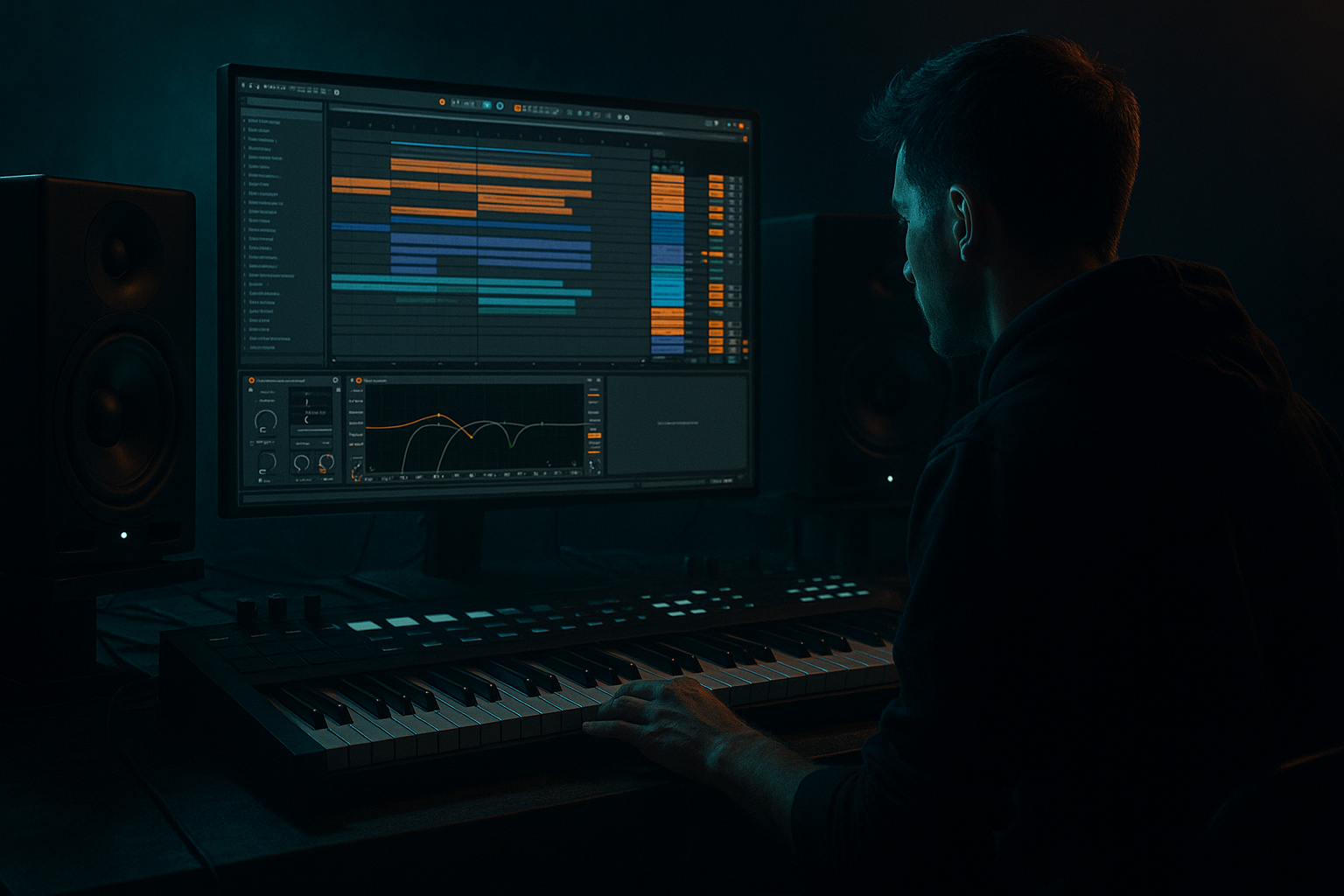
In this lesson you’ll learn a repeatable Ableton workflow to sample, shape, sync, and automate crackle so it sits in a modern jungle roller without killing punch.
---
2) What you will build
You’ll end up with:
---
3) Step-by-step walkthrough
Step 0 — Prep your session (so texture behaves like part of the drums)
1. Set project tempo: typical jungle roller range 165–175 BPM.
2. Group your drums: select all drum tracks → Cmd/Ctrl+G → name group DRUM BUS.
3. Create a dedicated track:
- Option A (recommended): Audio track named CRACKLE (more control per section).
- Option B: Return track named CRACKLE R (easy send automation).
Why: crackle is “mix-adjacent”—you’ll want group-level routing/sidechain like you do with reverb or parallel distortion.
---
Step 1 — Source crackle (make it usable, not random mush)
Best sources:
Import & loop:
1. Drag a vinyl crackle sample to CRACKLE audio track.
2. In Clip View:
- Turn Warp = ON
- Warp Mode: Beats (for “clicky” dust) or Complex Pro (for smoother bed)
- For Beats mode: set Transient Loop Mode = Off (often smoother for beds)
Looping tip (advanced):
---
Step 2 — Make it tempo-locked without sounding time-stretched
You want it stable and repeatable but not “warbly.”
1. In Clip View:
- Set Seg. BPM roughly to match (use “Warp From Here (Straight)” if needed).
2. If you hear artifacts:
- Try Beats mode with:
- Preserve: 1/16 (or 1/8 if it gets too busy)
3. If it’s too “grid-perfect,” add controlled drift:
- Turn Warp OFF for sections like breakdowns (automation) to feel more natural.
- Or keep Warp ON but use subtle modulation later (see Step 6).
---
Step 3 — Band-limit it like a record texture (crucial for rollers)
Crackle should live in a narrow, intentional band, leaving space for kicks/snares and subs.
On the CRACKLE track, add:
#### Device chain (stock)
1. EQ Eight
- High-pass: 24 dB/oct at 250–500 Hz
- Low-pass: 12–24 dB/oct at 8–12 kHz (depends on hats/air)
- Optional: small dip around 2–4 kHz if it fights snare crack
2. Utility
- Set Width 120–160% (only if it’s a mono sample and you want spread)
- Or keep it mono if your breaks are already wide
DnB context: Modern rollers often have tight low-end + bright tops. Crackle should sit above body, below “air,” unless you’re going for full vintage.
---
Step 4 — Rhythm: gate it to the groove (so it “rolls” with the break)
This is where crackle becomes musical.
#### Option A: Gate sidechained from drums (classic)
1. Add Gate after EQ Eight.
2. Enable Sidechain in Gate.
3. Set Audio From: your DRUM BUS (or specifically your break track).
4. Start settings:
- Threshold: adjust so crackle opens mainly on hits/energy
- Attack: 0.3–2 ms (fast)
- Hold: 20–60 ms
- Release: 80–200 ms (tune to swing)
- Floor: -inf to -20 dB (don’t always fully mute; try -12 dB for continuity)
Goal: crackle breathes with the break—more texture on snares/ghosts, less in kick transients.
#### Option B: Auto Pan as a rhythmic tremolo (super jungle-friendly) 🔄
1. Instead of Gate (or after it), add Auto Pan
2. Turn Phase = 0° (so it becomes volume modulation, not panning)
3. Rate: 1/8 or 1/16, Amount: 15–40%
4. Shape: closer to square for choppier, closer to sine for subtle movement
This can create that “shuffling bed” under an Amen-style roller.
---
Step 5 — Sidechain it from the kick/snare (so punch stays sacred) 🥁
Even when crackle is band-limited, it can smear transients psychoacoustically.
1. Add Compressor at the end of the chain
2. Enable Sidechain
3. Audio From: kick + snare (or DRUM BUS)
4. Settings to start:
- Ratio: 2:1 to 4:1
- Attack: 1–10 ms (leave snap)
- Release: 80–180 ms (tempo-dependent)
- Aim for 1–3 dB gain reduction on hits
Advanced tip: If your snare is huge, sidechain from kick only so snare reverb tails don’t over-duck the bed.
---
Step 6 — Make it feel “recorded,” not pasted: micro-modulation & saturation
Now we add believable movement and density.
#### Add “vinyl behavior” (subtle!)
1. Saturator
- Mode: Soft Sine or Analog Clip
- Drive: 1–4 dB
- Turn on Soft Clip if you want extra control
2. Chorus-Ensemble (optional, very subtle)
- Mix: 5–15%
- Rate: slow
- Keep it tasteful—this can get seasick fast
#### Add “needle bumps” (character moments)
- EQ Eight: band-pass around 1–6 kHz
- Add Transient shaping with Drum Buss:
- Drive low, Transient +10 to +30
- Gate it harder so pops are events, not constant noise
Use it like percussion fills: drop it in for the last 1/2 bar before a phrase change.
---
Step 7 — Arrangement: where crackle should appear in a roller
Think like a DJ-friendly jungle arrangement:
Suggested 64-bar layout
- Automate Utility Gain up 1–2 dB
- Reduce width, increase sidechain a touch
- Automate EQ Eight low-pass down to 6–8 kHz
- Add extra Saturator drive or re-introduce POPS for hype
Automation targets (fast wins):
---
Step 8 — Resample for control (print your texture like a pro) 🎚️
Once it’s grooving:
1. Create a new audio track: CRACKLE PRINT
2. Set Audio From: CRACKLE (post-FX)
3. Arm and record 16–32 bars.
4. Now you can:
- Chop it like audio
- Reverse small sections for tension
- Fade and place it exactly around fills
This also saves CPU and locks your “vinyl performance.”
---
4) Common mistakes
---
5) Pro tips for darker/heavier DnB 🕳️
- Mode: Wide Noise
- Freq: 3–6 kHz
- Amount: 0.2–1.5
Send crackle to a return with Overdrive → EQ Eight → Compressor and blend at -18 to -30 dB. Adds menace without constant hiss.
Sidechain the Gate from your break track (with ghost notes), not only the clean kick/snare. That’s how you get that rolling “shh-shh” movement.
---
6) Mini practice exercise (15 minutes) ⏱️
1. Load an Amen-style break (or any chopped jungle break) and a clean kick/snare layer.
2. Add a crackle loop on CRACKLE track.
3. Build this chain: EQ Eight → Gate (sidechain DRUM BUS) → Auto Pan (Phase 0°) → Compressor (sidechain kick) → Saturator
4. Targets:
- Crackle audible in intro, subtle in drop
- 1–3 dB ducking on kick
- Groove “breathes” with the break (Gate tuned)
5. Print 16 bars to CRACKLE PRINT and mute the live crackle track.
6. Do one automation move: low-pass sweep down in the 4 bars before the drop, then open on impact.
Deliverable: a 16-bar roller section where muting the crackle makes the drums feel noticeably less alive.
---
7) Recap ✅
If you want, tell me your tempo and whether you’re using an Amen, Think, or modern break—I'll suggest exact Gate/Auto Pan timings and an arrangement map that fits that groove.

