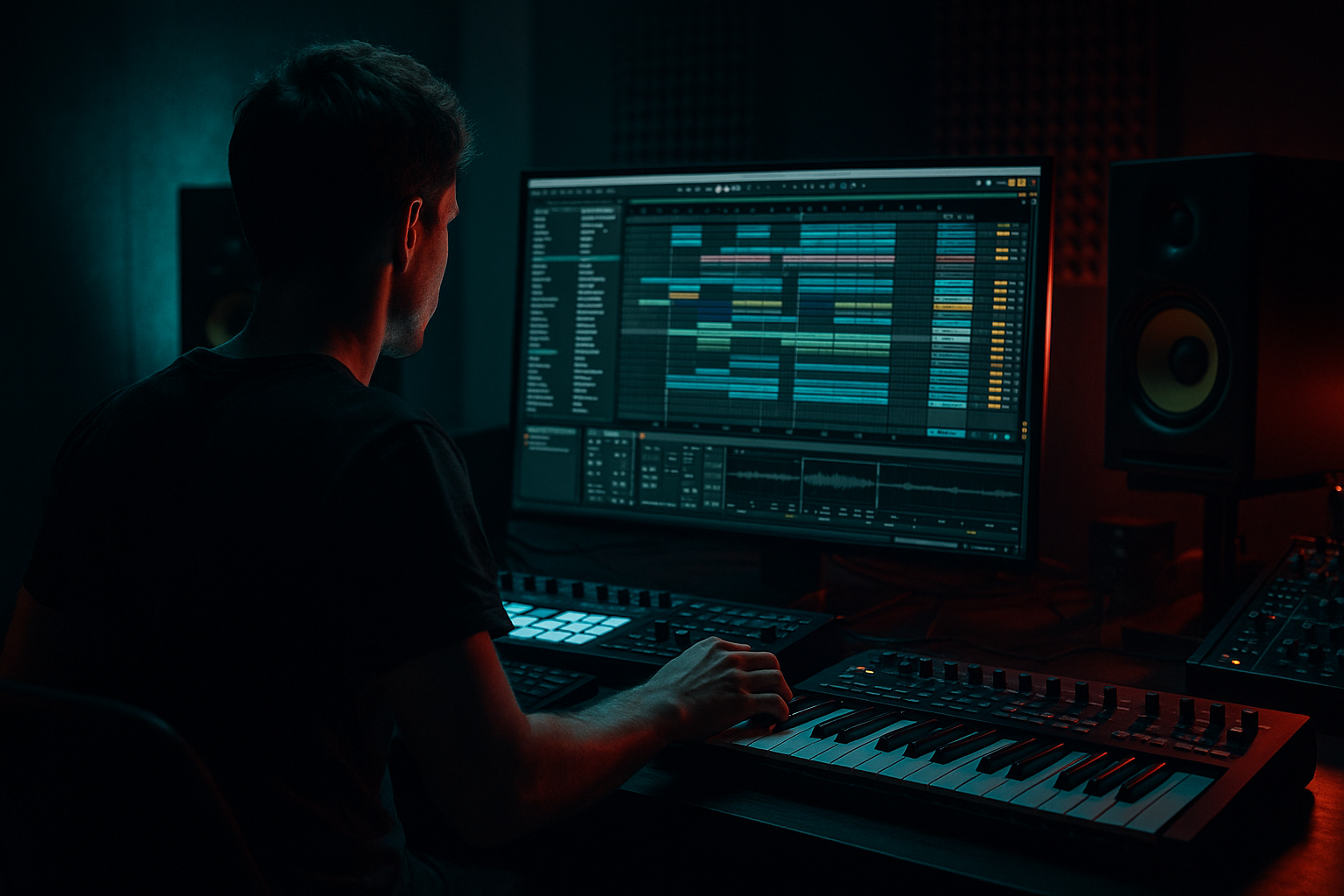
Main tutorial
```markdown
Vinyl Crackle as Texture Using Session View (Ableton Live)
Beginner • Sampling • Drum & Bass / Jungle
---
1. Lesson overview
Vinyl crackle isn’t just “noise”—in drum & bass it can be a glue layer that makes sterile drums feel sampled, adds movement in breakdowns, and helps transitions hit harder. In this lesson you’ll build a Session View texture lane that you can jam live, then record into Arrangement.
We’ll do it using stock Ableton devices and a few DnB-friendly techniques: sidechaining, filtering, resampling, and macro control. 🎛️
---
2. What you will build
You’ll create a small Session View “texture performance rig”:
- A Vinyl Crackle track with:
- 3–6 texture clips you can launch like a DJ:
- Use Operator (or Analog) generating Noise + filter it
- Then add Redux or Saturator to make it more “dusty”
- High-pass the mud:
- Optional: small dip around 3–6 kHz if it’s harsh
- Filter Type: Lowpass (or Bandpass for darker vibes)
- Set Frequency around 6–12 kHz to start
- Add a little resonance: 10–20%
- Turn on LFO:
- Mode: Analog Clip (great for crunchy texture)
- Drive: 2–6 dB
- Turn on Soft Clip if it spikes
- Enable Sidechain
- Audio From: your Drums track (or a Kick group)
- Start settings:
- For intro/breakdowns: Width 120–160%
- For drop: Width 0–80% (keep it tighter and punchy)
- Clip Gain: -18 to -12 dB (keep it low!)
- Auto Filter: gentle lowpass, no heavy LFO
- Increase Auto Filter LFO Amount slightly
- Utility Width: 140%
- Consider lowering the filter cutoff to 3–6 kHz for “underwater” vibe
- EQ Eight: higher high-pass (250–500 Hz) so it doesn’t fight bass
- Saturator Drive: 4–8 dB (watch levels)
- Utility Width: 0–60% (center it)
- Find a section with a louder pop
- Set Loop OFF
- Set clip length to 1 bar or even 1/2 bar
- Launch it as a one-shot before the drop or on the 4th bar of a phrase
- Crackle too loud: If you notice it constantly, it’s probably too hot. Keep it tucked in.
- No sidechain: Without ducking, vinyl noise masks transients and kills snare punch.
- Too much low end: Crackle has rumble. High-pass it or it’ll fight your sub and kick.
- Warp artifacts: If it sounds “phasey” or weirdly rhythmic, try Warp OFF or switch warp mode.
- Static texture all track: DnB thrives on contrast—use different clips per section.
- Make it meaner with bandpass + saturation:
- Gate it for rhythm (clean + aggressive):
- Pseudo “reese room” trick:
- Parallel distortion:
- Use crackle as a riser:
- Vinyl crackle is a controlled texture layer that adds “sampled” vibe and movement in DnB. 🏁
- Use Session View to create multiple texture clips and perform them across sections.
- The essential chain: EQ Eight (HPF) → Auto Filter (movement) → Saturator (grit) → Sidechain Compressor (ducking).
- Record your clip launching into Arrangement to instantly get natural transitions and structure.
- Auto-filter movement
- Saturation for grit
- Sidechain “ducking” to the kick/snare
- One-knob macros for easy performance
- “Intro dust” (subtle)
- “Breakdown hiss” (filtered + wide)
- “Drop grit” (mid-focused + saturated)
- “Fill burst” (one-shot vinyl pop moments)
Then you’ll record your clip launching into Arrangement for a clean DnB workflow. 🚀
---
3. Step-by-step walkthrough
Step 0 — Prep a simple DnB loop (so the crackle has context)
1. Set tempo to 172 BPM (classic DnB range: 170–176).
2. Create two tracks:
- Drums (put any Drum Rack loop, breakbeat, or built-in kit)
- Bass (optional for now)
3. In Session View, get a basic 8-bar drum clip going (kick on 1, snare on 2 & 4, hats rolling).
This gives you something to “mix the crackle into,” like in jungle sampling.
---
Step 1 — Get a vinyl crackle sample into Session View
Option A: Use a real crackle sample (recommended)
1. Create a new Audio Track named: `VINYL TEX`.
2. Drag a vinyl crackle audio file into an empty clip slot.
3. Double-click the clip to open Clip View and set:
- Warp: OFF (often best for noise textures)
- If the sample drifts or has a strong rhythm you don’t want, turn Warp ON and use:
- Warp Mode: Beats
- Preserve: 1/16 (keeps it “grainy” and consistent)
Option B: Create crackle from noise (stock-only fallback)
Ableton doesn’t include a dedicated “vinyl crackle generator,” but you can fake texture:
This won’t sound as authentic as a real crackle sample, but it’s workable.
---
Step 2 — Make the clip loop perfectly (Session View-friendly)
1. In Clip View:
- Enable Loop
- Set loop length to 4 bars (or 8)
2. Adjust Start position so it begins on a nice, consistent crackle region (avoid loud pops right at bar 1 unless you want them).
✅ Goal: A loop you can run indefinitely without distracting spikes.
---
Step 3 — Build a DnB texture device chain (stock devices)
On the `VINYL TEX` track, add devices in this order:
#### 1) EQ Eight (clean up)
- Enable a filter at ~150–300 Hz
- Set it to 24 dB/Oct if it’s too thick
#### 2) Auto Filter (movement / “DJ filter” feel) 🎚️
- Rate: 1/8 or 1/4 (DnB-friendly rhythmic motion)
- Amount: small (5–15%) so it breathes, not wobbles
#### 3) Saturator (grit + glue)
#### 4) Compressor (sidechain ducking to drums) 🥁
- Ratio: 4:1
- Attack: 1–5 ms
- Release: 80–150 ms
- Threshold: lower until you see 3–6 dB gain reduction on kicks/snares
✅ This makes the crackle sit “under” the groove like a proper mix element, not a blanket.
#### 5) (Optional) Utility (width control)
---
Step 4 — Create multiple Session View clips for performance
Now we’ll create different “states” using clip settings + clip automation.
1. Duplicate your vinyl clip into 4–6 slots (Cmd/Ctrl + D).
2. Rename them like:
- `Dust Intro`
- `Filtered Breakdown`
- `Drop Grit`
- `Pop Fill`
For each clip, change something:
#### Clip 1: Dust Intro (subtle)
#### Clip 2: Filtered Breakdown (moving + wide)
#### Clip 3: Drop Grit (mid-focused + dirty)
#### Clip 4: Pop Fill (momentary ear candy)
🎯 Session View mindset: treat crackle like a DJ texture channel you can “perform.”
---
Step 5 — Add Macro controls (easy “one-knob” performance)
If you have Audio Effect Rack (stock), do this:
1. Select Auto Filter + Saturator + Utility → Cmd/Ctrl + G to group into an Audio Effect Rack
2. Map macros:
- Macro 1: Texture Level → map to Utility Gain (or track volume if you prefer)
- Macro 2: Filter Cutoff → Auto Filter Frequency
- Macro 3: Movement → Auto Filter LFO Amount
- Macro 4: Dirt → Saturator Drive
- Macro 5: Width → Utility Width
Now you can ride crackle like a real mix element during a jam. 🎛️
---
Step 6 — Record your Session View performance into Arrangement
This is the “DnB producer move”: jam first, arrange after.
1. Hit the Arrangement Record button at the top.
2. Launch your drum clips and your vinyl clips in real time:
- `Dust Intro` during the first 16 bars
- `Filtered Breakdown` in the breakdown
- `Drop Grit` for the drop
- Fire `Pop Fill` right before drop or at phrase ends
3. Stop recording. Now you have a structured Arrangement with real transitions.
✅ You just built a performance-based texture workflow that feels like DJing your own tune.
---
4. Common mistakes
---
5. Pro tips for darker/heavier DnB
Auto Filter Bandpass around 1.5–4 kHz, then push Saturator. This creates a gritty “mid air” layer that suits neuro/rollers.
Add Gate after EQ. Set Threshold so it opens mainly on louder crackle moments. Makes it feel chopped like sampled jungle records.
Send crackle to a Return Track with Reverb (short, dark: Decay 0.8–1.5s, lowcut 400 Hz, highcut 6–8 kHz).
Keep the return low—this adds haunted space without washing drums.
Duplicate `VINYL TEX` → on the duplicate, heavy Saturator/Overdrive + aggressive EQ (bandpass mids) → blend quietly under the main. Adds menace without noise overload.
Automate Filter Cutoff from 2 kHz → 12 kHz over 8 bars, plus a tiny gain lift into the drop.
---
6. Mini practice exercise (10 minutes)
1. Create 4 vinyl clips: Intro / Breakdown / Drop / Fill.
2. Add the device chain: EQ Eight → Auto Filter → Saturator → Compressor (Sidechain).
3. Map Filter Cutoff and Texture Level to macros.
4. Jam a 32-bar structure:
- Bars 1–9: Intro dust
- Bars 9–17: Breakdown filtered + wide
- Bar 17: Pop fill one-shot
- Bars 17–33: Drop grit (tighter width)
5. Record into Arrangement and listen back:
- Does the snare still punch?
- Can you feel the texture without it taking over?
---
7. Recap
If you want, tell me your subgenre (liquid, rollers, jungle, neuro) and I’ll suggest 3 crackle clip “presets” (device settings + clip ideas) tailored to that sound.
```

