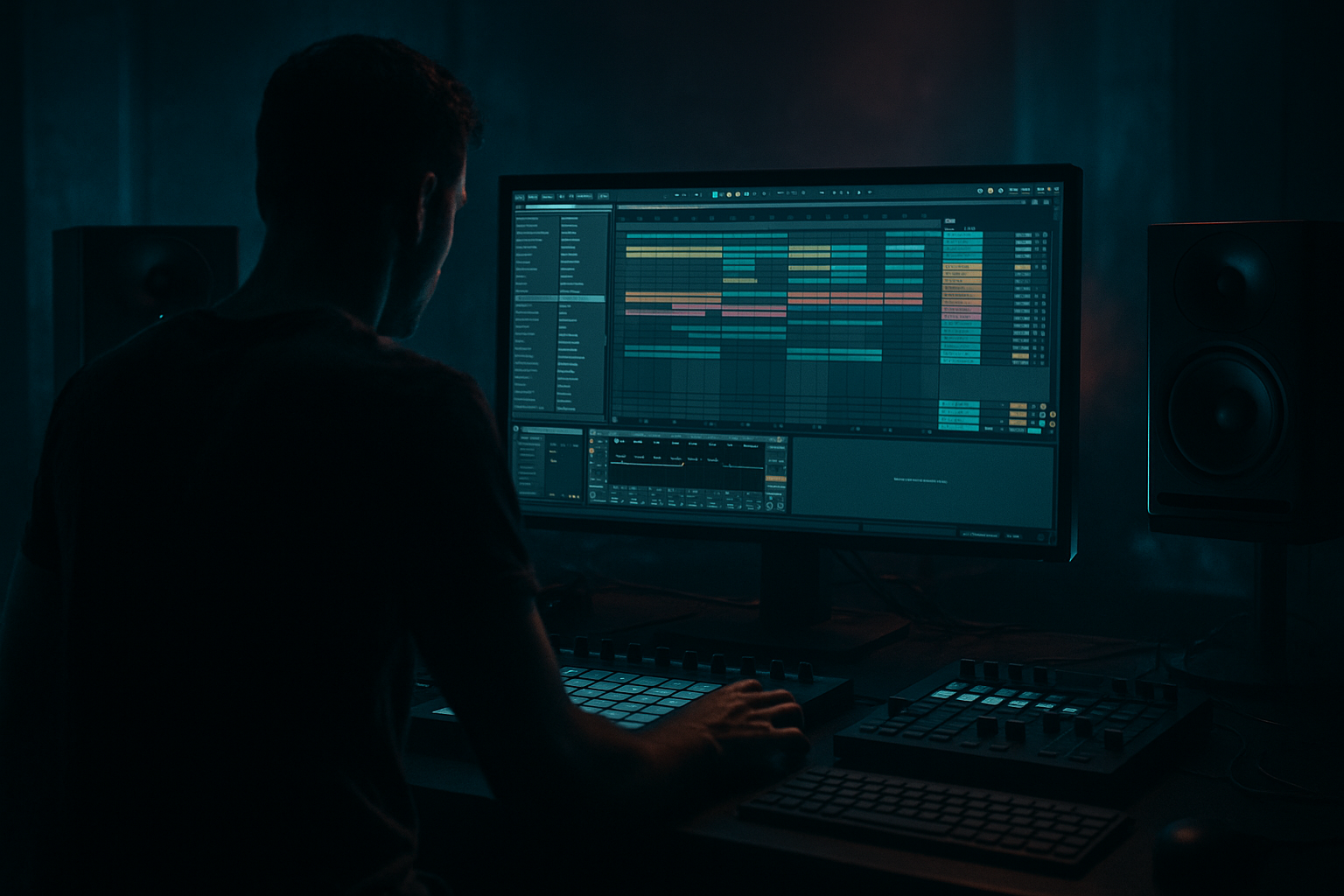
Main tutorial
Vinyl Heat Fill Workflow in Ableton Live 12 (Resampling)
Modern punch + vintage soul for jungle / oldskool DnB vibes 🔥🎛️
---
1. Lesson overview
This lesson shows you a repeatable “Vinyl Heat Fill” workflow in Ableton Live 12, aimed at jungle / oldskool drum & bass: think crunchy breaks, dusty turnaround fills, tape-ish saturation, and tight modern punch.
You’ll learn to:
- Make a 1-bar fill that feels sampled-from-vinyl
- Resample it into audio (for control + grit)
- Add modern transient punch while keeping vintage soul
- Drop it into an 8/16-bar DnB arrangement like a pro 🥁
- Source: a breakbeat (Amen-style / Funky Drummer style) or your own chopped drums
- Fill recipe: micro-chops + stutter + pitch dip + noise + reverb tail
- Processing: Drum Buss + Saturator + EQ Eight + Glue Compressor
- Output: resampled audio fill you can drag into arrangement and trigger before drops
- Load a Drum Rack with kick/snare/hats.
- Program a basic 2-step DnB groove, then we’ll “vinyl-ize” the fill.
- Fill on bar 8, then slam back to bar 1 with full drums + bass.
- High-pass: 24 dB/oct at ~30–45 Hz
- Gentle dip: 200–350 Hz (if boxy)
- Optional: slight shelf up at 8–10 kHz if your break is too dull (but keep it subtle)
- Mode: Analog Clip
- Drive: 2–6 dB
- Soft Clip: On
- Output: reduce so you’re not just “getting louder”
- Drive: 5–15% (taste)
- Crunch: 5–25% (jungle likes some crackle)
- Boom: 0–20% (careful with fills—don’t swamp your drop)
- Transients: +5 to +20 for snap
- Damp: adjust if it gets fizzy
- Attack: 3 ms (lets some snap through)
- Release: Auto
- Ratio: 2:1 or 4:1
- Aim for 1–3 dB gain reduction on peaks
- Soft Clip: On (if available)
- Adjust Gain so your fill is similar loudness to main drums, not 6 dB louder.
- Shifter (subtle):
- Or Clip Transpose automation:
- Warp it in Beats mode for stutters
- Reverse tiny bits
- Fade edges for clean edits
- Use it like a “one-shot fill” in multiple places
- Every 8 bars: quick 1-bar fill (classic)
- Every 16 bars: bigger fill with reverb tail + pitch dip
- Before a breakdown: longer fill + filter sweep
- Before drop: short, tight, stuttery fill (keep sub clean)
- Parallel dirt:
- Psycho “suck-in” before the drop:
- Transient control after resample:
- Darkness via top control:
- Call-and-response with bass:
- You made a 1-bar jungle/DnB fill using micro-chops + stutters.
- You shaped it with a modern punch chain: EQ Eight → Saturator → Drum Buss → Glue.
- You added vintage soul with controlled noise, pitch gestures, and a reverb tail.
- You resampled the fill into audio so it’s easy to place, edit, and reuse.
- You learned arrangement placement so fills enhance impact, not clutter it. ✅
---
2. What you will build
You’ll build a single “Vinyl Heat Fill” track that you can reuse:
Result: a fill that says “oldskool jungle” but hits with 2026-level punch. ⚡
---
3. Step-by-step walkthrough
Step 0 — Session setup (fast + DnB-friendly)
1. Set tempo: 165–174 BPM (try 170).
2. Turn on the metronome.
3. In Arrangement View, plan an 8-bar loop:
- Bars 1–7: main groove
- Bar 8: your fill
---
Step 1 — Pick/prepare your drum source
You’ve got two beginner-friendly options:
Option A: Use a break loop (classic jungle move)
1. Drag a breakbeat loop onto an audio track (e.g., “Amen-ish”).
2. In Clip View:
- Enable Warp
- Warp mode: Beats
- Preserve: Transients
- Set Transient Loop Mode to Forward
- Adjust Envelope to tighten (start around 70–90)
Option B: Use a Drum Rack (cleaner, modern)
For jungle vibes, Option A is easiest.
---
Step 2 — Create the fill rhythm (1 bar)
Duplicate your drum clip and isolate bar 8.
Goal: Keep the listener oriented (snare still “speaks”), but add chaos in the last half-beat.
1. Duplicate your break clip.
2. Trim so it’s exactly 1 bar.
3. Do micro-chops:
- Split the audio at transient hits (Cmd/Ctrl+E in Arrangement)
- Rearrange 1–3 small slices near the end of the bar
4. Add a stutter right before the drop:
- Take a snare slice and repeat it 1/8 → 1/16 note rate in the last beat
- Keep it short: last 1/2 bar maximum
DnB arrangement suggestion:
---
Step 3 — Add “Vinyl Heat” character (device chain)
Put this chain on your Fill track (or on the break track, then resample only the fill region).
#### Recommended device chain (stock Ableton)
1. EQ Eight
2. Saturator
3. Drum Buss
4. Glue Compressor
5. Utility (gain staging)
##### 1) EQ Eight (clean the mud, shape the nostalgia)
##### 2) Saturator (warmth + harmonics)
##### 3) Drum Buss (modern punch + controlled grit)
##### 4) Glue Compressor (classic “break glue”)
##### 5) Utility (level match)
---
Step 4 — Add vinyl soul: noise, wobble, and space (but controlled)
This is where it becomes “from the crate” 🧱🎚️
#### A) Vinyl noise layer (simple + effective)
1. Create a new audio track: “Vinyl Noise”
2. Drop a vinyl crackle sample (or a field recording hiss).
3. EQ it:
- HP at 200–400 Hz
- LP at 8–12 kHz (optional)
4. Sidechain it slightly to your drums using Compressor:
- Sidechain Input: Fill/Drums
- Ratio: 2:1
- Fast attack, medium release
- Only 1–2 dB ducking
#### B) Subtle pitch wobble (old tape vibe)
On the Fill track, try one:
- Mode: Pitch
- Fine: automate ±5 to ±15 cents in the last half-bar
- Drop -1 to -3 semitones for the last 1/8 note (classic pitch dip)
Keep it quick—this is a gesture, not a detune disaster.
#### C) Reverb tail only at the end
1. Add Hybrid Reverb on a Return track (or directly on fill).
2. Settings for jungle tail:
- Predelay: 10–25 ms
- Decay: 0.6–1.2 s
- High Cut: 6–10 kHz
3. Automate send so only the last snare hit blooms.
---
Step 5 — Resample the fill (the core “resampling” move) 🎧
Resampling is where the magic becomes “one piece of audio” you can slam, reverse, and re-chop.
Method: Resample to a new audio track
1. Create a new audio track called “FILL RESAMPLED”
2. Set its input to:
- Audio From: Resampling
3. Arm the track.
4. Solo your fill (or loop just the fill bar).
5. Hit record and capture 1 bar (or 2 bars if you want tail).
6. Consolidate (Cmd/Ctrl+J) to clean it into one clip.
Now you can:
---
Step 6 — Make it hit hard like modern DnB (post-resample punch)
On the resampled fill clip, do final shaping:
1. EQ Eight
- HP at 30–45 Hz
- Slight cut at 250 Hz if it’s cloudy
2. Saturator (light)
- Drive 1–3 dB, Soft Clip on
3. Limiter
- Ceiling: -0.3 dB
- Keep it honest—don’t crush; just prevent spikes.
Placement tip: Put the fill slightly quieter than the drop, so the drop feels huge. A good starting point is -1 to -3 dB vs your main drum bus.
---
Step 7 — Arrangement ideas (DnB/jungle rooted)
Use fills as punctuation, not constant fireworks:
Classic jungle move: last snare + reverb tail → hard cut → drop.
---
4. Common mistakes
1. Fill is louder than the drop
Fills should lead into impact, not replace it.
2. Too much low end in the fill
Break fills with heavy sub rumble can smear your drop. High-pass responsibly.
3. Over-warping the break
If Beats mode envelope is too tight, it gets clicky/robotic. Back off Envelope or add tiny fades.
4. Too much vinyl noise
Noise should be felt, not “announced.” Duck it slightly or automate it only in the fill.
5. Reverb everywhere
Jungle is about contrast—keep reverb as a moment, not a bath.
---
5. Pro tips for darker/heavier DnB 🖤
Send the fill to a return track with Saturator (Hard Curve) → EQ Eight (band-limit) → Drum Buss (Crunch), then blend low.
Automate Auto Filter on the fill (HP rising to ~300–600 Hz) in the last 1/2 bar, then full-spectrum returns on the drop.
If it’s too spiky, use Glue Compressor with slower attack (10 ms) and small GR. If it’s too soft, add Drum Buss Transients.
Use EQ Eight to gently shelf down 10–16 kHz on the fill so the drop’s hats feel brighter by comparison.
Mute bass on the fill (or filter it), then let the bass slam back on bar 1. That “gap” creates weight.
---
6. Mini practice exercise (15 minutes) ⏱️
1. Load a breakbeat loop and make a basic 8-bar drum loop.
2. Build two different fills for bar 8:
- Fill A: stutter + pitch dip
- Fill B: reverse slice + reverb tail
3. Resample both fills to audio.
4. Place Fill A before your first drop, Fill B before a breakdown.
5. Level match so the fills are 1–3 dB quieter than the drop.
Challenge: Make one fill “dusty” (more noise/saturation) and the other “clean but punchy” (more transients, less noise).
---
7. Recap
If you want, tell me your BPM and whether you’re using a break loop or Drum Rack, and I’ll suggest a specific 1-bar MIDI/audio fill pattern tailored to your vibe (dark roller vs jump-up vs jungle).

