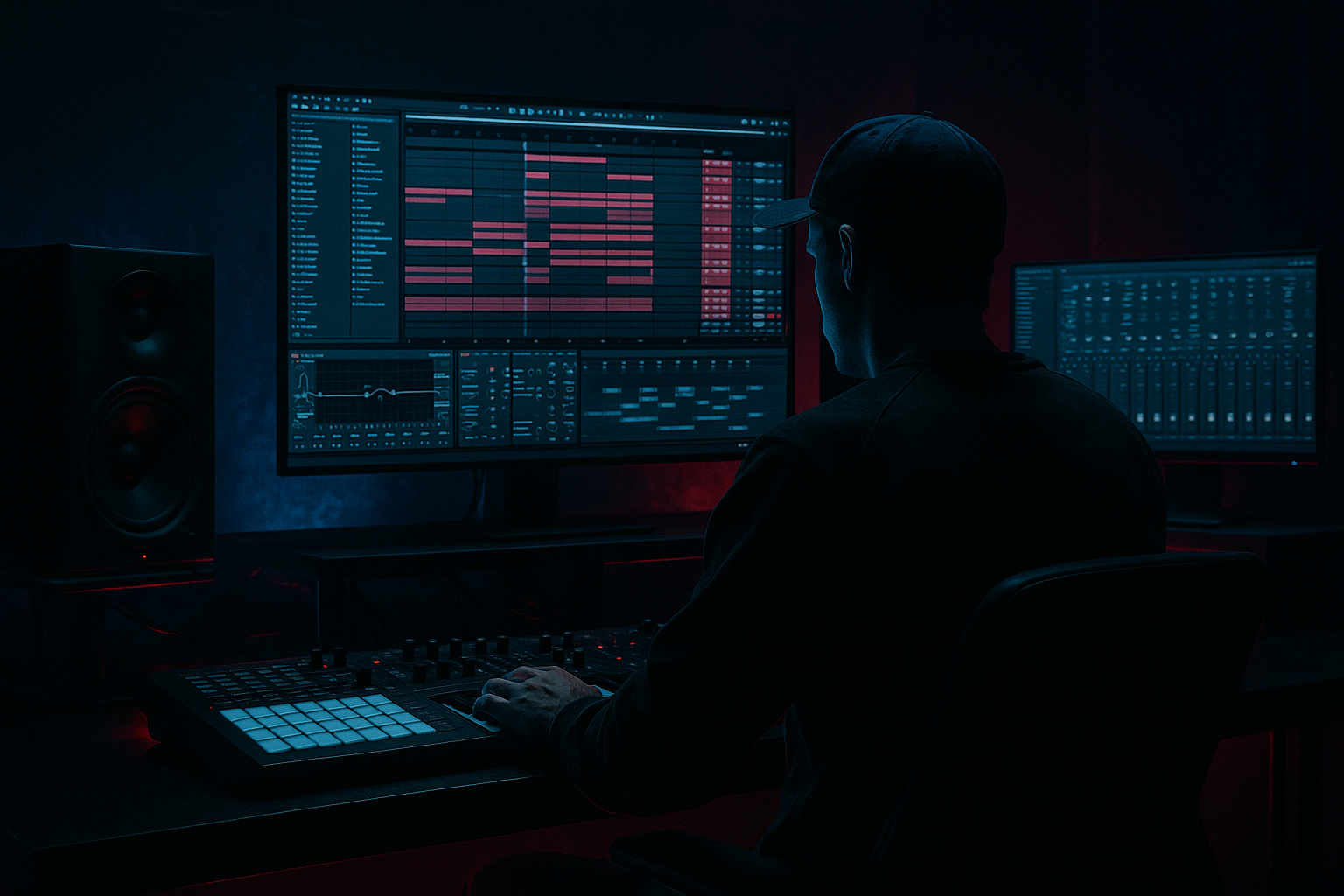
Main tutorial
```markdown
Vinyl Heat Jungle Breakbeat: Distort and Arrange in Ableton Live 12 🔥🌀
Skill level: Beginner
Category: Workflow (DnB / Jungle drum programming + vibe processing)
---
1. Lesson overview 🎛️
In this lesson you’ll take a classic jungle-style breakbeat, give it vinyl heat (warmth, saturation, grit, subtle wobble), and then arrange it into a proper drum & bass section inside Ableton Live 12.
You’ll learn a repeatable workflow:
- Prep a break so it loops tight
- Split & rearrange for jungle energy
- Add distortion/saturation in a controlled way
- Layer clean punch under the dirty break (key DnB technique)
- Arrange into intro → drop → variation → outro
- A 16-bar rolling jungle breakbeat with variations
- A “vinyl heat” processing chain (warm + crunchy but controlled)
- A basic DnB arrangement with:
- Keep the original groove as a base
- Add edits like:
- In the MIDI clip, select a single slice note at the end of bar 4
- Duplicate it to create 1/16 repeats for the last 1 beat
- Lower velocities for the repeats so it doesn’t sound like a machine gun
- Enable High-Pass around 25–40 Hz (remove rumble)
- Optional: small dip 200–350 Hz if boxy
- Mode: Analog Clip (great for breaks)
- Drive: start at +3 to +6 dB
- Turn on Soft Clip
- Use Output to level-match (don’t fool yourself with volume)
- Drive: 5–15%
- Crunch: 0–15% (tiny amounts go far)
- Boom: set to taste, but keep subtle for breaks
- Damp: adjust if it gets too fizzy
- Use lightly:
- If it gets harsh, back off immediately.
- Filter type: LP24 or LP12
- Automate cutoff:
- Add a tiny Drive in the filter for extra bite.
- Mode: Classic
- Amount: 5–15%
- Rate: 0.15–0.35 Hz
- Delay time low / subtle
- Keep it barely audible—you want texture, not seasickness.
- In Clip View, automate Transpose very slightly:
- EQ Eight on layers:
- Drum Buss lightly on layers for glue.
- Select `BREAK`, `KICK LAYER`, `SNARE LAYER` → Cmd/Ctrl + G → name it `DRUMS`
- Use the break but filtered:
- Add small teases:
- Reduce density: maybe play only every other bar.
- Full drums: break + layers + open filter
- Introduce 1–2 edits:
- Change something every 8 bars:
- Strip layers first (remove kick/snare layer)
- Then fade/filter the break down
- Leave a clean tail for DJ-friendly mixing
- Over-warping the break: too many warp markers kills groove. Use the minimum needed.
- Too much distortion too early: heavy drive before EQ makes mud and harshness explode.
- No clean layers: a fully distorted break often loses punch; layering solves this.
- Machine-gun stutters: repeating at full velocity sounds fake—use velocity shaping.
- Ignoring gain staging: if every device adds level, your “better” sound is just louder.
- Parallel dirt (Return track):
- Make snares scary:
- Transient control:
- Resample for confidence:
- Warp the break tight
- Slice to MIDI and write jungle edits
- Add warmth and grit using EQ Eight → Saturator → Drum Buss (→ Redux optional)
- Add subtle movement (filter automation, slight wobble)
- Layer clean kick/snare for modern DnB punch
- Arrange with regular micro-variation so it rolls and evolves
All with mostly stock Ableton devices.
---
2. What you will build 🧱
By the end, you’ll have:
- 8-bar intro (filtered/teased)
- 16-bar drop (full drums)
- 16-bar variation (fills, edits)
- 8-bar outro (stripped back)
---
3. Step-by-step walkthrough ✅
Step 0 — Session setup (fast + correct) ⚙️
1. Create a new Live set.
2. Set tempo to 170–174 BPM (try 172 BPM).
3. Create these tracks:
- Audio Track: `BREAK`
- MIDI Track: `KICK LAYER`
- MIDI Track: `SNARE LAYER`
- Return A: `DRUM ROOM` (reverb)
- Return B: `PARALLEL DIRT` (optional, but powerful)
---
Step 1 — Choose and warp your break properly 🥁
1. Drag a break sample onto the `BREAK` audio track.
Good targets: Amen, Think, Funky Drummer, Hot Pants, etc.
2. Turn on Warp.
3. In Clip View:
- Set Seg. BPM to match the sample if Live guesses wrong.
- Set Warp Mode:
- Start with Beats (good transient control)
- Then try Complex Pro if it sounds too choppy (less “slice” feel).
4. Make it loop cleanly:
- Set Loop braces to 1 bar or 2 bars
- Right-click the clip → Warp From Here (Straight) on the first downbeat transient.
5. Turn on Metronome and confirm your snare lands clean on beat 2 and 4.
DnB reality check: If the break doesn’t loop perfectly, distortion later will exaggerate the mess. Get the warp tight now.
---
Step 2 — Slice to MIDI for jungle edits ✂️
This is where you get the jungle movement.
1. Right-click the break clip → Slice to New MIDI Track.
2. Choose slicing preset:
- Slice By: Transients
- Create one slice per: Transient
- Slicing preset: Built-in (it will create a Drum Rack)
3. Live creates a Drum Rack with each slice on a pad.
Now you can program classic jungle patterns:
- snare doubles
- kick pickups
- reverse hits
- stutters at bar ends
Beginner-friendly approach:
Duplicate the original 1-bar MIDI clip a few times and only change one or two hits per bar.
---
Step 3 — Make a 4-bar “drop loop” with variation 🔁
1. Create a 4-bar MIDI clip driving the sliced Drum Rack.
2. Build it like this:
- Bar 1: mostly original break groove
- Bar 2: add a quick kick or ghost note
- Bar 3: add a snare flam (two snare slices close together)
- Bar 4: add a mini fill/stutter (1/16 repeats near the end)
How to do a classic jungle stutter:
---
Step 4 — Add “Vinyl Heat” processing chain (stock devices) 🌡️
You want warmth + grit + movement, not just loud crunch.
On the BREAK (or sliced Drum Rack track) add this chain in this order:
#### A) EQ Eight (clean the mud first)
#### B) Saturator (the main heat)
#### C) Drum Buss (thick + glued jungle)
- Freq: ~50–70 Hz
- Amount: 0–15%
#### D) Redux (optional, for crunchy edges)
- Bit Reduction: 10–14
- Downsample: 1.2–2.0
#### E) Auto Filter (vinyl-style motion)
- Intro: cutoff ~500–2k
- Drop: open up to 8–12k
✅ Key habit: After adding distortion, always adjust Output so the break is the same loudness as before. That’s how you judge tone, not volume.
---
Step 5 — Add “vinyl wobble” movement (subtle!) 🎚️
Use Shifter or Chorus-Ensemble carefully, or simulate wobble with modulation.
Option 1: Chorus-Ensemble (tiny, wide, vibey)
Option 2: Clip automation for warp “wow”
- Draw tiny pitch dips: -5 to -15 cents at the end of phrases
This mimics worn tape/vinyl instability.
---
Step 6 — Layer clean kick and snare under the dirty break 🧨
This is how you keep the break nasty but still hit like modern DnB.
1. On `KICK LAYER`, load a punchy one-shot (Drum Rack or Simpler).
2. Program a basic DnB kick:
- Often beat 1, sometimes an extra kick before snare for push.
3. On `SNARE LAYER`, load a tight snare one-shot.
4. Align snare with the break’s main snare hits (beats 2 and 4).
Processing suggestions:
- Kick: low-pass around 4–8k (keep it punchy, not clicky)
- Snare: high-pass around 120–200 Hz (clean low junk)
Timing tip: If it flamms, nudge the MIDI notes slightly or use Track Delay (bottom of mixer) by -5 to -15 ms on layers.
---
Step 7 — Glue and control dynamics (beginner-safe) 🧷
Group your drum tracks:
On the `DRUMS` group:
1. Glue Compressor
- Attack: 3 ms
- Release: Auto
- Ratio: 2:1
- Aim for 1–3 dB gain reduction on peaks
2. Limiter (safety)
- Leave default, just prevent overs
Optional: Add Saturator very lightly on the group (Drive +1–2 dB) for cohesion.
---
Step 8 — Arrangement: intro → drop → variation (DnB structure) 🧩
Use Arrangement View and build a simple, effective DnB flow.
#### A) Intro (8 bars)
- Auto Filter cutoff around 800 Hz → 3 kHz (slow rise)
- One snare hit
- A chopped fill at bar 8
#### B) Drop (16 bars)
- Snare doubles every 4 bars
- Tiny stutters at phrase ends
#### C) Variation (16 bars)
- Swap one slice pattern
- Add a 1/2 bar stop (drum mute) before a slam back in
- Use a different fill at bar 16
#### D) Outro (8 bars)
DnB arrangement rule: if nothing changes for 16 bars, it’ll feel static. Jungle thrives on micro-edits.
---
4. Common mistakes 🚧
---
5. Pro tips for darker/heavier DnB 🌑⚔️
Put Saturator + Drum Buss + EQ Eight on Return B, then send the break to it.
- High-pass the return around 200–400 Hz so the dirt is mostly mids/highs.
Add a short, dark room reverb on Return A:
- Reverb: Decay 0.4–0.8s, Pre-delay 10–25 ms, Low cut 200 Hz
If your break gets too spiky after saturation, try Drum Buss Transients slightly negative (soften) and rely on layers for punch.
Once it sounds good, Resample the processed break to a new audio track.
Then chop that audio for even grittier, committed jungle vibes.
---
6. Mini practice exercise 📝
Goal: Build a 16-bar drop loop with 3 distinct variations.
1. Make a 4-bar drum loop from sliced break.
2. Duplicate it to 16 bars.
3. Add:
- Variation at bar 5: snare double on beat 4
- Variation at bar 9: stutter fill (last 1 beat)
- Variation at bar 13: half-bar drum mute, then slam back in
4. Add the vinyl heat chain and level-match.
5. Export a quick bounce and listen on headphones + speakers.
---
7. Recap ✅
You now have a clean, repeatable Ableton Live 12 workflow to create vinyl-heated jungle breaks:
If you want, tell me what break you’re using (Amen/Think/etc.) and what vibe you’re going for (old-school jungle, modern neuro-roller, dark minimal), and I’ll suggest a specific 16-bar pattern + processing values tailored to it.
```

